





.webp)
For the last three years, enterprise customer experience teams have worked under the illusion that conversational AI would solve the customer friction equation once and for all. This is the reason why most of them are putting serious money behind Artificial Intelligence.
In fact, Gartner found that AI spending among customer service leaders increased 38% in 2026. However, on the other hand, the same report also highlights that only 24% of them could see positive financial returns across AI use cases.
The problem is that bolting AI to an existing customer journey does not fundamentally change how that journey works. A chatbot may answer faster, but retrieval is not a resolution. The customer can still end up moving between the same disconnected systems, teams, policies, and workflows as before.
Agentic CX changes that. Powered by agentic AI, it shifts the objective from merely answering questions to taking autonomous action across core business systems. Where traditional CX designs the journey, agentic CX organizes the enterprise around the outcome.
What is agentic customer experience (CX)?
AI for customer experience, or Agentic CX, is an approach to deliver an effortless customer experience in which AI agents use natural language processing to understand customer goals, make decisions, coordinate across systems and channels, take actions, and adapt until an outcome is reached, within defined business and governance boundaries.
Put simply, agentic CX starts from that customer goal and works backward into the organization. Take, for instance, a traveler whose flight has been cancelled. While a traditional digital experience might explain the rebooking policy, an agentic experience can go further.
It can understand that the customer's actual objective is to reach their destination, and just rebook. The AI can check different options and decide which are allowed by policy. It can rebook when allowed, arrange accommodation if needed, update systems, and communicate changes. It asks a human for help if the situation is beyond its authority.
The customer experiences one outcome, while the enterprise may have performed dozens of actions behind it.
How does agentic CX create value across the customer journeys?
To understand why agentic CX is causing such a stir among business leaders, one only has to look at where traditional customer journeys break down. In theory, customer journeys are drawn as smooth, predictable steps: a customer buys a product, receives an order, and occasionally asks a quick question.
In reality, however, real life is messy. A package arrives late. A credit card fails mid-checkout. A customer changes their mind about a size while simultaneously asking to update their delivery address.
Traditional automation fails here because it relies on rigid, predetermined scripts. If a customer strays off the path, the chatbot gets confused, repeats itself, or forces the customer to start all over again with a human representative.
Agentic CX creates value by replacing these rigid scripts with fluid, adaptive action. It allows the system to adjust to whatever the customer throws at it, turning fragmented interactions into seamless resolutions.
Here is how agentic CX builds tangible value across the customer lifecycle:
1. Removing effort for the customer
The single biggest point of friction in customer service is making the customer do the heavy lifting. In a traditional setup, if an order goes missing, the customer must gather tracking numbers, call support, wait on hold, and explain the problem multiple times to different departments.
With CX AI agents, that effort disappears. The AI agent connects directly to logistics and billing systems behind the scenes. It can verify the shipping delay, process a replacement order, and send a confirmation email in a single, uninterrupted flow. The customer asks once, and the work is done.
2. Eliminating silos between departments
Customers do not care how a company is structured internally. They do not want to hear that "support handles refunds, but shipping handles returns, and finance handles credit updates."
Agentic CX creates value by acting as a universal coordinator across the enterprise. Because AI agents can read and write customer data across CRMs, inventory software, and payment portals, they break down internal silos. The customer interacts with one intelligent point of contact that can touch every part of the business required to solve their issue.
3. Adapting to real-life disruptions
When a customer changes their mind halfway through a transaction, or switches from a web chat to a quick phone call, traditional bots lose context immediately.
Agentic AI maintains context across channels and time. If a customer pauses a conversation to check a detail and comes back two hours later, the agent remembers exactly where things stood. If the customer shifts goals mid-interaction (e.g., moving from "I want to exchange this item" to "Actually, just cancel my account"), the agent adapts immediately without forcing the user to re-authenticate or re-explain their situation.
4. Moving from reactive support to proactive value
Traditional customer service is purely reactive — the customer experiences a problem, gets frustrated, and reaches out.
Agentic CX allows organizations to flip this dynamic entirely. Because AI agents continuously monitor system signals, such as a delayed flight, a failed software integration, or a stuck shipment, they can take proactive action before the customer even files a complaint. An agent can automatically issue a credit, notify the customer of an alternative, and resolve the issue preemptively, turning a single fix into ongoing customer engagement.
At its core, the value of Agentic CX is straightforward: it takes complex, multi-step business operations and compresses them into instant, low-effort outcomes for the customer.
How agentic CX works: from customer intent to verified outcome
Agentic CX works because it routes a customer’s goal through a continuous, three-part mechanism: Reasoning, Execution, and Closed-loop verification.
Together, these three functions convert an unstructured customer interaction into a verified, real-world outcome.
1. Reasoning
Generative AI is inherently probabilistic. It guesses the next best word based on patterns. That flexibility is great for understanding human speech, but dangerous for executing financial transactions.
Agentic CX solves this by putting deterministic guardrails around probabilistic AI. When an AI customer service agent receives a complex query, the LLM breaks the goal into a series of logical sub-tasks.
However, before executing any step, a governance layer validates the plan against hard business logic: Is this user authenticated? Is the requested refund within policy thresholds? Does this action require human approval?
This ensures the system has the intelligence to plan around unexpected problems without the freedom to violate enterprise policies.
2. Transactional execution
Traditional customer support tools are passive listeners; they query knowledge bases using Retrieval-Augmented Generation (RAG) to output text. Agentic CX operates with transactional authority.
Through deep API integrations, an agentic system connects directly into underlying systems of record, such as SAP, Stripe, Zendesk, or custom logistics software. It does not merely look up an order status; it invokes real system tools. It can cancel a subscription in the billing engine, update a shipping destination in the warehouse database, and issue a promotional credit in the CRM, all in a single coordinated sequence.
3. Closed-loop verification and Self-correction
The single biggest flaw in traditional workflow automation is assuming that triggering an action is the same as completing it. Standard webhooks trigger a process and walk away, leaving the customer stranded if an underlying system fails.
Agentic CX introduces closed-loop verification. After an AI agent executes an API call, it continuously inspects the system of record to verify the outcome:
- Did the payment gateway return a successful transaction code?
- Did the inventory database actually reserve the replacement item?
If the system detects a failure, such as a timed-out server or a declined authorization, it does not hallucinate success or drop the interaction. Instead, it enters a self-correction loop: it attempts an alternative safe path, requests missing information from the customer, or escalates the case to a human specialist with complete execution logs attached.
What are the benefits of agentic CX?
When executed properly, agentic CX delivers distinct advantages across three core constituencies:
1. For customers
Research shows that 96% of customers who have a high-effort interaction become more disloyal to the brand afterward, against just 9% of those with a low-effort one.
Which is exactly the gap agentic CX solves. It provides instant, 24/7 resolution without repetitive re-authentication or handoff friction. More importantly, when multi-agent orchestration is in place, the customer experiences a business that truly understands their history, context, and immediate intent.
2. For employees
Repetitive work is the industry's single biggest cost problem, with contact centers running 30-45% annual agent turnover, well above other occupations, and 74% reporting ongoing burnout.
Agentic AI helps support teams by freeing them from repetitive, low-judgment transactional tasks, such as updating shipping addresses or processing routine returns. When agentic CX absorbs the repetitive load, human agents transition into high-empathy specialists, focusing on complex, emotionally sensitive, or high-stakes customer relationships.
3. For the business
Harvard Business Review found that even a 5% improvement in customer retention can lift profits by 25% to 95%, depending on the industry. In other words, a modest, realistic improvement in retention produces a disproportionately large increase in long-term enterprise profitability, far outweighing what cost reduction alone would justify.
How to scale agentic CX: 3-stage maturity model for enterprises
As enterprises rush to adopt agentic capabilities for customer experience, many are quietly encountering a new operational bottleneck of the AI Silo Trap.
Most organizations often begin their journey by building a collection of individual AI agents that don't share a customer's context or goal with one another. Each one might perform brilliantly at its own narrow task. Yet, to the customer, the experience remains fragmented, because nothing above the individual agent is actually orchestrating the relationship.
For building agentic CX, enterprises need to assess their maturity as a ladder:
Level 1: Soloists (isolated task agents)
At this stage, AI agents for customer experience operate in total isolation. A voice AI agent that resolves calls efficiently. A routing agent that triages tickets well. A proactive-alerts system that flags account issues.
Each optimizes strictly for its local metric (e.g., call duration or first-response speed) and has no visibility into the broader customer relationship.
This is where the majority of current enterprise deployments sit today, resulting in glorified digital scripts that feel faster but remain disconnected.
Level 2: Session players (context-aware handoffs)
At level 2, agents share information during channel switches. When a customer moves from an app chat to a phone call, the voice agent reads the prior transcript so the user does not have to repeat themselves.
While this is an improvement, each agent is still making decisions locally, optimizing for its own step rather than a shared, journey-level objective. A support agent resolves the ticket in front of it without any visibility into whether that same customer is also midway through a completely different interaction with the sales or billing team.
Level 3: The Orchestra (unified journey orchestration)
At full maturity, an enterprise deploys a central orchestration layer that governs all AI CX agents. Rather than running separate logic, every agent accesses a unified customer context engine and works toward a single, journey-level objective.
At this level, a proactive retention agent, a billing agent, and a support agent aren't three separate systems — they're drawing on the same context and working toward the same understanding of what "a good outcome" looks like for that person, right now.
Customer satisfaction does not scale with the number of AI agents an enterprise deploys; it scales with how effectively those agents are orchestrated.
When building an Agentic CX roadmap, the goal is not simply to purchase better point solutions, but to construct a shared context and governance framework that allows autonomous agents to operate as a single, cohesive team.
Building an agentic CX strategy: 7-step playbook
Transitioning an enterprise from basic conversational chatbots to an orchestrated Agentic CX architecture requires a methodical, backstage-first approach.
Here is a practical, seven-step blueprint for building a resilient agentic strategy:
Step 1: Audit your current maturity level
Before investing in new technology vendors platforms, conduct an honest audit of your existing infrastructure against the 3-stage maturity model. Do your current AI agents for CX share context seamlessly, or does a customer have to restart their narrative when switching from web chat to a phone queue? Most organizations discover they sit at Level 1, despite paying for Level 3 marketing promises.
Executive Action: Map all active conversational bots across departments and identify where customer context currently drops during handoffs.
Step 2: Unify the data and decision layer first
Avoid the temptation to purchase a glossier front-end chat widget. A sophisticated conversational interface sitting on top of fragmented, siloed backend systems merely creates a faster route to customer frustration. Fix your backstage integrations, CRMs, ERPs, and billing engines, so AI customer service agents read from and write to a single source of truth.
Executive Action: Prioritize API read/write readiness across core systems (Salesforce, SAP, Stripe, Zendesk) before scaling autonomous front-end capabilities.
Step 3: Design for handoffs explicitly
Context loss can be a killer of customer trust. Do not assume AI agents will share memory by default. Construct a dedicated, persistent memory layer so that every customer detail, prior interaction, and attempted solution survives across channels and system transitions.
Executive Action: Establish persistent session tokens that carry verified context from web to mobile app to voice channels without re-authentication.
Step 4: Align metrics with journey-level outcomes
If internal teams are evaluated strictly on localized, task-level metrics (such as average handle time or call deflection), local optimization will always defeat journey orchestration. Introduce cross-functional, journey-level KPIs that reward end-to-end resolution over individual ticket clearance.
Executive Action: Replace departmental deflection targets with cross-functional journey completion metrics across support, logistics, and billing.
Step 5: Define "Decision Rights," not just system permissions
There is a profound operational difference between system access and decision authority. An AI customer service agent may have the technical API access (permissions) to view a billing ledger, but business policy (decision rights) must dictate whether it can issue a credit above $50 without human sign-off. Mapping these explicit boundaries for every high-stakes action keeps autonomous execution safe and compliant.
Executive Action: Draft a formal "Authority Matrix" that shows the money and operation limits for autonomous agents compared to human escalations.
Step 6: Execute an iterative, journey-by-journey rollout
Avoid attempting a sweeping, enterprise-wide overhaul all at once. Identify a single, high-volume, high-friction journey—such as post-purchase delivery tracking or basic subscription tier changes—and redesign it end-to-end with full agentic orchestration. Prove the model, refine the guardrails, and then replicate the pattern across adjacent workflows.
Executive Action: Select one high-friction customer journey with high API maturity for a 90-day agentic pilot before expanding across the enterprise.
Step 7: Reskill support staff into AI supervisors
As routine transactions shift to Agentic AI, the role of the human representative evolves naturally. Reskill front-line support teams into AI Supervisors and journey managers who oversee agent workflows, handle high-empathy edge cases, and refine governance policies over time.
Executive Action: Establish an "AI Operations" career pathway for top tier-1 support staff to transition into agent training, prompt evaluation, and policy governance.
The new metrics of success
For many years, leadership has been measuring Call Deflection Rate as the most important metric across contact center operations. However, in the era of Agentic CX, measuring success by how many customers you turn away is an obsolete strategy.
When AI agents possess the authority to execute real work, the evaluation framework must shift from volume suppression to execution quality, grounded in data-driven insights.
Here are the four modern performance indicators that modern enterprises need to measure.
1. Autonomous Resolution Rate (ARR)
ARR is the primary health metric of an Agentic CX ecosystem. Unlike simple containment, ARR requires positive confirmation that a backend state change occurred.
For example, a rebooked seat confirmation code issued by an airline system or a cleared refund transaction ID from a payment processor.
If an interaction ends without a verified system action or an explicit customer confirmation, it cannot be classified as autonomously resolved.
2. Task Completion Time (TCT)
When a human representative handles a multi-system inquiry, such as updating an address, recalculating shipping taxes, and issuing a new invoice, they must manually toggle between three to five distinct software applications.
TCT measures how effectively AI customer service agents collapse these multi-app workflows. An agentic system should execute across multiple APIs in seconds, reducing a 15-minute manual back-office procedure down to a sub-two-minute customer experience.
3. Escalation Precision Rate
In a mature agentic model, escalation to a human representative is not a failure; it is a feature of governed design. Escalation Precision measures two things:
- Timing: Did the agent recognize its policy limits or emotional triggers early, or did it subject the customer to circular conversation loops before escalating?
- Context retention: Did the human representative receive a complete, structured summary of the agent’s attempted actions, eliminating the need for the customer to re-explain their problem?
4. Customer Effort Score (CES)
Where traditional automation forces the customer to adapt to the software (navigating menus, entering account numbers multiple times, re-verifying identity), AI agents adapt to the human.
CES measures the friction of the interaction: Did the customer have to ask once or three times? Did context survive across channel switches? Was the user forced to repeat data already held in the CRM?
Real-world enterprise deployments of agentic CX
Case study 1 - Banking
The problem:
A Fortune 50 financial institution needed to modernize its treasury and trade operations across 23 languages while adhering to strict banking compliance standards. The legacy environment processed over 1.5 million annual voice interactions across legacy Cisco and Avaya IVR infrastructure.
The agentic transformation:
Rather than granting broad autonomy immediately, the bank executed a staged rollout governed by a strict Authority Matrix (as outlined in Step 5 of the playbook). Phase 1 established bounded reasoning for high-volume, policy-defined workflows, while building the architectural foundation for agent copilot features like real-time guidance and automated call summarization.
The result:
- Automation lift: Increased the end-to-end automation rate from 21.3% to 42.3% in Phase 1 within a strictly bounded scope.
- Financial impact: Delivered $1.9 million in projected cost savings in Phase 1 alone.
Case study 2 -Retail
The problem:
A global ecommerce giant operated under a fragmented setup typical of Level 1 maturity. Voice interactions ran on a rigid IVR, while digital self-service operated on entirely separate, siloed decision logic. While each channel automated its own narrow scope, customers experienced jarring context drops whenever switching touchpoints.
The agentic transformation:
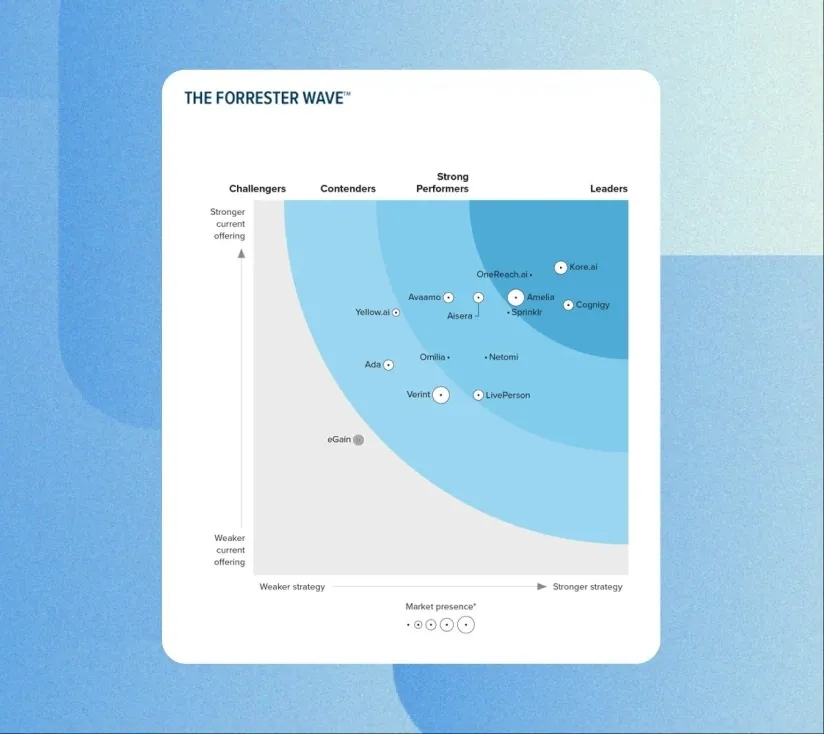
Kore.ai replaced the channel-specific tooling with one agentic service layer handling intent understanding, orchestration, and governance centrally, so the organization gets the same quality of service whether they call or type.
Where a case still needs a human, it hands off through the company's existing agent desktop with full conversational context attached.
The result:
- Volume scaled: 520,000 monthly voice calls and ~900,000 weekly digital sessions.
- Containment & accuracy: Achieved 75% voice containment, 57% digital containment, and 85% intent understanding accuracy.
- Governed escalation: Maintained a 9% live-agent transfer rate
Looking ahead: the permanent transformation of CX
Agentic CX represents a permanent shift in how enterprise operations are architected. Going into 2027, here’s how it fundamentally reshapes the relationship between the enterprise, its workforce, and its customers:
- For customers: Customers increasingly stop being the ones clicking "confirm." Their own AI agent, carrying preset limits on what it can do and spend, increasingly acts on their behalf. Interactions collapse into single-step outcomes, but customers see only the result, not the negotiation behind it, which makes transparency the new basis of trust.
- For employees: Frontline staff escape repetitive ticket processing, evolving from task execution to AI supervision. The newer shift will be mediating when a customer's agent and the company's agent disagree, and neither is authorized to resolve it alone — a genuinely different skill nobody has been trained for yet.
- For the business: Service stops being a cost center, but the win isn't most AI deployed. It's whose AI can be trusted by agents it doesn't own. Decision rights and governance move from best practice to competitive moat; get them wrong, and you're not slow - you're a casualty of the market correction already underway.