Top Use Cases for Voice AI Agents in Retail
Last Updated
October 19, 2026

Juhi Tiwari
Read Time

Summary
Voice AI agents are transforming retail customer service by moving beyond traditional IVRs and chatbots to understand requests, access data, and complete transactions. This article covers retail voice AI use cases including order tracking, returns, product discovery, inventory lookup, delivery scheduling, and multilingual support. A Kore.ai deployment handled approximately 520,000 monthly voice calls, achieving 75% voice containment and a 9% live-agent transfer rate.
What’s on this page
Retail has an AI adoption problem that isn't really about adoption. 88% of retailers have already integrated AI into their operations, but only 39% can point to a measurable impact on the bottom line. Industry analysts call that the implementation gap, and it comes down to one distinction: most of what retailers built is passive AI, a recommendation widget here, a chatbot that answers FAQs there, tools that suggest an action but need a human to actually carry it out. Voice AI agents close that gap differently. They don't just suggest, they act: checking real inventory, processing a real return, rebooking a real delivery slot, live, on a call.
The same shift is playing out industry-wide. Voice AI now handles roughly 19% of inbound contact-center volume across sectors, up from just 6% two years ago. Retail has a specific reason to care about that number: a general call center runs roughly $6 per call, climbing toward $10 in high-volume industries, and retail generates enormous volumes of exactly the repetitive calls that make that cost add up, order status checks, return requests, delivery questions, the kind of call a well-built voice agent can resolve without a hold queue in the way.
That shift is easiest to see in what it's replacing. For years, calling a retailer meant a menu of departments, a hold queue, and repeating an order number to whoever eventually answered, if anyone did. That's still the version of "customer service" most shoppers picture, and it's the version this new generation of agents is retiring, inside real e-commerce platforms handling real transaction volume, not a pilot program somewhere.
Here's where voice AI agents are delivering the most value in retail today, what the data actually says about the risk and reward, and what separates a deployment shoppers trust from one that just adds a new robotic voice to the queue.
The state of Voice AI
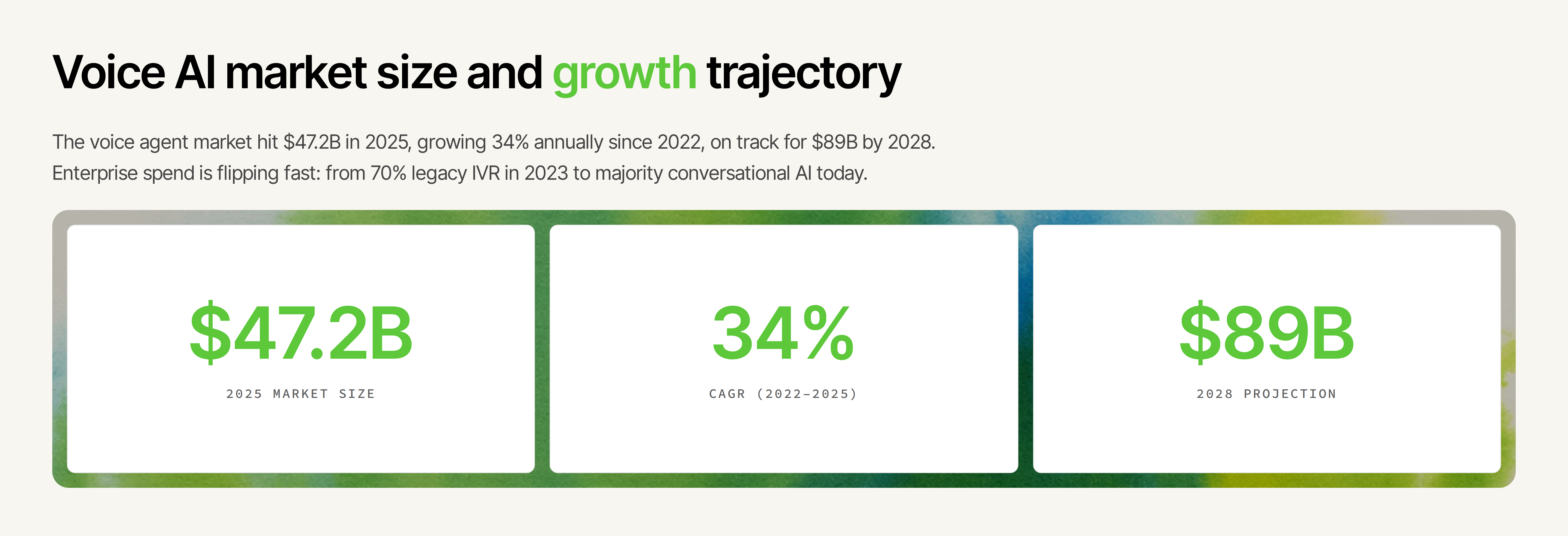
The state of voice AI in retail
A handful of numbers explain why retailers are moving fast on this:
- Search abandonment is a $2 trillion problem. Search abandonment, when a shopper can't find what they're looking for, costs retailers more than $2 trillion globally each year, $234 billion of that in the US alone, and roughly half of shoppers abandon their entire cart if even one item can't be found.
- Returns eat a real share of revenue. US retailers handled $890 billion in returns in a recent year, roughly 16.9% of total sales, with online return rates climbing as high as 40% for some categories. Reverse logistics alone can consume up to 7% of gross sales.
- Shopper patience runs out fast, not endlessly. 80% of shoppers will abandon a retailer after three bad experiences, and a mishandled delivery or return call is exactly the kind of experience that counts against that total.
- Retail's staffing math is brutal. The sector faces roughly 60% annual turnover, and store and contact-center managers spend up to 15 hours a week on scheduling and routine coordination alone, time that isn't going toward customers.
None of that means retailers are trying to remove people from customer service. It means the call types that are high in volume and low in ambiguity- the ones eating the bulk of inbound traffic, order status, simple returns, delivery questions- are moving to AI first, freeing staff for the moments that actually need a human's judgment: a VIP customer, a disputed charge, a genuinely upset shopper.
Proof it works: a Kore.ai retail voice deployment
Industry-wide numbers are useful, but one real deployment, at real scale, makes the case better than any forecast.
A global e-commerce marketplace modernizes voice and digital self-service
A large global e-commerce marketplace supporting millions of buyers and sellers was running customer support through legacy, menu-driven IVR and fragmented digital tooling. Orders, payments, returns, disputes, account access, and marketplace-specific questions all funneled through systems that couldn't deliver a consistent experience across channels, and the organization needed a way to scale automation without disrupting live operations or losing a clean path to a human for complex cases.
The company deployed Kore.ai's AI for Service to unify voice and digital into a single agentic service layer, with centralized intent understanding, orchestration, and governance instead of channel-specific tooling bolted together. On the voice side, natural, conversational interactions replaced the rigid IVR menu for core service needs: orders and transactions, refunds and returns, item-not-received cases, case status updates, fraud-related questions, and shipping and payment inquiries. When a call needs a human, it routes through Genesys Engage to the company's agent desktop with full conversational context attached, so nothing gets repeated.
The results, at scale:
A 9% live transfer rate on this kind of volume means the overwhelming majority of routine buyer and seller questions never need a human at all, and the ones that do arrive at that human with full context already attached. That's the pattern worth paying attention to: not novelty, but a legacy IVR replaced by something that actually resolves the call.
Read the full case study here - E-Commerce Giant Scales Customer Self-service Across Voice and Digital
Top use cases for voice AI agents in retail
1. Order status, tracking, and delivery updates
"Where's my order" is the single most common reason a shopper calls, and it's core to the e-commerce deployment above. A voice AI agent can pull live order and shipping data, explain exactly where a package is, and proactively flag a delay before the customer has to ask.
- Pulls real-time tracking data, not a static "processing" status that hasn't updated since checkout
- Explains a delay in plain language (weather, carrier capacity, a warehouse issue) instead of a generic apology
- Offers to text or email tracking updates so the customer doesn't have to call back to check again
The stronger version of this use case doesn't stop at informing the customer; it resolves the reason they called. If a shipment shows "out for delivery" but the address on file is wrong, the agent can correct it and re-trigger routing on the same call, rather than just confirming the (wrong) address back to the customer. Given that 80% of shoppers report abandoning a brand after just one bad delivery experience, closing the loop in a single call carries outsized weight on loyalty.
2. Returns and refund processing
Returns are both a routine call type and a real financial exposure: $890 billion in US returns annually, with online rates running as high as 40% in some categories. A voice AI agent can verify the order, confirm return eligibility against policy, issue a label or schedule a pickup, and process the refund, without the multi-day wait a mailed-in return often creates.
The mechanics that separate a good version from a liability:
- Confirms the item, condition, and reason for return before committing to anything
- Applies the retailer's actual return window and category rules rather than a blanket policy
- Routes anything that looks like abuse, a pattern of high-value returns, or a mismatched serial number to a human review rather than auto-approving
Done well, this single use case addresses a cost center that can eat up to 7% of gross sales in reverse logistics alone.
3. Product search, discovery, and guided selling by voice
A shopper who calls (or uses a voice assistant) to ask "do you have this in a smaller size" or "what pairs well with this" is doing exactly what a good sales associate would help with, just without one available. A voice AI agent can interpret natural, imprecise language, "something waterproof but still nice for a wedding", against the live product catalog and current inventory, rather than requiring exact keywords.
This matters more than it sounds: retailers lose an estimated $2 trillion globally because traditional keyword search fails to surface what a customer is actually looking for, and 68% of shoppers who hit a dead end simply leave. Voice search that understands intent, not just keywords, is a direct answer to that specific failure mode.
4. Order modification and cancellation
Plans change after checkout more often than retailers plan for: wrong size, wrong address, a customer who found it cheaper elsewhere and wants to cancel before it ships. A voice AI agent can look up the order, check whether it's still modifiable (has it shipped yet, is it a custom or final-sale item), and make the change or cancellation directly, reading back the update for confirmation before committing.
The design detail worth building in deliberately: once an order has entered fulfillment, a "cancel" request often can't be honored cleanly, and the agent should say so clearly and offer the actual alternative (a return once it arrives) rather than an unfulfillable promise.
5. Store locator, hours, and local inventory lookup
"Do you have this in stock at my local store" is a different question than "do you have this in stock," and it's one online-only search often can't answer well. A voice AI agent can check live inventory at a specific location, confirm store hours, and even hold an item for pickup, closing the loop between browsing online and buying in person.
This is a meaningful piece of the buy-online-pickup-in-store motion retailers increasingly depend on, and getting the answer right on the first call avoids the far more damaging alternative: a customer who drives to a store for an item that isn't actually there.
6. Loyalty program and account management
Checking a points balance, redeeming a reward, or updating account details are simple, high-volume, low-risk calls, exactly the profile a voice AI agent handles well. It can read back a points balance, explain what's redeemable now, apply a redemption to an order in progress, and update contact or payment details on file after verifying identity.
There's a revenue angle worth building into this use case, not just a cost-saving one. Once a customer's identity is verified and their issue is resolved, the agent has a natural, low-pressure moment to mention a highly relevant item, an abandoned cart from earlier that week, a companion product to something they just bought, before ending the call. Handled with restraint (one relevant offer, not a sales pitch bolted onto every interaction), this turns a routine support call into an occasional revenue moment instead of a pure cost center.
7. Payment support and card-not-present transactions
Taking a card payment over the phone is common in retail, phone orders, an agent completing a sale a customer started but didn't finish online, and it comes with a specific compliance obligation most teams underestimate. Under PCI DSS, cardholder data can't be stored in a call recording; the standard practice is to automatically pause or mask recording the moment a customer starts reading out a card number, then resume once that portion of the call ends.
A voice AI agent handling payment should be built around that requirement, not bolted onto it after the fact: masking card data in real time, never writing it to a transcript or log, and confirming the transaction verbally without repeating the full number back. This is one of the clearest cases where "the AI can technically do this" and "the AI can do this without creating a compliance exposure" are different questions.
8. Fraud detection in returns and refunds
Return fraud, "wardrobing" (buying, using, and returning an item), serial returners, and mismatched or counterfeit items being returned for a refund, is a direct hit to margin on top of the routine cost of processing legitimate returns. A voice AI agent can check a customer's return history and pattern against the specific request in real time: an unusually high-value item, a return initiated minutes after delivery, a customer with a return rate far above average.
The balance that matters here: flagging a genuinely suspicious pattern for human review, without punishing a loyal customer with a normal return by making the process suddenly harder. A blanket rule that treats every return as a fraud risk creates exactly the frustrated-customer problem retailers are trying to avoid by automating in the first place.
9. Delivery and appointment scheduling
For retailers that deliver large items, furniture, appliances, or offer services like curbside pickup, scheduling the actual appointment is its own call type. A voice AI agent can check real delivery-window or install-slot availability, book or reschedule, and send a reminder ahead of time, the same pattern that reduces no-shows in any industry that runs on scheduled appointments.
10. Proactive outbound: delays, back-in-stock, and delivery notifications
Retail doesn't have to wait for the phone to ring. A voice AI agent can call ahead when a shipment is delayed, notify a customer the moment an out-of-stock item is back, or confirm a delivery window before a driver is on the way, closing the loop before the customer has a reason to call in frustrated.
Outbound calls carry their own compliance line, though. Under the TCPA, purely informational calls (a delivery update, a back-in-stock alert the customer specifically requested) are held to a different consent standard than marketing calls, which generally require prior express written consent. A well-designed outbound program keeps those two categories clearly separated and tracks consent, and opt-outs, per category rather than treating "the customer gave us their number once" as blanket permission for everything. Retailers operating outside the US inherit a different rulebook entirely, India's TRAI regulations and Do Not Call registry, for instance, so a platform built for one market's outbound rules isn't automatically compliant in another.
11. Multilingual retail support
A national or global retailer serves customers who don't all speak English as a first language, and language friction at the exact moment someone wants to buy something, or needs help after a purchase, is a direct, measurable revenue loss, not just a service gap. A voice AI agent that holds a natural conversation in multiple languages, and switches mid-call if needed, extends the same accuracy and the same policies to every customer, rather than a thinner experience for anyone routed to a translated script.
How to make voice AI safe
A single retail voice call can touch three different compliance regimes at once: a card number under PCI DSS, a marketing opt-in under the TCPA, and a customer's purchase history under state privacy laws like the CCPA. Vendors don't always volunteer where those lines actually sit in their platform, so it's worth pushing on directly. Five questions separate a platform built for that reality from one that's only been tested against a demo script.
- Does it mask card data in real time, or just encrypt it afterward?
PCI DSS doesn't permit storing cardholder data in a call recording. A platform should be able to demonstrate automatic pause-and-resume recording the moment a caller starts reading a card number, not just encryption of a recording that already captured it.
- Can it prove consent before an outbound call, not just point to a purchased list?
The TCPA treats marketing calls and purely informational calls differently, and prior express written consent for marketing isn't the same bar as consent for a delivery update. A vendor should be able to show how consent is captured, categorized, and enforced per call type, not asserted as a blanket policy.
- Does it honor an opt-out immediately, or with a lag?
Under laws like the CCPA, a customer's request to opt out of data sale or sharing has to be honored promptly, not queued for a batch process next week. Ask to see what actually happens the moment a customer exercises that right mid-conversation.
- Can it tell a legitimate return from a fraudulent one without punishing loyal customers?
A platform that flags every return as suspicious solves fraud by creating a worse customer experience. Ask for the specific signals it uses (return velocity, item value, delivery-to-return time) and how a false positive gets reviewed, rather than just a claim that "fraud detection is built in."
- Will it produce a real trace of a call, or just describe logging in the abstract?
A vendor should be able to pull up an actual call trace, every decision, disclosure, and tool call the agent made, with card data and other sensitive fields already redacted. If a vendor can only describe audit capability without producing a real example, that's worth noting before, not after, a PCI assessment or a state privacy inquiry.
How Kore.ai's voice AI technology actually works
Every use case above depends on the same voice stack underneath, so it's worth knowing what's actually running on the call before comparing platforms on feature lists alone.
Kore.ai's Voice Gateway handles the audio, routing, and telephony side of the call, streaming close to the channel itself, while the Artemis runtime owns the decisions, fusing speech recognition, agent reasoning, and speech synthesis into one continuous session instead of bouncing the call across separate systems for every turn. That architecture keeps first audio consistently under 1.5 seconds, with turn-detection decisions landing in roughly 230 milliseconds on the optimized path, fast enough that the agent knows a caller is done talking before an awkward pause sets in.
That same continuity is what makes a customer changing their mind mid-call a non-event instead of a restart. If a shopper calling about a return says "it's the blue jacket," then corrects themselves, "actually, wait, it was the black one," the agent doesn't ask them to start over. It resumes the same field, replaces the value it was tracking, and keeps everything else, the order lookup already underway, intact, because one session owns the entire turn from start to finish rather than the call hopping between separate systems for recognition, reasoning, and speech output.
The agent is also built to behave like a person on the call, not a phone tree. It's always listening, so there's no dead gap between the bot and the caller. It can be interrupted mid-sentence and stop cleanly. It recognizes backchannel cues like "uh-huh" without treating them as the caller taking over the conversation, and when it needs a moment, checking real-time inventory at a specific store, for instance, it says so out loud instead of leaving dead air, while safety and compliance checks keep running in the background even as the response streams out.
Speech providers are a choice, not a lock-in: a retailer can bring its own ASR and TTS provider, Google Cloud, Microsoft Azure, AWS, Deepgram, ElevenLabs, or use Kore.ai's native integrations, and switch per use case under one contract rather than managing a dozen vendor relationships. And recognition quality is measured and improved on an ongoing basis, not assumed: vocabulary boosting for product and brand names, turn-level confidence passed to the agent so it asks for clarification instead of guessing, and ASR analytics that surface quality problems by provider.
Deep integrations into the systems retail already runs on are part of the same foundation. Kore.ai connects to commerce platforms like Shopify, Salesforce Commerce Cloud, BigCommerce, Magento, and SAP Hybris, along with 250+ other pre-built connectors, so an agent can check real inventory, pull a real order, and issue a real refund rather than working from a stale export. Kore.ai's AI for Retail pre-built agents give teams a configured starting point across order management, returns, loyalty, and support, so deployment starts in weeks against real systems rather than months against a blank integration project.
The bottom line
Shoppers still reach for a phone, or a voice channel, when something about an order feels urgent or has already gone wrong, and that's not changing. The data backs up what's already running in production at Kore.ai's own e-commerce deployment: a legacy IVR replaced by voice AI agents that handle roughly 520,000 calls a month, contain 75% of them without a human, and hand off the rest with full context attached. Start with the calls that hurt the most today, order status, returns, prove the value with real numbers, and expand from there.
FAQs
Is voice AI safe to use for handling retail payments?
Yes, when PCI DSS masking is built into the platform rather than added after the fact. Card data should never be written into a call recording or transcript; the standard is automatic masking or pausing while a customer reads out card details. Ask any vendor to demonstrate this live rather than describe it in a policy document.
Will voice AI agents replace retail customer service staff?
No, not entirely. In Kore.ai's e-commerce deployment, roughly 9% of voice interactions still transfer to a human by design, for disputes, high-value fraud flags, and genuinely upset customers. Given retail's roughly 60% annual staff turnover, the more realistic effect is absorbing repetitive call volume so staff can focus on higher-value work.
Can voice AI actually process a retail return, or just answer questions about the policy?
A well-built voice AI agent processes the return end to end: it verifies the order, confirms eligibility against the retailer's actual policy, issues a label or schedules a pickup, and completes the refund. That's a meaningful distinction, since an agent that only recites policy still leaves the customer needing a second call to get anything done.
What's the difference between voice AI and a traditional IVR system?
An IVR matches a keypress or a narrow phrase to a fixed menu and can't understand a request phrased differently than expected. Voice AI understands natural language, follows a conversation even when a customer corrects themselves mid-sentence, and completes multi-step tasks like processing a return instead of just routing the call to a queue.
Can voice AI handle the call spikes retailers see during Black Friday or holiday sales?
Yes, and seasonal volume is one of the clearest cases for automation specifically. A voice AI agent scales to a sudden jump in call volume without the weeks of hiring and training a temporary staffing surge requires, so a retailer isn't stuck choosing between adding seasonal headcount that's gone by January or leaving calls unanswered during the exact weeks when an abandoned call costs the most.
Share
Tags