
Ready-to-deploy applications across industries and functions.
Leverage pre-built AI agents, templates, and integrations from the Kore.ai Marketplace.



.webp)
What's new in AI for Work: features that drive enterprise productivity
In today’s rapidly evolving enterprise landscape, the ability to empower employees, streamline workflows, and unlock actionable insights is a competitive necessity.

Akhil Ganji
February 20, 2026
8 Min

Introduction
The enterprise AI landscape has moved rapidly from experimentation to expectation. While organizations invested heavily in generative AI over the past two years, many still struggle to translate pilots into meaningful, enterprise-wide impact. This shift is surfacing new challenges around governance, adoption, and security. The real bottleneck? Deployment at scale.
Today's enterprises need AI solutions that don't just answer questions, but actively work alongside employees, understand organizational context, and execute complex workflows across dozens of integrated systems. More importantly, they need to do this while maintaining the employee trust and control that enterprise IT teams require.
That's precisely what we've been building. Our latest feature updates to AI for Work represent a fundamental shift in how enterprises can deploy, manage, and scale AI agents across their organizations.
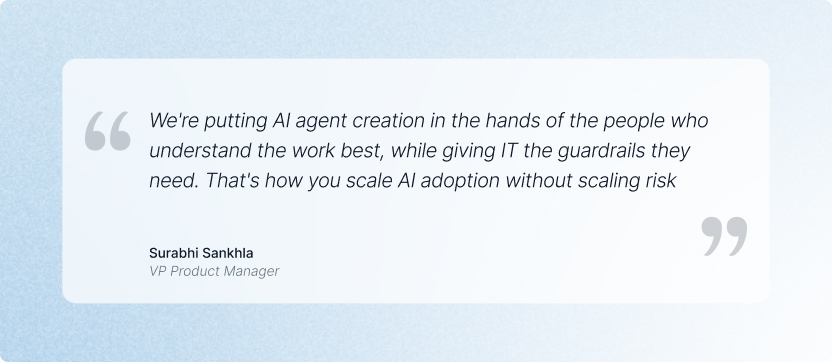
Democratizing AI agent creation (with the right guardrails)
Building AI agents used to require IT tickets, vendor coordination, and lengthy implementation cycles. With the updated Agent Builder, employees can now create and deploy agents tailored to their workflows, no code required.
What distinguishes enterprise-grade AI from consumer tools is governance. Administrators retain control over who can build agents, how they are deployed, and which systems they can access. IT maintains complete visibility into usage, permissions, and integrations, ensuring every agent operates within established security and compliance frameworks.
Finally, a marketing manager can build a Prompt AI agent that helps create marketing assets and always aligns with the brand tone and messaging. An HR business partner can build an AI agent that helps employees navigate benefits questions by drawing on an enterprise knowledge source.
Meeting employees where they already work
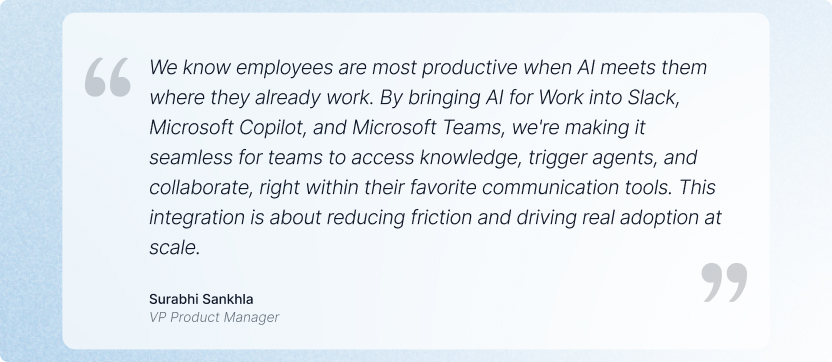
The best enterprise tool is the one employees actually use. The updated Slack integration brings AI for Work directly into your team's primary communication channel. Employees can search enterprise knowledge, trigger agents, and get intelligent responses through direct messages, without leaving their conversation flow.
Your customer success team is discussing an escalation in Slack. Instead of opening another application, they query the AI for Work directly. It pulls from your CRM, ticketing system, and knowledge base, all while respecting permissions, and delivers a semantic response in seconds. Because it operates within Slack's existing authentication and permissions, security and access controls remain intact while reducing adoption friction.
From reactive tools to proactive teammates
Your best teammates don't just respond when you ask; they know when you need things done and work accordingly. Your AI agents should work the same way.
Most AI solutions and assistants today are reactive. For routine tasks, employees have to remember to ask, wait for responses, and plan their work around the execution. The AI doesn't work according to employees' schedules; employees work around the AI.
The Agent Scheduler flips this dynamic. Now employees can align their AI agents to their actual work on their schedules, transforming AI agents from tools they use into teammates who deliver exactly when needed. Employees can schedule AI agent executions for specific times or set smart reminders that trigger agents based on their workflow needs.
A sales manager schedules their market intelligence agent to deliver briefings every Monday at 8 AM, ready for their weekly team meeting. An operations lead configures their vendor performance agent to run every Thursday, giving them time to review before Friday stakeholder updates.
Your AI agents become reliable team members who work on your schedule, not the other way around, making employees more productive while improving their overall experience with AI.
Making the organization more navigable
The Enterprise Directory makes organizational navigation intuitive by exposing reporting structures, expertise areas, project history, and collaboration patterns through structured, interactive views.
Institutional knowledge remains accessible, helping employees discover connections across the organization without endless searching. For HR leaders, it's a culture and engagement tool. For operational leaders, it's an execution accelerator. For project managers, it's the difference between building the right team in days rather than weeks.
Personalizing AI without compromising security
Employees need AI that understands their specific context and current work. IT needs control over data access and security. The traditional approach forces a choice: either lock everything down and sacrifice relevance, or open access and compromise governance.
The Personal Hub (projects) resolves this by creating employee-managed folders within the governed enterprise environment. Employees can upload their own documents and files that inform the AI's understanding of their specific context without compromising enterprise data boundaries.
An account executive uploads client meeting notes, industry research, and competitive analyses. When they ask about market opportunities, the AI synthesizes both enterprise data and their personal knowledge base, delivering insights far more relevant than generic responses. Employees control when to leverage their personal hub content versus enterprise knowledge, choosing the proper context for each task.
Personal data remains separate from shared enterprise knowledge. IT maintains visibility into data sources. Employees get AI that understands their unique roles.
The Agentic search that makes it all work
Employees no longer need keyword-based search. They need AI that understands who they are, which tools they use, and what's relevant to their role, delivering context-aware responses rather than generic results.
Our Context-Aware Agentic RAG does precisely that. The system is permission-native; every query executes within the user's actual access rights. It understands each employee's role, team, projects, and work patterns, so "the contract" means their contract, not a list of every contract in the system.
Why does this matter now?
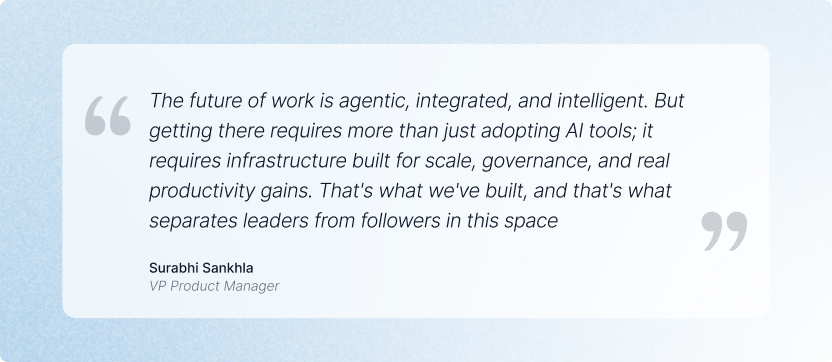
We're at an inflection point in enterprise AI adoption. The organizations that figure out how to deploy AI at scale, with proper governance, deep integration, and genuine intelligence, will unlock substantial productivity advantages.
For the executive leadership, AI for Work helps scale AI across the organization without creating security risks, integration sprawl, or unsustainable support burdens. For some leaders, it reduces friction, improves discoverability, and makes institutional knowledge easier to access — improving the employee experience without requiring massive change management. For others, the impact shows up in faster time-to-insight, less manual work, and fewer productivity drains from siloed systems.
Want to dive deeper into these feature updates? Explore our dedicated session in the new edition of AI Pulse, where we break down each capability and share some interesting demos.
The future of enterprise work is agentic, integrated, and intelligent. The question isn't whether AI will unlock productivity gains; it's how quickly your organization can get there.