





.webp)
Choosing a conversational AI platform in 2026 is considerably harder than it was even two years ago. Earlier conversational AI platforms were evaluated largely on how well they understood intent, retrieved an answer, and maintained a conversation across chat or voice.
Those capabilities still matter, but modern platforms are increasingly expected to reason over business context, retrieve enterprise knowledge, call tools, complete transactions, coordinate AI agents, and operate within clearly defined governance boundaries.
That also changes the buying decision. A convincing demonstration is no longer enough. You need to know what happens when the AI has to retrieve information from several enterprise systems, make a decision, invoke a tool, follow a policy, recover when an API fails, hand off work to another agent, and explain exactly what happened afterward.
The best conversational AI platform for your organization is therefore not necessarily the one with the longest feature list. It is the one that fits your use cases, clears your non-negotiable requirements, and continues to perform when those capabilities have to work together in production. Here is how to evaluate that properly.
What is a conversational AI platform in 2026?
A conversational AI platform is software used to build, deploy, manage, and improve AI applications that interact with users through natural language across channels such as web chat, messaging, apps, and voice. Modern platforms combine conversational AI with agentic AI so that applications begin completing tasks and orchestrating business processes.
Take something as ordinary as a customer asking to change a flight. A few years ago, a good conversational AI platform would explain the process of how to do it. Today, the same customer expects the AI to retrieve the reservation, check the fare rules, find alternatives, calculate the price difference, and complete the change.
That's why retrieval, guardrails, tool integration, and analytics have stopped being differentiators. They're table stakes. The real question in 2026 isn't whether a platform has these things. It's how well they work together once a request gets complicated.
Define what you actually need before you compare vendors
Before any vendor conversation, define the job the platform actually needs to do. Without your own requirements clear first, you end up comparing marketing decks instead of fit. Three questions cover most of it.
1. Does the AI need to answer, or does it need to act?
A platform that only answers questions carries a very different risk profile from one that can issue a refund or change an account. The more autonomy an agent has, the more it needs enforced guardrails and a real rollback path, not just a careful prompt. Know where your use case sits on that spectrum before you evaluate anything else.
2. Where do the conversations need to happen?
Map the channels that matter: chat, a portal, Teams or Slack, voice. If voice is part of the plan, treat it as its own test. Accents, interruptions, and background noise expose a voice AI agent in ways a text demo never will.
3. Who will actually build and run it?
Name the people who'll use this day-to-day: business teams, engineers, security, operations. A platform that works well for one of these groups while frustrating the rest becomes a bottleneck the moment adoption grows past a pilot.
With that defined, you're ready to set the requirements a vendor has to clear before it earns a deeper look.
Conversational AI platform requirements: What’s essential, what’s not
There’s a hard line between what a conversational AI platform must have and what is optional depending on your use case. Some of the must-haves are: conversational flow building, tool integration, retrieval-based grounding, guardrails, analytics, and baseline security. Miss any of these, and a platform is not really enterprise-ready, regardless of what else it offers.
Everything past that line is a fit question. Voice, digital humans, industry-specific models, protocol support — all these matter enormously to some buyers and not at all to others. This is also why the same platform can rank differently across two separate evaluations of the same market, one judging broad customer-facing use cases, another judging internal employee support. Neither ranking is wrong. They're answering different questions.
One more distinction worth making early: agentic execution versus conversational fluency. The market no longer rewards a platform for chatting naturally. It rewards whether an agent can carry a task to completion, grounded in real data, calling real systems, without a human quietly finishing the job. Ask to see that end-to-end, not a single rehearsed exchange.
How to evaluate a conversational AI platform: Six lenses framework
Once a vendor has cleared your non-negotiables, feature checklists become much less useful. At this stage, you are not asking whether a platform has integrations, guardrails, analytics, or an agent builder. You are comparing how well those capabilities work, how much control they give you, and whether they will hold up in production. There are six areas worth looking at closely.
1. Architecture and integration: Will it fit into the stack you already have?
A conversational AI platform should work with your existing enterprise architecture rather than forcing you to rebuild it around the vendor.
Start with the systems that matter most to your use case, whether that is your CRM, ITSM platform, contact center, HR system, payment infrastructure, or internal applications. Look beyond the number of connectors and ask what those integrations can actually do: which data they expose, which actions they support, how authentication works, and how they are maintained when the underlying systems change.
Then test context across those systems. Enterprise information rarely lives in one clean repository, so ask the vendor to answer a question that requires information from several sources and still respects the user's permissions.
Deployment matters here too. If your organization requires private cloud, on-premises, regional data residency, or particular model environments, establish exactly which parts of the platform can run where. “Hybrid” and “on-premises” can mean very different things across vendors.
Top tip: Give the vendor a workflow that spans three systems you actually use and ask them to run it end to end. That will tell you far more than the size of the connector catalog.
2. Builder and team experience: Can your people actually use it?
Most platforms can make creating an AI agent look easy in a controlled demo. The better test is what happens when your own team takes over.
Ask a business user to build an agent from scratch, add a knowledge source, or modify a workflow. Then ask a developer to inspect and extend what has been created. A strong platform should make common changes accessible to business teams without limiting the control technical teams will eventually need.
Also look at reuse. As agent creation becomes easier, organizations can quickly end up with multiple teams rebuilding the same knowledge connection, escalation logic, or agent under different names. The builder should help teams discover and reuse agents, tools, knowledge, and policies that already exist.
Top tip: Put the keyboard in the hands of someone from your team and ask them to make a real change. If the vendor has to take control again as soon as the scenario becomes slightly complex, you have learned something useful.
3. Governance and guardrails: How much control do you really have?
Every enterprise AI platform now claims to offer governance. The meaningful difference is how those controls are enforced and how granular they can become.
Your policies may need to vary by user, agent, tool, geography, data sensitivity, or transaction value. The platform should support those distinctions through enforceable policies rather than relying on the model to remember instructions inside a prompt.
Governance also has to survive multi-agent workflows. If one agent delegates work to another, permissions should not expand simply because the task crossed an agent boundary.
Finally, ask to see the audit trail. You should be able to follow what the agent did, which tools it called, what policy was applied, whether approval occurred, and what changed in the underlying system.
Top tip: Ask the vendor to demonstrate a sensitive action that requires approval, then show you exactly where that approval is enforced and how the entire action appears in the audit trail.
4. Quality and testing: Can you prove the AI still works after you change it?
Conversation quality and testing quality are related, but they are not the same thing.
Start with the experience itself. Bring real conversations rather than accepting the vendor's prepared examples. Assess whether answers are accurate, grounded in approved sources, relevant to the user's actual intent, consistent with your organization's tone, and compliant with your business rules.
Then look at how the platform tests change. Conversational AI evolves constantly as teams update models, prompts, workflows, integrations, and knowledge. A fix in one area can quietly break another.
Look for regression testing that can run large sets of representative conversations and agent workflows before a new version goes live. Testing should also cover tool failures, ambiguous requests, permission boundaries, knowledge gaps, and situations where the correct behavior is to escalate rather than answer.
Top tip: Ask the vendor to show how a new version is compared with the current one and how the platform identifies a quality regression after deployment.
5. Outcomes and economics: Can you prove the value and predict the cost?
Most platforms can report how many conversations, users, or requests the AI handled. Those numbers tell you the system is being used, but not necessarily whether it is delivering value.
Look for analytics that connect AI activity with the outcome behind the use case. For customer service, that might include resolution rate, escalation, customer satisfaction, handling time, or cost per resolution. For employee service, it might mean ticket reduction, time saved, employee satisfaction, or faster resolution.
Then examine the economics at production scale. Conversational AI pricing may be based on users, conversations, consumption, outcomes, or a combination of them. Agentic applications can complicate that further because one user request may trigger multiple agents, model calls, and tools.
Top tip: Ask the vendor to model what your deployment costs at expected volume and again at two or three times that volume. If the vendor cannot explain what happens to your bill as usage and workflow complexity increase, you do not yet understand the commercial model.
6. Vendor fit: Will they still be the right partner after the demo?
The platform matters, but so does the company behind it. Look at what the vendor has actually shipped in the past rather than relying entirely on what appears on the future roadmap.
Then speak with customers running deployments similar to the one you are planning. Ask what was harder than expected, how the platform behaved as usage increased, how much vendor support they needed, and what changed after the first year.
Finally, understand your exit options. Find out how easily you can export configurations, conversation data, agent definitions, and other assets if your architecture or vendor strategy changes later.
Top tip: Ask for a customer reference that has been live at meaningful scale for at least a year, and ask the vendor what substantial capabilities it shipped in the last two quarters.
The red flags: when to walk away from a conversational AI vendor
Not every weakness should eliminate a vendor. Some gaps can be worked around, negotiated, or addressed later. Others undermine the security, reliability, or scalability of the platform itself.
Here are some of the important red flags that should make you walk away before you spend weeks evaluating everything else:
No native PII redaction or flagging. If your workflows touch regulated or personal data, this alone should end the conversation. Bolting on redaction after a platform is already live is a far harder fix than getting it right from the start.
No real version control or rollback for agents. Fine for one pilot agent, unworkable once you're running a dozen. Every change becomes a guess, and undoing a bad one means rebuilding from memory instead of restoring a known good state.
No proactive analytics on where an agent is failing or where knowledge is missing. Without this, you find out about problems from frustrated users, not from the platform itself.
Guardrails that live only in a prompt, with nothing actually enforcing them. A prompt is a suggestion to the model, not a control. Anything genuinely sensitive needs to be blocked or approved by logic outside the model's own judgement.
Can't meet your security or deployment requirements. Data residency, private cloud, on-premises — treat these as architectural facts, not something to negotiate after the contract is signed.
Can't reliably connect to the systems you actually depend on. A long connector catalogue is marketing material. What matters is whether the systems you touch daily are natively supported and tested at your scale.
No standard way to connect to external agents or systems through an open protocol. That locks you into one vendor's ecosystem as the market moves toward interoperability.
No customer reference willing to talk to you. A vendor confident in its own delivery will happily connect you with someone live for a year, not just a curated success story from the sales deck.
None of these should surprise a vendor when you ask about them directly. If a vendor gets defensive rather than specific, that reaction is itself useful information.
Where Kore.ai fits into this framework
Here's how Kore.ai’s Artemis Platform holds up against each of the six lenses:
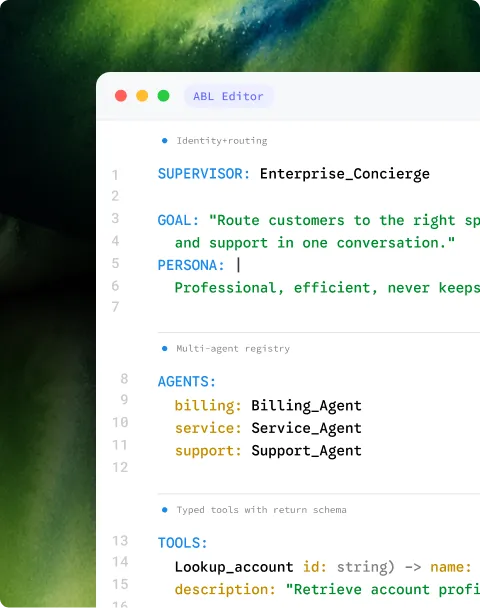
- Architecture and integration (lens one). Runs on ABL, a compiled agent definition language, with six built-in orchestration patterns for coordinating multiple agents, plus a context engine spanning multiple context graphs.
- Builder and team experience (lens two). Arch turns a plain-language workflow description into a full agent design, tools, policies, and handoffs, then builds, tests, and optimizes it, with proactive skill suggestions.
- Governance and guardrails (lens three). Policies are enforced by the runtime itself, engine-enforced constraints a model can't override, with a full trace of every agent run and a dedicated PII layer that masks sensitive data before it reaches the model.
- Quality and testing (lens four). Evaluation Studio scores agent behaviour against structured test cases before release and runs continuous regression suites to catch quality drift after a model or prompt change.
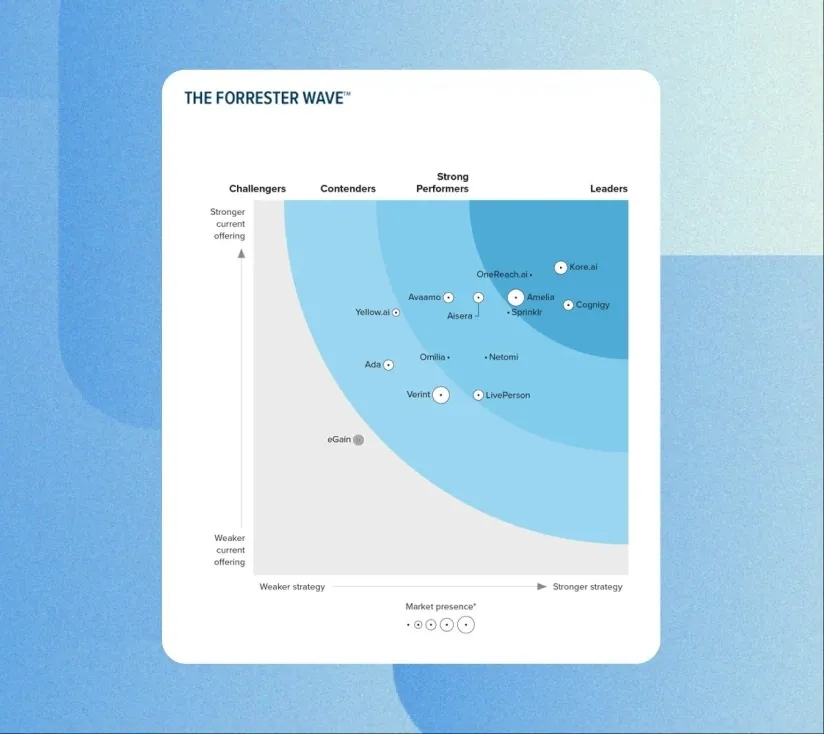
- Outcomes and economics (lens five). Forrester, in its report, says that Kore.ai’s pricing is unusually flexible: per user, outcome-based, or a blend of the two.
- Vendor viability (lens six). As Gartner puts it: R&D staffing has grown faster than most peers this year.
Run any vendor you're evaluating, Kore.ai included, through the same six lenses, and trust what you find over anything in a pitch.
Want to see exactly where Kore.ai lands against your own shortlist? Let’s have a chat. Not ready yet? Learn how Gartner and Forrester evaluate Kore.ai.
Frequently asked questions
Q1. What is the difference between a chatbot and a conversational AI platform?
A chatbot is typically one application built to handle a narrow set of conversations. A conversational AI platform is the underlying software used to build, govern, and operate many of those applications at once, across teams, channels, and use cases, with shared guardrails, analytics, and infrastructure underneath.
Q2. What are the must-have features of a conversational AI platform in 2026?
At minimum, a platform needs conversational flow building, tool integration, retrieval-based grounding, enforceable guardrails, analytics, and baseline security and privacy controls. Current market analysts treat these as entry requirements, not differentiators. Voice, video, industry-specific models, and advanced protocol support matter for some buyers and not others, depending on the use case.
Q3. How much does a conversational AI platform cost?
Pricing usually follows one of three models: per user, consumption-based, or outcome-based, often blended. Cost depends heavily on usage volume, since a single interaction can trigger several model calls or tool actions behind the scenes. Ask any vendor for a worst-case projection at three times your expected usage, not just a quote based on pilot volume.
Q4. How long does it take to implement a conversational AI platform?
Timelines vary by scope and by how many systems the platform needs to connect to. A narrow, single system pilot can go live in weeks. A deployment spanning multiple business systems, custom governance policies, and several agent workflows typically takes longer, and the biggest delays usually come from integration and security approval, not from the AI itself.
Q5. What is agentic AI, and how is it different from a standard chatbot?
Agentic AI refers to systems that can reason toward a goal, choose which tools or systems to use, and complete a multi-step task with limited human input, rather than simply answering a single question. A standard chatbot responds. An agentic system can retrieve information, make a decision, take an action, and hand it off to another agent or a human when needed.
Q6. Is Kore.ai a leading conversational AI platform?
Kore.ai is one of the platforms rated a leader in the two 2026 analyst evaluations referenced throughout this guide, one covering the broad conversational AI platform market and one focused specifically on employee services. The section above, where Kore.ai fits into this framework, walks through how it maps against the same six lenses used for every other vendor in this guide.