





.webp)
As AI in customer service becomes the default, here’s how to overcome the 8 challenges that prevent enterprises from realizing real productivity gains.
The pressure on Customer Experience (CX) leaders to realize value from Artificial Intelligence (AI) is increasing by the day. Gartner’s survey revealed that 91% of service leaders are under pressure from executive leadership to implement AI. On top of that, they are tasked with lowering cost-per-contact while boosting Customer Satisfaction (CSAT) and First Contact Resolution (FCR).
While agentic AI promises to balance this equation, implementing it across an enterprise contact center is rarely straightforward. An AI agent might fail the moment it needs to actually check an order status or hallucinate while chatting with a customer. Human agents on the floor start ignoring the AI-suggested answers because they simply do not trust them. And before you know it, a frustrated customer is escalated three separate times just to find someone who can help.
This is exactly the experience AI was supposed to prevent in the first place. When customer-facing AI misses the mark, it erodes customer trust, burns out your support team, and inflates handle times across the board.
To build a truly resilient support strategy, CX leaders need a clear picture of the genuine operational hurdles derailing AI deployments today, especially as customer expectations around speed and accuracy keep rising. Key obstacles include:
- Inconsistent and outdated knowledge bases
- Integration with legacy contact center tech stack
- Bolting AI onto broken workflows
- Weak AI governance and control
- Data security and regulatory compliance
- Customer trust and adoption resistance
- Cost volatility and unclear ROI
- Agent role redesign and burnout
Challenge 1 - Inconsistent and outdated knowledge bases
The problem:
In a contact center, "knowledge" isn't one thing. It's whatever human agents have always cobbled together from macros, tribal knowledge, and whichever knowledge base article ranks first in an internal search. That was manageable when a trained human could sanity-check an answer before saying it out loud.
The impact:
An AI agent doesn't have that instinct. When an agent ingests conflicting or outdated documentation, it suffers from hallucinations, generating responses that sound authoritative but violate current company policies or offer incorrect troubleshooting advice.
This is fundamentally a data quality problem before it's a natural language processing (NLP) problem, since even the best model can't compensate for conflicting source documents. A single incorrect answer regarding a return window or policy can lead to lost revenue, regulatory compliance risks, and customer churn.
The solution:
Establish a strict Knowledge Management Framework before launching customer-facing AI agents. Implement advanced Retrieval-Augmented Generation (RAG) architectures that limit the AI’s answers strictly to verified, sanctioned enterprise documents. Ensure your knowledge pipeline dynamically redacts deprecated policies and respects document-level access permissions.
Challenge 2 - Integration with legacy contact center tech stack
The problem:
Most enterprise contact centers run on a patchwork of platforms accumulated over decades—legacy telephony, Customer Relationship Management (CRM) systems, ERPs, and legacy ticketing software. When organizations rush to deploy AI, they often slap a conversational LLM interface over this fragmented stack.
The impact:
This creates a "thin layer" chatbot. The AI can greet the customer politely and answer generic FAQs, but it cannot access real-time backend systems. When a customer asks to execute a transaction—such as modifying an order, applying a promotional credit, or checking an account status—the AI hits a wall and must transfer the ticket. Instead of deflecting workload, it simply adds an extra, frustrating step to the customer journey.
The solution:
CX leaders must shift from conversational interfaces to agentic workflow automation that connects to your CRM system and other systems of record. Prioritize building or selecting tools with deep API connectivity that can sit securely between your support layer and systems of record, with real authorization to execute transactions.
AI must be given the authorization to safely execute transactional tasks, turning it from a static FAQ engine into a functional virtual support agent.
Challenge 3 - Bolting AI onto broken workflows
The problem:
It's tempting to treat Workflow Automation as a single step you bolt onto an existing support process, rather than a redesign of the whole path. For example, a support team might deploy AI to capture customer intent at the very beginning of a call or chat. The agent accurately identifies "this is a billing dispute" in two seconds.
However, behind that fast intake, the underlying resolution steps remain untouched. The customer is still funneled through the same four manual verification checks, one of which requires waiting on hold for a back-office specialist.
The impact:
Speeding up intent recognition while leaving the rest of the workflow manual simply moves the bottleneck a few seconds earlier in the call. The customer still spends the exact same total amount of time trying to get an answer.
When Average Handle Time barely moves, CX leaders are left in a tough spot: defending an expensive AI investment to executive sponsors who wonder why the promised efficiency gains never showed up in the numbers.
The solution:
Map the entire resolution path for high-volume issue types end to end, rather than treating ticket routing as the finish line for your support process. Look for friction points and manual steps that can be eliminated entirely once AI has secure access to account data.
By consolidating identity verification, data lookup, and initial troubleshooting into a single automated step, you replace a sluggish, fragmented journey with a unified experience that actually drives down handle time.
Challenge 4 - Weak AI governance and control
The problem:
Contact centers already have clear escalation rules for human agents. There are dollar limits on refunds, required manager sign-offs for policy exceptions, and structured approval chains.
However, when teams deploy AI agents, those rules often fail to carry over because they live in training decks and team leads' heads rather than in explicit system code. Consequently, the AI takes an action it technically has system access to perform, simply because no one explicitly configured the system to tell it where its authority ends.
The impact:
An AI agent might approve a refund far above acceptable thresholds, commit to a costly policy exception, or make an unauthorized promise to a customer. Beyond the immediate financial impact, this creates wildly inconsistent customer experiences and introduces compliance risks.
When executive leadership discovers the AI is making unauthorized financial commitments, trust in the entire AI program dissolves overnight.
The solution:
Document the exact financial limits and escalation rules your best human agents follow, then enforce them as hard constraints with clear human oversight built in at every threshold, not soft suggestions that AI service agents can talk their way around.
Build explicit workflows where out-of-bounds requests automatically trigger a human manager sign-off, and maintain an auditable log of why every action was either approved or escalated.
Challenge 5 - Data security and regulatory compliance
The problem:
Customer support conversations are naturally full of sensitive, regulated customer data. Customers routinely share credit card numbers during billing inquiries, health details during support intakes, or personal identifiers during account updates. When teams deploy AI, they often focus on conversation quality and speed, assuming data privacy is naturally covered by default.
Months into a live deployment, legal or compliance teams inevitably ask how that sensitive data is being tokenized, stored, or processed across third-party models, and the project team realizes they do not have a clear answer.
The impact:
Unmasked personal data or non-compliant retention policies create massive legal and financial liabilities. At the same time, global regulations are tightening rapidly. For example, transparency rules under the EU AI Act require clear disclosures whenever users interact with an automated system. Failing to meet these security and transparency standards can trigger heavy regulatory fines and severe damage to customer trust.
The solution:
Treat data security as a foundational platform requirement on day one. Ensure your agentic architecture performs real-time PII tokenization and redaction at the ingestion layer, before data ever reaches a processing model.
Look for enterprise AI platforms that guarantee strict tenant isolation and carry built-in certifications tailored to your industry, such as PCI DSS for payment processing, HIPAA for healthcare data, and GDPR for global operations.
Challenge 6 - Customer trust and adoption resistance
The problem:
Even when an AI agent works exactly as designed fast, accurate, and on-brand a significant share of customers still do not want a virtual assistant handling their issue.
In fact, a Gartner survey of over 5,000 consumers revealed that 64% of customers would prefer companies that didn't use AI in customer service at all, and 53% said they would consider switching to a competitor if they found out a company was using AI for support.
The impact:
A technically flawless deployment can still generate complaints, low satisfaction scores, and quiet churn if customers feel like they were routed away from a human option, or weren't told they were talking to AI in the first place.
It gets worse when a customer's context doesn't survive the journey: they explain an issue in chat, get bounced to a different queue, and repeat the entire story to a human rep who now has to re-diagnose it from scratch. That's the moment CSAT actually collapses, and also erases the very efficiency gains AI was supposed to deliver, since Average Handle Time goes up, not down.
The solution:
Never make AI the only door in. Keep a visible, low-friction path to a human agent across every communication channel, whether that's chat, voice AI, or a traditional IVR system, and be upfront when a customer is talking to AI rather than letting them find out later.
Consistent Support Channels and reliable Omnichannel Routing matter here directly, since a customer bounced between an AI-powered chatbot and three different queues erodes Customer loyalty fast.
Respecting customer preference also cuts the other way: customers who genuinely prefer Customer Self-Service over talking to anyone at all, human or AI, should get a frictionless path to that too. And for global operations, multilingual support that doesn't degrade the moment a conversation escalates is part of that same trust equation. Every handoff, across every channel, needs to carry full context so no customer ever has to repeat themselves.
Challenge 7 - Cost volatility and unclear ROI
The problem:
Most AI business cases are built around initial platform licensing fees without fully accounting for what it actually costs to run every interaction at scale. A massive share of operating expenses in advanced AI deployments goes into refining, rerouting, and verifying responses behind the scenes.
To make matters worse, many architectures route every single query through the exact same state-of-the-art generative AI reasoning model. Using a heavy, expensive model to answer something simple like "what are your business hours" is the AI equivalent of bringing in a senior specialist to handle a basic canned response.
The impact:
A year into a rollout, finance starts asking why compute and API bills keep climbing while the overall CX budget line has not actually shrunk. When costs spike without a matching drop in operating expenses, executive sponsors lose confidence. It is rarely a failure of the core technology that halts an AI deployment; it is this unexpected cost mismatch that causes leadership to stall or pull funding.
The solution:
Avoid routing every interaction through the same model. Establish clear, deterministic rules that send simple, high-frequency intents to fast, lightweight models or traditional rule-based automations, reserving larger reasoning models for genuinely complex, multi-step interactions.
Additionally, track your cost per contact by specific intent type, using real-time insights rather than relying on an aggregate average, ensuring that a cost spike in one category does not get hidden behind a healthy overall baseline. You can also layer in predictive analytics here to catch cost or volume anomalies before they show up in a quarterly review.
Challenge 8 - Agent role redesign and burnout
The problem:
When AI successfully takes over routine, repetitive tasks like password resets and balance checks, human agents are left handling only what remains: the complex, high-friction, and emotionally charged cases.
A Gartner survey found that 85% of customer service leaders are already expanding or evolving agent responsibilities as AI takes on basic volume. However, without the routine, simple tickets that used to give agents a mental breather between tough calls, the daily rhythm of support work becomes significantly more taxing.
The impact:
Facing a continuous stream of difficult interactions without adequate support leads to rapid agent burnout and rising turnover. If support reps feel that AI is simply stripping away easy wins and making their daily workload harder, they will view the technology with resentment.
This shows up as low adoption of assistant tools, longer handle times, and degraded customer satisfaction during high-stakes calls where empathy matters most.
The solution:
Position AI internally as an agent copilot that boosts productivity rather than a replacement. Deploy AI-powered assistance tools to actively reduce agent effort during and after complex customer requests, such as surfacing relevant policy documents in real time, drafting suggested replies, and automatically generating ticket summaries after a call ends.
Use Customer feedback from these high-stakes interactions to keep refining where AI helps and where it gets in the way.
In addition, involve your top-performing support reps in tuning how the AI handles edge cases. They carry the practical judgment calls that rarely make it into static documentation, and building that wisdom into the AI makes it a tool agents actually want to use.
How Kore.ai’s Artemis Agent Platform help implementing AI for CX
Fixing these eight problems one by one with point tools is exactly how most enterprises end up back at Challenge 7 of unclear ROI. Kore.ai built its Artemis Agent Platform to deliver AI-powered customer service as one connected problem rather than eight separate ones:
- Knowledge and legacy integration (Challenges 1): Artemis features Search AI working off a single governed enterprise knowledge layer, ensuring answers are grounded in real-time enterprise data rather than outdated static documents.
- Legacy system integration (Challenge 2): Native connectors to 300+ enterprise systems enable agents to execute real transactions inside systems of record (CRM, ERP, ticketing) rather than just providing read-only text.
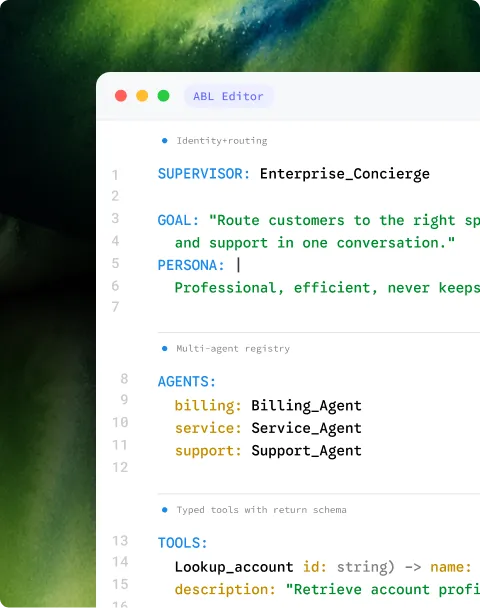
- Workflow design (Challenge 3): Powered by Arch™ AI and Agent Blueprint Language (ABL™), agents are designed to execute complete end-to-end resolution paths intent recognition, identity verification, task execution, and conditional handoffs.
- Governance and risk control (Challenge 4): ABL™ enforces hard policy boundaries, role-based access, and escalation rules at the platform runtime layer, independent of the underlying LLM, preventing prompt drift or unauthorized actions.
- Security and compliance (Challenge 5): Built with real-time PII tokenization, tenant isolation, and certifications spanning SOC 2 Type II, ISO 27001, PCI DSS, FedRAMP Moderate, HIPAA-alignment, and GDPR, which is part of why roughly three-quarters of Kore.ai's customer base sits in regulated industries like banking and healthcare.
- Customer trust (Challenge 6): Artemis enforces effortless omnichannel memory and continuous session state. Handoffs to live agents carry complete, synthesized interaction summaries so customers never have to repeat themselves.
- ROI and cost control (Challenge 7): Artemis is model-agnostic, so agent definitions keep running regardless of which underlying LLM you use, protecting the business case from being upended by a single vendor's pricing changes.
- Agent roles and human-in-the-loop (Challenge 8): Agent AI Assistance gives human agents real-time suggestions, dynamic playbooks, and conversation summaries, keeping the customer support agent in an active decision-making role rather than a passive one waiting to catch AI's mistakes.
Evaluating how to move past the AI pilot stage without stacking more point solutions? Let's have a chat about how you can scale your agentic customer support safely and predictably.
Frequently asked questions
Q1. What are the biggest challenges of implementing AI in customer service?
The most common ones are outdated knowledge bases, integration with legacy contact center systems, weak governance over what AI is allowed to do, data security and compliance gaps, unclear ROI as costs scale, and burnout among agents left with only the hardest cases. Most of these show up after deployment, not during the pilot, which is why they catch teams off guard.
Q2. How much does it cost to implement AI in customer service?
Costs vary widely by scope. Basic FAQ chatbots can start around $10,000 to $50,000, while enterprise deployments with legacy integrations, compliance requirements, and agentic workflows commonly range from $50,000 to $250,000 or more, plus ongoing monthly usage and maintenance costs.
Q3. How long does it take to implement AI in customer service?
You can take a basic AI assistant live in a few hours. However, enterprise deployments involving CRM and legacy system integrations, governance setup, and compliance review typically take 3 to 6 weeks. Timelines usually stretch further when knowledge bases need cleanup first or when the AI needs real transactional access, not just conversational ability.
Q4. What's the difference between an AI chatbot and an AI agent in customer service?
A chatbot generally answers questions using conversational AI, often as a "thin layer" over existing systems. An AI agent can take real action, checking an order, applying a credit, updating an account, because it's connected directly into backend systems of record with defined authorization, not just retrieving information to display.
Q5. Why do AI agents give wrong or made-up answers in customer service?
This usually isn't a model failure so much as a knowledge failure. When the underlying machine learning algorithms retrieve from outdated, duplicated, or conflicting internal documentation, it still answers confidently, producing responses that sound correct but violate current policy. This is why governed retrieval and a single source of truth matter more than the underlying model choice.
Q6. How to measure the true ROI of AI in customer support?
Enterprises should measure reductions in Average Handle Time (AHT), Cost Per Interaction (CPI), First Contact Resolution (FCR), and agent onboarding speed. Tracking intent-level execution costs against time saved provides an accurate picture of financial impact and operational efficiency.
Q7. Can AI handle customer inquiries across multiple languages and channels?
Yes, modern AI platforms support Multilingual Support across chat, voice, and email simultaneously. The stronger differentiator is whether context and customer sentiment carry over when a conversation moves between communication channels, since losing that context is what usually causes repeat Customer Requests and frustration, not the language switch itself.