





.webp)
Every generation of enterprise software eventually needed a language. Web development got HTML. Application logic got Java. Enterprise AI got prompts.
Prompts have become the default building block for everything. Define the agent in a prompt. Add governance in a prompt. Handle escalation in a prompt. The entire enterprise AI stack is instructions handed to a model, and a hope that it interprets them correctly.
It is never going to be enough. Over the past 24 months, we kept seeing the same two problems in every enterprise conversation.
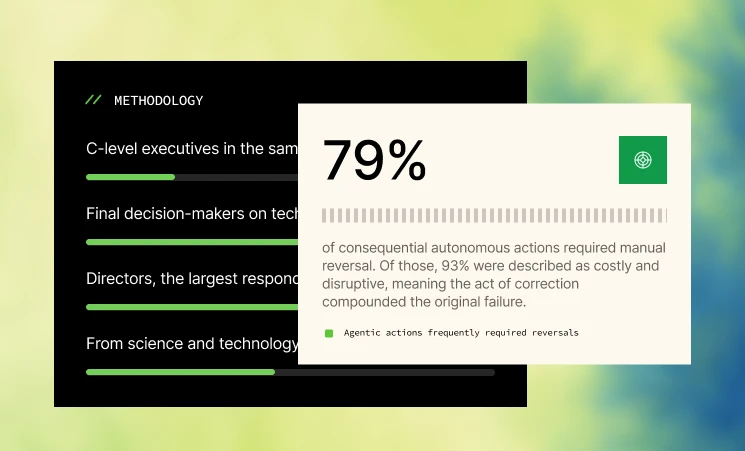
The first was governance. Policies exist, but they live in the wrong place, inside prompts the model can misread, drift from, or bypass entirely. The Kore.ai Agent Productivity Index 2026, a survey of 400+ IT and engineering leaders all actively running AI agents in production, confirmed how widespread this was: 72% believed their agents were introducing unmanaged financial or compliance risk despite safeguards already being in place.
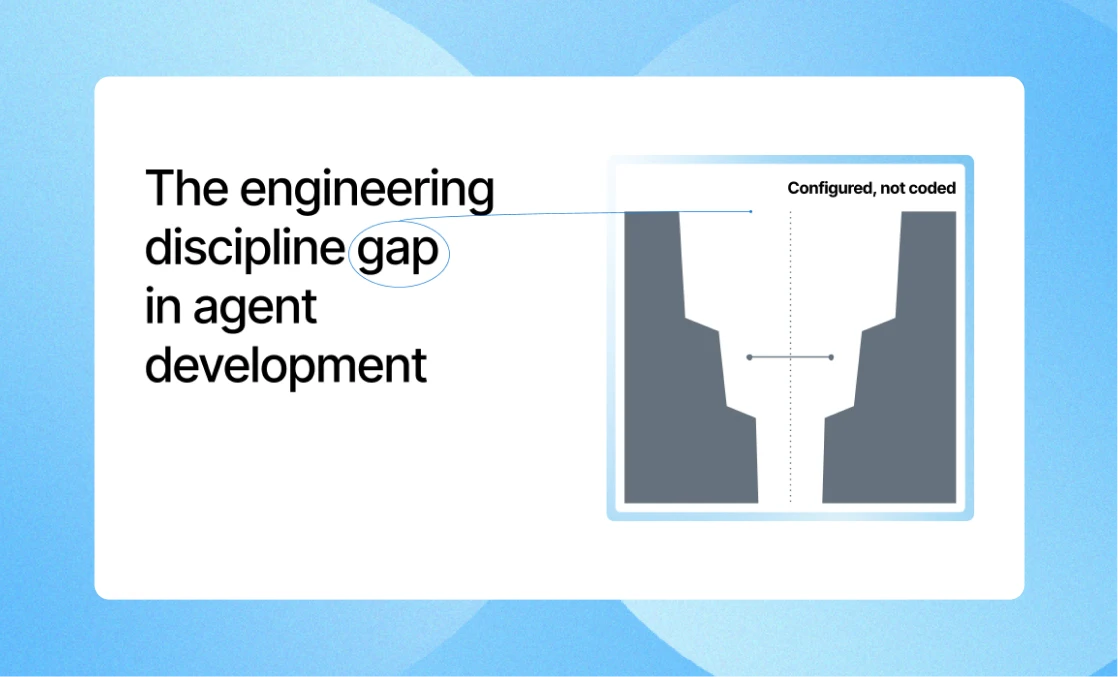
The second is how agents are being built. As AI becomes more democratized, anyone can build agents. And that is exactly what happens. No standards. No policies. No best practices. The result is a chaotic agent system that no compliance team can audit and no engineering team can maintain.
When governance depends on the model correctly interpreting a policy, that's a bet, not a guarantee.
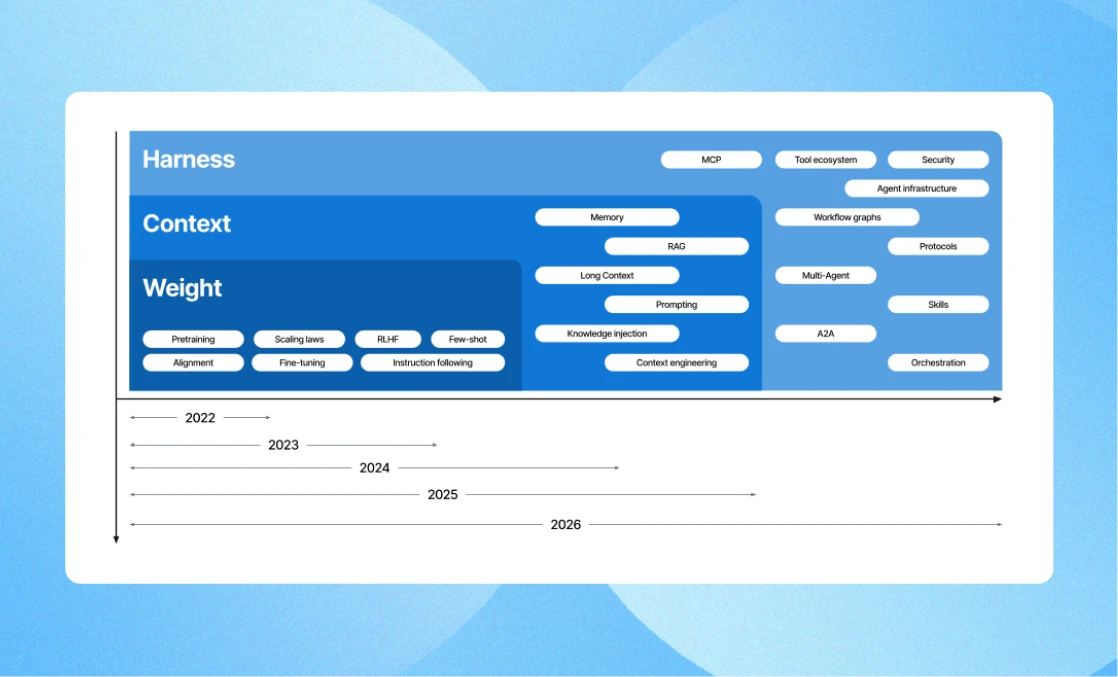
AI agents plan and act with less explicit instruction than any earlier generation of software required. Traditional SDLC methods were never designed to account for that. We need something fundamentally different. So we built it.
Introducing Agent Blueprint Language (ABL), the world's first compiled, declarative language built specifically for enterprise AI agents, and the foundation of Artemis, Kore.ai's AI-native enterprise agent platform. It's a language, with a compiler, that brings structure, governance, and predictability to enterprise AI for the first time.
ABL changes the foundation entirely. Governance is architected within the agent, compiled into the runtime, outside the model. Behavior is declared in a single versioned artifact. Problems are caught before production, before any live customer interaction.
Prompts, pro-code, and no-code: Why every existing approach to building AI agents has a ceiling
Most enterprises have tried at least one of these. Most already know where the ceiling is.
- Prompt-based platforms are fast to start. But governance buried inside model instructions can be misread, bypassed, or drift silently between model versions. For a bank or an insurer, a guardrail that works most of the time is not a guardrail.
- Custom pro-code development offers full flexibility, but every team rebuilds the same scaffolding from scratch. Engineering effort goes roughly 80% toward platform infrastructure and 20% toward the business logic that actually matters. Governance gets added at the end, if it gets added at all.
- No-code visual builders were designed for humans, not machines. As enterprises increasingly use AI to create and optimize AI systems, drag-and-drop canvases become dead ends.
None of these deliver what serious enterprise AI actually requires: agents that reason intelligently and operate within enforced, auditable boundaries. At the same time. In the same system.
The root problem is structural. Most enterprise AI platforms treat governance as an instruction to the model. The model interprets that instruction and decides how to apply it. That works in a demonstration. It becomes far harder to trust in production, where compliance policies and access controls must hold regardless of what the model reasons at the moment.
Enterprise software solved this problem decades ago by separating policy from execution. Rules are enforced by the system itself, not left to interpretation. Enterprise AI needed the same architectural shift. That is what ABL delivers.
What is Agent Blueprint Language (ABL)?
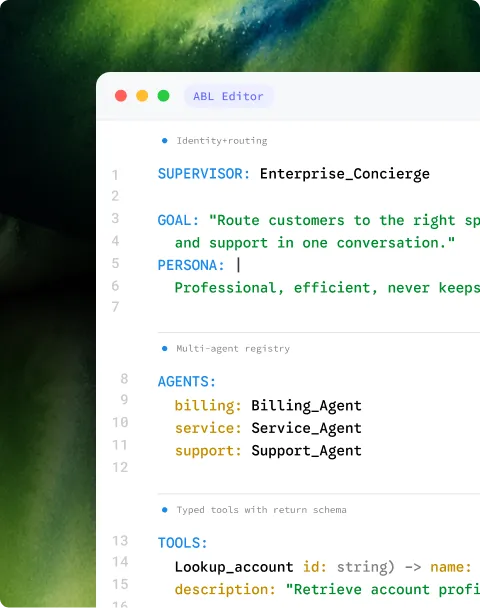
ABL is a compiled software artifact that defines the complete behavior of an enterprise AI agent, the same way application code defines the behavior of any enterprise system.
Written in YAML, it is readable by engineers, architects, compliance officers, and AI systems alike. But the format is just the surface.
Think about what React did for web development. Before it, developers chose between raw JavaScript that became unmanageable at scale and tools that quickly hit their limits. React introduced the right abstraction: structured, predictable, and understandable by both humans and machines. ABL represents the same shift for enterprise AI.
A single ABL file covers everything an agent needs:
- Identity and execution: what the agent is, what it can do, and how it runs
- Governance: constraints and guardrails compiled into the runtime, not written into a prompt
- Workflows: explicit separation between steps that require reasoning and steps that require deterministic execution
- Multi-agent coordination: delegation, handoffs, and escalation as native language capabilities, not custom code
Everything lives in one versioned artifact that engineers, security teams, and compliance officers can all read, review, and audit. The agent that is tested and approved is the exact agent that runs in production. No drift. No surprises.
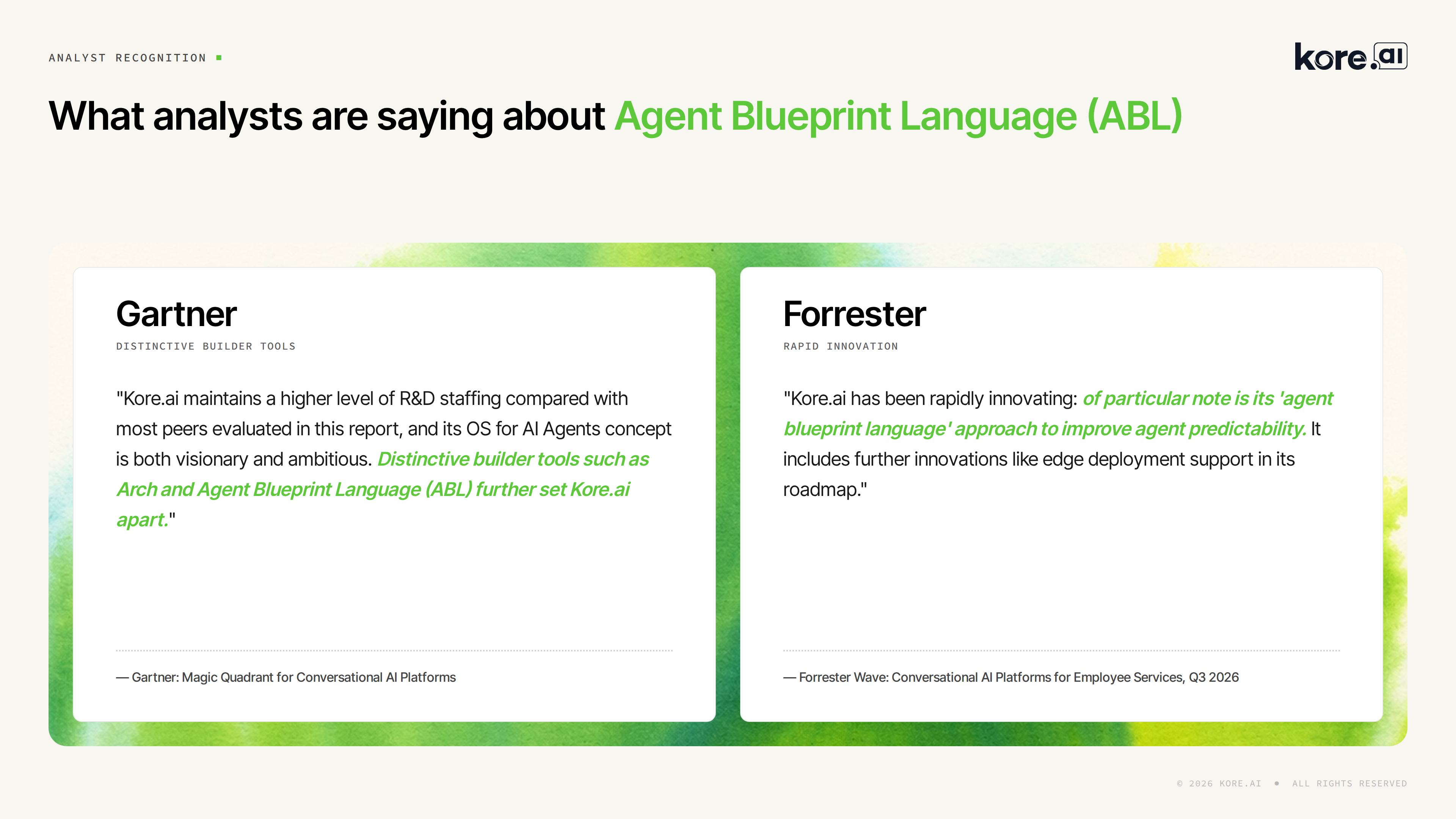
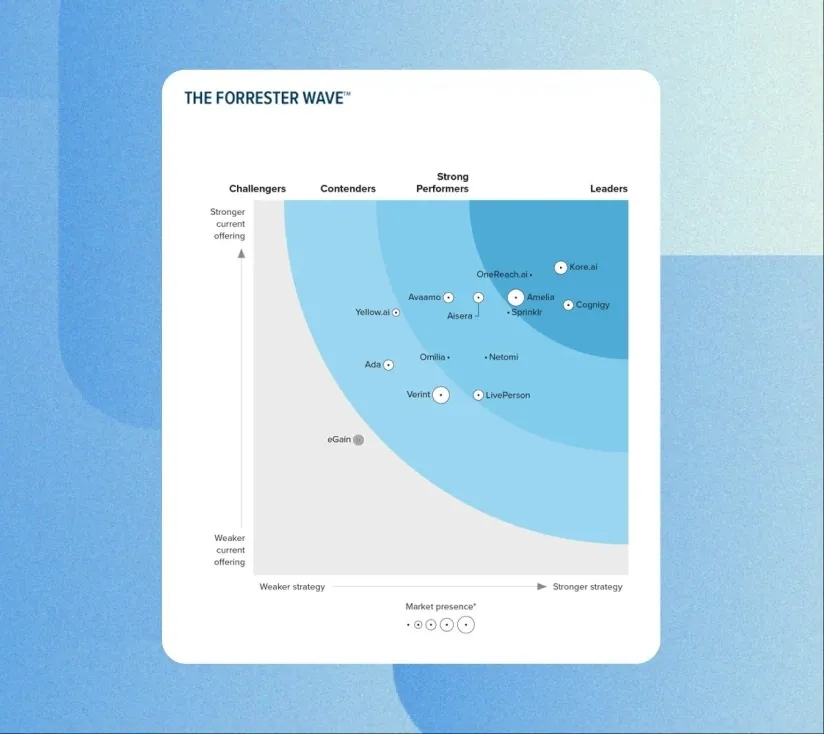
Read these reports in depth here:
- Gartner: Magic Quadrant for Conversational AI Platform
- Forrester Wave: Conversational AI Platforms for Employee Services Q3 2026
Why did we build Agent Blueprint Language?
ABL didn't start as a plan to design a new language. It started with a decade of enterprise deployments across regulated and unregulated industries, and the same problem showing up in every one of them: agent logic scattered across prompts, code, orchestration frameworks, and connectors, with every team building it differently. That's agent sprawl, and it turns into architectural debt fast, logic nobody can reuse, audit, or govern consistently.
The harder problem was the abstraction itself. Low-code and no-code tools are built for humans clicking through a canvas. Pro-code is machine-readable, but it forces an AI system to generate hundreds of lines of orchestration and infrastructure glue just to stand up one agent. We needed a layer high-level enough to hide that infrastructure, and structured enough for AI to generate reliably. That's the real reason ABL exists as a language and not just a schema, and it's what makes Arch AI possible: it takes a business requirement, decides the architecture, and generates a compact ABL definition instead of improvising a system from scratch every time.
So we rebuilt from the language up. ABL wasn't added to an existing platform, it was built for AI from the start: agent behavior defined in a structured language, validated at compile time, governed by constraints the model cannot override, and separated from the infrastructure underneath it. Scaling agentic AI needed a new layer between probabilistic reasoning and production software, one AI can program, humans can review, a compiler can validate, and the runtime can govern.
How the ABL compilation pipeline eliminates production risk before a single customer is affected
Most AI platforms take an agent definition and run it. ABL compiles it first. That distinction ensures the agent that is tested, reviewed, and approved is the same agent that runs in production.
Before a single customer interaction takes place, the compiler checks every tool reference, every handoff target, every guardrail definition. Schema violations, missing references, broken handoffs, and type mismatches are all caught before deployment, not during a live customer interaction.
The compiled output is an immutable Intermediate Representation (IR): versioned, Git-native, and promotable through dev, staging, pilot, and production. The same IR runs in every environment, unchanged from dev through production.
In-flight sessions are protected automatically. Redeploying an updated agent does not affect conversations already in progress. Existing sessions complete on the original IR. New sessions pick up the updated version. No customer experiences a behavior change mid-conversation because of a deployment
The compiled artifact fits cleanly into existing CI/CD pipelines, reviewable in pull requests like any other code change. Every guardrail modification produces a visible, auditable diff. Broken agents are blocked from reaching any environment because the compiler stops them first.
How ABL enforces enterprise AI governance at the runtime layer, not the prompt layer
In ABL, constraints and guardrails are compiled into the runtime artifact. They execute beneath the model. Every constraint runs regardless of what the model reasons, immune to a misread instruction or a crafted input designed to bypass it.
The difference may sound subtle, but it fundamentally changes the trust model. In prompt-based systems, governance depends on the model correctly interpreting instructions. In ABL, governance exists independently of the model. Policies are enforced by the runtime itself, regardless of how the model reasons.
When a constraint fires, the runtime blocks the action and generates a timestamped trace event tied to the specific policy. A first-class output of every interaction, not a log you search retroactively.
"The question every enterprise is asking is how to move AI from pilot to production without creating compliance exposure. What stood out about Kore.ai is that governance is architectural, not an afterthought. That is what it takes to get AI approved for the work that actually matters." - Arunkumar Ramakrishnan, Director of Enterprise Technology, Blue Cross Blue Shield of Massachusetts
How ABL Delivers Both Autonomous Reasoning and Deterministic Control Inside a Single Agent Definition
One of the most persistent misconceptions in enterprise AI is that you must choose. Either agents reason freely and you accept unpredictability, or you lock everything down and lose the flexibility that made AI useful.
ABL was designed to dissolve that tradeoff entirely.
This is what makes Artemis's Dual-brain architecture possible. One brain reasons. The other enforces. But that separation only works because ABL gives you the language constructs to declare exactly where each brain takes over, inside a single agent definition.
The FLOW construct lets teams define step-by-step execution paths where each step is explicitly designated as reasoning-based or deterministic. A single agent can reason conversationally in one step and apply a compiled business rule in the next, all within one definition.
The GATHER construct handles moments where data must be collected precisely: account numbers, policy IDs, transaction amounts. Fields are validated before the workflow continues. Data integrity does not depend on the model.
The boundary between "let AI reason" and "enforce this exactly" is declared by the author, not guessed by the model at runtime. ABL is what makes that boundary real.
"Compiled blueprints, governance in a separate deterministic layer, and one language for every agent are the design choices enterprise AI has been missing." - Keyur Parikh, Head of Workplace Technology Strategies and Services, Vanguard
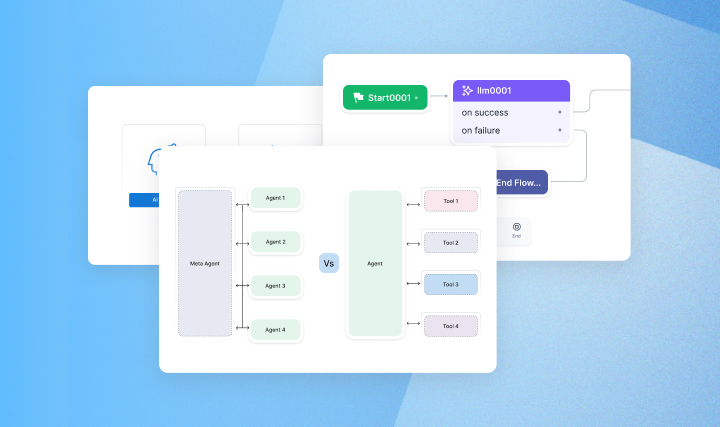
How ABL makes multi-agent orchestration a built-in language primitive
Real enterprise workflows are not single-agent problems. A claims triage process needs routing to a specialist. A fraud check needs parallel processing. A high-value transaction needs human review before execution.
In most frameworks, all of that coordination is custom-built per project, differently every time, with no consistent governance. In ABL, four orchestration primitives are part of the language itself.
DELEGATE sends a sub-task to a specialist and returns a typed result to the parent, which retains conversation ownership throughout. HANDOFF transfers the full conversation with context preserved and cycle detection built in. FAN-OUT dispatches work to multiple agents simultaneously, eliminating serial latency and producing 40 to 80 percent reductions in token consumption in complex deployments. ESCALATE is a compiled, deterministic policy routing to a human agent when defined conditions are met. Not a suggestion. A constraint the agent cannot skip.
These are guaranteed behaviors compiled into every deployment, not patterns rebuilt per project.
How ABL makes every enterprise AI agent decision traceable, testable, and fully reconstructable
Deploying an AI agent without systematic testing is a bet. ABL replaces that bet with evidence.
The evaluation framework uses a Persona x Scenario x Evaluator matrix. No agent reaches production without validation against an established behavioral baseline. Regression detection flags any degradation with the exact evaluator, persona, scenario, and score delta. CI/CD integration blocks deployments automatically the moment a regression is detected.
Spatial Trace Intelligence, a novel Kore.ai capability, creates vector-based representations of every execution path and generates confidence scores across versions. The answer to "will this behave the same way after the update?" becomes a number, not a judgment call.
The runtime captures more than 200 trace events per session: reasoning traces (every LLM call and tool result), decision records (every constraint check and guardrail evaluation), and a context audit trail (what each engine was working with at every decision point). Every agent decision is fully reconstructable for compliance review.
The three paths for building with ABL, all producing the same compiled and governed output
ABL was deliberately designed so that every type of builder can work with it without compromising the output. Three paths exist, and all three produce the same compiled, governed ABL artifact.
- Arch AI, Kore.ai's AI Architect: A business analyst describes what the agent needs to do in plain language. Arch AI builds the entire definition, selects the right orchestration patterns, and determines what should be deterministic versus reasoning-based. No ABL syntax required. No manual configuration. A production-ready artifact from a conversation.
- Studio IDE: A purpose-built code editor with syntax highlighting, autocomplete, and compile-time validation for engineering teams who prefer direct authoring. Every change is validated before it leaves the editor.
- External coding assistants: For teams already working in AI-native development environments, ABL can be generated through Claude Code, Cursor, and Codex via MCP integration. The same governance and compilation apply regardless of where the code originates.
The path does not matter. What matters is that every path ends in the same place: a compiled, versioned, governed artifact that behaves identically across every environment it runs in. No drift between how it was built and how it deploys.
What ABL delivers in production: Measured results from real enterprise AI deployments
Most AI platforms optimize for model performance. ABL optimizes for system performance. The difference shows up directly in production costs, infrastructure footprint, and operational reliability.
Two architectural decisions drive most of the gains. First, ABL's compiled Intermediate Representation eliminates the framework scaffolding overhead that conventional architectures carry into every deployment. There is no runtime interpretation, no redundant orchestration layer, no scaffolding rebuilt per project. The compiled artifact runs lean by design. Second, ABL's per-operation model routing means every individual step in an agent workflow runs on the right model for that step, not the most capable model available. Simple tasks run on fast inexpensive models. Complex reasoning steps run on capable models. Arch AI identifies which is which automatically, without manual configuration.
In multi-agent deployments, the FAN-OUT primitive dispatches work to multiple agents simultaneously rather than sequentially. That single architectural choice eliminates serial latency across parallel agent calls, which is where token consumption compounds fastest in complex workflows.
The results across early enterprise deployments:
- 40 to 80% reduction in token consumption in complex multi-agent deployments, by eliminating serial latency across parallel agent calls through FAN-OUT
- 40 to 65% reduction in LLM spend through per-operation model routing: a fast inexpensive model for simple tasks, a capable model for complex reasoning
- 80% or greater reduction in infrastructure footprint versus conventional architectures, because ABL's compiled IR eliminates framework scaffolding overhead entirely
- 60% latency reduction and 80% cost reduction on specific operations where Arch AI identifies fast models can replace reasoning models with no quality loss
- Zero mid-conversation behavior changes on redeployment. In-flight sessions always complete on the original compiled IR. No customer experiences a behavior change mid-conversation because of a deployment
These are not projected improvements. They are outcomes from enterprises already running ABL in production.
Enterprise AI has been assembled from parts for long enough. ABL is the foundation it was always missing.
Every approach before ABL had the same structural problem. Governance lived where the model could reach it. Orchestration was rebuilt from scratch on every project. ABL changes the starting point: compiled constraints beneath the model, orchestration primitives built into the language, one definition covering everything an agent is and does.
The question for your organization is not whether your current approach works for what you have built so far. The question is whether it was designed for what comes next: regulated workflows, real compliance obligations, and a scale of deployment where governance debt from every prior project eventually has to be settled.
Every generation of software eventually develops the abstractions required to scale. Enterprise AI is approaching the same inflection point.
Agent Blueprint Language represents our belief that AI agents should be defined, governed, and operated as software systems rather than collections of prompts. As enterprises move from experimentation to production, that distinction will matter more than any individual model.
We built ABL because enterprise AI needs a foundation. This is ours.
FAQs
Q1. Do my engineers need to learn ABL syntax to use it?
No. There are three ways to build with ABL, and only one requires writing ABL directly. Arch AI generates complete, validated ABL definitions from plain-language descriptions of the use case. Studio IDE provides a code editor with syntax highlighting and autocomplete for engineers who prefer direct authoring. Claude Code, Cursor, and Codex can generate ABL via MCP integration. All three paths produce the same compiled, governed output. Most enterprise teams start with Arch AI and never write ABL by hand.
Q2. How is ABL different from just writing agents in Python or LangChain?
You can build agents in Python, and many teams do. The problem is that every team builds them differently, governance gets added after the fact, and there is no standard way to validate, version, or audit agent behavior across a growing estate. ABL is not a replacement for Python in general. It is the right abstraction for the specific problem of defining, governing, and operating AI agents at enterprise scale. The same way React was not a replacement for JavaScript, but was the right tool for building complex web UIs that could be maintained, tested, and scaled.
Q3. What actually happens when a guardrail or constraint is violated?
The runtime blocks the action immediately and generates a structured trace event. That event is timestamped, tied to the specific policy that triggered it, and available for audit without any manual log searching. It is not a warning in a log file. It is a first-class output of every agent interaction, surfaced to compliance teams in real time.
Q4. Can ABL-built agents work with our existing AI models and infrastructure?
Yes. ABL is model-agnostic and infrastructure-agnostic. The platform supports 178 AI models across 15 providers including OpenAI, Anthropic, NVIDIA, Cohere, and LLaMA 2, with model selection configurable per agent and per individual operation. Deployment options cover SaaS on AWS, Azure, or GCP; private cloud in your own VPC; and fully air-gapped on-premises Kubernetes for sovereign and regulated environments. Agents connect to existing enterprise systems through HTTP, MCP, AWS Lambda, A2A protocol, OpenAPI definitions, and webhooks.
Q5. How does ABL fit into our existing CI/CD and DevOps workflows?
Cleanly. The compiled ABL artifact is a Git-native YAML file, stored in version control, promotable through dev, staging, pilot, and production via standard pipelines. It is reviewable in pull requests like any other code change. Every guardrail modification produces an auditable diff. CI/CD integration means the pipeline can automatically block a deployment when regression detection flags a quality drop, no manual gate required.
Q6. How does a compliance team interact with ABL?
A compliance officer can read an ABL definition the same way they read a policy document. Every constraint, guardrail, and escalation condition is explicitly declared in the YAML file, not buried inside model instructions or custom code. Every policy decision the agent makes at runtime generates a structured, timestamped trace event. Compliance teams get a readable definition of what the agent is supposed to do, and a complete audit trail proving what it actually did, for every single interaction.