Build governed AI agents: Introducing Arch AI
Last Updated
October 19, 2026

Juhi Tiwari
Read Time
Summary
Arch AI is Kore.ai’s AI solution architect for building governed enterprise AI agents. It transforms business requirements and SOPs into agent architectures, then supports development, testing, deployment, and continuous improvement. The article highlights Agent Blueprint Language (ABL), AI agent governance, runtime guardrails, observability, auditability, evaluation, and human approval, helping organizations scale agentic AI across industries while maintaining control over agent behavior and production operations.
What’s on this page
Building an AI agent has never been easier. Trusting one has never been harder.
Today, anyone can prompt their way to a demo. Getting an agent system that holds up in production is a different problem: the right agents, the right handoffs, the right rules, behavior you can account for after the fact. That takes architectural experience; most teams can't staff for every project, so most teams either skip the rigor and hope, or slow every project down to compensate.
We built Arch AI so you never have to make that choice.
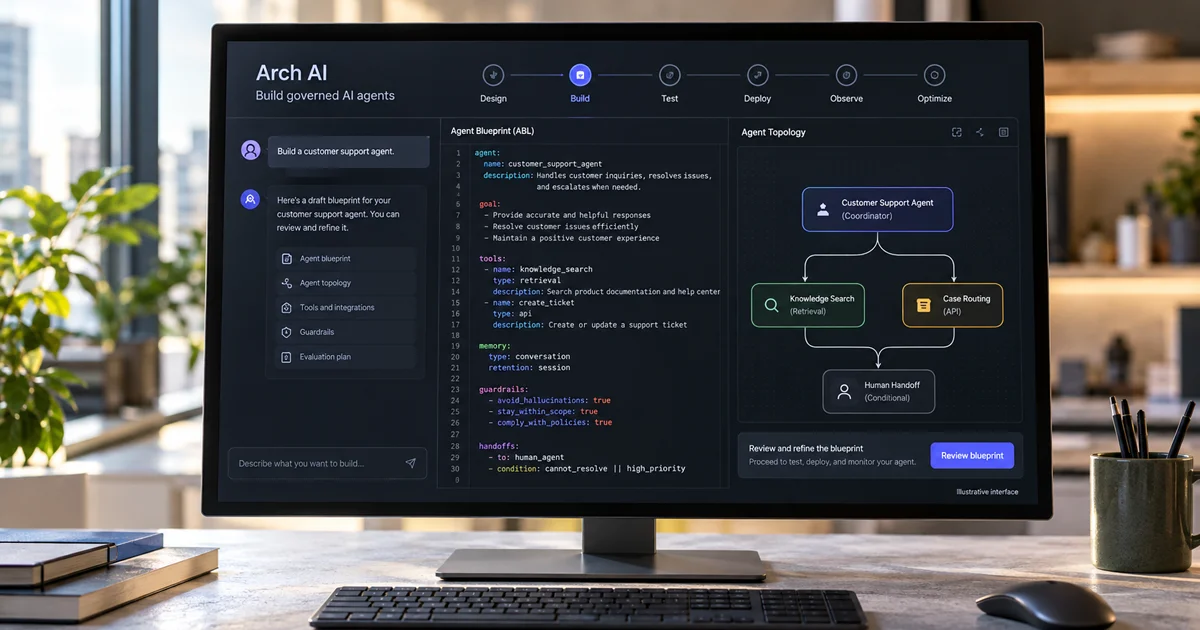
Arch AI is the AI solution architect inside the Kore.ai Agent Platform {Artemis}. Describe the workflow you want to automate in plain business language, and Arch AI designs the AI agent system, builds it, tests it against realistic scenarios, deploys it, and keeps improving it based on real usage. Think of it as a senior AI architect embedded in your platform, available to every team on every project at every step!
And speed never comes at the cost of control. Everything Arch AI builds is defined in Agent Blueprint Language (ABL), a formal written definition of exactly how each agent must behave, so every agent is governed by design and auditable from day one. Not chatbots held together by prompts. The result: production-ready AI agents in days, not months.
Read more: ABL - Agent Blueprint Language (world's first compiled, declarative language built by Kore.ai specifically for enterprise AI agents, and the foundation of {Artemis})
Arch AI isn't a customer support tool that happens to work elsewhere. Arch AI ships with proven starting points for banking, healthcare, telecom, and retail, plus internal functions like IT and HR, so whether you're automating claims processing, patient intake, network support, or employee onboarding, you're building on patterns already tested in your industry, not starting from a blank page.
Here's how it works: Watch below: Prasanna Arikala, CTO and Head of Products, demonstrate Arch AI)
How it works: describe, design, deploy
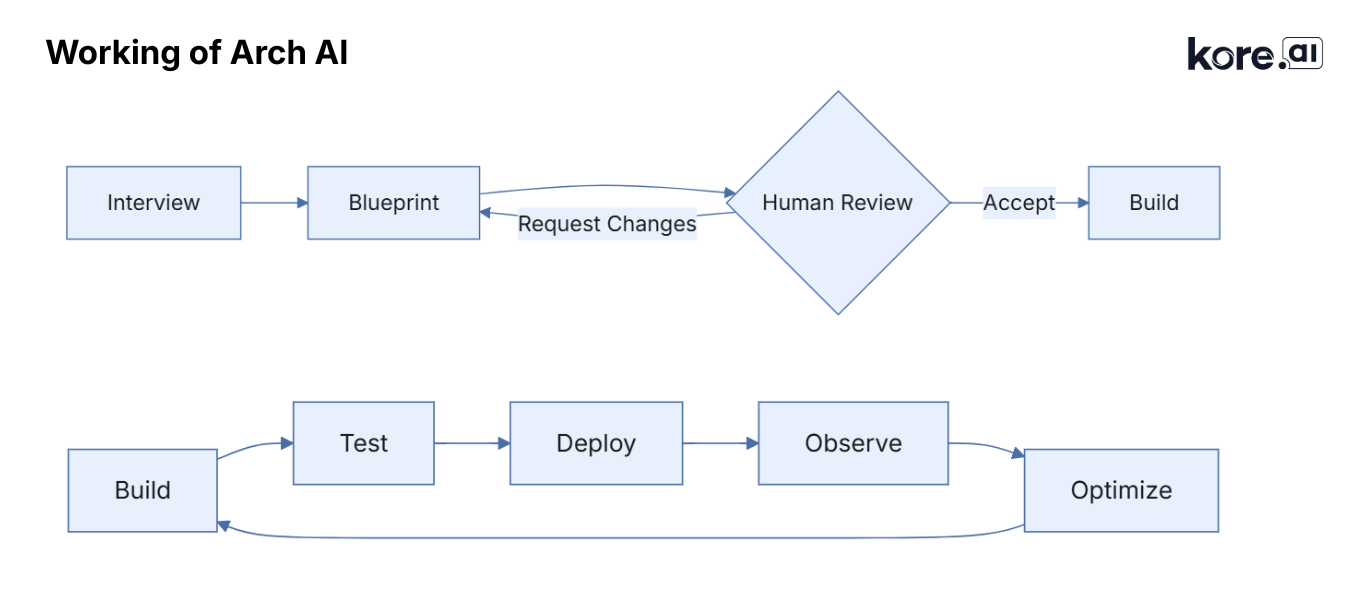
- You describe: Start a project and type something like "automate customer support for our online store." Arch AI interviews you the way a good consultant would. Which channels do your customers use? Which scenarios matter most: order tracking, refunds, escalation to a human? Want to add coupon queries midway? Just say so. Already have a standard operating procedure? Upload it, and Arch AI designs from that.
- Arch AI designs: Drawing on built-in template architectures and domain specialists, Arch AI recommends a proven design instead of improvising one. It presents the blueprint: which agents, how they hand off work, which rules apply. You review, adjust, and approve. Nothing gets built without your sign-off.
- Arch AI builds and deploys: Once you approve, Arch AI writes the agents and gets them ready to run. In a recent walkthrough, a shop assistant made up of five coordinated agents went from first description to working project in minutes. Real time, no code. For a voice application, you can pick up the phone and call it.
The bigger shift: your domain experts, the people who actually understand the process, now build directly. Your engineers stop being the bottleneck for every request.
Governance: every agent is validated, controlled, and explainable
Every agent Arch AI just built is compiled in ABL (Agent Blueprint Language) rather than assembled from prompts, which means its behavior is formally written down: what it can do, what it can't, which rules it follows, what data it can access. That definition is reviewable, versioned, and auditable, like any other business document. Not a black box.
This is the part most agent-building tools can't clear, and it's the reason security and governance is the #1 blocker to enterprise AI adoption, cited by 40% of enterprises in Forrester research. In Kore.ai's 2026 Agent Productivity Index, a survey of 400+ IT and engineering leaders already running AI agents in production, 72% said the agents in their organization today carry unmanaged financial or compliance risk, and 82% reported agents autonomously executing consequential actions in production without sufficient human oversight. That's because their behavior depends on how a model interprets a prompt at runtime, not on anything written down and enforced. In regulated industries, "usually compliant" isn't compliance.
ABL is what gives Arch AI agents three guarantees prompt-built agents can't make:
- Validated before launch: Every agent is checked for broken logic and gaps before going live. 100% of agents validated before deployment, so problems are caught by your team, never by your customers.
- Controlled at runtime: Agents follow the rules, permissions, and escalation paths you define, enforced by the platform. Zero unauthorized agent actions.
- Explainable, always: Every decision is traceable: what the agent did, why, which rule fired, what data it used. That matters most exactly where most enterprises fall short today: In our survey - 70% couldn't identify which agent caused a failure in a multi-agent environment. "The AI decided" is not an answer you can give a regulator or your board. With Arch AI-built agents, you always have the real answer.
One more advantage of ABL: precision. Anyone who has generated an AI image knows the frustration of a result that's 90% right, where fixing one detail means regenerating and hoping. Arch-built agents don't have that problem. You can change one policy or one handoff rule without touching anything else.
Where does your program stand right now?
Before you read further, a quick gut check. Score yourself on these four: (select all that apply)
Four "yes" answers means you're closer to being governed than most. Two or fewer, and the gap between "we have agents" and "we can trust our agents" is probably costing you time on every project, not just the risky ones.
After launch: Arch AI tells you what to fix, and why it will work
Most AI investments degrade quietly. Customers change, products change, models change. Arch AI treats launch as the midpoint, not the finish line.
In production, every interaction with your agents is automatically scored for accuracy, quality, and compliance. Not the 5-15% sample traditional quality management gives you. All of it.
Arch AI reviews that data continuously and surfaces specific, outcome-tied recommendations. Not "engagement is down." More like: "Escalation rate for billing is above threshold. Here's a routing change that could reduce it by 15%." Every recommendation requires your approval before it's applied.
Want proof before committing? Run agent versions against each other and measure the impact on the metrics your business runs on: CSAT, resolution rate, handle time, escalation rate. Changes ship because the evidence says they work.
Leadership sees all of it in business terms: resolution rates, cost per interaction, customer satisfaction, time saved, ROI. Numbers you can take to the board, not server uptime.
What you gain with Arch AI
- Speed: Idea to working agent in days. Kore.ai customers see up to 5x faster time to value.
- Independence from scarce talent: The architect's expertise is built into the platform, so you scale AI across the organization without scaling your hiring plan at the same rate.
- One standard instead of sprawl: When one team builds a successful workflow through Arch, it becomes a reusable template for every team. And whether agents are built by business users through Arch AI or by developers in code, everything lands in the same governed format.
The bottom line
The question is no longer whether AI agents create value. It's whether you can build them fast enough, trust them in real workflows, and keep them improving long enough for the value to show up on the P&L.
Arch AI is how you get all three from one platform: AI that designs, builds, governs, and improves your AI.
Bring a real use case to an Arch AI walkthrough. Describing it is most of the work.
You can connect with us here - Schedule some time!
FAQ
Q1. What is Arch AI?
Arch AI is the AI solution architect built into the Kore.ai Agent Platform. It turns a plain-language description of a business workflow into a complete, governed AI agent system, then tests, deploys, and continuously improves it.
Q2. Do I need technical skills to use Arch?
No. You describe your use case in plain business language, and Arch AI handles the architecture, build, and testing. Developers can still work in code if they prefer; every path produces the same governed format.
Q3. How is Arch AI different from other AI agent builders?
Most tools generate prompt-based chatbots. Arch AI generates agents defined in Agent Blueprint Language (ABL), which means every agent is validated before deployment, governed at runtime, fully auditable, and editable at any level of detail. Arch AI also stays engaged after launch, monitoring performance and recommending specific improvements.
Q4. How fast can we get an AI agent into production with Arch?
Production-ready agents typically take days rather than months. In a recorded walkthrough, a five-agent customer support system went from description to working project in minutes.
Q5. Is Arch AI suitable for regulated industries?
Yes. Every Arch-built agent has formally defined, auditable behavior, 100% pre-deployment validation, runtime policy enforcement, and full decision traceability, which is what legal, risk, and compliance teams require.
Share
Tags