Kore.ai Named a Leader in the 2026 Gartner® Magic Quadrant™ for Conversational AI Platforms
Last Updated
August 13, 2026

Abhijit Mhetre
Read Time
Summary
The conversational AI market is moving rapidly toward agentic AI, multimodal experiences, stronger governance, and enterprise-wide orchestration. This blog examines those changes through the 2026 Gartner® Magic Quadrant™ for Conversational AI Platforms, where Kore.ai was named a Leader for the fourth consecutive time, and explores what buyers should prioritize as the market matures, including scalability, governance, cost transparency, observability, and vendor stability.
What’s on this page
Agentic AI, multimodal experiences, market consolidation, new pricing models: a handful of powerful forces are reshaping how enterprises buy, deploy, and govern conversational AI. As the market grows more complex, buyers increasingly turn to trusted evaluations like the Gartner Magic Quadrant to cut through the noise and understand where vendors truly stand.
In the just-published 2026 Gartner Magic Quadrant for Conversational AI Platforms, Kore.ai has been named a Leader for the fourth time, recognized in every edition since Gartner first published the report in 2022.
That consistency matters, because this year's report captures a market in flux. In the last four years, we’ve seen new vendors enter the quadrant, established names shift positions (some dramatically), and a few are dropped from the evaluation altogether. Through all of that shift and churn, Kore.ai's position as a Leader has not wavered.
We believe this recognition, alongside our results in the companion Critical Capabilities for Conversational AI Platforms report, where Kore.ai received the highest score in the Enterprisewide Conversational AI Agents use case (3.96/5), reflects our consistency in innovation, our understanding of where enterprises are headed, and our ability to deliver in a market that refuses to stand still.
Below, we share where Gartner sees the market heading, and why we believe Kore.ai continues to lead it.
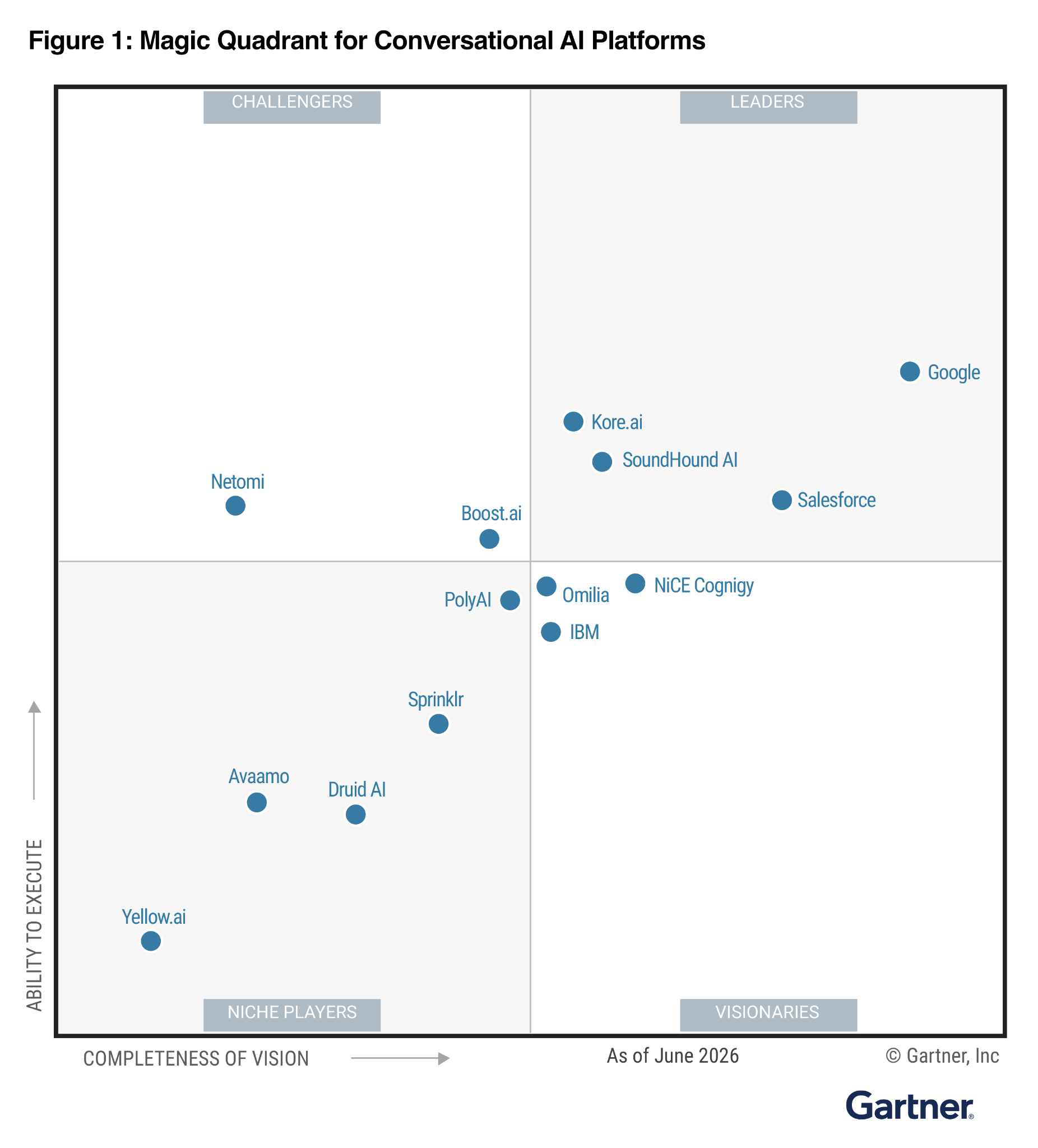
Read Full report here.
How Gartner defines the conversational AI platform market
Gartner defines conversational AI platforms (CAIPs) as platforms used primarily to develop applications that simulate human conversation across multiple channels and modalities, spanning text, voice, and visual content, by combining classic NLP with generative AI and agentic AI architectures. Unlike AI engineering environments aimed at data scientists, CAIPs are purpose-built for broad enterprise adoption, giving business users and citizen developers a unified, governed environment for building both customer-facing and employee-facing applications.
The bar for inclusion is meaningfully high. Gartner's mandatory feature set now spans multichannel connectivity, conversational flow building with agentic AI planning, tool integration (including MCP-based approaches), RAG enablement, AI guardrails, analytics, and QA and observability tooling. This is no longer a market for point solutions. It is a market for platforms that can carry the full lifecycle of enterprise conversational AI.
What the MQ 2026 report tells us where the market is headed
Beyond vendor positioning, this year's Magic Quadrant offers a clear-eyed view of a market in transition. A few observations stand out to us:
The shift to agentic AI is now structural, not experimental. Gartner notes a decisive move from traditional workflow automation toward agentic approaches, including adoption of AI agent communication protocols such as MCP and A2A. Conversational applications are becoming systems of collaborating agents, which raises the stakes for orchestration, governance, and observability.
Multimodality is maturing fast. Conversational experiences are extending beyond text and voice into image and video, rendered contextually across channels, sometimes in real time. Gartner also observes that the reliability of these capabilities still varies widely across vendors, which makes rigorous evaluation essential.
Self-building and self-learning capabilities are emerging. Some platforms can now autonomously build, maintain, and test conversational applications, with GenAI-assisted coding and AI-driven analytics extending the self-learning value proposition.
M&A is reshaping the vendor landscape. The report highlights accelerated merger and acquisition activity, which can strengthen product suites but also introduces uncertainty around roadmaps, service continuity, and long-term vendor viability. Gartner advises buyers to proactively manage vendor contracts and build contingency plans.
Governance and cost optimization are now board-level concerns. Buyers are placing greater emphasis on robust, multilayered AI guardrails rather than ad hoc, prompt-level controls, especially in multiagent deployments. At the same time, uncertainty around cost escalation remains a significant concern, elevating the importance of FinOps tooling and transparent pricing.
The market is entering early maturity, and positions are volatile. With hyperscalers among the Leaders and consolidation accelerating, Gartner observes that differentiation is shifting from product innovation alone to operational sustenance, pricing, and scale. This year's quadrant saw vendors rise, fall, debut, and exit.
“In a market where placements can change dramatically year over year, we believe sustained leadership, not a single strong showing, is the truest signal of a vendor's durability.” ~ Abhijit Mhetre, EVP and Head of Corporate Marketing.
Why we believe Kore.ai is positioned as a Leader
According to Gartner, Leaders demonstrate a strong balance of effective execution and a well-defined vision, provide robust and feature-rich platforms trusted by a wide range of customers, and consistently invest in innovation while remaining agile as requirements evolve. Doing that once is an achievement. Doing it in every edition of the report, four consecutive years through the chatbot era, the GenAI wave, and now the shift to agentic AI, is what we believe distinguishes Kore.ai. Three themes from this year's report stand out:
1. Consistent, ambitious innovation
Gartner recognized Kore.ai's product innovation as a strength, noting our higher level of R&D staffing compared with most evaluated peers and describing our OS for AI Agents concept as both visionary and ambitious. The report also calls out distinctive builder tools that set Kore.ai apart, including Arch, our reasoning-based agent, and Agent Blueprint Language (ABL), our proprietary domain-specific language for creating agents.
Independent industry coverage reached the same conclusion. In its rundown of the 2026 Magic Quadrant, CX Today noted that Kore.ai retains its Leader placement and "continues to earn it through product innovation," pointing to our standout R&D investment and observing that proprietary tools like Arch and ABL give builders something genuinely distinct from the standard low-code experience found elsewhere in the market.
This is not innovation for its own sake. Our roadmap items cited in the report, including a centralized governance console with adaptive guardrails, real-time voice coaching overlays, and predictive analytics that forecast AI agent performance degradation before it impacts users, map directly to the governance, observability, and reliability challenges Gartner identifies as defining this next phase of the market.
2. Enterprise-grade delivery and service
Recognition as a Leader is not just about vision; it is about the ability to execute. Gartner noted that Kore.ai's SLA agreements are more closely aligned with enterprise requirements than those of other vendors in the research, supported by numerous, well-distributed implementation and service partners across North America and Europe, and structured, comprehensive professional services.
The report also highlights our operational scalability: Kore.ai is one of the largest vendors in this Magic Quadrant by organizational size and capacity, with well-developed employee growth and education programs, increasing the likelihood that clients receive consistent service delivery and access to skilled personnel. Kore.ai serves over 500 enterprise customers globally. CX Today's analysis singled out service delivery as a core Kore.ai strength as well, observing that enterprise-aligned SLAs and a wide implementation partner network give the company credibility that extends beyond the product itself.
3. Market understanding, validated by use-case performance
The companion Critical Capabilities report puts capability claims to the test across four enterprise use cases. Kore.ai's results speak to the breadth and depth of the Agent Platform:
- Enterprisewide Conversational AI Agents: 3.96 out of 5, the highest score among all 14 vendors evaluated. We see this as especially meaningful, because it is the use case most representative of where the market is going: AI agents automating tasks and processes with varying autonomy, integrating across systems, and leveraging agentic planning and execution.
- Employee Assistance: 3.90, second highest among evaluated vendors.
- Customer Self-Service: 3.87, second highest among evaluated vendors.
- Domain-Specific: 3.87, tied for the highest score.
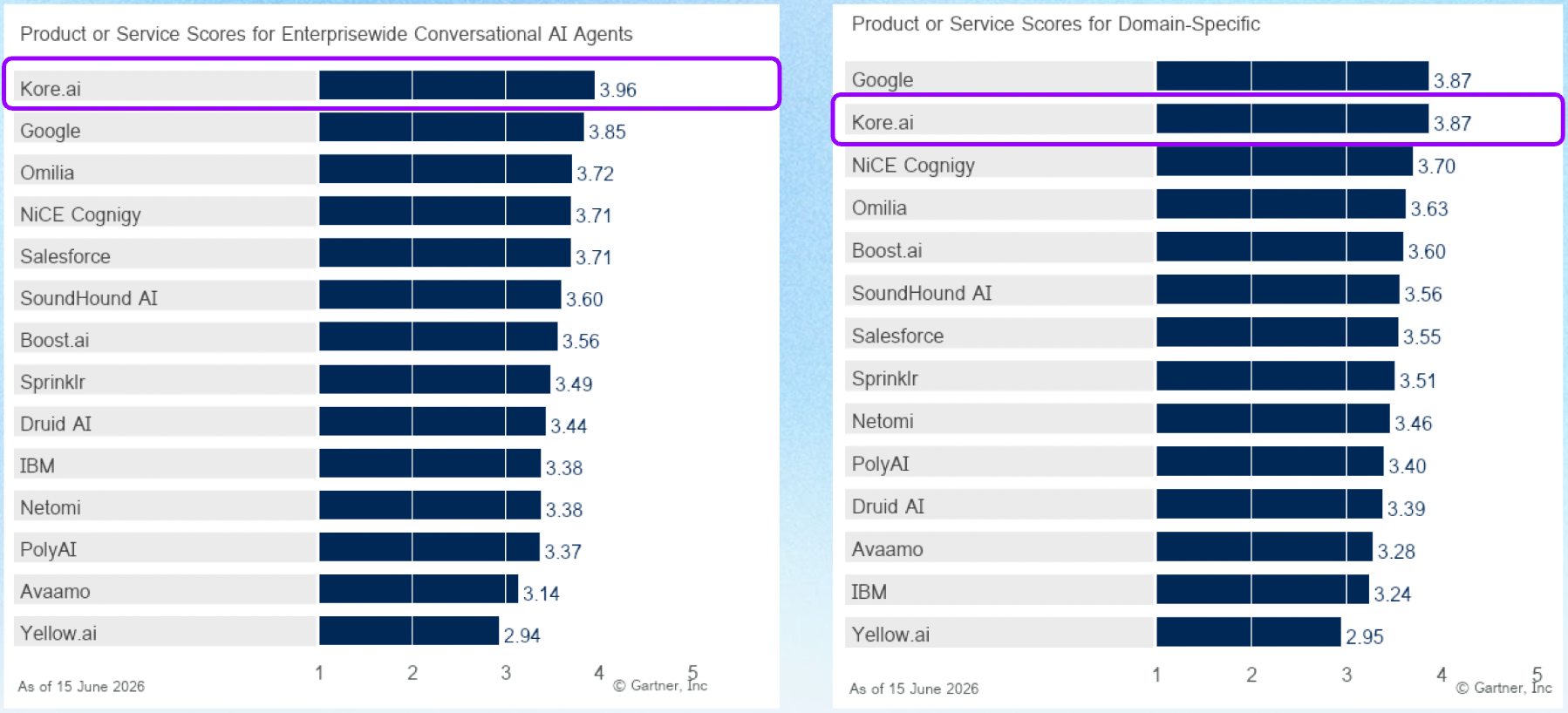
Source: Gartner Critical Capabilities for Conversational AI Platforms, July 2026
Underneath those use-case scores, the Critical Capabilities report rated Kore.ai highly on the individual capabilities enterprises care most about, including GenAI Enablement (4.6), Infrastructure (4.5), Analytics (4.1, the highest rating among all evaluated vendors), AI TRiSM and Governance (4.0), and AI Assistant Orchestration (4.0). The report specifically highlighted our event-based streaming architecture for real-time conversation analytics and the breadth of proprietary, third-party, and open-source LLM options the Agent Platform supports.
Gartner does not endorse any vendor, product or service depicted in its research publications, and does not advise technology users to select only those vendors with the highest ratings or other designation. Gartner research publications consist of the opinions of Gartner's research organization and should not be construed as statements of fact. Gartner disclaims all warranties, expressed or implied, with respect to this research, including any warranties of merchantability or fitness for a particular purpose.
The Kore.ai approach: an agent platform built for the enterprise
Enterprise customers are looking to put advanced AI to work: elevating customer service, transforming workplace operations and streamlining business processes. Kore.ai enables this through the Kore.ai Agent Platform Artemis, spanning customer service, employee productivity, and process automation, with dedicated solutions for CX, EX and specific domains. The Agent Management Platform (now part of Artemis) allows enterprises to manage and govern AI agents, whether built on Kore.ai or on other platforms, reflecting our conviction that the future is heterogeneous and that governance must extend across the entire agent estate.
What continues to set Kore.ai apart is our model-agnostic, cloud-agnostic, and infrastructure-agnostic approach. Enterprises get the full spectrum of development options (no-code, low-code, GenAI-assisted, and pro-code), along with the guardrails, analytics, and orchestration needed to move from experimentation to enterprise-wide scale with confidence.
"Enterprise AI is entering its third wave, where governance, observability, and trust define success at scale. Every wave has raised the bar for what an enterprise platform must prove, and our pace of innovation has cleared it each time. The companies that scale AI will be the ones using AI to build, govern, and improve AI on a single layer. That is the architecture this market is moving to, and it is the one we've built." ~ " Raj Koneru, Founder and CEO of Kore.ai.
Key considerations for buyers in 2026
Drawing on the report's guidance, we'd encourage application leaders evaluating CAIPs to:
- Prioritize scalability and flexibility. Look for flexible model and tool choices, smart composition of AI techniques, robust governance, and advanced analytics as out-of-the-box features.
- Scrutinize governance depth. Favor multilayered, policy-driven guardrails over ad hoc, prompt-embedded controls, particularly for multiagent deployments.
- Demand cost transparency. Rigorously evaluate cost structures, FinOps capabilities, and optimization practices to avoid unexpected escalation.
- Plan for vendor volatility. With M&A accelerating, assess vendor stability and build contingency plans to protect operational continuity.
Way forward
The conversational AI platform market is consolidating, maturing, and moving decisively toward agentic AI. In a landscape where differentiation increasingly depends on the ability to execute at scale, not just demo well, we believe four consecutive years as a Leader validates the path we've been on since the market's earliest days: building an open, governed, enterprise-grade platform for the agentic era.
Ready to see what a Leader's platform can do for your enterprise?
Read the full Gartner Magic Quadrant on Conversational AI Platforms Report
Gartner, Magic Quadrant for Conversational AI Platforms, Gabriele Rigon, Justin Tung, Arup Roy, Adrian Lee, Uma Challa, 7 July 2026. Gartner, Critical Capabilities for Conversational AI Platforms, Justin Tung, Uma Challa, Adrian Lee, Gabriele Rigon, Arup Roy, 7 July 2026.
GARTNER is a registered trademark and service mark of Gartner, Inc. and/or its affiliates in the U.S. and internationally, and MAGIC QUADRANT is a registered trademark of Gartner, Inc. and/or its affiliates and are used herein with permission. All rights reserved.
Gartner does not endorse any vendor, product or service depicted in its research publications, and does not advise technology users to select only those vendors with the highest ratings or other designation. Gartner research publications consist of the opinions of Gartner's research organization and should not be construed as statements of fact. Gartner disclaims all warranties, expressed or implied, with respect to this research, including any warranties of merchantability or fitness for a particular purpose. GARTNER is a registered trademark and service mark of Gartner, Inc. and/or its affiliates in the U.S. and internationally, and MAGIC QUADRANT is a registered trademark of Gartner, Inc. and/or its affiliates and are used herein with permission. All rights reserved.
Share