





.webp)
AI has fundamentally reset what enterprise leaders expect from their workforce. With enterprise licenses, infrastructure, and token costs surging, the demand for measurable productivity gains has never been higher.
But if you look closely at the office floor, employees aren’t suddenly moving twice as fast; in fact, they are stretched more than before. Research has found that 96% of C-suite leaders expect AI to boost productivity, yet 77% of employees using AI say it has actually added to their workload instead.
That gap between expectation and experience usually comes down to how AI actually gets introduced into the workplace. Most enterprises hand employees an AI tool without fixing the data it needs, the workflow it sits inside, the governance around it, or the skills to use it well — in other words, they implement AI loosely, layering it onto an unprepared organization instead of integrating it into a ready one.
Loose implementation like this cancels out the productivity gain they were funded to deliver. In this guide, we'll break down the seven genuine roadblocks turning enterprise AI into a workplace drag instead of a productivity engine. Key obstacles include:
- Poor data quality and legacy system fragmentation
- Workflows bolted on, not redesigned
- Shelved AI pilots and unclear ROI
- Weak AI governance and growing risk exposure
- Employee distrust and low adoption
- AI literacy and skills gaps
- Shadow AI use
Challenge 1 - Poor data quality and legacy system fragmentation
The problem: AI can't answer a simple question because the systems behind it were never built to talk to each other.
Even well-designed workplace AI use cases run into a wall the moment they touch existing systems. Most enterprise HR, IT, and finance data was never centralized — it's spread across a decade of point solutions, each built to run its own function, not to share data with anything else.
A recent survey found that 4 in 5 enterprises struggle to integrate AI, citing data quality and IT infrastructure problems as top concerns.
This shows up clearly in HR and IT service management. If an employee asks an AI assistant, "What's my remaining PTO, and can I expense this conference?" the assistant often can't answer — not because the model is weak, but because the PTO balance lives in one system and the expense policy in another, with no integration connecting the two.
The solution: Build the integration layer first, then clean the data flowing through it.
This isn't a company-wide data cleanup project; it's an integration problem first. Stand up a middleware or API layer connecting your core HR, IT, and finance systems for one specific use case, so an AI assistant can pull from more than one system in a single interaction.
Once that connection exists, data quality becomes a small, contained problem to fix.
For example, connecting your ITSM platform to your HRIS through a single integration, so an assistant can check PTO balance in one system and open a ticket in another, in the same conversation, proves the architecture works before you expand it further.
Challenge 2 - Shelved AI pilots and unclear ROI
The problem: Pilots get graded on activity, not outcomes; so even real-time savings never show up on the balance sheet.
Most AI pilots are judged by usage: logins, prompts sent, hours notionally saved. None of that tells you whether the business is actually better off. A recent MIT study found that 95% of enterprise generative AI pilots delivered no measurable business impact. Similarly, Forrester notes only 15% of decision-makers saw a real earnings lift.
The underlying issue is that leaders are tracking "soft value" like time saved per employee. Saving a worker 15 minutes a day doesn't help the P&L if they just spend that extra time clearing out their inbox or sitting in meetings.
The solution: Tie AI value to a hard P&L metric.
Stop letting activity metrics like “logins” or “hours saved” justify your AI spend. Work with your finance team to attach every pilot to an existing P&L line item — a reduction in cost-per-transaction, a faster contract sign-off cycle, a shorter time-to-productivity for new hires. Require every pilot to move one of these numbers before you approve budget to scale it.
Challenge 3 - Workflows bolted on, not redesigned
The problem: The AI step got faster. The approval chain wrapped around it didn't.
Enterprises frequently hand employees an AI tool but leave the manual approval chains, multi-department handoffs, and review steps exactly as they were.
The result is one fast AI step sitting inside a process still built for a world without it; a request gets answered by AI in seconds, then sits for three days waiting on the same manual sign-off it always did.
This surface-level tool layering is why so few organizations capture meaningful AI value at the workplace level, even when individual employees say the tool itself is genuinely useful.
The solution: Rebuild two or three high-friction workflows end to end, with a clean human checkpoint built in.
Shift from automating individual tasks to redesigning the process those tasks sit inside. Pick two or three high-friction workflows, such as IT ticket triage, expense approvals, or new-hire provisioning, and rebuild them fully around AI instead of spreading a tool thin across every function.
Let AI handle the repetitive handoffs and data entry, but design a specific point where a human reviews and signs off - anything above a set dollar amount, or anything touching sensitive employee data - so the human role shifts to handling exceptions, rather than disappearing from the process.
For example, a global pharmaceutical enterprise redesigned its IT support around a centralized AI assistant and now handles 70% of employee requests directly, freeing staff for higher-value work instead of routine tickets.
Challenge 4 - Weak AI governance and growing risk exposure
The problem: No one has clearly defined what these agents are allowed to do, who owns them, or how to step in when they act wrong.
Governance gaps aren't just about tracing a decision after the fact; that's one symptom of a bigger gap. As workplace AI agents take on more autonomous tasks, most enterprises haven't answered basic governance questions before deployment: what data and systems can this agent actually touch? Which actions can it take without a human sign-off, and which require one? If it makes a bad call, is that IT's problem, HR's problem, or the vendor's?
Without settling these before an agent goes live, you end up with agents holding more access and autonomy than anyone deliberately granted them.
On top of that, agents behave differently from traditional software. Unlike hardcoded rules that execute the same way every time, agents act probabilistically — the same agent can respond differently to two employees asking what looks like the same question. And when something goes wrong, the logs typically show what the agent did, not why it decided to do it, which is what puts legal and compliance teams on edge and stalls the broader roadmap out of fear of liability.
Kore.ai's 2026 Agent Productivity Index, a survey of over 400 enterprise IT leaders, found that 72% of enterprises say their AI agents carry unmanaged financial or compliance risk, and 62% have delayed a deployment specifically over governance concerns.
The solution: Govern agents by autonomy level and task risk, not by a single blanket policy.
Before deployment, settle three things for every agent: what systems and data it can access, which actions need a human sign-off versus which it can take independently, and who owns it if something goes wrong.
Then govern by autonomy level and task sensitivity rather than a single company-wide policy — Gartner's research notes that applying uniform governance across agents with very different levels of autonomy over-restricts simple, low-risk agents while under-restricting the ones handling sensitive data or approvals.
AI agent platforms that embed clear audit trails, centralized admin dashboards, and behavioral guardrails make it possible to enforce this without slowing every agent down to the pace of your most sensitive one.
Challenge 5 - Internal resistance to adoption
The problem: Employees are not on board with AI
There's a real gap between how leadership sees workplace AI adoption and how employees experience it day to day. An AI study found that 75% of executives admit their company's own AI strategy is "more for show" than genuine guidance.
The problem is that most AI initiatives are imposed from the top down as an executive mandate rather than built with employee input. When tool rollouts feel forced, and job security remains stressful, your employees won't collaborate with AI; they will actively work around it out of a fear of looking replaceable.
The solution: Bring employees into the rollout and track trust the way you track usage.
Overcoming this kind of resistance takes deliberate, empathetic leadership. Start by being transparent about why you're deploying AI in the first place: is it to cut ticket backlog, speed up onboarding, or free people from repetitive admin work? Focus your internal messaging on expanding capacity and driving new business growth.
Be direct about job security specifically, too. Naming what AI will and won't touch closes the gap employees would otherwise fill in with their own worst assumption.
Involve employees in the rollout itself. Bring representatives from the team a tool will affect into its design and testing, let them flag what won't hold up in real work, and give them an actual stake in how it gets used. Even a small amount of ownership is what turns a mandate into something people help each other adopt.
Challenge 6 - Shadow AI breaks employee experience
The problem: Employees are already using AI at work — just not the version IT approved.
When official workplace AI tools fall short, employees don't stop using AI; they just stop asking permission. MIT's research found that employees at over 90% of firms use personal AI tools for work tasks even when their company's official AI pilots have stalled or failed.
This signals that employees clearly see productivity value in AI; they just aren't finding it in what their organization has officially given them.
The solution: Provide a good alternative so that no one needs a workaround.
You cannot defeat Shadow AI with stricter firewalls. You eliminate it by providing a sanctioned alternative that is genuinely better. That means going beyond a single locked-down chatbot and giving people the ability to build and use AI agents suited to their actual work, inside a governed environment IT can actually see.
When employees can safely build the exact automation tools they need, the incentive to use risky, unsanctioned software disappears.
Challenge 7 - AI literacy and skills gap
The problem: The tool got sanctioned, but no one showed employees how to use it.
Many enterprises are asking employees to work alongside AI without giving them the skills to do it well. Gartner's own labor market survey found that only 20% of executives believe their workforce is truly AI-ready, and just 27% have a comprehensive AI strategy at all.
This shows up in daily work as a confidence gap as much as a skills gap: a large share of employees report receiving only basic instruction on new AI tools, with a meaningful share getting little to no training at all, and younger employees often struggling with inadequate support more than their more tenured colleagues.
The solution: Train for the specific task, not generic AI literacy.
Build structured, role-specific AI training tied to the tasks employees actually do, not a generic "AI 101” training that never touches their day-to-day workload.
A recruiter needs to know how an AI screening assistant handles edge cases in their specific hiring workflow. Similarly, an IT admin needs to know how to correct a service-desk agent's mistake.
Skills built around a specific job function stick far better than general AI literacy content, and they close the gap between what your workplace AI tools can do and what your employees actually trust them to do.
AI at the workplace implementation framework: A 4-phase roadmap
To turn AI into a real productivity engine, treat it as an operational transformation, not an isolated software rollout. In fact, both Gartner and McKinsey point to a phased, capability-building approach for embedding AI into the enterprise workforce without disrupting daily operations.
Phase 1: Define your AI ambition
Before purchasing a single enterprise license, you must define where AI will actually move the needle. Gartner recommends mapping your initiatives across an AI Opportunity Radar, splitting your strategy into two distinct categories:
- Everyday AI: Focused on incremental worker efficiency (e.g., conversational chat tools, email drafting assistants). These require low investment but yield diffuse, hard-to-measure financial value.
- Game-changing AI: Focused on deep process automation and custom autonomous agents (e.g., automated IT ticket resolution, end-to-end invoice reconciliation). These require higher upfront investment but deliver massive, concentrated structural returns.
Your action step:
Bring IT, HR, and business unit leaders together to plot your candidate use cases against this ambition. Prioritize one Everyday AI tool to build baseline organizational momentum, and one Game-changing AI project to target your heaviest operational bottleneck.
Phase 2 - Build data readiness and risk guardrails
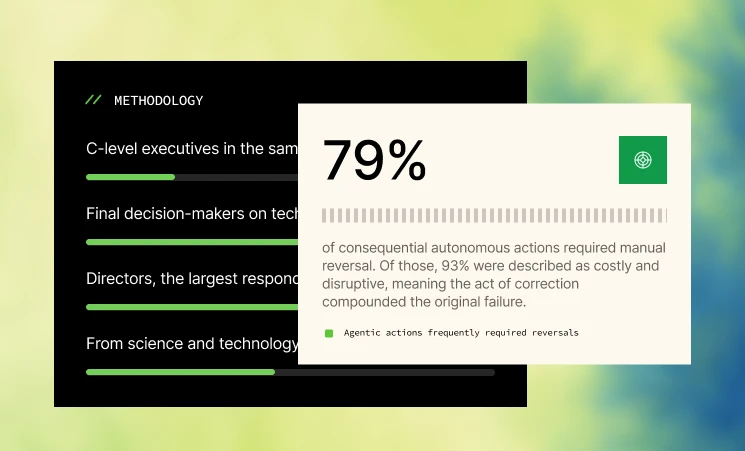
You cannot scale AI safely if your backend infrastructure is a chaotic web of legacy data silos. In fact, 82% of enterprises report agents have autonomously executed consequential actions in production without sufficient human oversight, according to Kore.ai AI Agent Productivity Index.
This is why, for successful AI transformation, you must establish strict data and governance readiness before provisioning tools to the wider workforce.
Your action step:
Instead of attempting a massive, multi-year cleanup of your entire corporate data warehouse, isolate the specific data required for your Phase 1 priority use cases.
Create a secure, encrypted data enclave for the AI to access. Concurrently, establish a tiered governance model: clear out low-risk informational tools for rapid deployment, but require formal, human-in-the-loop review frameworks for any agent that modifies database records or executes transactions.
Phase 3 - Re-engineer workflows and establish AI Center of Excellence (CoE)
True workplace productivity does not happen by giving individual employees isolated productivity hacks. It happens by re-architecting the assembly line.
This is what McKinsey calls a genuine "operating model" shift. It says that organizations that get a human breakthrough, not just a technology breakthrough, whether from workflow redesign, talent, or a clearer view of the future of work, are the ones moving faster.
Your action step:
To redesign workflows effectively, establish a centralized, cross-functional AI Center of Excellence (CoE) that brings together IT leaders, security experts, and business unit managers.
Ask them to map your target workflow start to finish and find the exact point where a human is acting as a mere "data mover" between systems.
Redesign the workflow so AI agents handle the routine handoffs and data entry, and shift the human role entirely to exception-handling and quality control.
Phase 4 - Launch role-specific enablement and track AIQ
A tool is only as valuable as your workforce's capacity to leverage it. Once the infrastructure and redesigned workflows are live, focus entirely on building your organization's internal Artificial Intelligence Quotient (AIQ). This is the measure Forrester uses to explain why low AI fluency and narrow, task-level use cases keep so many enterprises from converting AI investment into real results.
Your action step:
Task your CoE with delivering highly specialized, role-based upskilling programs directly tied to the new workflows. Train your HR team on auditing automated screening outputs, and teach your IT desk how to monitor agent execution logs.
Track employee sentiment, trust, and workflow velocity alongside your basic license adoption percentages to ensure the tools are actively reducing workloads rather than increasing digital fatigue.
Conclusion
All of the seven challenges above are not about whether AI "works" in the workplace. But whether your organization has done the less glamorous work underneath it: clean employee data, redesigned processes, right-sized governance, genuine employee trust, real skills investment, and tools good enough that people actually want to use them instead of working around them.
This is exactly the gap Kore.ai's AI for Work is built to close. Instead of retrofitting governance after an incident, or leaving employees to work around a locked-down chatbot, it gives enterprises:
- Employee-facing AI agents built for HR, IT, and other workplace functions
- Built-in traceability and admin controls, so every action an agent takes can be reviewed, reversed, and explained
- No-code agent building, so employees can create the automation they actually need instead of reaching for unsanctioned tools
- 200+ ready-to-deploy agent templates, so workflow redesign doesn't start from a blank page
Book a demo if you’re ready to give your employees AI agents that are productive and governed from the start.
Want to see where the gaps are showing up most right now? Kore.ai's 2026 Agent Productivity Index breaks down the data behind agent governance failures in more detail.
Frequently asked questions
Q1 - What are the biggest challenges of implementing AI in the workplace?
The biggest challenges are: legacy systems and poor data blocking integration, AI pilots stalling before they show real ROI, AI getting bolted onto broken workflows instead of redesigned ones, weak governance turning productivity gains into risk, employees not trusting or adopting AI tools, shadow AI filling the gaps official tools leave behind, and AI literacy gaps slowing everyone down.
Q2 - How do you successfully implement AI in the workplace?
Start with one well-bounded, high-friction workflow and a specific metric you expect AI to move, fix the data behind it, govern agents by autonomy level rather than one blanket policy, and bring employees into the rollout early. Scale to the next workflow only once the first shows a real, measurable result.
Q3 - Do legacy IT and HR systems really block AI implementation?
Yes. A large majority of enterprises report struggling to connect AI tools to legacy infrastructure, largely because employee data sits scattered across disconnected HR, IT, and finance systems that were never built to talk to each other. It's one of the most common reasons AI projects stall before scaling.
Q4 - What is shadow AI, and why is it a workplace risk?
Shadow AI is employees using personal, unsanctioned AI tools for work tasks because the tools their company officially provides fall short. Research shows employees at over 90% of firms do this even when official pilots stall. It's a real security risk, but also a signal that sanctioned tools aren't meeting employees' actual needs.
Q5 - How should leaders measure the financial ROI of an enterprise AI implementation?
To accurately calculate enterprise AI ROI, you must have a measurement strategy to track definitive, process-specific outcomes against clear operational baselines, including reduction in external IT service desk operational costs, accelerated customer support resolution and ticket clearance rates, and shortened contract sign-off cycles or accelerated new-hire provisioning times.