





.webp)
Executive perspective
Over the past eighteen months, a quiet but profound shift has taken root inside global enterprises. Workflows that once required teams of people, multiple systems, and long chains of approvals are now being executed end-to-end by autonomous AI systems. Customer issues are resolved before an agent opens a ticket. CRM tasks complete themselves in the background. IT incidents are diagnosed and remediated without waiting in a queue.
This is Agentic AI, and it is already here. Not as a feature, not as an add-on, but as the beginning of a new operational era.
If you’re leading an enterprise today, you should be asking yourself:
- What happens when workflows no longer wait for people?
- What does my operating model look like when decisions become autonomous?
- How will my customer experience evolve when 80% of routine issues are resolved without human intervention?
- What competitive advantage emerges when AI agents can operate 24/7 across every system I own?
These questions are no longer hypothetical. They are strategic.
Analysts now forecast that by 2027, Agentic AI will be the No. 1 newly deployed technology to improve customer experience, and that by 2029, autonomous AI will resolve the majority of common service issues, reducing operational costs by nearly 30%. At the same time, enterprise software is rapidly evolving: a third of all applications will embed agentic capabilities by 2028, up from less than 1% just a few years ago.
This is not the incremental evolution of AI. It is the rise of autonomous digital operators, software entities capable of interpreting goals, executing multi-step actions, coordinating with other systems, and improving themselves over time.
For enterprise leaders, the implications are enormous. Agentic AI introduces a new execution layer inside the business, one that doesn’t replace human judgment but absorbs the repetitive, procedural, high-volume work that bogs down teams and limits scale. Instead of employees manually navigating dozens of tools, AI systems increasingly orchestrate them on behalf of employees, and eventually, on behalf of the enterprise itself.
Understanding how this new layer works is no longer optional. It is foundational to any serious conversation about competitiveness, operational resilience, and workforce strategy.
In the sections that follow, we’ll go beyond the buzzwords to examine the technical architecture, cognitive mechanisms, and operational systems that make Agentic AI possible. Because the real question facing enterprises right now isn’t whether Agentic AI will reshape operations.
It’s how quickly your organization will be ready for it, and what advantages you want to secure before your competitors do.
Enterprise shift toward autonomy
Most enterprise systems today still rely on humans as the primary operators of work. Employees move between applications, interpret ambiguous scenarios, reconcile data inconsistencies, and manually resolve exceptions. Even with automation, RPA bots, and workflow engines, the enterprise continues to function as a human-in-the-loop machine, reliable but inherently limited. This model is now reaching a point where complexity, scale, and speed requirements surpass what manual operational structures can sustain.
A growing gap between work and workforce capacity
Operational complexity has increased dramatically as enterprises expand digital touchpoints, regulatory obligations, and interconnected systems. Customer interactions alone have multiplied across channels, requiring immediate, consistent responses that human teams struggle to maintain. Compliance requirements have become more dynamic, demanding continuous tracking and enforcement rather than periodic review. And above all, workforce capacity, constrained by cost, availability, and training cycles, simply cannot scale at the pace enterprise demand now requires. This widening gap is where Agentic AI is emerging as a structural solution.
Early signals of an agent-led operating model
The shift toward autonomy is already visible in enterprise technology.
- CRM platforms are projecting up to a 50% reduction in user screen time by 2027, driven by AI agents that pre-complete tasks in the background before a human ever opens the interface.
- IT operations, historically dependent on manual triage and rule-based automation, are on a path toward 60% agent integration by 2028, up from less than 5% in 2024, signaling that incident detection, correlation, and resolution are increasingly becoming machine-led.
- Customer service ecosystems are evolving rapidly, with forecasts showing that up to 80% of routine issues may be resolved autonomously by 2029, meaning customers will receive near-instant assistance without waiting for human availability.
These trends are not speculative; they reflect real changes in how enterprise systems behave. Instead of waiting for users to execute steps, systems are beginning to anticipate needs, interpret context, and complete actions independently.
A transition from user-first to agent-first architecture
Collectively, these developments indicate a shift from software that depends on human action to software that performs actions on behalf of humans. In an agent-first enterprise, workflows no longer flow through people; instead, they flow through intelligent systems capable of reasoning, planning, executing, and improving. The enterprise begins to transition from being a network of tools operated by employees to a network of autonomous digital operators that collaborate with employees.
This transition marks a profound evolution in enterprise architecture, one that requires technical understanding, strategic redesign, and operational readiness. To see why this shift is accelerating, we need to look deeper into the technical machinery that enables autonomous behavior at scale.
What makes agentic AI fundamentally different
Traditional generative AI systems were never designed to operate inside enterprise workflows. Technically, they function as single-step predictive models: a prompt enters, the model generates a response, and the process ends. They hold no persistent memory, maintain no procedural state, cannot interact with enterprise systems, and lack the computational scaffolding required to execute multi-step logic. In essence, classical GenAI is a stateless probability engine, powerful in language generation, but incapable of running business processes.
Agentic AI represents a fundamentally different architecture because it introduces statefulness, goal-orientation, planning capability, tool-use, memory integration, and verification logic, the core elements required for autonomous operations in complex enterprise environments. Instead of producing an isolated output, an agent manages a continuous loop of perception > reasoning > planning > action > verification > learning.
The Shift From Single-Step Prediction to Multi-State Cognitive Systems
At its core, an agent incorporates a multi-state cognitive pipeline that lets it behave like a digital operator rather than a text generator.
- The agent maintains a persistent internal state, enabling it to track progress across multi-step tasks.
- It builds task graphs or hierarchical plans using structured decomposition techniques such as Tree-of-Thought (ToT), hierarchical task networks (HTN), or recursive ReAct loops.
- It uses procedural reasoning frameworks to evaluate dependencies, resource constraints, and policy rules before choosing an action.
- It interacts with external systems through secure execution environments, allowing API calls, SQL queries, system updates, and workflow triggers.
This is why the enterprise shift is so dramatic: traditional GenAI cannot execute a workflow; Agentic AI is architected to run one end-to-end.
A Complete Integration of Reasoning, Execution, and Systems Control
Where traditional AI stops after generating text, agentic systems integrate directly with enterprise architecture. Technically, an agent does the following:
- Interprets objectives through semantic-graph construction: The agent converts human or system instructions into machine-readable goal structures, mapping intents to procedural tasks.
- Analyzes system environments using real-time signals: Agents ingest logs, APIs, structured data, and system states to build situational awareness, something static models cannot do.
- Builds multi-step execution plans using planning algorithms: Instead of a one-off output, the agent generates a plan consisting of tasks, conditions, dependencies, fallbacks, and verification points.
- Uses tool APIs and action models to perform real operations: This is the core differentiator: by calling APIs, automating workflows, and manipulating enterprise data, agents act like operators inside systems, not observers.
- Validates outcomes using rule-based and statistical verification layers: Agents perform automatic grounding, policy checks, and result validation to prevent hallucinated or unsafe actions.
- Manages exceptions using escalation hierarchies: When a task exceeds confidence thresholds or violates rules, the agent escalates to a supervisor agent or a human reviewer.
- Learns from prior episodes using structured memory: Agents store episodic traces, action histories, successes, and failures that improve decision quality over time.
This architecture makes Agentic AI closer to an autonomous software robot than a generative text system.
A Technology Already Operating Inside Enterprise Systems
Agentic AI is not a research prototype; it is already executing workflows in production environments:
- In CRM ecosystems, agent-driven systems are expected to reduce user interaction time by 50% by 2027, because agents complete tasks proactively.
- In IT operations, agentic diagnostic and remediation systems are on pace to be embedded in 60% of ITOps tools by 2028, compared to under 5% in 2024.
- In customer service, multi-agent architectures are anticipated to autonomously resolve up to 80% of routine service issues by 2029, a number impossible for human teams alone.
These transformations are possible only because agentic systems possess the technical capability to operate, govern, and optimize workflows on their own.
Why We Must Now Examine the Technical Architecture
To fully grasp what makes Agentic AI uniquely powerful and disruptive, it’s essential to explore the precise technical components that enable autonomy. These include the agent’s reasoning core, its planning engine, its execution layer, its memory subsystems, its verification and safety scaffolding, and its multi-agent orchestration logic.
Together, these elements create a system capable of functioning as a digital workforce: operating software, executing decisions, coordinating tasks, and continuously improving. The next section breaks down this architecture in depth.
How does Agentic AI work?
An AI agent is not a single model or a monolithic script. It is a multi-layered cognitive and operational system, engineered to function as a persistent, stateful, goal-driven operator inside the enterprise. Each layer contributes a specific capability: understanding intent, decomposing work, interacting with systems, validating outcomes, and coordinating with other agents. Together, these layers form a continuous, self-directed pipeline that allows an agent to behave much like a trained analyst or process specialist, only faster, more consistent, and infinitely scalable.
The following subsections break down this architecture in detail:
The Cognitive Reasoning Engine: How Agents Understand Goals
Every autonomous agent begins with one fundamental capability: the ability to understand what the enterprise is asking for. This goes far beyond parsing text. It requires the agent to interpret intent, extract embedded objectives, recognize business constraints, and translate ambiguous inputs into structured, machine-readable goals. This is the role of the cognitive reasoning engine, the analytical core of every agent.
Traditional LLMs respond to prompts; agents diagnose them. They operate like trained analysts who take a loosely defined request and infer the actual business outcome required.
How agents derive goal understanding
To interpret goals accurately, the cognitive layer combines several advanced reasoning mechanisms:
- Deep Natural Language Understanding (NLU): The agent interprets human instructions, system messages, emails, structured inputs, or workflow triggers. It identifies intent, tone, urgency, and domain terminology, transforming informal requests into actionable tasks.
- Semantic Parsing and Intent Modeling: Inputs are converted into structured representations such as semantic frames, intent graphs, or reasoning trees. For example, “fix this customer’s issue” becomes a multi-layered objective: retrieve history, validate claims, identify policy impacts, propose resolution paths, and update systems.
- Domain-Specific Reasoning: Enterprise processes depend heavily on industry rules, financial limits, healthcare protocols, supply chain dependencies, or ITIL standards. This is why organizations are racing toward Domain-Specific Language Models (DSLMs), with analysts predicting over 50% of enterprise GenAI models will be domain-tuned by 2027. DSLMs enable agents to reason accurately within the business's logic.
- Contextual Composition Across Systems: The agent retrieves relevant knowledge from memory, prior conversations, historical cases, policy documents, customer profiles, operational data, and enterprise knowledge graphs. This allows it to anchor reasoning in a real enterprise context rather than isolated text patterns.
- Instruction Disambiguation and Prioritization: Agents must decide what the request really means. A phrase like “resolve this ticket quickly” may involve multiple subtasks: diagnosing the issue, checking SLAs, reviewing past incidents, updating logs, and sending a customer follow-up.
This cognitive layer gives agents the ability to:
- Understand not just words but business meaning
- Integrate procedural, policy, and domain knowledge into reasoning
- Recognize when instructions are underspecified
- Identify what additional information is required
- Interpret requests the way a trained employee would
- Lay the foundation for multi-step planning and execution
In essence, the cognitive reasoning engine transforms a raw instruction into a clear, structured, context-aware objective, the starting point for everything the agent does next.
The autonomous planning system: how agents break down work
Once an agent understands an objective, it must determine how to accomplish it, not as a single command, but as a coherent, multi-step strategy. This is where Agentic AI diverges sharply from traditional LLMs. Instead of reacting to instructions, an agent builds a dynamic, constraint-aware plan that can adapt as the environment changes.
How agents convert goals into executable strategies
To do this, agents draw on a sophisticated planning stack:
- Hierarchical Task Decomposition: Using methods like HTN (Hierarchical Task Networks) and ToT (Tree-of-Thought reasoning), the agent breaks complex goals into structured subtasks, much like an analyst building a workflow diagram.
- Constraint-Aware Reasoning: Enterprise workflows include compliance rules, SLA expectations, permissions, and risk thresholds. The planning engine evaluates all constraints upfront, eliminating unsafe or non-viable paths.
- Dynamic Decision Graphs: Instead of choosing a single route, the agent constructs branching decision graphs and scores each path based on context, risk, and historical performance.
- Reflective Reasoning and Plan Optimization: Before executing, the agent runs internal self-critique cycles, identifying faulty assumptions or missing inputs. This dramatically reduces error propagation.
- Real-Time Adaptive Replanning: If a system behaves unexpectedly, an API times out, data is missing, or a dependency changes, the agent recalculates the strategy instantly and adjusts without manual intervention.
This planning layer is what elevates Agentic AI from reactive text generation to proactive, goal-driven execution.
The action and execution layer: how agents perform real work
Planning is abstract unless the agent can execute it. The action layer is where cognition becomes output, enabling agents to perform real operational tasks across the enterprise stack.
What the execution layer allows agents to do
Within secure execution sandboxes, agents can:
- Call Enterprise APIs: Updating CRM records, retrieving ERP data, modifying ITSM tickets, and orchestrating microservices. By 2028, analysts expect agents to initiate the majority of enterprise API calls.
- Execute SQL and Query Operations: Agents run queries, validate data consistency, perform joins, and reconcile information across distributed databases.
- Trigger Workflow Engines and Automations: They initiate BPM workflows, microservice chains, serverless functions, and integration pipelines, effectively acting as orchestration engines.
- Use RPA or UI Automation for Legacy Systems: When APIs aren’t available, agents fall back on UI automation: interacting with screens, forms, and legacy tools using DOM analysis or computer vision.
- Process and Generate Documents: Agents extract information from PDFs, spreadsheets, contracts, logs, and create high-quality reports, forms, or compliance packets.
- Manage Tickets, Alerts, and Communications: They open tickets, escalate issues, send notifications, update audit logs, and track SLA progress end-to-end.
This layer transforms agents from “smart assistants” into fully operational digital workers capable of carrying out tasks autonomously and consistently.
The memory architecture: how agents maintain context over time
Agentic AI requires memory structures far beyond the token-limited short-term recall of LLMs. Enterprise workflows are long-running, multi-system processes with evolving context, and agents must retain continuity, history, and institutional knowledge.
The memory layers that power agent autonomy
- Short-Term (Working) Memory: Holds active context for the current task, intermediate reasoning, variables, prior steps, tool outputs, and immediate goals.
- Long-Term Knowledge Memory: Stored in vector databases or knowledge graphs, this includes SOPs, product data, historical cases, customer profiles, compliance rules, and operational documentation.
- Episodic Memory: Records every workflow the agent has executed, successful paths, errors, resolutions, and optimizations, enabling self-improvement over time.
These memory structures allow agents to maintain context across extended workflows, avoid repeating mistakes, and operate with a deep understanding of institutional norms and constraints.
The Verification & Governance System: How Agents Safeguard Outcomes
Enterprises cannot allow autonomous systems to act without verification. This layer ensures that agents stay safe, accurate, compliant, and aligned with policy, not just once, but at every step of execution.
How agents enforce safety, accuracy, and control
- Pre-Execution Validation: The agent reviews its own reasoning and plan to detect inconsistencies, missing data, or compliance risks before execution begins.
- Continuous Policy & Compliance Enforcement: Every action is evaluated for regulatory alignment, role-based access control, data privacy rules, financial limits, and workflow governance.
- Cross-Agent Oversight: Verification agents audit the work of execution agents, while supervisor agents make higher-level decisions and resolve conflicts, replicating governance structures found in human teams.
- Fact Grounding Through Trusted Data Sources: Before executing critical actions, agents verify claims against CRMs, ERPs, databases, policy stores, or authoritative documents.
- Real-Time Monitoring During Execution: Agents detect anomalies, unexpected system responses, contradictory outputs, or risk signals and can pause, adjust, or escalate accordingly.
- Smart Escalation Logic: If confidence drops below thresholds or the risk score spikes, the agent routes the task to a human with full context and recommended next steps.
This governance system ensures that autonomy enhances accuracy rather than introducing operational risk.
Multi-Agent Orchestration: How Agents Work Together as Digital Teams
Complex enterprise workflows rarely map to a single function. They require multiple skill sets, decision layers, and approval flows. Agentic architectures reflect this reality through multi-agent systems that operate like coordinated digital teams, each agent specializing in a specific role.
Core Digital Roles Inside a Multi-Agent Ecosystem
- Planner Agent: Breaks down the objective, creates the workflow, maps dependencies, and adapts plans when conditions change.
- Execution Agent: Interacts with systems, performs API calls, executes SQL, triggers workflows, and updates records.
- Verification Agent: Validates reasoning, checks outputs, audits steps, and enforces correctness before actions are finalized.
- Supervisor Agent: Oversees all activities, prioritizes tasks, resolves conflicts, maintains global workflow state, and escalates to human operators when needed.
How These Agents Coordinate in Real Time:
- A shared memory layer
- A central orchestration engine
- Event triggers and state updates
- Dependency graphs
- Conflict detection and resolution mechanisms
- Fallback and retry pathways
- Cross-agent review cycles
This orchestration fabric ensures that agents work cohesively, not as isolated tools, but as a synchronized digital workforce capable of handling end-to-end enterprise processes with resilience and precision.
What Agentic AI Looks Like Inside Real Enterprise Workflows
Once all the architectural layers of Agentic AI, reasoning, planning, execution, memory, verification, and orchestration, activate together, workflows begin to operate with a level of intelligence and autonomy that mirrors experienced human teams. But unlike humans, agents operate continuously, consistently, and at machine speed. This isn’t a future-state vision. It’s happening right now in organizations that have begun embedding agents into critical business processes.
Below, we explore some examples on how Agentic AI behaves inside actual enterprise workflows, not as an assistant, but as a digital operator capable of running end-to-end processes.
Customer Dispute Resolution: From Intake to Closure
Customer resolution workflows are among the first processes where Agentic AI has demonstrated full autonomy. Instead of simply summarizing complaints, agents execute the full remediation cycle:
How the Workflow Operates With Agents
- The agent retrieves the full customer profile, historical interactions, and product context.
- It analyzes transaction data and compares anomalies against known patterns.
- It checks internal policy rules, entitlements, and SLA guidelines.
- It identifies the root cause of the issue and generates recommended resolution options.
- It executes the required system updates, refunds, adjustments, documentation, or workflow triggers.
- It drafts and sends customer-facing communication.
- It writes a complete audit trail for compliance and future review.
All without a human ever touching the case unless required.
Why Enterprises Are Deploying This Now
Analysts project that by 2029, 80% of common service issues will be resolved autonomously, leading to nearly 30% reductions in service operations costs. Agents make this possible by handling every step, not just answering questions, but fixing issues.
IT Incident Management: Autonomous Diagnosis and Remediation
IT operations are another high-value domain where Agentic AI is rapidly gaining adoption. Incidents often require reading logs, identifying patterns, checking dependencies, and applying fixes, tasks that trained engineers spend significant hours on.
How Agents Handle IT Incidents
- Agents ingest live system logs and telemetry signals.
- They compare error signatures with historical incidents stored in episodic memory.
- They identify probable root causes using correlation and anomaly detection.
- They propose corrective actions or execute them directly (restart services, patch modules, clear caches, rebalance workloads).
- They validate whether the system has stabilized.
- They escalate to humans only when anomalies persist or exceed risk boundaries.
Why This Is Transformational
With agents embedded into AIOps tools, analysts expect 60% of IT operations tools to integrate autonomous agents by 2028, up from less than 5% in 2024. This shift drastically reduces MTTR (Mean Time to Resolution) and increases system resilience.
CRM and Sales Operations: The Workflow That Runs Itself
CRM platforms are undergoing one of the most dramatic transformations. For decades, they depended on users manually entering data, updating records, qualifying leads, and routing opportunities. Agentic AI is reversing this paradigm.
How CRM Workflows Run With Agents
- Lead qualification happens automatically using behavioral signals and historical CRM patterns.
- Data entry is completed in the background as agents extract and sync information from emails, calls, forms, and documents.
- Follow-up sequences are triggered proactively based on customer behavior, timing, and channel preferences.
- Contract routing, quote generation, and task assignments occur without a user clicking buttons.
The Impact
By 2027, CRM users are expected to experience a 50% reduction in screen time because the system completes most tasks before the seller ever logs in. Agents turn CRM from a manual-input system into a self-operating engine.
Finance, Compliance & Back-Office Processes: Precision at Scale
Beyond customer-facing tasks, agents excel in precision-heavy, rule-driven workflows:
Where Agents Deliver Value
- Accounts receivable & payable automation
- Audit trail generation
- Reconciliation workflows
- Compliance checks against DSLM-powered policy engines
- Fraud pattern identification
- Document classification and validation
These workflows involve numerous checks, small decisions, and repetitive actions, ideal for autonomous execution.
What Makes Agents Effective Here
- Perfect consistency
- Zero fatigue
- Real-time rule enforcement
- Ability to handle thousands of small steps without error
Back-office automation is expected to be one of the fastest-growing enterprise use cases.
The Enterprise After Agents: A System That Operates Itself
Individually, each workflow shows how agents perform targeted tasks autonomously. Collectively, they demonstrate a broader truth:
Agentic AI is not assisting workflows; it is running them.
Systems no longer wait for human input. Processes no longer stall during handoffs. Operational bottlenecks no longer depend on headcount. This is the new operating reality, one where enterprise workflows execute themselves with human oversight instead of human effort.
The Strategic Implications of Agentic AI for Enterprise Leaders
The emergence of Agentic AI forces a fundamental strategic shift in how enterprises think about operating models, cost structures, workforce design, and competitive dynamics. For senior executives, this is not just a technology decision; it is a business architecture decision. The companies deploying agents today are not simply automating tasks; they are restructuring how work is done, how teams scale, and how decisions are made across the enterprise.
Agentic AI introduces a new execution layer that behaves like a digital workforce, one that can grow rapidly, operate continuously, and enforce governance automatically. The implications ripple across cost, speed, customer experience, and long-term competitive advantage.
1. Structural Cost Advantage: A New Cost Curve for Operations
Autonomous workflows change the economics of enterprise operations.
By shifting repetitive, rules-driven, multi-step tasks from humans to agents, organizations reduce the need for manual intervention and headcount-heavy operational layers.
Where the Cost Advantage Emerges
- Less reliance on manual processing teams
- Reduced error-related rework
- Lower cost of compliance due to built-in governance
- 24/7 execution without overtime or staffing constraints
- Automation that scales horizontally without linear cost increases
With customer service alone expected to see up to 80% of issues resolved autonomously by 2029, the cost savings are no longer incremental; they are structural.
2. Radical Cycle-Time Compression: Faster Workflows, Faster Decisions
Agents execute tasks in seconds that traditionally took minutes, hours, or days. They eliminate bottlenecks created by queues, handoffs, working hours, and backlogs.
Impacts on the Enterprise
- Service resolutions occur instantly.
- Multi-step workflows (like onboarding, approvals, fulfillment accelerate dramatically
- IT incidents auto-resolve before escalating
- CRM tasks are pre-completed before humans log in
- Compliance checks run continuously, not periodically
This compression of cycle time enhances customer experience and unlocks new capacity without additional labor.
3. Superior Governance, Accuracy, and Consistency
Unlike humans, agents do not forget rules, skip steps, improvise processes, or fatigue under workload. Their actions are governed by embedded policy engines, real-time data grounding, and verification layers.
Enterprise Advantages
- Standardized execution of critical workflows
- Automatic compliance enforcement
- Full audit logs for every action
- Reduced operational risk
- Near-zero variance in process quality
By 2027, over 50% of GenAI models used by enterprises will be domain-specific, enabling deeper rule alignment and more accurate reasoning. Agents provide governance by design, not as an afterthought.
4. Scalability Without Headcount Constraints
Human teams scale linearly: more tasks require more people. Agents scale computationally: more tasks require more instances, not more humans.
Why This Unlocks New Operating Models
- Workflows can scale to millions of transactions without hiring surges
- Peak workloads (end of quarter, seasonal spikes, outages) are handled automatically
- Businesses can expand into new regions or functions without building parallel operational teams
- The digital workforce grows elastically based on demand
By 2028, 60% of enterprise automation is expected to be delivered through AI agents, many built by nontechnical teams via no-code platforms. Scalability becomes a software decision, not a staffing challenge.
5. Competitive Separation: Early Adopters Pull Away - Fast
Agentic AI creates advantages that compound. Organizations that deploy early begin accumulating institutional AI memory, domain-specific reasoning engines, and workflow-specific agents that competitors cannot easily replicate.
Where Competitive Moats Form
- Proprietary DSLMs trained on unique enterprise data
- Agents that reflect years of operational patterns and exceptions
- Autonomous workflows tailored to specific internal processes
- Reduced cost structure, enabling more aggressive pricing
- Faster cycle times enabling superior customer experience
This separation is already visible in early-adopter industries such as financial services, retail, and telecom, where agent-led processes significantly outperform traditional operations.
As analysts predict a 149.8% growth in enterprise AI models by 2025 and steady adoption through 2028, the window for early-mover advantage is closing quickly.
6. The Enterprise Operating Model Is Changing - Permanently
Agentic AI is not an enhancement to existing systems. It is a new execution fabric that sits across the enterprise, transforming how work happens. Leaders who adopt early will design the operating models that others attempt to copy later. In the next decade, analysts expect:
- 33% of enterprise software to include agentic capabilities by 2028
- 80% of knowledge worker tasks to be AI-augmented by 2028
- Up to 50% of user interactions to be handled by agents by 2029
- At least 15% of business decisions are to become autonomous
This is the beginning of a structural transformation in how enterprises function. Agentic AI is becoming the new operating system of the enterprise, and those acting now are shaping the competitive landscape for years to come.
Conclusion: The Autonomous Enterprise Is No Longer Conceptual - It Is Emerging Now
Agentic AI is not a simple enhancement to existing enterprise systems; it is a new execution layer capable of interpreting goals, reasoning through complexity, planning multi-step workflows, acting across applications, verifying outcomes, and collaborating with other agents with near-human sophistication.
Within this decade, most enterprise workflows will shift from human-operated processes to autonomous agent-driven execution, with employees moving upstream to oversee intelligent systems rather than manually driving them. Organizations preparing for this shift today will operate faster, scale more efficiently, govern more reliably, and deliver consistently superior customer and employee experiences.
This transition is already unfolding. Analysts expect that by 2028, autonomous agents will initiate the majority of enterprise API calls, resolve a significant share of operational tasks, and underpin over 30% of all enterprise decision-making. Enterprises that adopt early will build compound advantages in speed, institutional AI memory, and process intelligence, advantages that competitors will struggle to replicate later.
Agentic AI is not a “future possibility.” It is already reshaping enterprise operations. The question for leaders is no longer if they should adopt it, but how fast they can redesign operating models around autonomous systems.
And this is precisely where Kore.ai’s approach to Agentic AI stands apart.
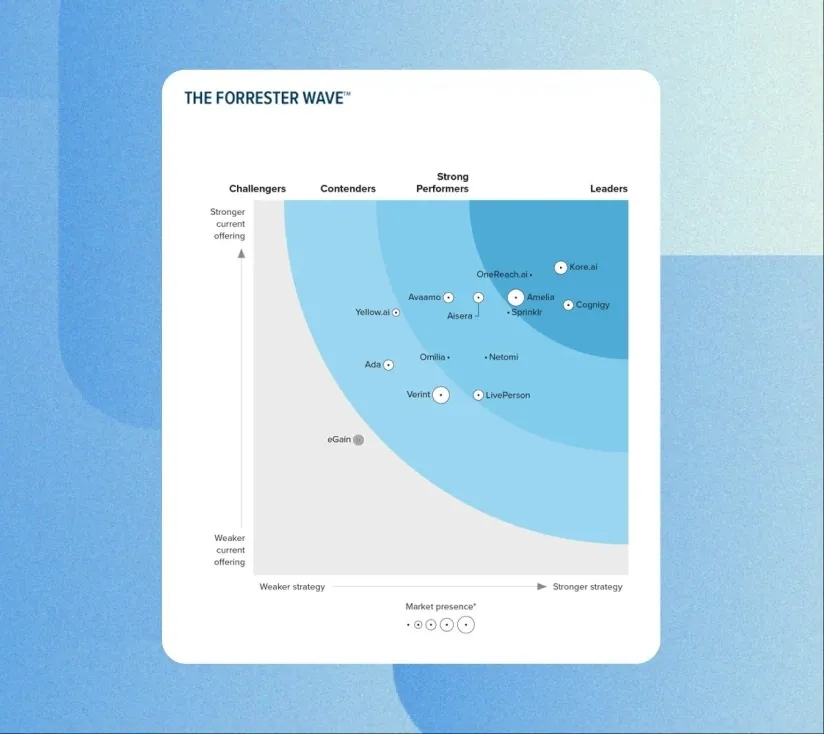
Kore.ai has spent years engineering the foundations needed for true enterprise-grade agentic systems. With its domain-aware reasoning capabilities, orchestrated multi-agent frameworks, robust safety and governance layers, and deeply integrated enterprise toolset, Kore.ai enables organizations to deploy autonomous agents that don’t just converse, they take action.
Where others focus on generating responses, Kore.ai’s agentic ecosystem focuses on completing work: resolving customer issues, orchestrating IT operations, managing HR requests, executing finance workflows, driving internal processes end-to-end, and a lot more. Its architecture supports:
- Goal understanding and dynamic planning
- Tool-based execution across systems and applications
- Persistent enterprise memory and context retention
- Verification, grounding, and policy enforcement
- Collaboration among specialized agents through orchestration
This makes Kore.ai one of the few platforms capable of supporting real, production-grade Agentic AI, not prototypes, not demos, but reliable autonomous workflows at scale. As enterprises move toward this autonomous future, Kore.ai provides not just the tools to build agents but the foundation to operationalize Agentic AI safely, responsibly, and at scale.
The next decade will be defined by enterprises that move beyond automation and embrace autonomy. Kore.ai is helping those enterprises get there, not by imagining the future of Agentic AI, but by delivering it today.