The end of manual AP: Zero-Touch invoice processing with AI for process
Last Updated
February 20, 2026

Deepak Anand
Read Time

Summary
Traditional invoice automation often breaks down when exceptions require judgment and context. This blog explores how agentic AI enables zero-touch invoice processing, handling invoice validation, fraud detection, duplicate payments, tax and currency checks, contract compliance, and payment timing across finance systems. It shows how accounts payable can move beyond static OCR and RPA toward autonomous processing, while maintaining governance, auditability, and human oversight for genuine exceptions.
What’s on this page
Accounts payable is quietly becoming one of the most strategic battlegrounds in the modern enterprise. What was once a back-office cost center is now directly tied to cash flow optimization, supplier trust, fraud prevention, and regulatory compliance. Yet despite decades of investment in OCR, RPA, and AP platforms, most organizations are still trapped in manual exception handling, slow cycle times, and brittle workflows that break the moment reality deviates from the template. As invoice volumes grow, formats proliferate, and fraud becomes more sophisticated, incremental automation is no longer enough. In this blog, we will discuss where zero-touch invoice processing enters the picture, powered not by static rules, but by agentic intelligence that can reason, adapt, and act across systems.
The problem with today’s invoice processing
On paper, invoice processing looks automated. In reality, most finance teams are orchestrating a fragile relay race across inboxes, PDFs, OCR engines, and ERP screens. An invoice arrives by email or portal upload. Data is extracted, fields are mapped, and business rules attempt to reconcile what’s on the page with what lives in procurement and finance systems. And then, inevitably, something breaks.
A scan is slightly skewed. A vendor changes their invoice format. A PO number is missing or mis-typed. Tax logic doesn’t align with regional rules. What should be a straight-through transaction quietly turns into an exception, and exceptions are where automation gives way to human labor.
AP analysts step in to review, correct, re-key, and re-route invoices back into the system. Approval workflows stretch across teams and hierarchies, often stalling while someone searches for missing context. Each handoff adds time, cost, and risk. By the time an invoice is paid, days or even weeks have passed, and the organization has absorbed far more operational friction than the transaction itself should require.
The downstream impact is measurable. Cycle times routinely stretch into double digits. Every manual touch introduces cost and increases the likelihood of error, whether it’s a duplicate payment, a missed fraud signal, or a compliance gap that surfaces later in an audit. Vendors grow frustrated by delays and disputes. Finance leaders are left with rising operating expense and limited confidence in the integrity of their controls.
OCR and RPA were meant to solve this problem, but they were designed for a more predictable world. They assume stable formats, static rules, and clean data. When reality deviates, as it always does, those automations become brittle. Even enterprises running mature AP platforms like Coupa or Ariba still report that a significant share of invoices require manual intervention, especially long-tail and non-PO invoices. Automation exists, but autonomy does not.
The exception funnel in practice
- Invoices appear to move through a structured flow extraction, validation, ERP matching, approval, payment. But at each stage, a percentage quietly drops out of automation and into manual review.
- A missing PO number. A tax mismatch. A vendor format change. A slight variation in invoice numbering. Each deviation widens the exception funnel, pushing more work back to humans.
- As invoice volumes grow, that funnel expands. The result is predictable: longer cycle times, higher operating costs, inconsistent controls, and rising fraud exposure. Automation handles the predictable. Humans handle the unpredictable.
- The problem is not that automation doesn’t exist. It’s that it stops precisely where judgment and context are required.
From static workflows to AI for process
This operational friction might have been tolerable when AP was viewed purely as a back-office function. That framing no longer holds. Today’s finance leaders are under pressure to do more than process transactions. They are expected to protect cash, manage supplier risk, enforce compliance, and surface insights that inform broader business decisions.
As a result, accounts payable is undergoing a quiet but profound shift in identity. According to Ardent Partners, 64 percent of AP leaders now see their function as very or exceptionally valuable to the enterprise. AP is no longer just about paying invoices. It is a strategic control point for working capital, fraud prevention, and supplier trust.
This shift exposes a growing mismatch. While expectations for AP have expanded, the underlying operating model has not. Linear workflows, static rules, and human-dependent exception handling are ill-suited for a function now tasked with real-time decision-making and risk management. Finance teams are being asked to act strategically, but they are constrained by tools designed for transactional throughput.
The pressure to evolve is not driven by technology trends alone. It is driven by scale, complexity, and accountability. Invoice volumes continue to rise. Regulatory scrutiny is increasing. Fraud is becoming more sophisticated. And leadership teams want faster, more reliable insight into how money moves through the organization. In this environment, incremental automation is no longer sufficient. AP needs systems that can reason, adapt, and enforce policy dynamically, not just move documents from one step to the next.
The transformation of AP’s role
- Accounts payable is no longer defined by transaction throughput alone. Historically, AP operated as a cost center focused on processing volume efficiently and minimizing manual workload. Visibility was delayed, controls were reactive, and success was measured by how quickly invoices moved through the system.
- That model no longer meets the expectations placed on modern finance teams.
- Today, AP is expected to act as a control point for working capital optimization, supplier risk management, compliance enforcement, and fraud prevention. CFOs and CIOs increasingly look to AP not only to process invoices, but to safeguard cash and provide real-time insight into financial obligations.
- The challenge is that while expectations have evolved, tooling has not kept pace. Legacy automation improves speed, but it does not elevate decision-making. True transformation requires systems that reason across data, enforce policy dynamically, and adapt as business complexity grows.
Real-world scenarios: From human blind spots to agentic intelligence
These are not edge cases or hypothetical risks. They are daily realities for modern AP teams operating at scale. In fact, a 2024 survey from Ardent Partners found that 49 percent of AP leaders cite invoice approvals taking too long, while 47 percent point to persistently high exception rates as their top operational challenges. The root cause is not a lack of automation, but a lack of intelligence where judgment and context are required.
The scenarios below illustrate how those challenges manifest in real environments, and how agentic AI closes the gap left by traditional AP systems.
Fraud disguised as routine work
Fraud rarely announces itself. One of the most common entry points is the spam invoice that looks legitimate at first glance. Fraudsters spoof vendor display names and send invoices from convincing email addresses, forcing AP teams to spend hours validating authenticity or, worse, approving fraudulent payments under pressure.
With Kore.ai’s AI for Process, agents inspect full email metadata, validate sender identity against vendor master records, and recognize anomalous patterns based on prior attempts. Suspicious addresses are logged and blocklisted, allowing future attacks to be quarantined automatically rather than rediscovered repeatedly by humans.
Maverick buying hidden behind “valid” POs
Purchase order matching is often treated as the final gate for approval, but it tells only part of the story. AP teams may confirm that an invoice matches a PO without validating whether the vendor itself was approved or whether the purchase aligns with procurement policy. Over time, this creates quiet leakage and erodes spend discipline.
Agentic intelligence extends validation beyond the PO. Each invoice is evaluated against approved vendor lists, historical buying behavior, and policy constraints. Maverick spend is flagged early, reinforcing procurement controls without slowing down compliant transactions.
Duplicate payments that slip through the cracks
Duplicate invoices rarely arrive as exact copies. Slight variations in invoice numbers, dates, or line items allow them to bypass traditional matching logic. By the time the error is discovered, funds may already be gone.
Agentic AI reasons across vendor history, amounts, line-item patterns, and timing to identify near-duplicates, not just identical matches. This deeper contextual understanding prevents double payments that static rules routinely miss.
These gaps persist even in enterprises running world-class AP platforms. Structured workflows work well when inputs are predictable. They struggle when decisions require correlation across systems or interpretation of intent. This is where agentic AI acts as an intelligence layer across Finance, Procurement, ERP, and Compliance.
Global complexity in currency and tax validation
For multinational organizations, currency conversion and tax compliance add another layer of friction. Manual validation of exchange rates or VAT and GST codes is slow and inconsistent, especially when regulations vary by jurisdiction.
With agentic intelligence, invoices are validated against live exchange-rate feeds and local tax rules. Entries are aligned automatically with ERP tax codes, reducing rework and ensuring regulatory consistency across regions.
Contract and sla compliance before payment
Invoices are often approved based solely on surface-level checks, without validating whether billed amounts align with contractual terms. This creates opportunities for overbilling and missed SLA violations.
Agentic AI retrieves contract terms from CLM systems, compares invoiced rates and quantities against negotiated agreements, and flags discrepancies before approval. Compliance becomes preventative rather than corrective.
Payment timing as a strategic lever
Early-payment discounts and cash-flow optimization opportunities frequently go unnoticed in manual workflows. By the time invoices are approved, the window for value capture has already closed.
Agentic systems evaluate payment timing dynamically, recommending when to accelerate payment to capture discounts or defer disbursement to preserve liquidity. AP moves from transactional execution to working-capital optimization.
Fraudulent vendor creation: the most expensive blind spot
Some of the most damaging AP fraud schemes begin long before an invoice arrives. Fraudulent vendor creation allows bad actors to introduce seemingly legitimate suppliers into the system. Once onboarded, invoices from these vendors appear routine.
A well-known example occurred in 2019, when Toyota Boshoku lost $37 million after attackers manipulated vendor banking details. PO matching alone could not prevent the loss. Non-PO invoices bypass controls. Insiders can create both vendors and dummy POs. Low-value thresholds allow repeated small invoices to slip through. Lookalike vendors exploit naming similarities.
With Kore.ai’s AI for Process, vendor onboarding and activity are continuously validated against external registries, banking data, and fuzzy-matched identity checks. New vendors and unusual invoice patterns trigger proactive alerts, closing gaps that traditional controls leave exposed.
Real-World Scenarios: From Human Blind Spots to Agentic Intelligence
The business value
AP leaders, CFOs, and CIOs now see invoice processing not just as a back-office workflow, but as a lever for working capital, supplier trust, and risk management. That’s why it’s consistently on the C-suite agenda.
For enterprises processing thousands of invoices monthly, the impact is measurable:
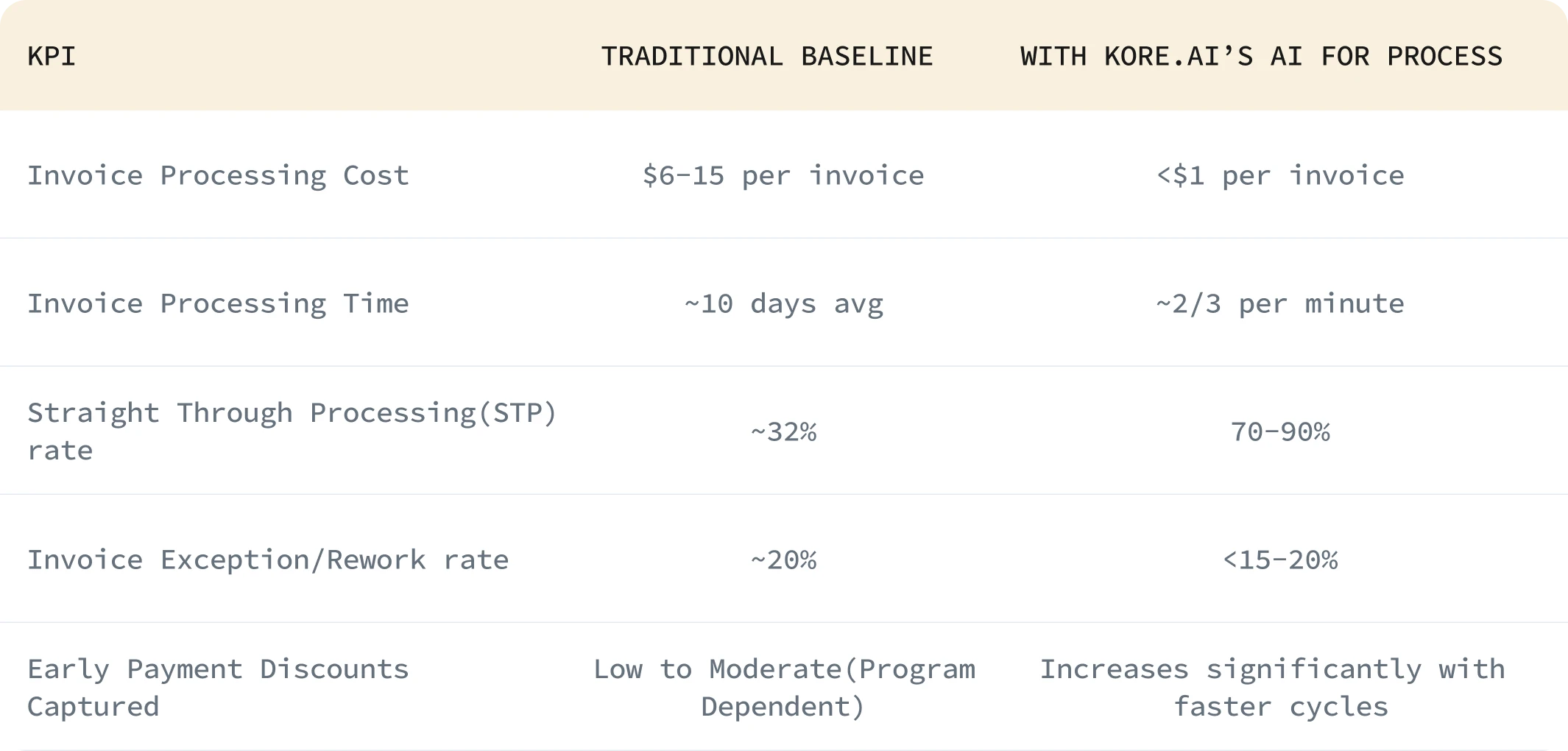
These gains don’t require discarding existing systems. By layering Kore.ai’s agentic intelligence on top of current AP platforms, enterprises extend their automation coverage from today’s 50-60% to 80%+ - without disrupting prior investments.
To put the opportunity in perspective: the U.S. federal government has lost an estimated $2.8 trillion since 2003 through improper payments — and ~$162B in just FY 2024. Cutting even a small slice of that leakage via Kore.ai’s AIP for invoice processing translates into massive savings at scale.
Together, these findings show both the scale of inefficiency in today’s AP and the urgency for modernization. Also, this is not just about cost savings. Regulatory bodies such as the GAO and compliance frameworks like SOX require organizations to demonstrate financial controls, auditability, and fraud prevention. Kore.ai’s AI for Process provides built-in audit trails, exception logs, and reasoning transparency, helping enterprises meet compliance requirements while reducing exposure to improper payments.
Beyond the numbers, organizations also see:
- Cost Reduction: AP overhead drops by 60–70%.
- Faster Vendor Payments: Stronger supplier relationships and improved working capital.
- Negotiation Leverage: On-time or early payments create leverage for securing better terms, discounts, and strategic vendor partnerships.
- Reduced Risk & Compliance Alignment: Fewer duplicates, lower fraud exposure, and improved audit readiness. Built-in audit trails and exception logs support SOX, GAO, and other regulatory requirements.
- Scalability: Long-tail invoices automated at scale, without brittle templates.
The end state: Autonomous invoice processing
The future of accounts payable is not about making existing workflows marginally faster. It is about removing human effort from routine invoice processing altogether and reserving human judgment for the moments where it truly adds value.
In the zero-touch end state, 70–80 percent of invoices are processed straight-through, from receipt to payment, without manual intervention. Routine approvals no longer consume analyst time. Instead, AI agents handle validation, routing, and execution automatically, while humans focus on true exceptions, policy decisions, and strategic vendor negotiations.
This shift fundamentally changes the role of finance. AP teams move from transaction processors to strategic value creators. Visibility into cash flow improves. Compliance becomes proactive rather than reactive. Risk is addressed before payment, not after an audit. Finance leaders gain confidence that controls are enforced consistently, even as invoice volumes grow and supplier ecosystems become more complex.
Importantly, this vision aligns directly with AP’s 2024 strategic agenda. Across the industry, leaders are prioritizing deeper automation, elimination of paper-based processes, and smarter analytics to elevate AP into a true strategic partner to the business. Zero-touch invoice processing is not a future aspiration tied to hypothetical technology. With agentic intelligence, it is an operational reality that organizations can achieve today.
Why kore AI for process?
Kore.ai’s AI for Process is purpose-built to enable this transformation. Rather than replacing existing AP platforms, it complements them by introducing intelligence where static workflows fall short. It acts as an adaptive reasoning layer across Finance, Procurement, ERP, and Compliance, orchestrating decisions that traditional automation cannot.
At the foundation is document understanding at scale, enabling accurate extraction across both structured and unstructured invoices, regardless of format or language. On top of that, agentic orchestration allows AI agents to coordinate actions across ERP systems, finance applications, and approval workflows, dynamically adapting as conditions change.
Governance is not bolted on after the fact. It is built in by design. Every decision is logged, every exception is traceable, and every action is auditable, supporting regulatory frameworks such as SOX and oversight bodies like the GAO. This level of transparency is critical as organizations face increasing scrutiny around financial controls and improper payments.
Just as important is speed to value. New invoice formats and scenarios can be onboarded in days rather than months, allowing organizations to scale automation coverage without brittle templates or prolonged implementation cycles.
With Kore.ai’s AI for Process, invoice processing evolves from a manual bottleneck into a strategic advantage. Touchless invoice processing is no longer aspirational. It is achievable today. The question is no longer whether accounts payable will move to an autonomous model, but which organizations will lead the way. Talk to an expert at Kore.ai today to get started with automating AP invoicing with agentic process automation.
Share