





.webp)
AI agents for customer service are autonomous systems that resolve support requests end-to-end without human intervention. Here are the top 8 AI agents for enterprise customer support in 2026.
AI agents for customer support have quickly become one of the fastest-expanding applications of enterprise AI. In fact, AI agents are expected to automate around 70% of customer support interactions by 2027, according to Gartner.
Today, enterprises are moving towards “AI-native execution,” where businesses deploy autonomous intelligent systems that execute workflows end-to-end, without human intervention. This distinction matters because if your AI agent can’t issue a refund, change a flight, or troubleshoot a router without a handoff, it’s not an agent; it’s just a fancy FAQ.
As a result, enterprise leaders are facing a new challenge: separating true agentic platforms from tools that simply layer automation on top of chat interfaces. The market is now crowded with vendors claiming “agentic AI” capabilities. But very few offer the orchestration, governance, and scalability required to support complex, multi-agent customer service environments.
In this guide, we review the best 8 AI agents for customer service in 2026, evaluating each AI customer service agent based on their ability to support enterprise-grade automation and complex customer support workflows.
Key takeaways (The TL;DR)
- True AI customer service agents go beyond answering questions. They can understand context, respond with empathy, and take action autonomously across every channel and language.
- Not all AI agents are built the same. Some specialize in voice automation or contact-center workflows, while others support multi-agent orchestration and complex service journeys.
- Governance is critical for customer support AI agents. Capabilities like auditability, guardrails, and observability are essential for safe enterprise deployment.
- Enterprise platforms should support scale. Look for multi-agent orchestration, strong integrations with enterprise systems, AI governance controls, and proven deployment.
- At a glance: Best AI agents for customer service and customer support in 2026 are Kore.ai, Zendesk, NiCE Cognigy, Omilia, Soundhound, Sierra AI, Sprinklr, and Yellow.ai.
Before we dig into the topic deeper, let's quickly understand what exactly AI agents in customer service are.
What are AI agents for customer service?
Customer service AI agents, also called AI customer service agents, are intelligent systems that can resolve issues end-to-end. They autonomously understand a customer’s request, determine the necessary steps to resolve it, and execute those actions across enterprise systems, like processing a refund or updating a policy, without human intervention.
Unlike legacy chatbots that simply point users to FAQs, AI agents use text or voice to understand a customer’s needs, pull real-time data, apply reasoning, and trigger backend processes across CRM, billing, ticketing, contact center platforms, and more.
To be considered a true AI agent, it must possess 3 core capabilities:
1 - Reasoning and planning: Instead of following a rigid script, the agent understands the customer’s goal. It can think through the steps required to solve a problem.
2 - Tool use (Actionability): A true agent is connected to your tech stack via APIs. It has the keys to your enterprise systems and database, allowing it to take actions.
3 - Autonomous orchestration: AI agents can manage "multi-turn" conversations. This means they can ask clarifying questions, handle interruptions, and even hand off the task to another specialized AI agent if the request crosses departments (e.g., from Support to Finance).
What are the benefits of AI agents in customer service?
In 2026, customer service AI agents are transforming support by automating routine work and executing tasks end-to-end. The impact of AI agents has moved beyond “saving time” to creating measurable enterprise value across cost, speed, and customer experience.
Here are five of the most important advantages organizations see when adopting AI agents for customer support:
1. Reduction in operational costs
AI agents do more than deflect calls; they resolve them. By handling end-to-end tasks like account verification and billing updates without human intervention, they slash the "cost-per-interaction."
In fact, McKinsey reports that adopting agentic AI in customer operations can decrease service operation costs by up to 30% through automated systems and decreased customer repeat contacts.
2. Gains in resolution speed
One of the biggest advantages of AI agents is their ability to respond instantly and resolve issues faster than traditional support channels. AI systems can analyze requests, retrieve relevant information, and execute actions without waiting for human intervention.
Research shows organizations using AI in customer service can reduce first-response times by up to 74%, dramatically improving the speed of support interactions.
3. Higher CSAT and Customer Lifetime Value (CLV)
When customers get what they want instantly without repeating themselves to multiple human reps, satisfaction scores soar. Proactive agents can even prevent issues before they occur, increasing long-term loyalty.
According to McKinsey, AI models show a 15% to 20% increase in customer satisfaction and up to a 20% reduction in attrition (churn) for high-value segments.
4. Higher productivity for support teams
AI agents don't just replace tasks; they empower your human workforce. According to BCG, AI agents can reduce an employee’s “low-value work time” by 25% to 40%. By handling the "busywork," they allow human agents to focus on high-empathy, high-complexity cases that require a personal touch.
5. Scalable 24/7 customer support
Unlike human agents, AI systems can operate continuously without downtime. This allows companies to provide customer support across different time zones and handle spikes in demand during peak periods.
Studies show that more than half of companies are already deploying AI for customer service automation and faster responses, highlighting how quickly organizations are adopting AI to scale support operations.
8 best AI agents for customer service in 2026 & beyond
Now that we’ve covered what AI agents for customer service are and how they’re transforming support, the next step is understanding which ones are leading the market.
It’s important to note that enterprises don’t typically buy standalone agents. They adopt agentic AI platforms to build, deploy, and manage these agents at scale.
Below are the 8 best customer service AI agent platforms that stand out in 2026 and beyond, along with a breakdown of where they excel, the problems they solve, and the use cases they’re best suited for.
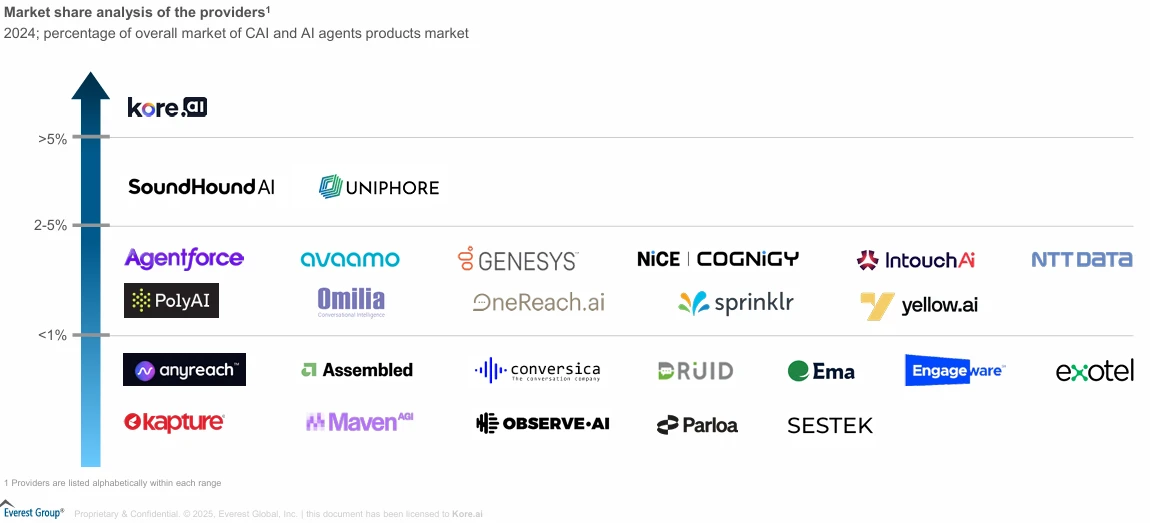
(Source: Everest Group AI Agents for CXM PEAK Matrix® Assessment Q4 2025)
1. Kore.ai - Best for enterprise-grade AI agents across complex customer service workflows
Kore.ai is an enterprise-grade agentic AI platform that helps organizations design, deploy, manage, and scale AI agents across industries. It is particularly well-suited for organizations that need to automate support across chat and voice, connect AI agents to core business systems, and maintain strong governance as automation scales.
What sets Kore.ai apart is its ability to balance structured workflows with AI-driven conversations. According to Everest Group AI Agents for CXM PEAK Matrix® Assessment 2025, the platform excels by combining traditional intent-based automation with advanced LLM capabilities. This ensures that while the conversation feels natural and context-aware, the business maintains 100% control over accuracy and compliance.
At the heart of Kore.ai’s agent platform is its multi-agent orchestration engine. Everest Group highlights Kore.ai’s “intelligent delegation” and “long-term memory” as standout strengths. This allows enterprises to design journeys where different specialized AI agents collaborate seamlessly to resolve a single customer issue.
Furthermore, Kore.ai augments human agent performance with its Agent Assist and live service operations suite. This suite provides next-best-action guidance, knowledge surfacing, live transcription, call summarization, and post-interaction analysis, along with bi-directional CRM integrations that surface customer data in real time. These features help elevate human agent productivity in the contact center environments.
Where Kore.ai truly comes into its own, though, is in its AI governance-first approach. The platform includes a comprehensive AI governance dashboard that provides full visibility into every agent’s decisions, actions, and performance. Enterprises can trace interactions, monitor agent reasoning, manage security guardrails, enforce role-based access controls (RBACs), and review detailed audit logs to ensure compliance and responsible AI behavior at every step.
Kore.ai is trusted by 400+ Fortune 2000 companies, delivering more than $1Bn in cost savings. They have proven across industries like finance, healthcare, technology, manufacturing, telecom, and retail, with deep expertise in complex workflows.
Key features of Kore.AI for customer service
- AI agents for chat and voice - Deploy AI agents that automate omnichannel customer interactions across chat, voice, and digital channels while resolving real service requests such as account updates, troubleshooting, or order changes.
- Multi-agent orchestration - Design service journeys where multiple AI agents collaborate, share context, and complete different parts of a customer request from authentication to resolution.
- Native voice experience - Ensure high-quality, low-latency voice interactions with a native, customizable voice infrastructure that handles billions of interactions every year.
- Agent assist for contact center teams - Provide real-time guidance to human agents with capabilities such as next-best actions, knowledge recommendations, live transcription, and automated call summaries.
- AI-driven quality monitoring - Automatically evaluate customer interactions, monitor service quality, and generate insights that help managers improve agent performance and compliance.
- Outbound engagement automation - Run proactive voice and digital campaigns for notifications, reminders, or service updates while personalizing communication at scale.
- 250+ enterprise-grade, plug-and-play integrations give agents direct access to systems like CRM, ITSM, HRIS, ERP, and data lakes. Teams can also add custom integrations or bring in any system they need, without heavy engineering.
- No-code + pro-code development framework lets business teams build visual workflows and agent logic without writing code, while developers extend functionality with APIs, custom skills, and deeper integrations.
- Agent marketplace with 300+ pre-built AI agents allows enterprises to build and deploy agents up to 10 times faster and start generating ROI from the get-go.
Pros of Kore.ai
- Strong fit for enterprises handling complex, high-volume customer service operations
- Combines structured automation with more flexible LLM-based interactions
- Advanced multi-agent orchestration for more complex service journeys
- Strong agent-assist capabilities for live contact center teams
- Good deployment flexibility for organizations with compliance or data residency requirements
- Flexible pricing (Request-based, session-based, per-seat, or pay-as-you-go pricing structures)
- Deep integration ecosystem with 250+ plug-and-play enterprise connectors
- Agent marketplace with 300+ pre-built AI agents
- Proven scalability, trusted by 400+ Fortune 2000 enterprises
- Recognized as a Leader by Gartner, Forrester, Everest, and G2 in relevant categories
Cons of Kore.ai
- Less aligned with the needs of SMBs looking for simpler, lightweight, and point solutions
- Video-based agent interactions are less mature than chat and voice capabilities.
- The wide product suite may overwhelm teams without a structured onboarding plan and defined starting points.
- Given the number of integrations, some documentation, especially for newer connectors, is evolving.
Analyst recognition
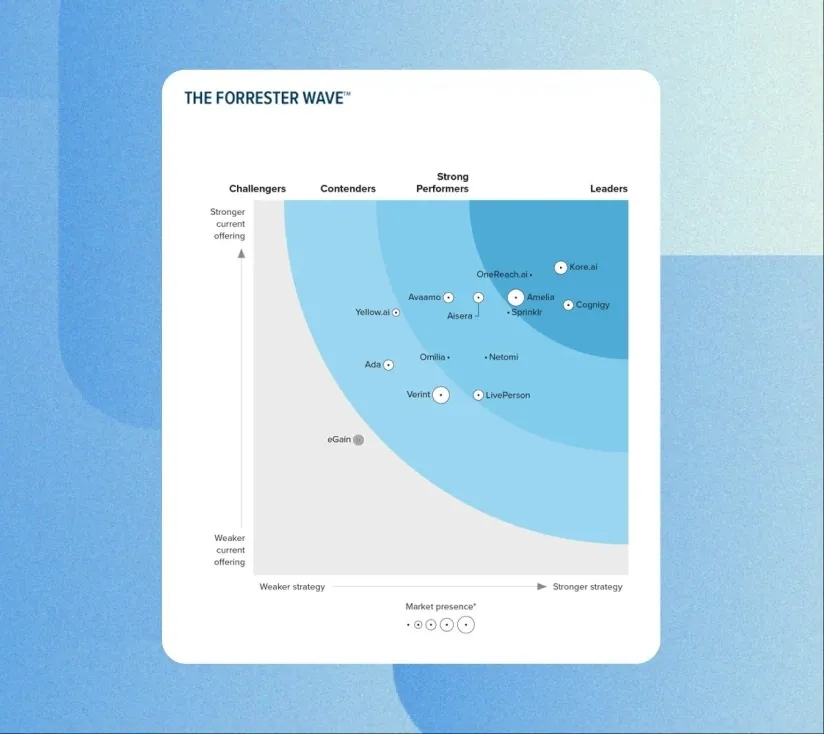
- Kore.ai is named a Leader in Forrester Wave™: Conversational AI platforms for customer service, Q2 2026.
- Kore.ai platform has been named a Leader in the Everest Group’s Agentic AI Products PEAK Matrix® Assessment 2026.
- Kore.ai has been named a Leader in the 2026 AIM Research’s PeMa Quadrant for Agentic AI Platform Providers.
- Kore.ai platform has been named a Leader in the Gartner® Magic Quadrant™ for Conversational AI Platforms, 2025, for the third consecutive year.
- Kore.ai has been named a Leader in the Everest Group’s Conversational AI & AI Agents in CXM Products PEAK Matrix® Assessment 2025.
Overall verdict
Kore.ai enables enterprises to introduce AI agents into customer service. Its combination of workflow control, multi-agent orchestration, live agent-assist features, and deployment flexibility makes it especially relevant for enterprises looking to automate complex support journeys while keeping governance and service quality in check. If your goal is to orchestrate secure, autonomous, and scalable AI agents for customer service, Kore.ai stands out as one of the strongest options in the market.
2. Zendesk - Best for organizations already tied to the Zendesk ecosystem
Zendesk is a widely used customer service platform, best known for its help desk, ticketing, and customer support management tools. In recent years, the company has begun transitioning from a traditional ticketing system to a more AI-driven service platform.
Zendesk AI Agents are designed for rapid deployment, specifically for enterprises already within the Zendesk ecosystem. One of Zendesk’s biggest advantages is its seamless integration – AI agents operate within the same interface that service teams already use, allowing companies to introduce automation without major platform changes.
However, Zendesk’s AI capabilities remain closely tied to its legacy support architecture. As a result, the platform feels strongest when AI is layered into the existing Zendesk ecosystem, and not necessarily as a broader AI agent platform for highly complex enterprise orchestration.
Gartner, in its Magic Quadrant™ for the CRM Customer Engagement Center 2025, cautions that Zendesk’s business rule engine is not fully customizable for very large centers with advanced business processes or specialized UI requirements. The report also notes that some large-scale clients have reported hurdles when seeking technical support for complex integrations.
Another consideration relates to how Zendesk AI agents handle knowledge retrieval. Currently, Zendesk AI agents do not support search rules for knowledge sources. In practical terms, this means organizations cannot instruct the AI agent to retrieve information only from specific knowledge bases for certain users or contexts. Enterprises managing regional documentation or role-specific knowledge repositories may therefore find it harder to control which information the AI agents reference during interactions.
Finally, Gartner highlights pricing complexity during contract renewals. Zendesk’s negotiation practices and pricing structure can make long-term cost predictability difficult. Enterprises should proactively negotiate price-increase caps and clear definitions for Zendesk’s “outcome-based” pricing to maintain long-term budget predictability.
Key features of Zendesk AI agents
- Automated customer support responses - Zendesk AI agents can handle common support queries across channels such as chat, messaging platforms, and email, helping teams automate repetitive requests and reduce ticket volume.
- AI copilot for human agents - Zendesk provides an AI assistant that supports service agents during live interactions by generating ticket summaries, suggesting replies, and surfacing relevant context from past conversations.
- Smart ticket routing and triage - The system can analyze incoming support requests, identify customer intent, and automatically route tickets to the appropriate team or workflow.
- Knowledge-driven automation - Zendesk AI agents retrieve answers from help center articles and historical support data to respond to customer questions and resolve common issues.
- Operational insights and reporting - AI-powered analytics provide visibility into customer interactions, resolution trends, and support performance to help teams improve service operations.
Pros of Zendesk AI agents
- Strong fit for organizations already using the Zendesk customer service platform
- AI copilot capabilities that assist human agents
- Automated ticket triage
- Quick deployment for teams with an established Zendesk knowledge base
- Multichannel support across chat, messaging, and email
Cons of Zendesk AI agents
- AI capabilities are closely tied to the Zendesk ecosystem, limiting flexibility for organizations using multiple support platforms
- Effectiveness depends heavily on the quality and structure of the help center's knowledge base
- Limited ability to control knowledge retrieval rules in generative procedures
- Primarily optimized for help-desk automation rather than complex multi-agent orchestration
- Outcome-based pricing models can make cost forecasting more difficult for enterprises scaling automation
- Advanced automation capabilities may require higher-tier Zendesk plans or additional add-ons
Analyst recognition
- Zendesk is positioned as a Visionary in Gartner’s Magic Quadrant™ for the CRM Customer Engagement Center 2025.
Overall verdict
Zendesk AI Agents are best suited for organizations already using Zendesk for customer support. Their biggest advantage is the seamless integration with existing ticketing workflows, making it easy for teams to introduce AI-driven automation.
However, because its AI capabilities remain closely tied to the Zendesk ecosystem and help-desk architecture, enterprises exploring broader agentic orchestration or complex multi-system automation may find the platform more limited in scope.
3. NiCE Cognigy - Best for contact center voice and chat automation
Cognigy (recently acquired by NiCE) is a contact-center-focused platform that has evolved its offering to support AI agents for enterprise customer experience. The platform focuses on voice and chat automation, enabling enterprises to build conversational workflows that support customer interactions across digital channels and telephony systems.
In the 2025 Magic Quadrant™ for Conversational AI Platforms report, Gartner highlights Cognigy’s multimodal capabilities and process management features, describing the platform as highly usable for building conversational applications.
However, for organizations looking for highly autonomous reasoning agents, the architecture might present a challenge. Cognigy’s flow-based architecture, which evolved from traditional conversational design patterns, can feel less flexible when teams are building very specialized or highly dynamic agent behaviors. In these cases, the “logic-tree” heritage of the platform can become a bottleneck compared to newer, agent-first architectures.
Further, Gartner cautions that Cognigy’s strategic direction around agentic AI may appear less distinct and more generic compared to some competitors, which may be a consideration for enterprises evaluating broader AI agent orchestration capabilities.
More broadly, now that Cognigy is part of NiCE, the roadmap may be uncertain. Some organizations may want to watch how the product settles over time. Gartner also observes that historically Cognigy’s strategy tends to prioritize near-term commercial execution over a longer-range, research-driven product vision, which is worth keeping in mind for teams planning multi-year agentic CX programs.
Key features of NiCE Cognigy
- Native Voice Gateway for high-volume, low-latency telephony environments
- Visual conversation flow builder with a node-based design
- Multilingual AI agents supporting more than 100 languages
- Role-based access and governance controls
- Flexible deployment options, including on-premises or private cloud
- Prebuilt omnichannel connectors for platforms such as Slack, WhatsApp, and web chat
Pros of NiCE Cognigy
- Strong capabilities for conversational AI in contact center environments
- Flexible development approach supporting both low-code and developer workflows
- Effective at modernizing IVR and voice automation systems
- Solid multichannel support across voice and digital channels
Cons of NiCE Cognigy
- The flow-based legacy architecture can be restrictive for highly dynamic or complex autonomous agent behavior.
- Lacks a strong “agentic” vision compared to research-first competitors.
- Higher learning curve for very deep customizations
- Roadmap may be uncertain post-acquisition
- Strategy leans toward immediate sales and execution rather than fundamental AI innovation.
Analyst recognition
- Cognigy is positioned as a Leader in the 2025 Gartner Magic Quadrant for Conversational AI Platforms.
- Cognigy is positioned as a Leader in the 2025 Everest Conversational AI agents PEAK Assessment.
Overall verdict of NiCE Cognigy
NiCE Cognigy is well-suited for enterprises looking to modernize an existing contact center with proven conversational tools. Its strong voice capabilities make it attractive for enterprises modernizing legacy IVR systems.
However, enterprises looking for the next generation of "reasoning" agents that can operate outside of rigid flows should carefully evaluate whether Cognigy’s roadmap will keep pace with the rapidly evolving frontier of agentic AI.
4. Omilia - Best for enterprise prioritizing voice-first channels
Omilia is a conversational AI platform focused primarily on voice-based customer service automation. The company offers advanced speech recognition and natural language understanding technologies designed specifically for contact center environments.
Everest Group, in its Conversational AI Agents in CXM Products PEAK Matrix® Assessment 2025 report, highlights its strengths in conversational analytics and voice AI capabilities. The report also notes the platform’s ability to support both deterministic workflows and probabilistic conversational models, giving enterprises flexibility in how they design and optimize customer interactions.
However, the Everest report also observes that while Omilia continues to expand its digital capabilities, most deployments remain focused on voice, meaning organizations prioritizing omnichannel automation may need to assess whether the platform’s digital capabilities align with their CX strategy.
Gartner, in its 2025 Magic Quadrant™ for Conversational AI Platforms report, notes that Omilia’s market presence is smaller than some larger CX technology vendors and that its strongest footprint remains in EMEA. This may be a consideration for global enterprises evaluating vendor reach and ecosystem maturity.
In addition, while the platform offers some agent-assist capabilities, it currently lacks the ability to ensure fulfillment of commitments made by human agents during calls. It also does not support human-triggered AI agents executing tasks in real time on behalf of agents during live interactions, which may limit certain advanced contact center automation scenarios.
Key features of Omilia
- Pathfinder orchestration engine that analyzes call transcripts and unstructured data to optimize conversational workflows
- Deep-learning voice biometrics for real-time identity verification during customer interactions
- xSense NLU optimized for noisy telephony environments and complex voice interactions
- Testing Studio+ simulation environment for evaluating and stress-testing conversational AI agents
- Conversational analytics tools for monitoring and optimizing customer interactions
Pros of Omilia
- Strong capabilities in voice-based conversational AI
- Advanced conversational analytics and performance insights
- Flexible conversational design frameworks for customer service automation
- Proven experience supporting large-scale contact center deployments
Cons of Omilia
- Primarily focused on voice automation rather than broader agentic AI orchestration
- Omilia’s ability to serve clients across regions remains untested
- Limited experience deploying conversational AI solutions for sales and marketing processes
- Limited experience supporting B2B and B2E conversational use cases
- Agent-assist capabilities do not currently ensure fulfillment of commitments made by human agents
- Does not support human-triggered AI agents executing tasks in real time during live interactions
- Buyers expect greater flexibility, scalability, and clearer communication around the product roadmap
Analyst recognition
- Omilia is positioned as a Visionary in the 2025 Gartner Magic Quadrant for Conversational AI Platforms.
- Omilia is positioned as a Leader in the 2025 Everest Conversational AI agents PEAK Assessment.
Overall verdict of Omilia
Omilia enables enterprises to introduce advanced conversational AI into voice-driven customer service environments. With a strong presence and customer base in EMEA, the platform has proven capabilities in large-scale voice deployments.
However, enterprises evaluating broader omnichannel customer experience automation should consider the platform’s voice-centric deployment history, regional experience, and evolving enterprise capabilities when assessing its long-term fit.
5. Soundhound AI - Ideal for enterprises prioritizing voice AI in CX
SoundHound AI has expanded its enterprise conversational AI footprint following its acquisition of Amelia, an enterprise AI platform previously focused on cognitive automation and customer service workflows. The combined platform aims to bring together SoundHound’s proprietary voice AI technology with Amelia’s conversational automation and enterprise orchestration capabilities.
Everest, in its report, notes that the platform supports agentic AI frameworks capable of reasoning, planning, and executing multi-step tasks, allowing enterprises to automate complex workflows.
However, the Everest reports that while SoundHound offers orchestration between internal AI agents, native integration with third-party agent platforms is not yet available, and support for emerging interoperability standards such as Model Context Protocol (MCP) is not fully implemented.
From an operational standpoint, the report also points out that while SoundHound can evaluate agent performance across conversations in real time, it does not currently provide coaching guidance for human agents, such as recommendations on tone, phrasing, or conversational improvements during live interactions.
Finally, the Everest report also highlighted several operational areas for improvement, including more robust quality control during platform version upgrades, lower latency in AI agent responses, and reduced technical complexity for large-scale deployments.
Key features of SoundHound AI
- AI Proprietary voice AI engine optimized for real-time conversational interactions
- Agent orchestration capabilities supporting multi-step workflow automation
- Design assistants and no-code tools for building conversational agents
- Multilingual conversational support across voice and digital channels
- Integration capabilities enabling automation across enterprise systems
- Performance monitoring tools for evaluating conversational interactions
Pros of SoundHound AI
- AI Strong voice recognition and conversational speech processing capabilities
- Proprietary speech technology optimized for real-time conversations
- Agent orchestration capabilities supporting complex conversational workflows
- Flexible development tools for building enterprise conversational experiences
Cons of SoundHound AI
- Native integration with third-party AI agent platforms is not yet available
- MCP support is still planned
- Effective deployment depends heavily on clearly defined goals and agent-tuning expertise
- Multimodal sentiment analysis capabilities remain limited
- No real-time coaching guidance for human agents during customer interactions
- Industry metrics for performance dashboards are still evolving
- Buyers highlighted the need for stronger quality control during platform upgrades
- Latency improvements and reduced technical complexity are requested by enterprise users
Analyst recognition
- SoundHound AI is positioned as a Visionary in the 2025 Gartner Magic Quadrant for Conversational AI Platforms.
- SoundHound is positioned as a Leader in the 2025 Everest Conversational AI agents PEAK Assessment.
Overall verdict of SoundHound AI
SoundHound AI enables enterprises to introduce advanced conversational AI into voice-driven customer service environments. Its speech recognition and agent orchestration capabilities make it particularly effective for organizations prioritizing real-time voice automation.
However, enterprises evaluating broader AI agent ecosystems should consider the platform’s evolving interoperability capabilities, operational complexity, and buyer-reported areas for improvement when planning large-scale deployments.
6. Sierra AI - Ideal for small and medium teams adopting autonomous customer service
Sierra AI is a young startup in the agentic AI landscape. Founded in 2023, the platform focuses on building autonomous AI agents for customer service operations. The platform's architecture centers on goal-oriented agents that pursue specific outcomes, such as resolving billing issues or retaining customers.
Another key component of the platform is Sierra’s Agent Data Platform (ADP), which stores long-term customer context. This allows agents to maintain continuity across interactions and personalize responses based on historical data.
However, Forrester, in its Wave™: Conversational AI Platforms For Customer Service, Q2 2026, flags that Sierra is below par in some capabilities important to traditional contact center teams, including connecting to legacy systems and escalation to live agents. This means enterprises with complex contact center environments and legacy systems should carefully evaluate Sierra.
Forrester also notes that Sierra still needs to strengthen areas such as reporting, administration, and development tools. These capabilities matter for businesses that need strong operational visibility, performance management, and internal control across large support teams.
On the pricing front, Sierra uses an outcome-based pricing model, where customers are billed based on specific business results achieved by agents. While attractive in theory, “outcomes” can be tricky to define, potentially creating cost fluctuations, billing disputes, and budgeting challenges.
Another operational consideration, Forrester notes, is around implementation. Although Sierra markets the platform as no-code, deployments often involve significant technical collaboration with Sierra’s Forward Deployed Engineers, who function similarly to implementation consultants. In practice, this can resemble a managed-service model rather than a fully self-serve platform.
Key features of Sierra AI
- Goal-oriented AI agents capable of completing end-to-end service workflows
- Agent Data Platform (ADP) that stores long-term customer context for personalization and decision-making
- Agent Studio and Agent SDK for building and deploying AI agents across enterprise systems
- Brand-level customization to align agent behavior with company policies and operational workflows
Pros of Sierra AI
- Strong focus on autonomous customer service automation
- Goal-oriented agents capable of executing real business tasks
- Flexible multi-LLM support
Cons of Sierra AI
- Single-agent architecture may be less suitable for complex enterprise service environments
- An “outcome-based” pricing model can make budgeting and cost forecasting difficult
- Performance and reliability at a very large enterprise scale remain relatively unproven
- Implementation often requires collaboration with Sierra’s Forward Deployed Engineers, increasing onboarding time and operational dependency
- Enterprise deployment track record remains limited compared with established vendors
Analyst recognition
Sierra AI is positioned as a Strong Performer in the Forrester Wave™: Conversational AI Platforms For Customer Service, Q2 2026
Overall verdict of Sierra AI
Sierra is a good option for organizations that want to introduce autonomous customer service, especially for workflows like refunds, account updates, and subscription changes. However, as a relatively new platform, Sierra’s enterprise maturity, scalability, and ecosystem are still developing. Organizations planning large-scale automation initiatives should carefully evaluate the platform’s outcome-based pricing model, implementation approach, and architectural fit.
7. Yellow.ai - Best for quick-start CX
Yellow.ai is a conversational AI platform designed to automate customer interactions across digital and voice channels. The platform supports chat, voice, SMS, email, and social media automation, allowing enterprises to deploy AI-powered customer service across multiple touchpoints from a single environment.
Gartner, in its report, highlights Yellow.ai’s ability to support omnichannel CX use cases through tools such as an AI agent builder for deploying multichannel conversational agents and Agentic Discovery, which analyzes historical support tickets to uncover trends and insights.
However, Gartner also highlights several strategic considerations. Yellow.ai’s customer base is primarily concentrated in Asia, with comparatively limited presence in North America and Europe. Organizations operating globally may therefore want to assess whether the vendor’s regional coverage and partner ecosystem align with their deployment needs.
Gartner also cautions that Yellow.ai holds fewer regulatory and compliance certifications compared with many other vendors in the report. It’s also worth noting that in September 2025, an XSS vulnerability in a Yellow.ai support chatbot could have exposed session cookies to theft. Though Yellow.ai has since patched the issue, for organizations in regulated or high-risk environments, it’s a useful reminder that security maturity and guardrails should be central to any platform evaluation.
Finally, Gartner highlights that Yellow.ai’s R&D organization is relatively smaller compared to other vendors. For enterprises evaluating long-term innovation and technical differentiation, this could be a factor when comparing vendors.
Key features of Yellow.ai
- Omnichannel automation across chat, voice, SMS, email, and social channels
- AI agent builder for deploying multichannel conversational agents
- Agentic Discovery tools that analyze historical support data
- Prebuilt workflows and templates for common customer service scenarios
- Analytics and monitoring capabilities for tracking performance and customer interactions
Pros of Yellow.ai
- Strong omnichannel automation capabilities across voice and digital channels
- Positive customer feedback on platform experience
- Pre-built templates that accelerate deployment
Cons of Yellow.ai
- R&D investment and research output are smaller compared to many competitors
- Customer base remains heavily concentrated in Asia, with very limited presence in North America and Europe
- Fewer regulatory certifications than several competing conversational AI vendors
- Complex enterprise workflows may require additional engineering despite “quick-start” positioning
Analyst recognition
- Yellow.ai is positioned as a Challenger in the 2025 Gartner Magic Quadrant for Conversational AI Platforms.
- Yellow.ai is positioned as a Major contender in the 2025 Everest Conversational AI agents PEAK Assessment.
Overall verdict
Yellow.ai enables organizations to introduce AI-powered automation across customer service channels quickly. Its usability and prebuilt workflows make it a strong option. However, enterprises evaluating long-term AI agent strategies should carefully assess the regulatory certifications, geographic footprint, and platform’s research investment, especially if they require deep enterprise governance or global-scale deployments.
8. Sprinklr - Ideal for social-first customer service
Sprinklr positions itself as a Unified-CXM (Customer Experience Management) platform, aiming to be the single operating system for managing end-to-end customer experience operations. This essentially means that Sprinklr integrates AI agents into wider customer engagement workflows, including social listening, digital marketing, and service management, giving a more holistic view of the customer’s public and private interactions than a standalone CRM.
According to Gartner’s 2025 Magic Quadrant™ for Conversational AI Platforms, Sprinklr serves customers across North America, Europe, the Middle East, and Southeast Asia, and is continuing to expand its roadmap with AI copilots and multimodal conversational capabilities.
However, Gartner highlights several considerations while evaluating Sprinklr. The report notes that Sprinklr’s product architecture is split into two separate interfaces — Conversational AI and AI Agent Studio. This means that developers must choose between these interfaces depending on the specific GenAI or agentic features required, which creates a disjointed and confusing coding experience.
Pricing structure is another factor to assess. Gartner indicates that Sprinklr’s pricing model is generally less transparent than those of several competitors. Plus, its AI Agent Studio is locked behind the highest pricing tier, making it difficult for organizations to predict long-term costs.
Finally, Gartner notes that Sprinklr has shown slower employee growth in its conversational AI business compared with other vendors in the market. Combined with the platform's workforce reduction of around 15% in early 2025, may further impact the company’s ability to scale product development and support for conversational AI deployments over time.
Key features of Sprinklr
- Conversational AI integrated into the broader Unified-CXM customer experience platform
- AI Agent Studio for building conversational automation workflows
- Unified agent desktop combining AI-driven and human-assisted customer interactions
- Omnichannel engagement across web, messaging, and voice channels
- Multilingual conversational capabilities with native speech-to-text and text-to-speech support
Pros of Sprinklr
- Global customer base across multiple regions
- Broad partner ecosystem
- Strong language support with native voice and text capabilities
- Integrated CXM platform that combines conversational AI with customer engagement tools
Cons of Sprinklr
- Conversational AI capabilities are split across multiple interfaces, which can complicate development workflows
- AI Agent Studio available only in higher pricing tiers
- Pricing structure less transparent
- Slower employee growth in conversational AI compared with other vendors
Analyst recognition
- Sprinklr is positioned as a Niche Player in the 2025 Gartner Magic Quadrant for Conversational AI Platforms.
Overall verdict of Sprinklr
Sprinklr is relevant for an organization where social media is the primary customer touchpoint, plus one that already uses Sprinklr to manage social and digital customer engagement.
However, enterprises evaluating platforms specifically for large-scale customer support automation should carefully assess the platform’s architecture, pricing transparency, and product roadmap.
How to choose an AI agent for customer service
Selecting the right AI agent for customer service is not just about features. For organizations asking what recommendations can be made for the best custom AI agents for customer support, the answer comes down to four key criteria: fast deployment, flexible automation, strong analytics, and the ability to scale as service operations grow.
1. Fast time-to-value
Customer support teams need automation that delivers results quickly. Platforms with rapid deployment capabilities, prebuilt templates, and strong domain expertise can significantly shorten implementation timelines.
Look for vendors that provide ready-to-use customer service workflows, such as order status, refunds, account updates, or password resets, so teams can move from pilot to production faster and start realizing ROI sooner.
2. Easy workflow building
AI agents must do more than answer questions; they need to execute service workflows and complete tasks across enterprise systems. The best platforms offer low-code tools, visual workflow builders, and prebuilt integrations that allow support teams to design and refine automation without relying heavily on engineering resources. At the same time, the platform should support deeper customization for more complex service journeys.
3. Advanced analytics and insights
Once AI agents are deployed, organizations need visibility into performance. Strong platforms provide analytics that track resolution rates, containment, escalation trends, and customer sentiment. More advanced tools also offer predictive insights that help teams optimize workflows, identify friction points, and continuously improve customer service automation.
4. Enterprise scalability
Customer support automation rarely stops at a single use case. The right platform should scale across channels, geographies, brands, and support teams while maintaining consistent service quality.
Evaluate whether the solution can handle higher interaction volumes, integrate with existing CX systems, and support long-term expansion without requiring major architectural changes. For regulated industries or organizations with strict data residency requirements, also assess whether the platform supports on-premise deployment — a critical distinction when choosing an on-premise AI customer service platform for enterprise software.
Conclusion: Choosing the right AI agent for customer support
Selecting the right AI agent platform ultimately depends on how ambitious your customer service automation roadmap is over the next 24-36 months. Some organizations start with basic self-service automation, while others aim to deploy AI agents that can handle complex workflows, assist live agents, and orchestrate actions across multiple enterprise systems.
Before choosing a platform, it helps to clarify a few key considerations:
- Your current and future customer service use cases - Are you solving a single problem today, such as FAQ automation or order tracking, or planning to expand into more advanced workflows like refunds and proactive service automation?
- Required scale and reliability - Customer support environments often handle thousands or even millions of interactions. Can the platform maintain performance while supporting higher volumes and additional channels?
- Flexibility across channels and integrations - Customer support increasingly spans chat, voice, messaging, and social channels. The right platform should integrate easily with your existing CX systems, CRM platforms, and knowledge bases.
- Governance, security, and operational control - For enterprise deployments, it’s important to ensure AI agents operate within defined guardrails. Can the platform enforce policies, provide visibility into decisions, and maintain compliance with organizational and regulatory requirements?
- Commercial fit and cost predictability - Pricing models vary widely, from usage-based pricing to outcome-based models. Enterprises should evaluate whether the vendor’s pricing structure aligns with their long-term automation strategy.
- Vendor maturity and validation - Consider the vendor’s track record. Analyst recognition, large enterprise deployments, and proven customer outcomes can help reduce risk when introducing AI agents into mission-critical customer service environments.
Across the platforms discussed in this guide, each of these AI customer service agents brings different strengths depending on the organization's priorities — whether the focus is high-ticket service scenarios requiring governance and precision, or high-volume automation at enterprise scale. Some platforms excel in voice automation, others in social or omnichannel engagement, while several focus on rapid deployment for customer service workflows.
However, for enterprises looking to deploy AI agents at scale across complex customer support environments, Kore.ai stands out as one of the most comprehensive platforms. Its capabilities include:
- Enterprise-grade AI agents for customer support automation
- Multi-agent orchestration to coordinate workflows across systems and teams
- Deep integrations with enterprise CX, CRM, and contact center platforms
- Flexible deployment models to support enterprise governance and compliance
- Flexible pricing structures suited for large-scale automation initiatives
- Proven scalability with adoption across hundreds of large global enterprises
- Recognition from major industry analysts
For organizations planning to expand automation across customer service operations over time, Kore.ai provides a strong foundation for building and scaling enterprise-grade service automation.
Ready to see how Kore.ai can help you build and scale enterprise-grade AI agents? Schedule a custom demo. Not ready yet? Explore our resources section to learn more about AI agents for customer support.
FAQs
Q1. What is the difference between AI agents and chatbots in customer service?
Traditional chatbots typically follow scripted workflows and respond to predefined intents. AI agents go further by reasoning through a customer’s request, accessing enterprise systems through APIs, and executing actions such as updating accounts, processing refunds, or troubleshooting issues without human intervention.
Q2. How exactly do AI agents work in customer service?
AI agents interpret customer requests using natural language understanding, identify the customer’s intent, and determine the steps required to resolve the issue. They retrieve information from enterprise systems such as CRM platforms, ticketing tools, knowledge bases, and billing systems. Depending on the request, the agent may provide an answer, execute an action like updating account details, or escalate the issue to a human agent with full context.
Q3. What use cases can AI agents automate in customer support?
AI agents can automate a wide range of customer service workflows, including order tracking, password resets, billing updates, subscription changes, troubleshooting technical issues, appointment scheduling, and refunds. More advanced implementations allow agents to orchestrate multi-step workflows across CRM, billing, and support systems.
Q4. How to measure the success of AI agents in customer support?
Organizations typically track metrics such as resolution rate, containment rate, average handling time, customer satisfaction (CSAT), cost per interaction, and escalation rates. These metrics help determine whether AI agents are improving service efficiency and customer experience.
Q5. How do human agents work alongside AI agents?
AI agents and human agents typically operate in a collaborative model. AI agents autonomously handle routine service workflows such as account updates, refunds, or troubleshooting. When requests require judgment, policy exceptions, or emotional support, the AI escalates the interaction to a human agent with full context, allowing support teams to focus on complex or high-value cases.
Q6. What is the biggest challenge when deploying AI agents for customer support?
One of the most common challenges is ensuring that AI agents are connected to reliable data and well-structured workflows. Without strong integrations, clear service processes, and high-quality knowledge sources, even advanced AI systems may struggle to resolve customer requests accurately.
Q7. What security and governance features should enterprises look for in AI agents?
Enterprise deployments require strong governance capabilities such as role-based access control, audit logs, policy guardrails, model monitoring, and explainability. These features ensure that AI agents operate within defined boundaries and remain compliant with regulatory and organizational requirements.
Q8. What AI agents are available for automating customer service tasks?
Several enterprise platforms offer AI agents purpose-built for customer service automation. The most comprehensive options in 2026 include Kore.ai for enterprise-wide orchestration, Zendesk AI Agents for help-desk automation, NiCE Cognigy for contact center voice and chat, Omilia for voice-first environments, SoundHound AI for voice-driven CX, Sierra for autonomous customer workflows, Yellow.ai for omnichannel quick deployment, and Sprinklr for social-first customer engagement. Each platform varies in orchestration depth, governance capabilities, and deployment flexibility.
Q9. What AI agents offer customer support automation?
AI agents that offer customer support automation typically provide three core capabilities: natural language understanding to interpret customer requests, integration with enterprise systems like CRM, ITSM, and billing platforms to take action, and multi-turn conversation management to handle complex, multi-step service workflows. Platforms like Kore.ai is among the leading options for deploying AI-driven customer support automation at enterprise scale.
Q10. What platforms offer tools to build AI agents for customer service?
Platforms that offer tools to build AI agents for customer service typically include a combination of no-code workflow builders, pre-built agent templates, enterprise system integrations, and governance controls. Kore.ai's Agent Platform is one of the most comprehensive, offering a no-code and pro-code development framework alongside 250+ pre-built integrations and an agent marketplace with 300+ ready-to-deploy agents.
Q11. Which AI task management solutions have the best customer support?
Enterprises looking for AI platforms that combine workflow automation with strong customer support capabilities tend to find the most value in platforms built for enterprise orchestration rather than standalone task management tools. Kore.ai, for instance, integrates AI agents across customer-facing and internal workflows, giving support teams both automation and operational visibility in a single platform.
Q12. What recommendations can you give for the best custom AI agents for customer support?
For organizations building custom AI agents for customer support, the most important recommendations are:
(1) start with clearly defined service workflows rather than open-ended automation;
(2) choose a platform with strong no-code and pro-code tools so both business and engineering teams can contribute;
(3) prioritize platforms with pre-built integrations to CRM, ITSM, and billing systems to avoid costly custom connector work;
(4) ensure the platform supports governance controls like guardrails, audit logs, and role-based access from day one; and
(5) validate the platform's track record with enterprises at your scale before committing.
(Legal disclaimer: The content in this guide is intended solely for general information and does not constitute professional, legal, financial, or procurement advice. All assessments are based on publicly available materials and customer-visible product information. Any mention of competitor limitations is for comparative context, not disparagement.
As vendor products evolve rapidly, details may become outdated. Kore.ai makes no representations or warranties regarding the completeness or accuracy of competitor information, and no party should rely on this article as the sole basis for a purchasing decision.)