How agentic workflows transform enterprise automation
Last Updated
September 29, 2026

Abhijit Mhetre
Read Time
What’s on this page
Executive summary
Until now, GenAI models such as large language models (LLMs) have performed tasks including generating text and summarizing documents, but they haven’t been able to take action on their own. Instead, they’ve acted on or responded to user prompts. Agentic AI is changing that.
Agentic AI refers to goal-driven software entities that have been granted rights by the organization to act on its behalf to autonomously make decisions and take action. These entities use AI techniques combined with components such as user intent, conversation context, planning, business context and guidelines, guardrails, and user personalization to complete tasks and achieve objectives.
What are agentic workflows?
Agentic workflows are intelligent, goal-driven processes powered by AI agents that can think, plan, and act with autonomy. Unlike traditional workflows that follow rigid steps and depend on manual inputs, agentic workflows adapt in real time, make decisions independently, and continuously improve based on feedback and outcomes.
Here’s the difference: Traditional automation waits to be told what to do. Agentic workflows don’t. These AI agents understand high-level goals, break them into tasks, assign work across systems (or other agents), and make decisions as things evolve, without needing human supervision at every step.
You can think of them as AI teammates. They don’t just automate routine work; they manage it intelligently, adjust as circumstances change, and collaborate with people when needed. Whether it’s resolving a customer issue, summarizing a project report, or reallocating inventory on the fly, agentic workflows handle it with context, reasoning, and purpose.
At the core of agentic AI is the ability to operate with both agency (the capacity to act independently) and autonomy (the freedom to make decisions within a defined goal). These aren’t just nice-to-haves, they’re what set agentic systems apart from traditional AI.
Without agency, AI is passive. Without autonomy, it can’t adapt. But when you combine both, you get AI that takes initiative, understands context, and drives meaningful outcomes.
Agentic workflows enable this shift. They don’t just execute steps; they interpret, decide, and act. And that’s what makes them a powerful evolution for enterprises ready to move beyond automation and into intelligent, adaptive systems.
What is the difference between traditional workflows and agentic workflows?
Traditional workflows are rigid, not scalable, and require manual oversight, making them suitable for repetitive tasks but inefficient for handling complex or evolving processes. They struggle with integrating unstructured data and cross-departmental collaboration, limiting scalability.
Agentic workflows, on the other hand, leverage AI agents to create adaptable, intelligent systems that autonomously manage complex tasks, integrate diverse data, and handle exceptions. These workflows foster collaboration and scale easily, transforming tasks like invoice processing, leave approvals, or IT troubleshooting into seamless, automated processes that drive operational efficiency and scale.
What is the difference between AI agents and agentic AI?
AI Agent and Agentic AI are closely related but distinct concepts that differ in scope and functionality. Here's a breakdown:
AI Agent - An AI agent is an autonomous program or system that performs specific tasks or makes decisions on behalf of a user or system. It operates within a defined environment and responds to inputs using AI models to achieve particular goals.
- Key Features:
- Performs tasks like data retrieval, task automation, or communication.
- Operates within a specific domain (e.g., virtual assistants, recommendation systems).
- Executes predefined or learned behaviors, often guided by rules, algorithms, or training data.
- Examples: Chatbots, voice assistants like Alexa or Siri, customer support bots.
Agentic AI - Agentic AI refers to a broader system or framework where multiple AI agents work collaboratively to orchestrate complex workflows or solve higher-order problems. It emphasizes autonomy, collaboration, and adaptability in decision-making across interconnected systems or workflows.
- Key Features:
- Focuses on the orchestration of tasks, not just their execution.
- Often involves multiple agents acting in concert to achieve broader objectives.
- Capable of self-organizing, learning from context, and dynamically adapting to changes.
- Examples: Multi-agent systems in enterprise workflows, supply chain management, or adaptive business process automation.
Key differences between AI agent and agentic AI:
AspectAI AgentAgentic AIScope Limited to specific tasks or domainBroader, versatile and multi-facet orchestration Complexity Handles individual, well-defined tasks Manages complex, multi-step workflows Collaboration Operates as a single entity or isolated system Involves multiple AI agents and non-AI systems working together Autonomy Level Reactive to commands or inputs Proactive decisions and actions, self learning and optimization Examples Chatbots, FAQ bots, virtual assistants, Enterprise workflow systems, and multi-agent collaboration frameworks.
In Summary:
- AI Agents: are individual components that handle specific tasks, while Agentic AI represents a more advanced, orchestrated system where these agents collaborate to manage and optimize workflows dynamically. Agentic AI can be seen as an evolution or higher-level implementation of AI agents for complex and scalable enterprise use cases.
How is Agentic Process Automation (APA) different from Robotic Process Automation (RPA)? - RPA vs APA
Robotic Process Automation (RPA) and Agentic Process Automation (APA) are two distinct approaches to automation with different scopes and capabilities. RPA focuses on automating repetitive, rule-based tasks, such as data entry or invoice processing, by mimicking human actions based on predefined scripts. It is most effective for structured processes with predictable inputs but struggles to handle variability or unstructured data, and when the work requires adaptability and quick decision-making based on the situation. This is where agentic workflows come into play, enabling enterprises to bring unprecedented agility to task management and automation.
Agentic Process Automation (APA), on the other hand, leverages AI-powered agents to manage dynamic, multi-step workflows. These agents adapt to changes, understand context, and proactively handle exceptions, making APA suitable for complex, unstructured scenarios.
Another key distinction lies in integration and decision-making. RPA relies on shallow integrations and often requires human intervention for decision-making or coordinating processes. In contrast, Agentic Process Automation employs deep integrations with enterprise systems, accessing both structured and unstructured data to make autonomous decisions and orchestrate workflows intelligently. By bridging gaps that traditional automation cannot address, APA transforms business operations with greater scalability, efficiency, and innovation, enabling enterprises to adapt to evolving needs seamlessly.
Why do agentic workflows matter?
Key Capabilities of Agentic AI:
- Autonomous decision-making: Agentic AI systems can analyze data, derive insights, and make decisions without requiring explicit human input. They adapt to evolving contexts, ensuring processes remain effective in dynamic environments.
- Multi-agent collaboration: It facilitates coordination among multiple AI agents that work together to execute complex workflows, ensuring seamless interactions and optimized task management.
- Contextual understanding: Agentic AI processes unstructured and structured data to deliver context-aware responses, making it ideal for tasks like troubleshooting, customer support, or dynamic decision-making.
- Workflow orchestration: By integrating with various enterprise systems and APIs, it can autonomously manage end-to-end workflows, reducing bottlenecks and improving operational efficiency.
- Learning and adaptation: Leveraging machine learning and feedback loops, these systems continuously improve by learning from user interactions and operational data.
What are the benefits of agentic workflows?
- Enhanced efficiency and scalability: Agentic workflows automate complex processes and adapt to organizational needs, improving operational efficiency and scaling workflows without additional human effort.
- Improved accuracy and consistency: By reducing reliance on manual input, it minimizes errors and ensures consistent execution of tasks, boosting reliability in high-stakes scenarios.
- Cost Savings: Automating intricate workflows and decision-making processes reduces operational costs, reallocates resources effectively, and enhances ROI.
- Empowered workforce: By handling repetitive and cognitive-heavy tasks, Agentic AI allows employees to focus on strategic, creative, and decision-making activities, fostering innovation and job satisfaction.
- Faster time-to-value: With capabilities like no-code/low-code AI agent creation, Agentic AI enables faster deployment and quicker realization of business value.
"Traditional enterprise process automation was limited by rigid, rule-based systems lacking any autonomy. With the advent of advanced AI models capable of evaluation and reasoning, we’re ushering in a new era where intelligent AI agents can independently manage business processes, reducing over-reliance on human support. AI for Process enables enterprises to design scalable, reliable Agentic Apps that redefine efficiency, while empowering humans to step into more strategic, supervisory roles." ~ Raj Koneru, CEO & Founder, Kore.ai
What are the key components of agentic workflows?
- Autonomous agents: Central to Agentic AI are intelligent agents capable of performing tasks independently, making decisions, and adapting based on contextual data and predefined goals.
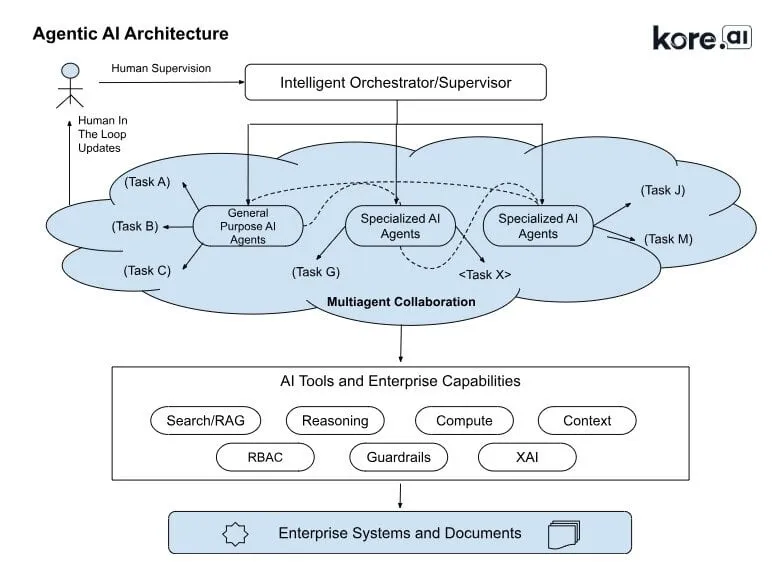
- Intelligent orchestration: Agentic workflows rely on intelligent AI agents to dynamically coordinate tasks and processes across multiple systems. Unlike static workflows, they adapt to real-time inputs and changing conditions, ensuring optimal resource allocation and task completion.
- Contextual understanding: Using advanced NLP and contextual AI, agentic workflows comprehend the intent, context, and nuances of tasks. This ensures actions are relevant and align with organizational goals, making workflows smarter and more efficient.
- Multi-agent collaboration: Agentic workflows often involve multiple AI agents working together. Each agent handles specific aspects of a workflow while coordinating with others to complete complex, multi-step processes seamlessly.
- Enterprise capability: To operate in a large enterprise, robust measures for AI governance, guardrails, data privacy, and role-based access controls, traceability (Explainable AI or XAI) to decisions and actions, a no-code user-friendly interface allowing non-technical or citizen developers to create and manage AI agents or agentic workflow.
- Integration with enterprise systems: These workflows are designed to integrate effortlessly with existing enterprise tools, databases, and APIs. This interoperability ensures that workflows leverage data and systems already in place without requiring overhauls.
- Continuous adaptation and learning: Agentic workflows employ machine learning to evolve over time. Feedback loops and real-time data inputs allow workflows to refine their performance, identify inefficiencies, and adapt to new requirements or challenges.
How to implement agentic AI systems? What are the challenges and best practices?
While implementing an Agentic AI system seems exciting and beneficial, the devil is always in the execution. Agentic AI implementation could face several challenges, as discussed below, and we would like to present a few best practices to help you overcome these challenges.
What are the challenges in building and deploying agentic AI systems?
Implementing Agentic Workflows in enterprises presents several practical challenges, ranging from technological to organizational.
1. Integration complexity
One of the key challenges is integrating AI agents with existing enterprise systems, which often consist of legacy applications, disparate data sources, and diverse technologies. Achieving seamless interoperability across these systems requires significant effort in customizations, API management, and ensuring data flow integrity. Enterprises must align AI capabilities with various business functions, including CRM, ERP, and HR systems, which may not have been designed to support AI-driven workflows.
2. Data privacy and security
Since Agentic Workflows often require the collection, processing, and sharing of sensitive enterprise data across systems, maintaining data privacy and security becomes a crucial issue. Enterprises must implement robust security measures such as encryption, identity access management, and compliance with regulations like GDPR or CCPA. There is also a risk of data breaches or misuse if security protocols are not tightly managed.
3. Change management and cultural resistance
Introducing Agentic Workflows in an enterprise requires a cultural shift. Employees may resist AI-driven changes, especially if they perceive automation as a threat to their jobs or feel unprepared to work with new technologies. Proper training, stakeholder buy-in, and clear communication of the benefits are essential to mitigate resistance and ensure a smooth transition.
4. Scalability and flexibility
While Agentic Workflows are designed to scale, adapting them to rapidly changing business needs and new use cases is challenging. As business environments evolve, workflows must adapt without requiring major rewrites or a complete redesign. Ensuring that AI agents can handle high volumes of tasks efficiently without becoming bottlenecks is key to long-term success.
5. Ongoing maintenance and monitoring
AI systems are not set-and-forget tools. Continuous monitoring, performance evaluation, and adjustments are necessary to ensure that Agentic Workflows stay effective as business processes evolve and AI agents learn from interactions. This ongoing maintenance requires human resources and expertise to keep the system running optimally and to handle emerging issues such as bias or model drift.
What are the best practices for building and deploying agentic AI systems?
Successfully building Agentic AI in enterprises involves a combination of strategic planning, technical execution, and change management. Below are the key considerations and best practices for ensuring a smooth and successful deployment of Agentic AI.
1. Clear objectives and high-impact use cases
Before implementing Agentic AI, businesses must clearly define their objectives and identify specific use cases that will benefit most from automation. This includes determining where AI can deliver the highest return on investment (ROI), such as automating repetitive tasks, improving decision-making, or enabling personalized customer experiences. It's essential to align AI initiatives with overall business goals to ensure the system is built with the right intent.
2. System integration and data flow
Agentic AI systems must be able to seamlessly integrate with existing enterprise applications, data sources, and workflows. This requires robust APIs, connectors, and data pipelines to ensure that AI agents have access to accurate and real-time information. Data consistency, integrity, and accessibility are critical to the system's success. Companies should prioritize platforms that support flexible integration and provide tools for data governance and quality assurance. (Source: Forbes)
3. Scalability and flexibility
The AI agents should be designed to scale as the enterprise grows and adapts to evolving business needs. Whether it’s handling increasing data volumes or adapting to new use cases, the AI system must remain flexible and capable of handling new tasks without requiring a complete overhaul. A modular approach to AI development is recommended, allowing enterprises to incrementally build out their AI capabilities (Source: Deloitte).
4. User adoption and training
Introducing Agentic AI into the workforce requires overcoming resistance to change. Employees need to understand how the new system will enhance their productivity, not replace them. Investing in comprehensive training programs, providing continuous support, and fostering an AI-first culture are all essential to drive user adoption. Leaders should also encourage experimentation and feedback from employees to optimize AI systems and workflows (Source: Harvard Business Review).
5. Ethical considerations and data privacy
When deploying Agentic AI, businesses must prioritize data privacy and security. This involves ensuring that AI models are compliant with regulations like GDPR and CCPA and that sensitive data is anonymized or protected. Ethical considerations include preventing bias in AI models and ensuring transparency in how decisions are made by AI agents. Enterprises should implement privacy-preserving techniques such as differential privacy or federated learning to mitigate risks.
6. Ongoing monitoring and improvement
Successful implementation doesn’t end with deployment. Continuous monitoring of AI agents is necessary to assess their performance and accuracy. Enterprises should build feedback loops into the system to allow for iterative improvements and ensure that the AI remains aligned with business objectives. Routine audits and model retraining may be required to address issues such as model drift or data biases.
7. Cross-department collaboration
Effective implementation of Agentic AI requires collaboration between IT, business operations, data scientists, and domain experts. A cross-functional team can help bridge gaps between technical and operational needs, ensuring that the AI solution is designed to solve real-world business problems and aligns with strategic objectives.
By focusing on these key considerations and following best practices, enterprises can build and deploy Agentic AI solutions that drive operational efficiencies, improve decision-making, and scale across departments, ultimately leading to long-term success.
What are the real-world use cases of agentic workflows?
Agentic AI can transform a wide range of enterprise processes that involve multiple steps and typically require human intervention. From internal workflows such as approvals, recruitment, customer support ticket resolution, FAQs, report analysis, and invoice processing to external operations like loan applications, healthcare claims, or customer service requests, Agentic AI can automate these tasks to enhance efficiency and scalability.
Here are some practical examples of how Agentic AI can make a difference:
1. Enterprise travel request process automation with agentic AI
- Traditional Process: In traditional systems, Employees manually fill out travel request forms and submit them for managerial approval. The manager may ask for clarifying questions or provide suggestions. Once approved, the request goes to the finance or travel desk for policy checks and vendor coordination. The travel desk may also need to offer options, discuss with the employee, and proceed with the bookings. This process is slow, prone to errors, and involves multiple back-and-forth communications, causing delays and frustration.
- Agentic AI-powered workflow: Agentic AI simplifies the process by using conversational AI to guide employees through request submission and pre-filling forms using integrated employee data. An AI validation agent instantly checks the request against travel policies and budgets, flagging issues in real time for correction. Approved requests are automatically routed to managers with AI-generated insights for faster decision-making. Once approved, a booking agent seamlessly handles flight, hotel, and transportation reservations, adhering to company policies and securing the best deals. Employees receive real-time updates throughout the process, ensuring transparency and efficiency.
- Benefits: Agentic AI reduces processing time from days to minutes, eliminates errors, and provides a streamlined, user-friendly experience. It boosts productivity, ensures compliance, and enhances employee satisfaction while reducing the operational workload for travel and finance teams.
2. Enterprise recruitment process automation with agentic AI
- Traditional recruitment process: In the traditional approach, HR teams manually create job descriptions, post them to job portals, and collect applications from various channels. Shortlisting involves sifting through resumes, followed by lengthy coordination to schedule interviews between hiring managers and candidates. After interviews, candidates are informed of their status individually, and job offers are drafted and sent manually. This process is slow, error-prone, and often frustrating for both HR teams and candidates, leading to delays and inefficiencies.
- Agentic AI-powered recruitment process: Agentic AI transforms recruitment by automating key steps. AI generates job descriptions based on company needs and posts them automatically to career pages and job portals. It screens resumes, evaluates candidates against predefined criteria, and creates ranked shortlists within minutes. Interview scheduling is streamlined by an AI agent that integrates with calendars to find mutually available times without back-and-forth communication. During interviews, AI can assist in initial screening, assessing candidates’ qualifications, and communication skills. Candidates are kept informed throughout the process by a conversational AI agent that provides updates and next steps. Once a candidate is selected, AI drafts and sends personalized job offers, ensuring policy compliance and efficient communication.
- Benefits of Agentic AI in recruitment: Agentic AI significantly reduces hiring time, minimizes manual errors, and enhances the candidate experience through transparency and engagement. HR teams are freed from administrative burdens, allowing them to focus on strategic goals, while organizations benefit from faster, more efficient, and consistent hiring processes.
3. Invoice processing automation with agentic AI
- Traditional invoice processing in enterprises: In a traditional setup, invoice processing is a manual and time-consuming workflow. Vendors submit invoices through various channels such as email, mail, or online portals. The finance team collects these invoices and manually enters the data into the enterprise’s accounting system. Each invoice is checked for accuracy, ensuring that the amounts, vendor details, and purchase orders match. Once verified, the invoices are sent to the relevant departments for approval. This often involves back-and-forth communication to address discrepancies or gather missing information. After approval, the finance team schedules payments, reconciles records, and archives the invoices. The process is error-prone, lacks standardization, and can delay payments, straining vendor relationships and increasing operational costs
- Agentic AI-powered invoice processing: Agentic AI reimagines invoice processing by automating and streamlining the entire workflow. Invoices submitted by vendors are captured using AI-powered document processing tools, regardless of the format or channel. These tools extract and validate data such as vendor details, invoice amounts, and purchase order references in real time. An AI validation agent cross-checks the extracted data against purchase orders and company records to ensure accuracy. Discrepancies are flagged and sent to the appropriate stakeholders for resolution, with the AI agent facilitating communication and tracking updates. Once validated, an approval agent automatically routes invoices to the relevant departments or managers for approval, using predefined workflows to ensure compliance with company policies. After approval, an AI-powered payment agent schedules and processes payments, updating accounting records in real time and ensuring timely transactions. Throughout the process, a communication agent keeps vendors informed about the status of their invoices, enhancing transparency and trust.
- Benefits of Agentic AI in invoice processing: By automating data entry, validation, and approvals, Agentic AI significantly reduces processing time, minimizes errors, and ensures compliance with company policies. The finance team can focus on strategic tasks like financial planning and vendor management, while vendors benefit from timely payments and improved communication. This leads to cost savings, better vendor relationships, and a highly efficient invoice management system.
4. Claim processing automation in healthcare with agentic AI
- Traditional claims processing: In a healthcare insurance organization, claims processing typically involves multiple manual steps. Patients or providers submit claims via paper forms, email, or online portals. Claims processing teams manually input data into the system, verify the information against policy coverage, and check for completeness and accuracy. This involves validating medical codes, cross-referencing patient and provider details, and assessing claims against policy terms. If discrepancies or missing information are found, the team must follow up with providers or patients, causing delays. Once verified, the claim is reviewed by an adjuster, approved, and sent for payment processing. This lengthy process often results in errors, delays in reimbursements, and increased operational costs.
- Agentic AI-powered claims processing: Agentic AI automates and accelerates the claims process from submission to payment. Claims are submitted digitally and processed instantly using AI-powered document processing tools. These tools extract relevant data, validate it against policy terms, and flag discrepancies for immediate resolution. An AI validation agent checks for accuracy in medical codes, eligibility, and coverage, significantly reducing manual intervention. Discrepancies are sent to the appropriate stakeholders, with AI agents facilitating communication and updates. Once validated, an approval agent routes the claim to an adjuster or auto-approves straightforward cases based on predefined rules. Finally, a payment agent processes approved claims and updates the system in real time. Throughout the process, a conversational AI agent keeps patients and providers informed about claim status, ensuring transparency and reducing follow-up inquiries.
- Benefits of Agentic AI in claims processing: Agentic AI reduces claim processing time from days to minutes, minimizes errors, and ensures compliance with regulations. It enhances operational efficiency, improves patient and provider satisfaction, and allows claims teams to focus on complex cases and strategic priorities. This leads to cost savings and a more streamlined, patient-centric experience.
5. Home loan mortgage application processing with agentic AI
- Traditional process: In a typical finance organization, home loan processing involves several manual steps. Applicants submit their documents via online portals, email, or in person. Loan officers manually input data into systems and verify documents like income proof, credit history, and property details. The application is reviewed by underwriters, who assess eligibility and risk by cross-checking details with credit bureaus and internal policies. This process often requires back-and-forth communication for missing information, leading to delays. After underwriting, the loan offer is prepared, reviewed, and sent to the applicant. Manual errors, prolonged turnaround times, and inefficient communication are common challenges in this workflow.
- Agentic AI-powered process: Agentic AI streamlines mortgage processing by automating the end-to-end workflow. Applications are submitted digitally, and an intake agent extracts data and validates documents in real time. An AI-powered verification agent cross-checks income, credit history, and property details against databases and policies, flagging discrepancies instantly. An underwriting agent evaluates eligibility and risk using AI models, ensuring faster and consistent decision-making. Once approved, a creation agent prepares the loan offer, ensuring compliance with regulatory and organizational standards. Throughout the process, a conversational AI agent keeps applicants informed about the status of their application, reducing follow-ups and enhancing transparency.
- Benefits of Agentic AI in mortgage processing: By automating document handling, verification, and underwriting, Agentic AI reduces processing time, minimizes errors, and ensures consistent compliance. This enhances customer satisfaction, reduces operational costs, and enables finance teams to process more applications efficiently, giving organizations a competitive edge in the market.
6. Customer support ticket automation in home appliances retail with agentic AI
- Traditional Process: In a home appliances retail organization, customer support tickets are often handled manually. Customers submit requests via phone, email, or web forms. Support agents log the ticket, categorize the issue, and route it to the appropriate department. Agents then communicate with the customer to gather additional information, troubleshoot, or schedule technician visits. This process involves extensive back-and-forth communication, delayed resolution times, and a high chance of errors or missed follow-ups. Customers may experience frustration due to inconsistent updates and long wait times, negatively impacting brand loyalty.
- Agentic AI-Powered Process: Agentic AI automates ticket handling from submission to resolution. When customers submit support requests, an AI intake agent captures the details, categorizes the issue, and routes it to the appropriate team or system. For common issues, the AI resolution agent uses predefined workflows and knowledge bases to provide instant solutions or troubleshooting steps. If escalation is required, the AI coordinates with the relevant team and schedules technician visits by integrating with scheduling systems. Throughout the process, a conversational AI agent keeps customers updated on the ticket status, resolution timelines, and next steps. For resolved tickets, the AI agent can also collect feedback to improve future support interactions.
- Benefits of Agentic AI in Customer Support: Agentic AI reduces ticket resolution times by automating repetitive tasks like categorization, routing, and troubleshooting. It ensures consistent communication, improves customer satisfaction, and allows support teams to focus on complex or high-priority issues. This leads to operational efficiency, enhanced customer loyalty, and a stronger brand reputation.
Kore.ai's approach to building reliable and scalable agentic AI with agent platform
Kore.ai provides a robust "Agent Platform" no-code platform designed to streamline knowledge-intensive business processes with autonomous AI agents. By leveraging this platform, businesses can automate complex workflows, enhance decision-making, and improve operational efficiency. With tools like the no-code agent and workflow builder, centralized AI management, and strong AI governance through enterprise guardrails, organizations can accelerate the automation of their processes while maintaining control.
A) Easy to build:
- No-code agent and workflow builder: Kore.ai’s intuitive no-code platform allows businesses to easily create AI agents and design workflows without requiring technical expertise. This drag-and-drop builder makes automation accessible to all teams.
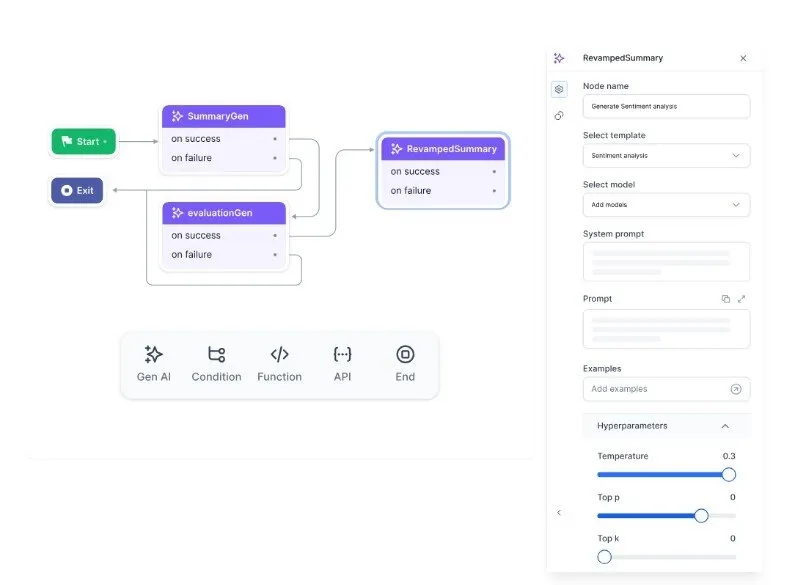
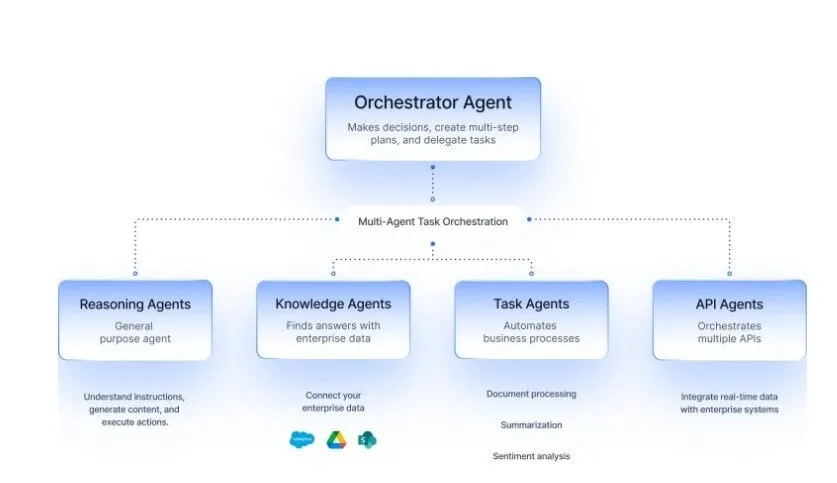
- Multi-agent orchestration: It supports the coordination of multiple AI agents working in tandem, ensuring smooth, efficient process automation across departments.
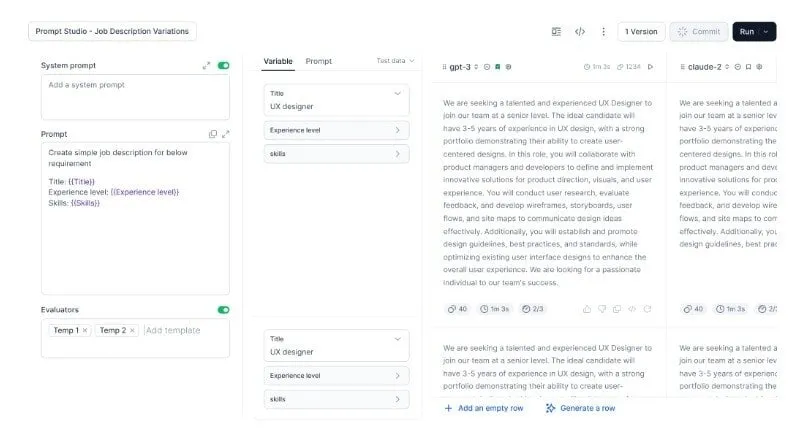
- Ready-to-use prompt library (Prompt Studio): The platform comes with a library of pre-configured prompts and templates, allowing businesses to quickly get started with automation for common tasks and processes.
B) Easy to integrate
- API connectors and REST APIs: Integration with existing systems is seamless through out-of-the-box API connectors and REST APIs, allowing data flow between applications and AI agents.
- Context-aware AI for nuanced decision-making: The AI system understands the context of each task and adapts decision-making accordingly, enabling more informed and accurate outcomes.
- Pre-built integrations to enterprise systems: Kore.ai offers pre-built connectors to popular enterprise applications, ensuring faster integration and reducing the complexity of connecting disparate systems.
C) Easy to monitor and control
- Real-time AI analytics: The platform provides real-time analytics, enabling businesses to track AI performance and outcomes, ensuring that processes are running as expected.
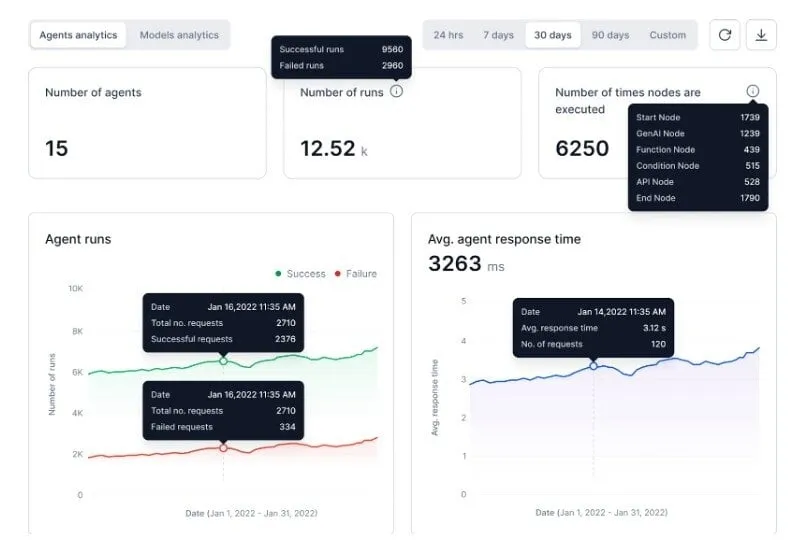
- Continuous AI evaluation: Continuous monitoring of AI agent behavior allows businesses to fine-tune processes and ensure optimal performance.
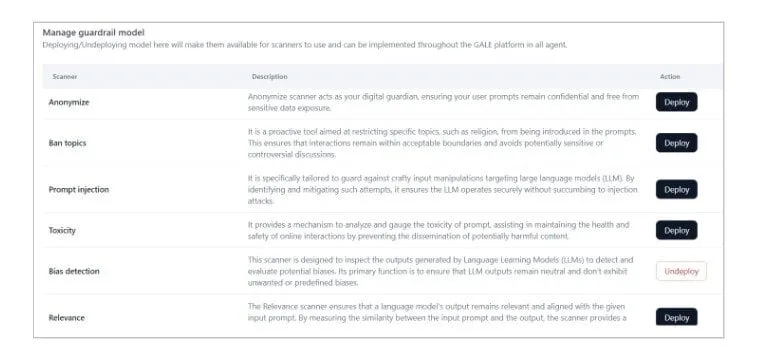
- Built-in Enterprise guardrails: The platform includes robust governance features, helping organizations maintain compliance, monitor AI usage, and prevent unintended outcomes with predefined guardrails.
D) Easy to scale
- Agnostic to cloud, data, and AI models: The platform is cloud-agnostic, integrating with a variety of data sources and AI models to provide flexibility as businesses scale.
- Compliant with industry and government norms: The platform is designed to meet the highest standards of compliance, adhering to industry and government regulations to ensure the secure and ethical use of AI.
- Quick to build, deploy, test, and scale: Kore.ai enables organizations to rapidly build, test, and deploy AI-driven processes, ensuring that scaling is efficient and effective without unnecessary delays.
Kore.ai's Agent Platform offers a powerful, flexible, and scalable solution that simplifies the implementation of agentic AI for organizations, driving innovation, efficiency, and better outcomes across business operations.
"The future of enterprise operations lies in networks of AI agents working collaboratively to manage and optimize organizational processes under human supervision. In these networks, agents will seamlessly discover and collaborate, operating with autonomy and efficiency. To achieve this vision, a robust AI agent platform is essential, one that integrates autonomous agents, advanced enterprise knowledge retrieval, and intelligent orchestration. AI for Process brings future-ready capabilities today." ~ Prasanna Arikala, CTO Kore.ai
Conclusion
Agentic AI will create a goal-driven digital workforce that autonomously plans and executes tasks, continuously operating without the need for breaks or breaks. By granting AI systems the ability to make decisions and select actions to achieve specific outcomes, agentic AI will drive performance gains that improve over time as systems evolve.
These systems will transform decision-making by rapidly analyzing complex data, identifying patterns, and acting autonomously. This will streamline problem-solving, accelerate decision-making, and enable scalable solutions. Additionally, agentic AI will upskill teams, allowing them to manage complex processes and projects via natural language. However, its governance and orchestration require advanced tools and strict safeguards.
Recommendations:
- Strategic Integration: Integrate agentic AI into your strategic planning, defining the level of agency allowed in various workflows.
- Design for Efficiency: Develop solutions that connect siloed data and applications, enhancing user experience and automating decisions across systems.
- Establish Guardrails: Set clear ethical and operational guidelines around autonomy, liability, security, and privacy, ensuring robust safeguards for identity, security, and monitoring.
We hope this whitepaper supports your AI strategy development. If you have any questions or are interested in building and integrating an Agentic AI system into your enterprise, feel free to contact us for a no-obligation, complimentary consultation.
Share
Tags