AI Solutions
AI Solutions
AI for Work

Search across silos. Automate workflows. Orchestrate AI agents. Govern with confidence.

learn more
features
Enterprise SearchIntelligent OrchestratorPre-Built AI AgentsAdmin ControlsAI Agent Builder
Departments
SalesMarketingEngineeringLegalFinance
PRE-BUILT accelerators
HRITRecruiting
AI for Service

Leverage Agentic capabilities to empower customers and create personalized experiences.

learn more
features
AI agentsAgent AI AssistanceAgentic Contact CenterQuality AssuranceProactive Outreach
PRE-BUILT accelerators
RetailBankingHealthcare
AI for Process

Streamline knowledge-intensive business processes with autonomous AI agents.

learn more
features
Process AutomationAI Analytics + MonitoringPre-built Process Templates
Use Cases
Zero-Touch IT Operations Management
Top Resources
Scaling AI: practical insights
from AI leaders
AI use cases: insights from AI's leading decision makers
Beyond AI islands: how to fully build an enterwise-wide AI workforce
QUICK LINKS
About Kore.aiCustomer StoriesPartnersResourcesBlogWhitepapersDocumentationAnalyst RecognitionGet supportCommunityAcademyCareersContact Us
Agent Platform
Agent Platform
Agent Platform

Your strategic enabler for enterprise AI transformation.

learn more
FEATURES
Multi-Agent Orchestration
AI Engineering Tools
Search + Data AI
AI Security + Governance
No-Code + Pro-Code Tools
Integrations
GET STARTED
AI for WorkAI for ServiceAI for ProcessAgent Marketplace
LEARN + DISCOVER
About Kore.aiCustomer StoriesPartnersResource HubBlogWhitepapersAI Research ReportsNewsroomAnalyst RecognitionDocumentationGet supportAcademy
GET INVOLVED
AI PulseEventsCommunityCareersContact Us
upcoming event

CCW Berlin brings together international experts, visionary speakers, and leading companies to explore the future of customer experience, AI, and digital transformation in a dynamic blend of congress and exhibition

Berlin
4 Feb
register
Recent AI Insights
The AI productivity paradox: why employees are moving faster than enterprises
AI INSIGHT
12 Jan 2026
The Decline of AI Agents and Rise of Agentic Workflows
AI INSIGHT
01 Dec 2025
AI agents and tools: Empowering intelligent systems for real world impact
AI INSIGHT
12 Nov 2025
Agent Marketplace
More
More
Resources
Resource Hub
Blog
Whitepapers
Webinars
AI Research Reports
AI Glossary
Videos
AI Pulse
Generative AI 101
Responsive AI Framework
CXO Toolkit
support
Documentation
Get support
Submit RFP
Academy
Community
COMPANY
About us
Leadership
Customer Stories
Partners
Analyst Recognition
Newsroom
Events
Careers
Contact us
Agentic AI Guides
forrester cx wave 2024 Kore at top
Kore.ai named a leader in The Forrester Wave™: Conversational AI for Customer Service, Q2 2024
Generative AI 101
CXO AI toolkit for enterprise AI success
upcoming event

CCW Berlin brings together international experts, visionary speakers, and leading companies to explore the future of customer experience, AI, and digital transformation in a dynamic blend of congress and exhibition

Berlin
4 Feb
register
Talk to an expert
Not sure which product is right for you or have questions? Schedule a call with our experts.
Request a Demo
Double click on what's possible with Kore.ai
Sign in
Get in touch
Background Image 1
Blog
Conversational AI
Validating Low-Confidence LLM Generation

Validating Low-Confidence LLM Generation

Published Date:
March 3, 2025
Last Updated ON:
November 24, 2025

 This is an approach that actively detects and mitigates hallucinations during the generation process.
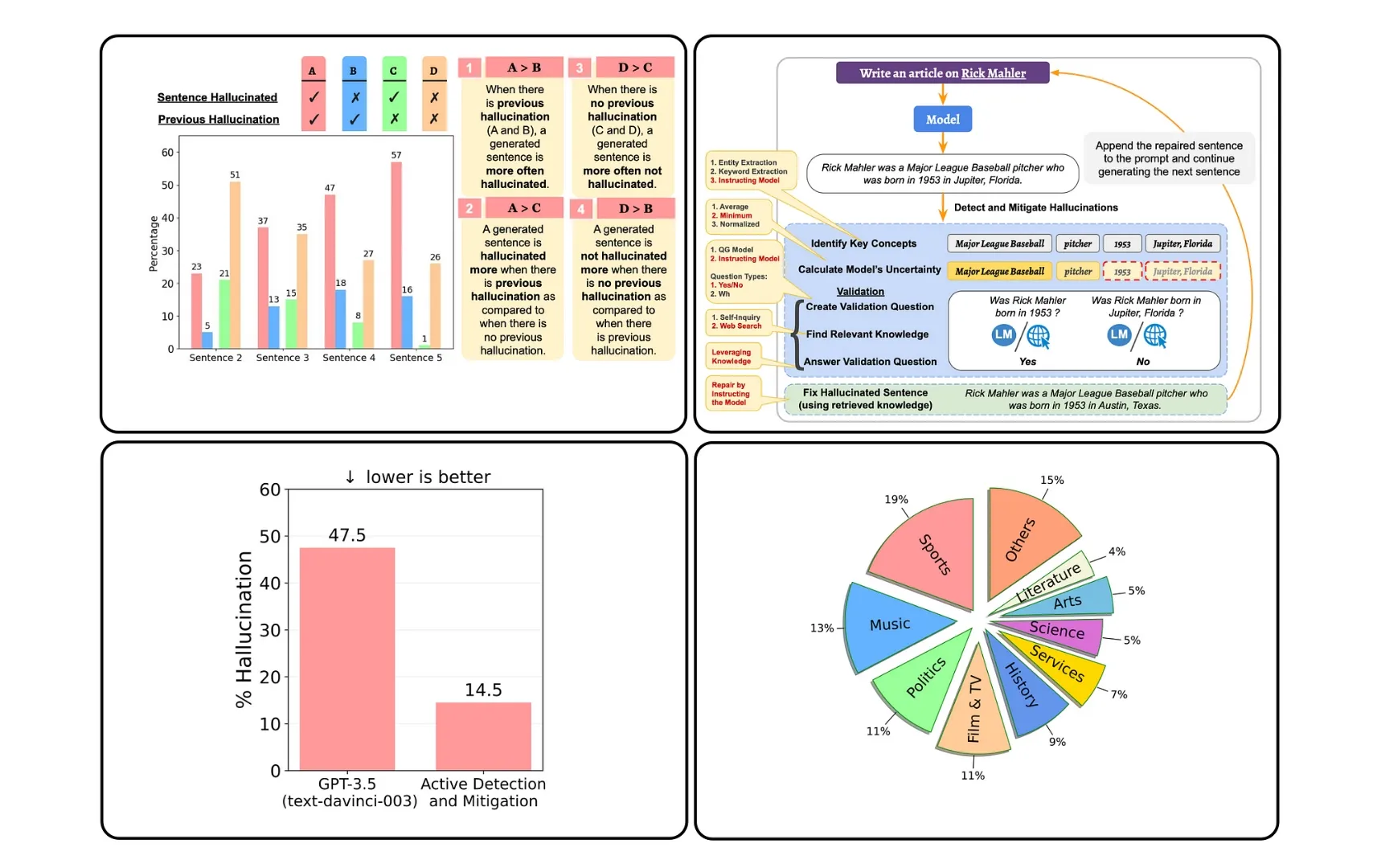
Composite figure on LLM hallucination detection, mitigation workflow, benchmark results and topic distribution of evaluated prompts.

Introduction

The basic approach has a hallucination detection phase and a mitigation phase.

While the mitigation phase is more familiar, the detection phase is novel to some extent.

  • The study identifies that hallucination can be remedied via retrieved knowledge (no surprises there).
  • This proposed architecture detects hallucination in real-time by making use of a certainty model.
  • Uncertainty is detected via entity extraction, keyword extraction and instructing model.
  • Inference cost is a concern following this methodology; together with inference latency.
  • While reading the study, the thought did come to mind, why not default on a RAG approach, and run the certainty model in parallel in an incremental fashion.
  • Running the certainty model in parallel can lend inspectability and observability in terms of hallucination.
  • The certainty model can also be run on an ad-hoc basis to optimise on resources and cost; but still perform a level of due diligence.
  • An interesting observation from the study that once hallucination starts, its is propagated to the next sentence; with a very low probability that hallucination will take place in once sentence, and not in the following sentence.

Detection and mitigation

During the detection phase, hallucination candidates are identified followed by measuring the uncertainty to establish the degree of hallucination. This uncertainty provides a signal for hallucination.

The validation process is quite complex with added overhead:

  • Create a query that tests the correctness of the information pertaining to the concept,
  • Retrieve knowledge relevant to the validation question,
  • Answer the validation question leveraging the retrieved knowledge, and
  • Verify the corresponding information in the generated sentence to detect hallucinations.

The mitigation and repair phase relies on retrieving relevant reference knowledge. This step is interesting, because we find ourselves again back at a RAG approach where inference is grounded with a contextual reference.

The proposed active detection and mitigation approach successfully reduces the hallucinations of the GPT-3.5 model from 47.5% to 14.5% on average.

Basic approach

Considering the image below, given an input which passes through the model with the generated text.

The process then enters a phase of detection and mitigation of hallucinations.

In the Hallucination Detection phase, this approach:

  1. Identifies the important concepts,
  2. Calculate model’s uncertainty on them,
  3. Then validate the correctness of the uncertain concepts by retrieving relevant knowledge.

In the Mitigation Stage:

  1. Hallucinated sentences are repaired using the retrieved knowledge as evidence.
  2. Append the repaired sentence to the input (and previously generated sentences) and
  3. Continue generating the next sentence.

This approach not only mitigates hallucination as it happens, but also stems the propagation on subsequent sentences.
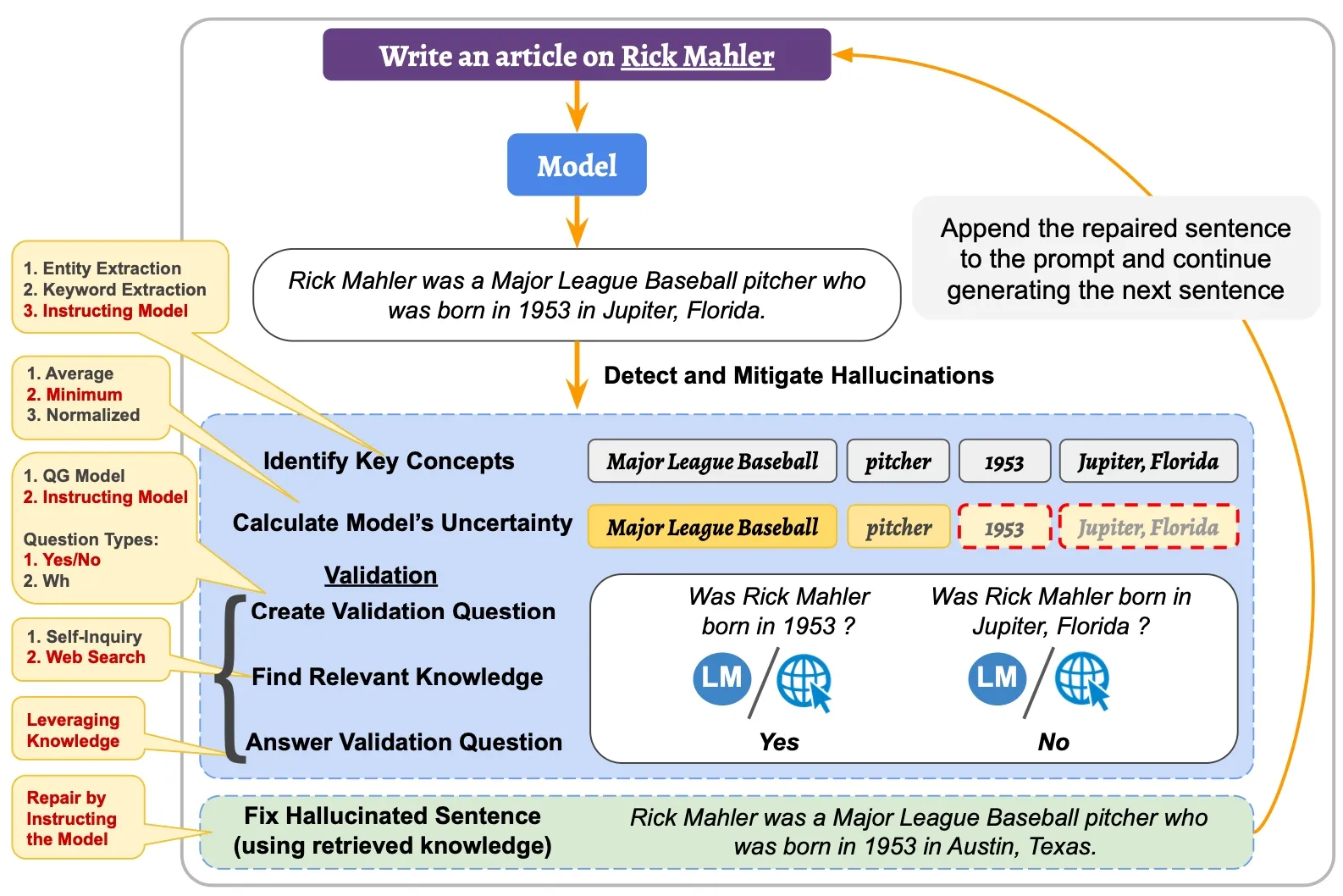
Diagram of hallucination mitigation pipeline that validates model claims about Rick Mahler using key concepts, web search and answer-driven sentence repair.
Process flow for detecting and mitigating LLM hallucinations

Hallucination in the context of language models refers to the generation of text or responses that seem syntactically sound, fluent, and natural but are factually incorrect, nonsensical, or unfaithful to the provided source input.

Detecting hallucination

Hallucination is detected via Entity Extraction, Keyword Extraction and directly instructing the model to identify the important concepts from the generated sentences.

Considering the graphic below, the study identified patterns in terms of where hallucination shows up in sequences of sentences. The image shows four sentences, A, B, C & D.

Hallucination in a sentence often results in further hallucinations in the subsequently generated sentences and thus actively detecting and mitigating hallucinations can not only fix the current hallucination but can also prevent its propagation in the subsequently generated sentences.

This shows that hallucination is perpetuated and increases once hallucination starts. Even if no remedial action is taken, once hallucination is detected, the complete inference should be considered possibly false.
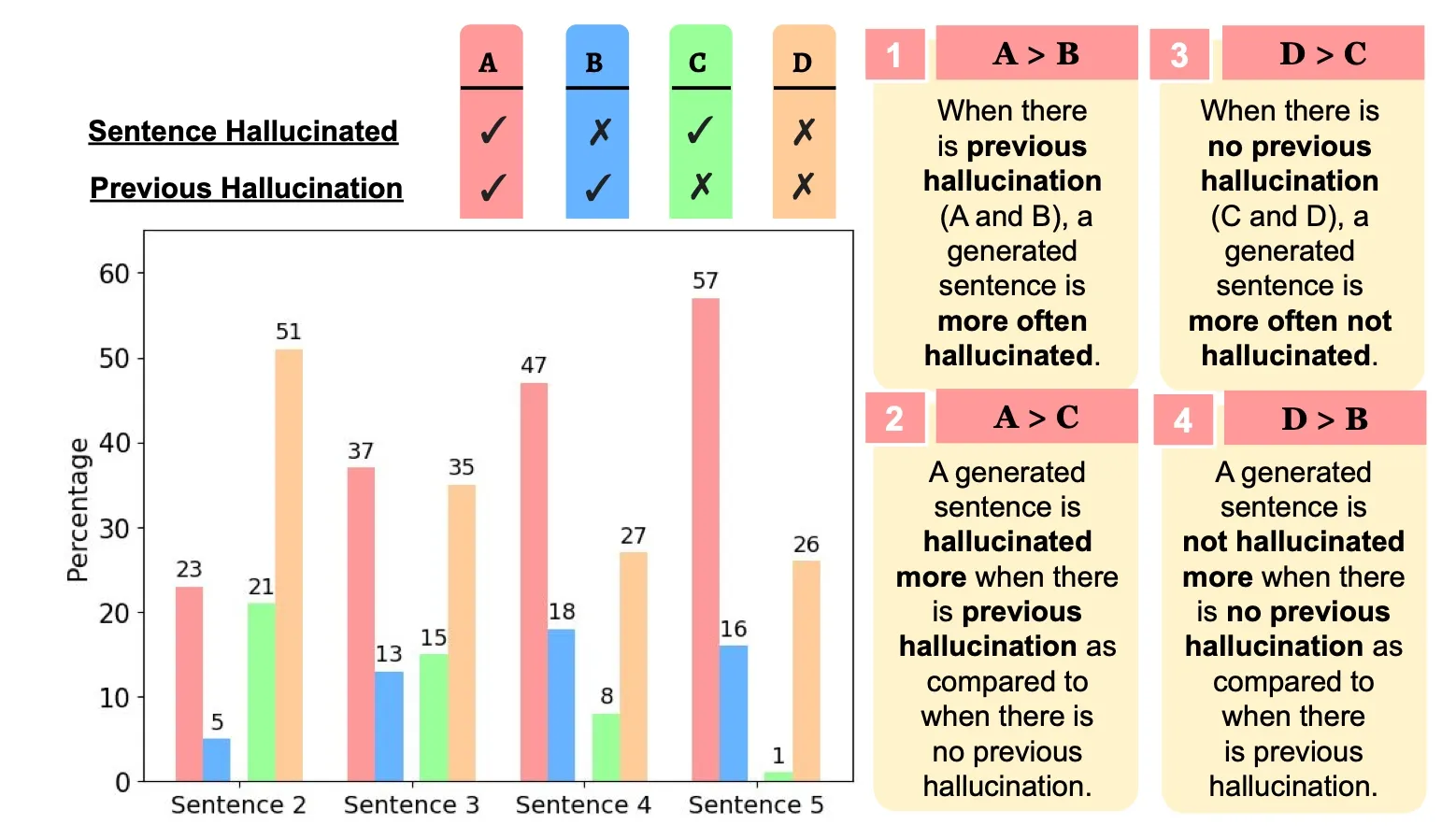
Bar chart showing how previous hallucinations increase LLM sentence hallucination rates, with four scenario comparisons and key observations.
Visualizing hallucination propagation in sentence sequences

Relevant reference data

Sources of relevant reference data are:

  1. Web-search
  2. Self-inquiry
  3. Validation Question

The table below shows the instructional prompts used for different steps of the approach.

These techniques are the preferred techniques as they do not require calling an external task-specific tool to achieve the corresponding objectives.

I guess there is always that tension between encapsulating functionality in a prompt and building an application structure outside of the prompt.

There is no single approach to this; with the growing complexity of LLM-based solutions, prompts cannot contain the whole and logic needs to be accommodated via chaining, agents, prompt pipelines, etc.
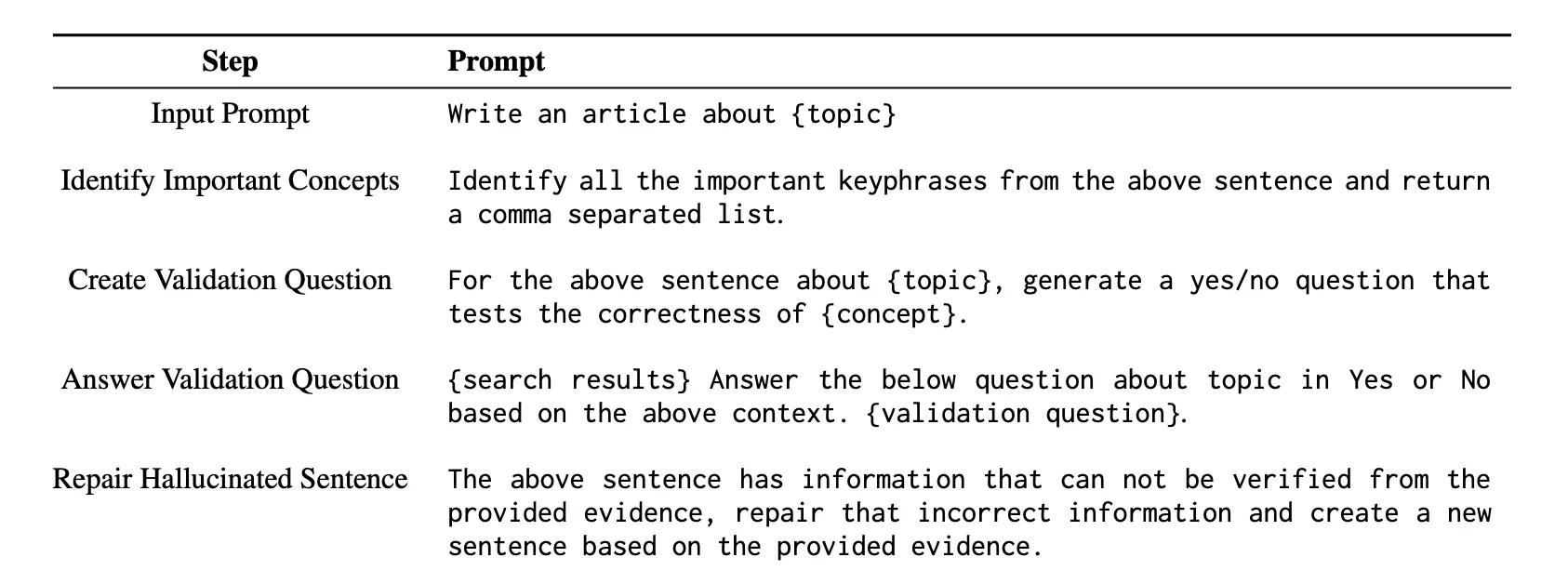
Prompting workflow table for hallucination repair outlining steps from input prompt to identifying key concepts and fixing unverifiable sentences.
Prompt templates for validating LLM-generated concepts

Inference cost

While this approach improves the reliability of large language models (LLMs) by reducing hallucinations and making the models more trustworthy... This improvement comes with the drawback of increased inference cost. The authors argue that, despite the higher cost, addressing the reliability and trustworthiness concerns of LLMs is crucial for their widespread adoption, given the rapid pace of computational advancements. The authors do however acknowledge that their approach can be made more efficient by employing various techniques, such as validating concepts in parallel and executing intermediate steps with a smaller, low-cost model.

The the full study here
Share
Link copied
authors
Cobus Greyling
Cobus Greyling
Chief Evangelist
Forrester logo at display.
Kore.ai named a leader in the Forrester Wave™ Cognitive Search Platforms, Q4 2025
Access Report
Gartner logo in display.
Kore.ai named a leader in the Gartner® Magic Quadrant™ for Conversational AI Platforms, 2025
Access Report
Stay in touch with the pace of the AI industry with the latest resources from Kore.ai

Get updates when new insights, blogs, and other resources are published, directly in your inbox.

Subscribe
Thank you! Your submission has been received!
Oops! Something went wrong while submitting the form.

Recent Blogs

View all
Agentic AI in Retail: Transforming Customer Experience & Operations 
January 23, 2026
Agentic AI in Retail: Transforming Customer Experience & Operations 
Top Glean Alternatives (2026 Guide)
January 23, 2026
Top Glean Alternatives (2026 Guide)
AI Agents in 2026: From Hype to Enterprise Reality
January 16, 2026
AI Agents in 2026: From Hype to Enterprise Reality
Start using an AI agent today

Browse and deploy our pre-built templates

Marketplace
Reimagine your business

Find out how Kore.ai can help you today.

Talk to an expert
Background Image 4
Background Image 9
You are now leaving Kore.ai’s website.

‍

Kore.ai does not endorse, has not verified, and is not responsible for, any content, views, products, services, or policies of any third-party websites, or for any verification or updates of such websites. Third-party websites may also include "forward-looking statements" which are inherently subject to risks and uncertainties, some of which cannot be predicted or quantified. Actual results could differ materially from those indicated in such forward-looking statements.


Click ‘Continue’ to acknowledge the above and leave Kore.ai’s website. If you don’t want to leave Kore.ai’s website, simply click ‘Back’.

CONTINUEGO BACK
Reimagine your enterprise with Kore.ai
English
Spanish
Spanish
Spanish
Spanish
Get Started
AI for WorkAI for ServiceAI for ProcessAgent Marketplace
Kore.ai agent platform
Platform OverviewMulti-Agent OrchestrationAI Engineering ToolsSearch and Data AIAI Security and GovernanceNo-Code and Pro-Code ToolsIntegrations
ACCELERATORS
BankingHealthcareRetailRecruitingHRIT
company
About Kore.aiLeadershipCustomer StoriesPartnersAnalyst RecognitionNewsroom
resources
DocumentationBlogWhitepapersWebinarsAI Research ReportsAI GlossaryVideosGenerative AI 101Responsive AI frameworkCXO Toolkit
GET INVOLVED
EventsSupportAcademyCommunityCareers

Let’s work together

Get answers and a customized quote for your projects

Submit RFP
Follow us on
© 2026 Kore.ai Inc. All trademarks are property of their respective owners.
Privacy PolicyTerms of ServiceAcceptable Use PolicyCookie PolicyIntellectual Property Rights
|
×