





.webp)
If you’re in the market for deploying an AI agent platform in your organization, chances are Sierra AI has appeared on your radar. It’s a young, fast-growing startup that has gained visibility thanks to its well-known founders and recent funding rounds.
While Sierra AI is a promising option, selecting an AI agent platform is a long-term strategic decision that goes far beyond headlines. Enterprises should carefully evaluate the depth of each platform – the use cases it truly supports, its reliability at scale, integration maturity, governance and security controls, total cost of ownership, and its track record in real-world deployments similar to their own.
Always ask yourselves:
- Can this platform scale across the enterprise?
- Will it integrate deeply with the data and systems we currently use?
- How mature are the platform’s governance, security, and audit framework?
- What evidence does the vendor have of real-world enterprise deployments?
Given these considerations, it’s natural and smart to compare Sierra AI with other providers and choose a platform that truly fits your organization's current and evolving needs and delivers long-term value.
In this guide, we break down the top Sierra AI alternatives to help you evaluate your options and choose the platform that best aligns with your organizational goals.
Key takeaways (TL;DR)
- Sierra AI is strong for customer service, but if you need agents that operate across employee-efficiency use cases like IT, HR, finance, or complex operational workflows, you’ll quickly run into its limitations.
- Choosing the right alternative requires looking for scalability across departments, deep system integrations, predictable pricing, and enterprise-grade governance.
- Top platforms like Kore.ai provide broader enterprise depth, with a wide range of use case support, flexibility to extend across the organization, stronger governance, multi-agent orchestration, and proven large-scale deployments.
- Avoid platforms that lock you into narrow use cases or rigid architecture, and opt for solutions that evolve as your organization’s needs grow.
What is Sierra AI?
Sierra AI is a conversational AI start-up focused on building AI-powered agents that operate across both chat and voice channels. It was founded just 2 years ago in 2023 by former Co-CEO of Salesforce Brett Taylor and ex-Google VP of Labs, Clay Beaver. Despite being a young start-up with a limited track record, Sierra AI raised $350 million in Series B funding in September 2025 and now reports serving more than 100 enterprise customers.
What are the key features of Sierra AI?
Sierra AI positions itself as a platform for building and running business-ready AI agents. The key features of the platform include:
- Agent OS: It’s the system to build, manage, and update agents. It’s the layer that connects an AI agent to a company’s internal systems, policies, and data.
- Experience manager: an interface that allows teams to test and adjust how the agent responds and monitor performance in real time.
- Live Assist: Real-time AI co-pilot for customer care agents.
- Agent Data Platform (ADP): Memory and intelligence layer that enables agents to personalize interactions.
- Parallel model routing: Helps fetch the best answer based on cost and latency.
- Brand-level customization: allows agents to match a company’s tone of voice, policies, decision logic, and operational workflows.
Why look for Sierra AI alternatives and competitors?
While Sierra AI is emerging as a strong player, it’s not always a perfect fit for every enterprise. Here are some key reasons why you might consider other platforms:
1. Limited use cases
Sierra AI is primarily designed for customer-service workflows, where its agents focus on resolving inquiries. While this is a strong fit for CX teams, the platform is less suited for broader enterprise needs, such as workplace automation, IT support, HR operations, finance processes, or complex multi-step business workflows.
If you’re looking for an Agentic AI platform that can scale across departments, whether today or as part of your future roadmap, Sierra AI may not offer the breadth or flexibility your organization will eventually need.
2 - Limited capabilities
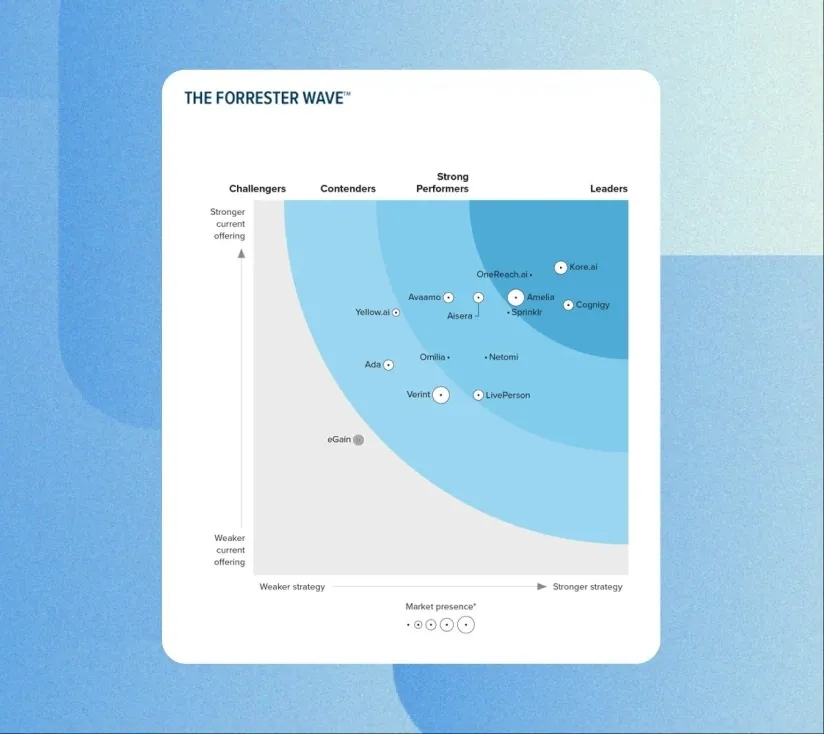
Forrester, in its Wave™: Conversational AI Platforms For Customer Service, Q2 2026, placed Sierra AI as a strong performer. However, it also flags that the platform is below par in some capabilities important to traditional contact center teams, including connecting to legacy systems and escalation to live agents. This means enterprises with complex contact center environments and legacy systems should carefully evaluate Sierra.
3. Complex “outcome-based” pricing model
Sierra charges its customers on an “outcome-based” pricing model, which means you’re billed based on specific business results achieved by the agents. On paper, this sounds great because you pay for success, but in practice, defining what exactly counts as an “outcome” can be tricky:
- When workflows involve several steps, agents, or human handoffs, agreeing on what qualifies as a completed outcome may lead to billing disputes.
- Sierra Costs may swing unpredictably from month to month, based on how outcomes are tagged or how many interactions it takes to finally reach a result. That makes budgeting harder.
- There is also a significant verification burden where teams may need to manually audit every outcome, adding operational overhead for quality assurance, finance, and ops teams.
4. Limited enterprise validation
While Sierra’s website highlights a few well-known brands, most of its customer base appears to be mid-sized companies, and the platform is still building its presence within larger enterprises. However, for large enterprises with complex organizational structures and highly specialized workflows, this limited breadth of deployment examples may not offer enough evidence.
5. Unproven enterprise scale
Sierra is still early in its journey, so its performance and stability at large-enterprise scale are not yet fully proven. As automation grows across regions, channels, and teams, requirements like high concurrency, deeper governance, and long-term reliability become tougher. Enterprises planning a broad, multi-year rollout should evaluate whether Sierra’s scale track record and roadmap match those demands.
6. Steep learning curve
Although Sierra markets itself as a no-code platform, implementing it typically requires significant technical involvement. Much of the deployment relies on Sierra’s own Forward Deployed Engineers, who operate more like implementation consultants. This can feel closer to a managed-service model than self-serve. As a result, onboarding and configuration often take several months, and internal teams may still depend on Sierra’s staff for ongoing adjustments.
👉 Before moving further, if you want to learn the best customer service platforms, explore the top agentic AI platforms for customer support and service
Top Sierra AI alternatives in 2026 & beyond
Below are the top 5 Sierra AI alternatives that stand out in 2026 and beyond, along with a breakdown of where they excel, the problems they solve, and the use cases they’re best suited for.
1 - Kore.ai: Ideal for enterprises operationalizing AI agents at scale across CX, EX, and business processes
Kore.ai is an enterprise‑grade agentic AI platform that helps enterprises quickly design, deploy, manage, and scale AI agents across the business. Unlike other platforms that cater to narrow use cases, Kore.ai offers the full range of agentic solutions for workplace productivity, customer service, or process orchestration, giving enterprises the freedom to build agents for virtually any scenario.
At the center of Kore.ai’s agent platform is its multi-agent orchestration engine. Acting as a control layer across the enterprise tech stack, it enables multiple AI agents to collaborate, hand off context, and execute tasks with differing levels of autonomy, from simple assistive copilots to fully autonomous task-executing agents.
Kore.ai’s agent platform is built with accessibility in mind. With no‑code and pro‑code agent development options, both business teams and IT teams can get agents up and running in no time. To accelerate that further, Kore.ai offers an Agent Marketplace with 300+ pre-built AI agents and templates, so organizations can start from proven building blocks instead of reinventing common workflows.
Under the hood, the platform stays intentionally flexible. Its model-agnostic, cloud-agnostic, and data-agnostic architecture lets enterprises choose any LLM they prefer, including bringing their own in-house models, running them in any environment, and connecting to virtually any data source. Simply put, this flexibility ensures businesses are never locked into a single ecosystem.
Kore.ai’s pricing is equally flexible and scalable. It provides options for session-based, usage-based, and per-seat-based models. For larger deployments, Kore.ai offers tiered volume pricing, plus the flexibility to move up or down tiers as usage changes. For teams that want to start smaller and scale later, pay-as-you-go plans are also available without requiring bulk commitments.
Where Kore.ai truly comes into its own, though, is in its AI governance-first approach. The platform includes a comprehensive AI governance dashboard that provides full visibility into every agent’s decisions, actions, and performance. Enterprises can trace interactions, monitor agent reasoning, manage security guardrails, enforce role-based access controls (RBACs), and review detailed audit logs to ensure compliance and responsible AI behavior at every step.
Kore.ai’s leadership in the agentic AI landscape is widely recognized across the industry. Forrester, init’s Wave™: Conversational AI platforms for customer service, Q2 2026, named Kore.ai a Leader, the same report that placed Sierra AI as Strong Performer.
The platform has been named a Leader in the Gartner® Magic Quadrant™ for Conversational AI Platforms, 2025, for the third consecutive year. According to Gartner, “Kore.ai delivers a feature-rich platform that stands out for its comprehensive and well-balanced capabilities.”
Similarly, Kore.ai has been named a Leader in The Forrester Wave™: Cognitive Search Platforms, Q4 2025. According to Forrester, “Kore has been able to capitalize on the rush to deploy 'ChatGPT for the enterprise' over the past few years.”
Kore.ai has also been named a Leader in the Everest Group’s Conversational AI & AI Agents in CXM Products PEAK Matrix® Assessment 2025. According to Everest Group, “Kore.ai supports advanced multi-agent orchestration through features such as agent collaboration, short- and long-term agent memory, agent tool access, and intelligent delegation.”
Kore.ai is trusted by 400+ Fortune 2000 companies, delivering more than $1Bn in cost savings. They have proven across industries like finance, healthcare, retail, technology, manufacturing, and telecom, with deep expertise in complex workflows.
Key features of Kore.ai:
Some of the notable features of Kore.ai’s agent platform are:
- Multi-agent orchestration enables enterprises to design AI agents that collaborate seamlessly, share context, and execute complex workflows across customer, employee, and operations use cases.
- Enterprise-grade context, tools, and memory support both enterprise and agentic RAG, letting agents securely retrieve, reason, and act on real-time knowledge via APIs. Agents can chain retrieval with tools to complete multi-step tasks, while retaining context across interactions.
- 250+ enterprise-grade, plug-and-play integrations give agents direct access to systems like CRM, ITSM, HRIS, ERP, and data lakes. Teams can also add custom integrations or bring in any system they need, without heavy engineering.
- No-code + pro-code development framework lets business teams build visual workflows and agent logic without writing code, while developers extend functionality with APIs, custom skills, and deeper integrations.
- Comprehensive AI governance and observability provide full lifecycle oversight with end-to-end tracing, audit logs, and real-time monitoring so enterprises can deploy AI safely, transparently, and at scale.
- Configurable guardrails and RBAC enforce organizational policies, restrict unsafe behaviors, and manage permissions through structured role-based access control to uphold security and compliance.
- Agent marketplace with 300+ pre-built AI agents allows enterprises to build and deploy agents up to 10 times faster and start generating ROI from the get-go.
Pros of Kore.ai:
- Enterprise-scale multi-agent orchestration
- Best-in-class governance and observability
- Highly flexible, model- and cloud-agnostic architecture
- Enterprise + Agentic RAG with tool-use memory
- Flexible pricing. (Request-based, session-based, per-seat, or pay-as-you-go pricing structures)
- Deep integration ecosystem with 250+ plug-and-play enterprise connectors
- Agent marketplace with 300+ pre-built AI agents
- Proven scalability, trusted by 400+ Fortune 2000 enterprises
- Recognized as a leader by third-party analysts
Cons of Kore.ai:
- Not suited for small and medium businesses
- Given the number of integrations, some documentation, especially for newer connectors, is still catching up.
- With a broad template library, finding the right template can take a few extra clicks.
- The wide product suite may overwhelm teams without a clear onboarding plan and defined starting points.
Overall verdict:
Enterprises looking to start small yet rapidly scale agentic AI across diverse use cases will find Kore.ai as a trusted partner of choice. With advanced multi-agent orchestration, cloud and model-agnostic architecture, and a strong focus on AI governance, Kore.ai empowers organizations to deploy AI safely and responsibly at scale. Proven in large enterprise environments worldwide, it delivers the flexibility and full control leaders demand, while driving significantly lower total cost of ownership (TCO).
Learn how Kore.ai can help you build and scale enterprise-grade AI agents.
2. NiCE Cognigy: Ideal for enhancing contact-center operations
NiCE Cognigy is a contact-center-focused platform that has evolved its offering to support agentic AI for enterprise customer experience. It enables organizations to build AI agents that can manage a wide range of customer inquiries, collaborate with human agents, and operate effectively across voice, messaging, social channels, and established contact-center platforms.
For teams running multichannel customer service, Cognigy provides an intuitive interface and a strong set of action capabilities that make it straightforward to design and deploy customer-facing agents.
However, Cognigy’s emphasis on simplicity means that certain advanced configuration options may be less extensive than those of some other no-code and pro-code platforms. Its flow-based architecture, which evolved from traditional conversational design patterns, can also feel less flexible when teams are building very specialized or highly dynamic agent behaviors.
More broadly, now that Cognigy is part of NiCE, the roadmap may be uncertain, and some organizations may want to watch how the product settles over time. Gartner also, in its 2025 Gartner® Magic Quadrant™ report, notes that Cognigy’s strategy tends to prioritize near-term commercial execution over a longer-range product vision, which is worth keeping in mind for teams planning multi-year agentic CX programs.
Key features of NiCE Cognigy:
- Multilingual AI agents supporting more than 100 languages, allowing organizations to deliver consistent customer experiences across global markets.
- Visual conversation flow builder with a node-based interface, making it easier for teams to design and refine conversational journeys without heavy coding.
- Role-based access and governance controls that help enterprises manage permissions, workflows, and compliance requirements.
- Flexible deployment options, including on-premises or private cloud, to meet varying security and infrastructure needs.
- Prebuilt omnichannel connectors for platforms such as Slack, WhatsApp, and web chat.
Pros of Cognigy:
- Suitable for CX operations
- Robust enterprise compliance
- Broad omnichannel support
- Accessible visual builder
- Extensive integration ecosystem
Cons of Cognigy:
- Flow-based architecture can feel rigid for highly dynamic use cases
- Higher learning curve for very deep customizations
- Roadmap may be uncertain post-acquisition
- Limited long-range product vision
Overall verdict:
NiCE Cognigy is a solid choice for organizations aiming to enhance their contact-center operations with agentic AI, offering strong omnichannel capabilities. While some advanced configurations may take time to master, NiCE Cognigy provides a capable and mature platform for teams looking to modernize customer interactions with AI-driven workflows.
3. Decagon: Ideal for omnichannel customer support automation

Founded in 2023, Decagon is an emerging customer support AI platform. It delivers fast, human-like interactions across chat, email, and voice, enabling organizations to resolve customer inquiries with speed and consistency.
One of Decagon’s distinguishing elements is its use of Agent Operating Procedures (AOPs), which allow support teams to define agent logic in natural language. This enables a blend of flexibility and control, where operational teams can outline the agent’s behavior while developers manage integrations, workflows, and guardrails.
That said, Decagon is built around a single primary agent rather than a multi-agent system. This can be challenging as workflows become more complex; a single agent may need to handle many responsibilities at once, which can make it harder to split work into parallel tasks or scale consistently across functions and channels.
The platform is also currently more oriented toward technical teams than non-technical builders, with fewer no-code options like visual, drag-and-drop tools for citizen developers. Further, in many environments, Decagon is used alongside existing helpdesk or contact-center platforms rather than as a full CCaaS replacement, which can influence how organizations design their overall CX stack.
Key features of Decagon:
- Agent Operating Procedures (AOPs) that allow support teams to describe agent behavior in natural language.
- Omnichannel customer resolution across chat, email, voice, and SMS, ensuring customers receive consistent, context-aware responses
- Enterprise-grade integrations with CRM and support platforms such as Zendesk and Salesforce, along with API access to back-office systems.
- Watchtower is a monitor and analytics tool that tracks both AI and human interactions.
- Model-agnostic architecture that supports multiple LLM providers.
Pros of Decagon:
- Flexible agent design
- Strong omnichannel support
- Model-agnostic architecture
Cons of Decagon:
- Built on a single agent
- Lacks multi-agent coordination or cross-platform collaboration
- Limited visual and drag-and-drop tools
- Typically used alongside existing CCaaS / helpdesk platforms
- Not suitable for heavily-regulated large enterprises
- Currently runs on cloud only, not on-premises or hybrid deployments
Overall verdict: Sierra AI vs Decagon
When comparing Sierra vs Decagon, both are contenders in customer-service AI, though their design philosophies differ. Sierra emphasizes configurable AI agents, while Decagon focuses on single natural-language agent design and fast omnichannel resolution. For teams seeking a developer-friendly approach to design workflows, Decagon can be a compelling Sierra alternative; however, the lack of multi-agent coordination can make it harder to modularize complex CX workflows and maintain consistent oversight as automation expands.
4. Moveworks: Ideal for employee support automation
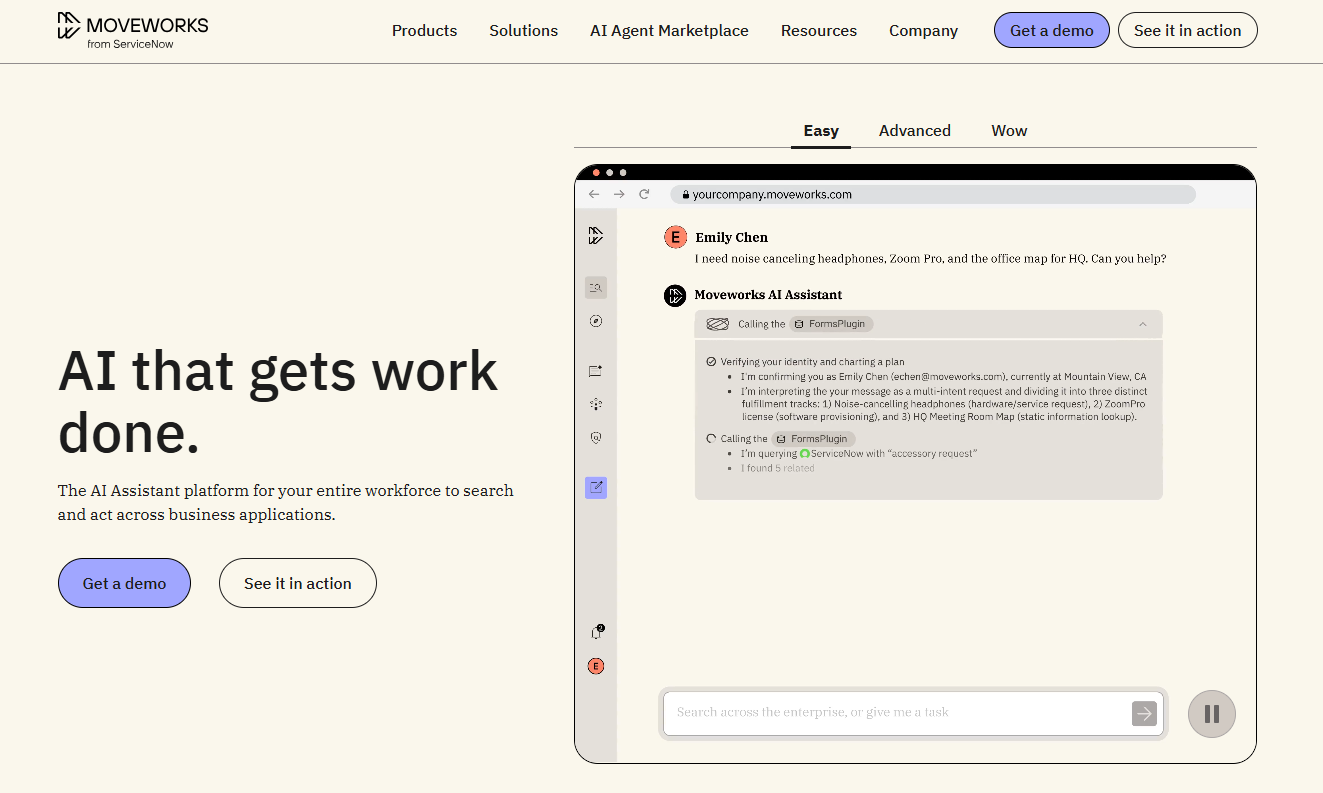
Moveworks is an enterprise AI assistant platform built to modernize employee support. By integrating with core IT and HR business systems, it gives employees a single, intelligent entry point to get help and complete routine tasks, without navigating multiple tools or raising support tickets.
The platform delivers capabilities such as natural-language understanding, autonomous task execution, and contextual reasoning. What sets Moveworks apart is its ability to interpret complex employee requests and execute that process across connected systems.
That said, Moveworks is more specialized in employee support automation and has limited reach in customer-facing operations, back-office processes, or broader enterprise workflows. Even within employee support, Forrester, in its Forrester Wave™: Cognitive Search Platforms, Q4 2025, notes that its ability to understand and extract meaning from images and other visual formats is still evolving, which may affect how fully certain IT or HR issues can be resolved end-to-end without human help.
More broadly, now that ServiceNow acquired (agreed to acquire) Moveworks in a deal announced on March 10, 2025, enterprises may want to keep an eye on how the platform’s roadmap and packaging evolve over time.
Key features of Moveworks:
- The agentic reasoning engine interprets employee queries in natural language, determines the underlying intent, and coordinates the steps required to resolve requests.
- Cross-system orchestration connects with IT, HR facilities, and other enterprise systems through an extensive library of integrations, enabling end-to-end workflow automation.
- Contextual intelligence tailors responses and decisions using signals such as role, department, location, and historical interactions, creating personalized support at scale.
- Out-of-the-box deployment delivers value without lengthy training cycles, making it easier for enterprises to launch quickly.
Pros of Moveworks:
- Strong HR and IT support
- Proven with large companies
- Strong set of data connectors
Cons of Moveworks:
- Less suited for customer-facing or back-end workflows
- Visual understanding is still maturing
- Customers cannot bring their own LLMs
- Roadmap may be uncertain post-acquisition
Overall verdict: Sierra AI vs Moveworks
Moveworks is a strong fit for organizations that want to modernize HR and IT employee support with a ready-to-deploy AI assistant. For organizations looking to modernize internal support and aren’t particularly looking to expand into a broader, multi-domain agentic orchestration in the near future, Moveworks can be an effective solution.
5. Yellow.ai: Ideal for quick-start CX
Yellow.ai positions itself as a conversational AI platform focused on enhancing customer engagement across voice and digital channels. It claims to offer a library of templates and pre-built workflows that make it easy to get started with routine automation across chat, voice, email, and messaging channels.
For small to mid-sized organizations looking to launch conversational automation quickly, especially for standard customer inquiries, FAQ handling, or basic internal support, Yellow.ai can deliver fast wins. Its strength lies in helping teams deploy AI bots that can reduce support load without needing to build everything from scratch.
However, while Yellow.ai’s pre-built templates perform well for standard customer-service scenarios, workflows that rely on stronger reasoning, sustained context, or tighter system integrations often require significant technical work or custom engineering. In practice, organizations may find the experience becomes rather less ‘no-code’ than expected, with project timelines stretching as the level of complexity increases.
It’s also worth noting that in September 2025, an XSS vulnerability in a Yellow.ai support chatbot could have exposed session cookies to theft. Though Yellow.ai has since patched the issue, for organizations in regulated or high-risk environments, it’s a useful reminder that security maturity and guardrails should be central to any platform evaluation.
Key features of Yellow.ai
- Omnichannel automation across chat, voice, email, web, and social media, enabling seamless customer and employee interactions.
- Pre-built industry templates enable teams to launch common customer-service use cases quickly without building from scratch.
- Cross-channel orchestration that allows conversations and context to move across different communication mediums.
- Enterprise-focused tooling for managing workflows, analytics, and agent behavior.
Pros of Yellow.ai
- Strong omnichannel presence
- Pre-built templates to support quick-start use cases
- Suitable for small to mid-sized companies
Cons of Yellow.ai
- Context retention and intent detection can be inconsistent
- Steep learning curve
- Some integrations may require additional engineering support
- Enterprise-level scale, security, and reliability are a challenge
- Limited presence outside the APAC and SEA region
Overall verdict: Sierra AI vs Yellow.ai
When comparing Sierra vs Yellow.ai, the choice often comes down to the speed and nature of deployment. Sierra focuses on building adaptable AI agents, whereas Yellow.ai prioritizes rapid rollout through pre-built templates and omnichannel workflows for small and mid-sized companies. For teams seeking quick-start customer engagement automation, Yellow.ai can be a great Sierra alternative.
How to choose the best Sierra AI alternatives and competitors?
Choosing the best Sierra alternative is more than comparing a laundry list of features and looking for a platform that can scale with your organization. Carefully evaluate each vendor against the following criteria:
1. Scalability across use cases
Make sure the platform can scale beyond a single team or department. Many AI tools lock you into narrowly defined agents that work well for one function, say customer support, but can’t extend to sales, operations, compliance, HR, or back-office workflows. This creates pockets of automation that sit in silos, each requiring separate maintenance, separate data flows, and separate investment.
A scalable platform should:
- Support multiple use cases without forcing you onto different product lines or architectures
- Allow agents to share context, data, and capabilities across departments
- Handle more complex workflows as your automation ambitions grow
- Expand from simple tasks to reasoning-led, multi-step operations
2. Proven, enterprise-grade track record
When choosing a Sierra alternative, prioritize vendors with a demonstrable history of delivering at enterprise scale. Recognition from independent analysts, such as Gartner, Everest Group, and Forrester, provides an external benchmark of maturity, stability, and product depth.
Equally important is real-world adoption. Look for customer stories and evidence that the platform is used by a substantial number of large organizations and has been deployed successfully across complex, high-stakes environments. Partnerships, multi-year customer relationships, and references from regulated industries are all indicators of a platform that can sustain long-term value.
3. Deep enterprise integrations
It’s not the sheer number of integrations that matters, but whether the platform connects seamlessly with the systems you already rely on. A long integration list means little if it doesn’t cover your core stack.
Look for platforms that offer secure, well-documented API connections, along with smooth authentication flows and robust access controls. The integration experience should feel stable and designed for enterprise environments.
Ultimately, the right platform should slot naturally into your existing ecosystem, enabling automation across your current tools rather than forcing you to rebuild your tech stack around it.
4. Transparent and fair pricing model
When evaluating Sierra alternatives, make sure the pricing model is transparent and genuinely supportive of long-term enterprise growth. You should always know exactly what you’re paying for, without hidden add-ons, unexpected usage fees, or confusing tiers that require endless back-and-forth with account managers.
A good platform makes budgeting straightforward: the cost structure is easy to calculate, simple to explain internally, and predictable as you scale automation across departments. This becomes especially important when AI use cases grow rapidly. The last thing you want is a pricing model that becomes unexpectedly expensive the moment you expand into new workflows.
5. Strong governance, security, and compliance
Achieving robust security, compliance, and governance takes time, investment, and long-term discipline, so it should be a major deciding factor when choosing a Sierra alternative. When AI agents access multiple systems, handle sensitive data, and operate across departments, you simply cannot risk weak controls or unclear ownership.
Look for platforms that set governance and compliance into their core architecture, not as afterthoughts. Clear access controls, secure data flows, audit trails, and recognized certifications are non-negotiable for enterprise-grade AI.
What is the right Sierra AI alternative for you?
Choosing an alternative to Sierra comes down to how ambitious your automation roadmap is over the next 24-36 months. Before you pick a platform, get clear on a few fundamentals:
- Your current and future use cases: Are you solving one narrow CX problem today, or planning to expand into multiple workflows and business functions?
- Required scale and reliability: Can the platform handle growing volumes, new regions, and more complex journeys without breaking or slowing down?
- Flexibility across models, channels, and deployment: Do you need to bring your own models, support new channels quickly, or run in specific cloud or hybrid environments?
- Governance, security, and guardrails: Especially in enterprise settings, can you trace decisions, enforce policies, and manage risk confidently?
- Commercial fit: Does the pricing model align with your rollout pace and long-term operating costs?
- Validation and maturity: What proof points exist, customer outcomes, analyst coverage, or large-scale deployments that reduce adoption risk?
In practice, each platform on this list is strong when used for the purpose it was designed for. For instance, if you only need focused use cases, Cognigy, Decagon, Moveworks, or Yellow.ai may fit specific needs.
But as soon as your AI goals and strategy expand beyond one department, or you need agents that reason, collaborate, and act across multiple systems, the gaps between platforms begin to show.
Enterprise-scale automation needs a foundation built for breadth, orchestration, deep governance, and long-term resilience. This is where Kore.ai stands out. It’s designed to operationalize AI agents across CX, EX, and operations with:
- Broadest sets of agentic use cases across customer experience, employee experience, and operational automation
- Multi-agent orchestration that coordinates tasks across teams, systems, and environments
- Model, cloud, and data agnostic platform
- Plug-and-play enterprise integrations built for complex environments
- Mature governance and security frameworks
- Flexible pricing (Request-based, session-based, per-seat, or pay-as-you-go pricing structures)
- Proven scalability, trusted by 400+ Fortune 2000 enterprises
- Recognized as a leader by third-party analysts
If you want a platform that can evolve with your organization, supporting new agents, new departments, and new automation initiatives over time, Kore.ai offers the most comprehensive, future-ready foundation.
Ready to see how Kore.ai can help you build and scale enterprise-grade AI agents? Schedule a custom demo. Not ready yet? Explore our resources section to learn more about Agentic AI.
FAQs
Q1. Why do companies look for Sierra AI alternatives?
Some of the key reasons why you might consider other platforms than Sierra AI are:
- Limited use cases
- Limited capabilites
- Complex "outcome-based" pricing
- Limited enterprise validation
- Unproven enterprise scale
- Steep learning curve
Q2. What are the main alternatives to Sierra AI?
- Kore.ai - Ideal for enterprise-wide use cases
- Cognigy - for customer support
- Yellow.ai - for quick deployment of standard CX workflows for SMBs
- Decagon - for natural-language agent building
- Moveworks - for employee support automation
If you need to scale across the enterprise, Kore.ai offers significantly more breadth and depth.
Q3. What should I look for in a Sierra AI alternative?
Key factors include:
- Scalability across different business functions
- Proven enterprise deployments
- Deep integration capabilities
- Transparent, predictable pricing
- Strong governance, security, and compliance
- Flexibility across AI models and cloud environments
Q4. How do I pick the right Sierra AI competitor for my organization?
Start by asking:
- Will we expand to other departments later?
- Do we need deep integrations?
- Do we need strict governance and compliance?
If the answer is yes, platforms with broader enterprise capabilities, like Kore.ai, offer more longevity.
Q5 - What does Sierra AI cost?
Sierra AI charges its customers on an “outcome-based” pricing model, which means you’re billed based on specific business results achieved by the agents.
Q6 - Which Sierra AI alternative is best for finance, retail, and healthcare use cases?
For regulated industries, always choose the platform that follows a governance-first approach and can prove security depth. For example, Kore.ai offers ISO 27001:2022, ISO 17442:2020, SOC 2 Type I & II, PCI DSS, HIPAA, and GDPR.
(Legal disclaimer: The content in this guide is intended solely for general information and does not constitute professional, legal, financial, or procurement advice. All assessments are based on publicly available materials and customer-visible product information. Any mention of competitor limitations is for comparative context, not disparagement.
As vendor products evolve rapidly, details may become outdated. Kore.ai makes no representations or warranties regarding the completeness or accuracy of competitor information, and no party should rely on this article as the sole basis for a purchasing decision.)