Agentic AI Apps
AI Solutions
Pre-built Applications

Ready-to-deploy applications across industries and functions.

AI for Banking
AI for Healthcare
AI for Retail
AI for IT
AI for HR
AI for Recruiting
Application Accelerators

Leverage pre-built AI agents, templates, and integrations from the Kore.ai Marketplace.

Kore.ai Marketplace
Pre-built agents
Templates
Integrations
Tailored Applications

Design and build applications on our Agent Platform using our enteprise modules.

Platform
Agent Platform

Your strategic enabler for enterprise AI transformation.

Learn more
Enterprise Modules
AI for Work
AI for Service
AI for Process
Top Resources
Scaling AI: practical insights
from AI leaders
AI use cases: insights from AI's leading decision makers
Beyond AI islands: how to fully build an enterwise-wide AI workforce
QUICK LINKS
About Kore.aiCustomer StoriesPartnersResourcesBlogWhitepapersDocumentationAnalyst RecognitionGet supportCommunityAcademyCareersContact Us
Agent Platform
Agent Platform
Agent Platform

Your strategic enabler for enterprise AI transformation.

learn more
PLATFORM MODULES
Multi-Agent Orchestration
AI Engineering Tools
Search + Data AI
AI Security + Governance
No-Code + Pro-Code Tools
Observability
Integrations
Enterprise Modules
For Service
AI AgentsAgent AI AssistanceAgentic Contact CenterQuality AssuranceProactive Outreach
For Work
Modules
Enterprise SearchIntelligent OrchestratorPre-Built AI AgentsAdmin ControlsAI Agent Builder
Departments
SalesMarketingEngineeringLegalFinance
For Process
Process AutomationAI Analytics + MonitoringPre-built Process Templates
upcoming event

Join the first generation of leaders who are designing, governing, and leading the truly intelligent organization.

Orlando
12 May
register
Recent AI Insights
What's new in AI for Work: features that drive enterprise productivity
AI INSIGHT
20 Feb 2026
Parallel Agent Processing
AI INSIGHT
16 Jan 2026
The AI productivity paradox: why employees are moving faster than enterprises
AI INSIGHT
12 Jan 2026
Agent Marketplace
More
More
Resources
Resource Hub
Blog
Whitepapers
Webinars
AI Research Reports
AI Glossary
Videos
AI Pulse
Generative AI 101
Responsive AI Framework
CXO Toolkit
Private equity
support
Documentation
Get support
Submit RFP
Academy
Community
COMPANY
About us
Leadership
Customer Stories
Partners
Analyst Recognition
Newsroom
Events
Careers
Contact us
Agentic AI Guides
forrester cx wave 2024 Kore at top
Kore.ai named a leader in The Forrester Wave™: Conversational AI for Customer Service, Q2 2024
Generative AI 101
CXO AI toolkit for enterprise AI success
upcoming event

Join the first generation of leaders who are designing, governing, and leading the truly intelligent organization.

Orlando
12 May
register
Talk to an expert
Not sure which product is right for you or have questions? Schedule a call with our experts.
Request a Demo
Double click on what's possible with Kore.ai
Sign in
Get in touch
Background Image 1
Blog
Conversational AI
Improve conversational UIs using social intelligence

Improve conversational UIs using social intelligence

Published Date:
November 21, 2024
Last Updated ON:
February 18, 2026

For Conversational User Interfaces to improve, the reliance on social intelligence will need to be leveraged. Many now regards social intelligence is a prerequisite for human-like Artificial Intelligence.

Introduction

We have all heard people say, be nice to everyone even if they are rude to you because you don’t know what that person has been through today.

This speaks to us as humans that we should be having a sense of social intelligence.

Social intelligence refers to the ability to navigate and understand social situations effectively. It involves being aware of the emotions of others, as well as being able to interpret social cues, communicate effectively, and maintain positive relationships.

Socially intelligent individuals are attuned to social norms, cultural differences, and situational contexts.

They can read social cues and understand the unspoken rules of social interaction. This allows them to navigate social situations with ease and adapt their behaviour accordingly.

But how will a social intelligence system for AI look? This study looks at the taxonomy of such a system.

Multimodality

There has been keen interest in the introduction of multimodal features to Large Models, with image and video generation and detection. However, I see a huge significance in making use of multimodal features within a conversational UI, allowing for a more nuanced conversational experience.

Understand

We have long focussed on social intelligence by only considering the cognitive aspect of it, and our systems’ ability to understand what users’ intent is. And understanding the user, based on their input and any related customer data the system can glean from back-end lookups.

Behavioural

As conversational UI designers, we are often also fixated on the behavioural part of the bot; hence designing bots which behave in a certain way.

Both understanding and behaviour are important to building to good conversational UI, but not sufficient.

LLMs perform worse than best human performance on most tasks on cognitive and situational intelligence.

~ Source

Social intelligence data infrastructure

What this study attempts, is creating a taxonomy of what a Social Intelligence system would look like.

A seen in the image below, the study on social intelligence has identified three distinct types of social intelligence:

  1. Cognitive Intelligence
  2. Situational Intelligence
  3. Behavioural Intelligence

Cognitive intelligence

Under cognitive intelligence traditionally chatbots have covered items like intent and emotion quite well. Advances have been made on the emotional front, ensuring that Conversational UIs shows some level of empathy.

As most of our chatbots have been task orientated, much focus has been placed on intent recognition.

Future datasets should focus more on specific, nuanced, and long-tailed social situations. ~ Source

Situational intelligence

This aspect considers the social context, and social context informs cognitive and behavioural intelligence.

Cultural differences between high-context and low-context cultures refer to variations in how communication is conducted and interpreted within different societies.

These differences can have significant implications for interpersonal relationships, business transactions, and overall social interactions.

High-Context Cultures

In high-context cultures, much of the meaning in communication is conveyed through implicit cues, such as non-verbal gestures, tone of voice, and contextual clues.

People in high-context cultures rely heavily on shared cultural knowledge and understandings to interpret messages. Examples of high-context cultures include Japan, China, and many Middle Eastern countries.

Low-Context Cultures

In contrast, low-context cultures rely more on explicit verbal communication to convey meaning.

Messages are typically straightforward and direct, with less reliance on context or shared cultural knowledge. Examples of low-context cultures include the United States, Germany, and some Northern European countries.

One can argue that in the recent past, chatbots have been low-context communicators.
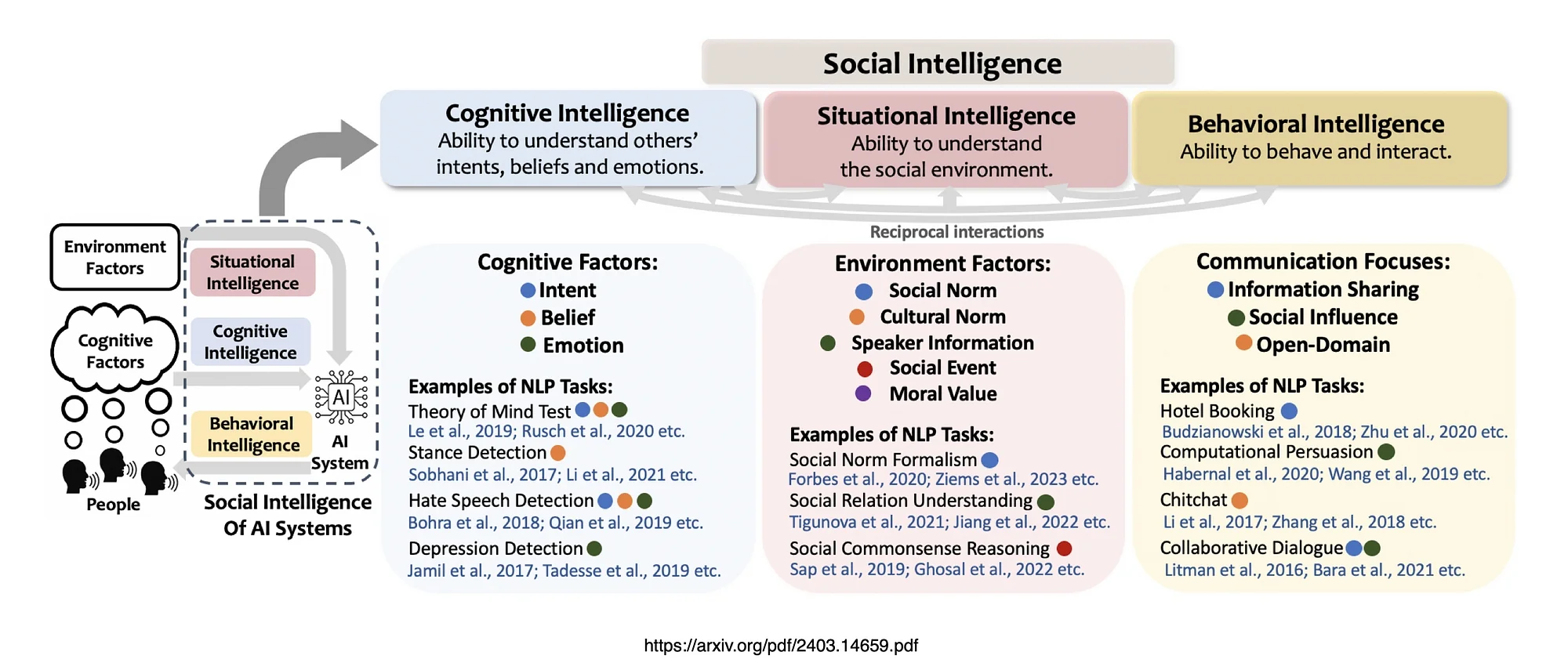
 Visual representation of different social intelligence types, highlighting emotional, interpersonal, and contextual skills.
Social intelligence blends context, cues, and empathy

Behavioural intelligence

Behavioural intelligence encompasses the skills and abilities needed to effectively communicate and interact with others in order to achieve social objectives.

It goes beyond mere communication and encompasses a range of behaviours and actions aimed at navigating social situations with finesse and achieving desired outcomes.

At its core, behavioural intelligence involves understanding social dynamics, recognising social cues, and adapting one’s behaviour accordingly to build rapport, influence others, and foster positive relationships.

This includes not only verbal communication but also non-verbal cues such as body language, facial expressions, and tone of voice. This is something which in the past has been referred to as face speed. The cues we send to each other via expression, tone and posture.
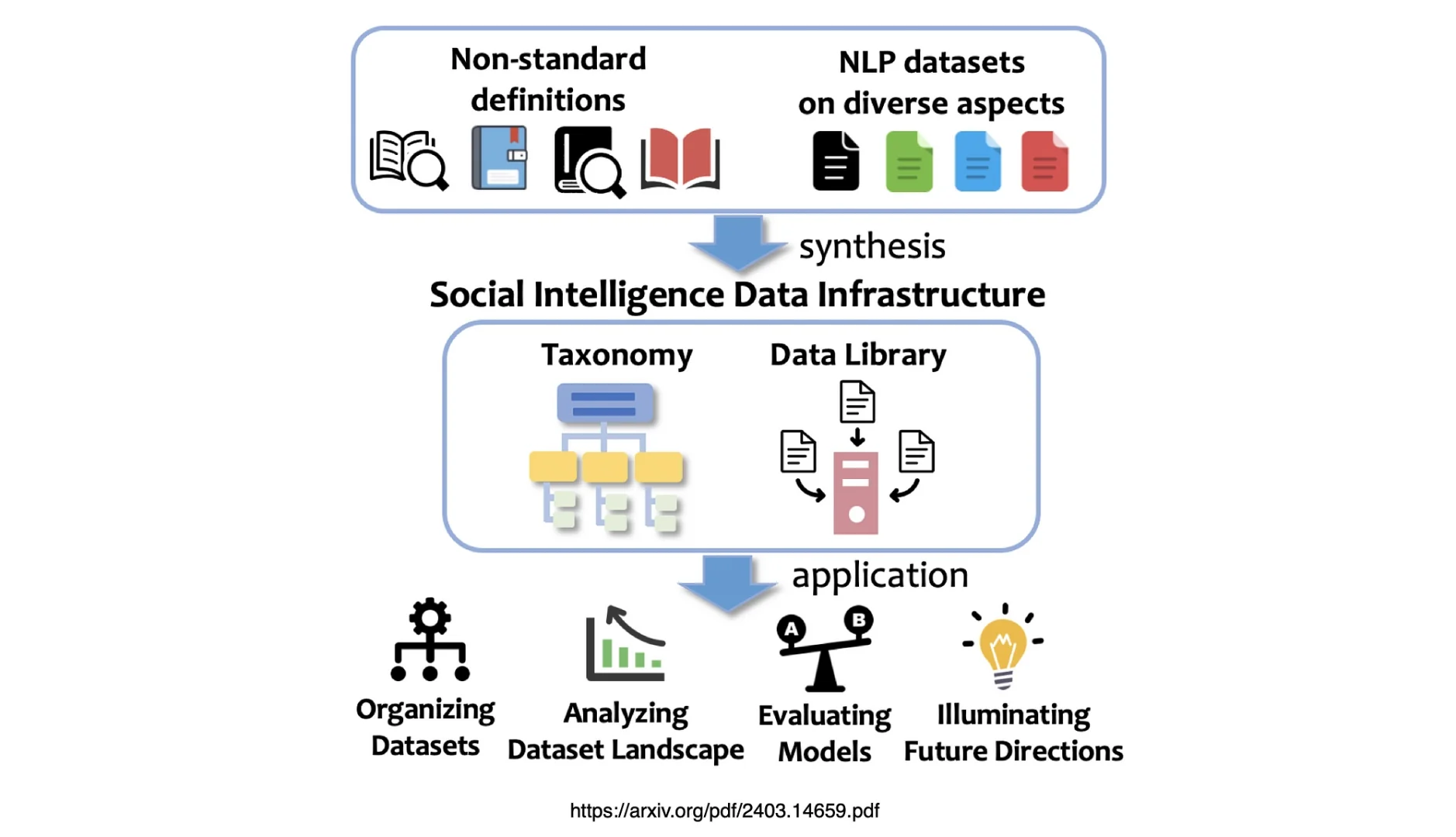
Diagram illustrating social intelligence data infrastructure with interconnected nodes and data flow representations.
From intent and emotion to culture‑aware responses

Considering the image below, On the left side, you’ll find the distribution of three intelligence types.

While on the right side, you’ll see the frequency of various subcategories within cognitive, situational, and behavioural intelligence.
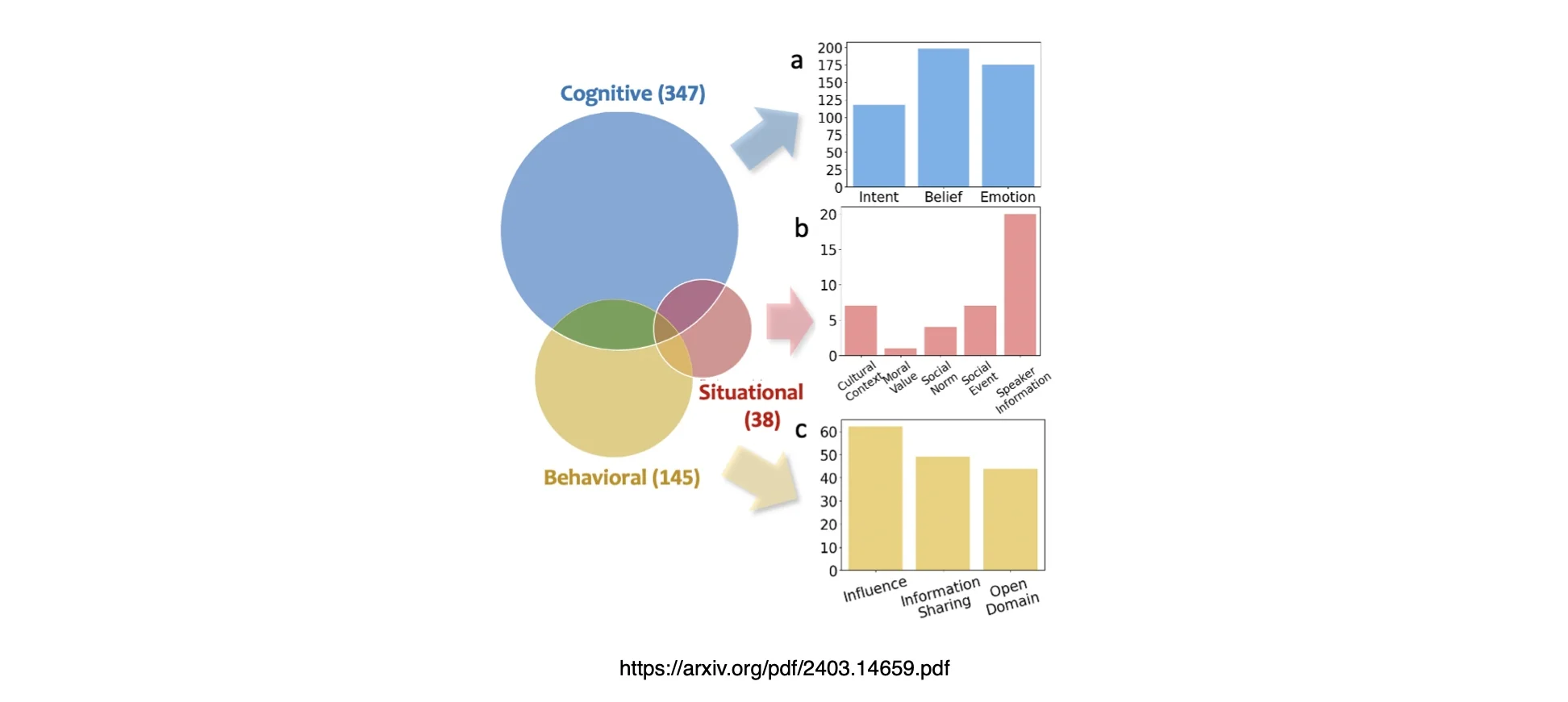
Cognitive, situational, behavioral: a unified taxonomyxonomy

Multi-modality

To solve for challenges like face-speed, gestures and other human communication modalities beyond language…

Future datasets will have to be integrated to multiple modalities, which can aid in the development of AI systems with a deeper and more comprehensive grasp of social contexts and cues.

This will ultimately enhance social intelligence by providing a more accurate understanding of human interactions.

Conclusion

The study presents a social AI data infrastructure, featuring a well-founded taxonomy and a comprehensive data library containing 480 NLP datasets.

This infrastructure aims to standardise the concept of social intelligence in AI systems and streamline the organisation of existing NLP datasets.

Additionally, a perform an in-depth analysis of the data library and assess the performance of LLMs (Large Language Models), providing valuable insights into the current landscape of data and guiding future developments in dataset creation to enhance social intelligence in NLP systems.

This initiative facilitates the curation of high-quality datasets and fosters the holistic advancement of social intelligence within the NLP field.

Find the study here.

Talk to an expert
Share
Link copied
authors
Cobus Greyling
Cobus Greyling
Chief Evangelist
Forrester logo at display.
Kore.ai named a leader in the Forrester Wave™ Cognitive Search Platforms, Q4 2025
Access Report
Gartner logo in display.
Kore.ai named a leader in the Gartner® Magic Quadrant™ for Conversational AI Platforms, 2025
Access Report
Stay in touch with the pace of the AI industry with the latest resources from Kore.ai

Get updates when new insights, blogs, and other resources are published, directly in your inbox.

Subscribe
Thank you! Your submission has been received!
Oops! Something went wrong while submitting the form.

Recent Blogs

View all
AI agents in retail: 12 proven use cases & examples (2026)
March 5, 2026
AI agents in retail: 12 proven use cases & examples (2026)
The end of manual AP: Zero-Touch invoice processing with AI for Process
February 20, 2026
The end of manual AP: Zero-Touch invoice processing with AI for Process
AI Agent governance: A practical guide to risk, trust, and compliance
February 20, 2026
AI Agent governance: A practical guide to risk, trust, and compliance
Accelerate time-to-value from AI

Find out how Kore.ai can help

Talk to an expert
Start using an AI agent today

Browse and deploy our pre-built templates

Marketplace
Background Image 4
Background Image 9
You are now leaving Kore.ai’s website.

‍

Kore.ai does not endorse, has not verified, and is not responsible for, any content, views, products, services, or policies of any third-party websites, or for any verification or updates of such websites. Third-party websites may also include "forward-looking statements" which are inherently subject to risks and uncertainties, some of which cannot be predicted or quantified. Actual results could differ materially from those indicated in such forward-looking statements.


Click ‘Continue’ to acknowledge the above and leave Kore.ai’s website. If you don’t want to leave Kore.ai’s website, simply click ‘Back’.

CONTINUEGO BACK
Agentic AI applications for the enterprise
English
Spanish
Spanish
Spanish
Spanish
Pre-Built Applications
BankingHealthcareRetailRecruitingHRIT
Kore.ai agent platform
Platform OverviewMulti-Agent OrchestrationAI Engineering ToolsSearch and Data AIAI Security and GovernanceNo-Code and Pro-Code ToolsIntegrations
 
AI for WorkAI for ServiceAI for ProcessAgent Marketplace
company
About Kore.aiLeadershipCustomer StoriesPartnersAnalyst RecognitionNewsroom
resources
DocumentationBlogWhitepapersWebinarsAI Research ReportsAI GlossaryVideosGenerative AI 101Responsive AI frameworkCXO Toolkit
GET INVOLVED
EventsSupportAcademyCommunityCareers

Let’s work together

Get answers and a customized quote for your projects

Submit RFP
Follow us on
© 2026 Kore.ai Inc. All trademarks are property of their respective owners.
Privacy PolicyTerms of ServiceAcceptable Use PolicyCookie PolicyIntellectual Property Rights
|
×