Bridging the gap: how AI can solve enterprise application silos
Last Updated
October 19, 2026

Deepak Anand

Suman Chittimuri
Read Time
What’s on this page
How AI-first orchestration can help enterprises eliminate system silos, boost productivity, and unlock end-to-end process automation, without ripping and replacing.
The silent crisis in enterprise IT
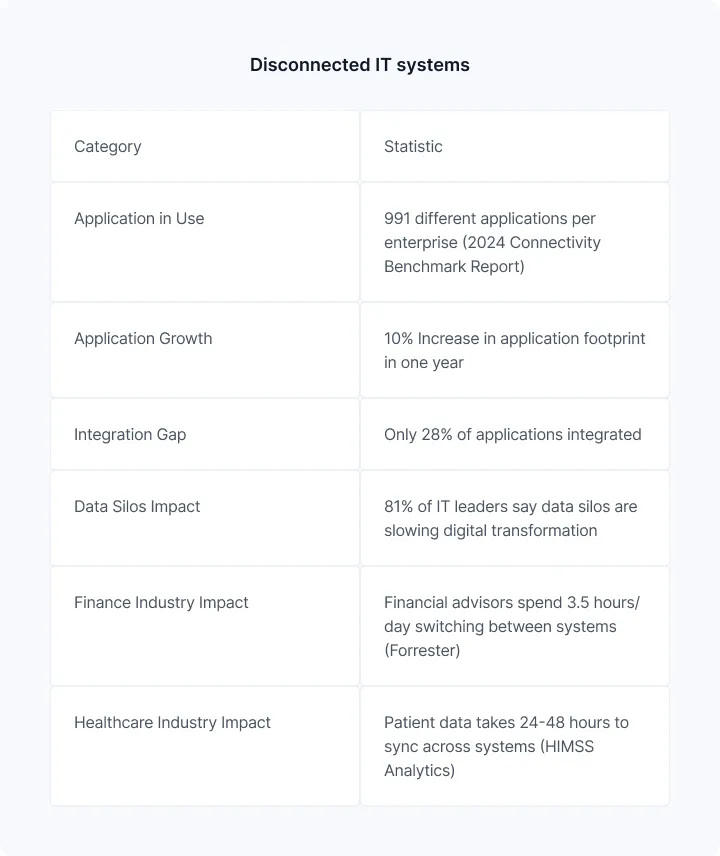
Picture this: your organization is running 991 different applications right now. If that sounds overwhelming, you’re not alone. The 2024 Connectivity Benchmark Report by MuleSoft¹ found that enterprises saw a 10% increase in their application footprint in just one year. The bigger problem? Only 28% of those applications are integrated, and 81% of IT leaders say data silos are actively slowing digital transformation.
This isn’t an abstract statistic but a daily operational drag. Forrester² reports that financial advisors spend an average of 3.5 hours every day switching between systems to serve clients. In healthcare, HIMSS Analytics³ found that it can take 24–48 hours for critical patient data to sync across systems, in an industry where minutes can save lives.
The growing cost of disconnected systems
Research shows that managers lose up to 40% of their time on administrative work caused by disconnected systems.
The cost of application sprawl is rising fast. ServiceNow⁴ research shows managers lose up to 40% of their time to administrative work caused by disconnected systems, time that could be spent leading teams or driving strategy. In manufacturing, McKinsey⁵ found that delays in syncing data between sales and production systems lead to excess inventory, costing companies an average of 2% of annual revenue.
It’s not just efficiency at stake; innovation is also suffering. Gartner⁶ reports that organizations with disconnected development and deployment tools experience a 65% longer time-to-market for new products compared to those with integrated DevOps environments.
Why traditional solutions fall short
IDC estimates enterprises spend $3.5 million annually on maintaining point-to-point integrations.
Attempts to fix the problem with traditional integration methods often run into three roadblocks: rigid architecture, overwhelming complexity, and the inability to scale at speed. IDC⁷ estimates enterprises spend $3.5M annually on maintaining point-to-point integrations, with 60% needing major updates within 18 months. Deloitte⁸ found that nearly half of organizations require specialized integration teams of 10+ developers just to maintain their existing connections. And in healthcare, KPMG⁹ found that traditional integrations take 8.5 months on average yet business needs are changing every 3–4 months.
A new paradigm: AI-driven integration
AI offers a fundamentally different approach. Rather than building brittle, static connections, AI can understand context and intent across systems, adapt dynamically to workflow changes, learn from user interactions, and handle unstructured data naturally.
An AI-first integration strategy shifts the focus from connecting systems to optimizing the workflows that span them. By building intelligence into the integration layer, enterprises can enable adaptability from day one and measure success in real business outcomes: time saved, errors reduced, and ROI delivered.
From integration to orchestration
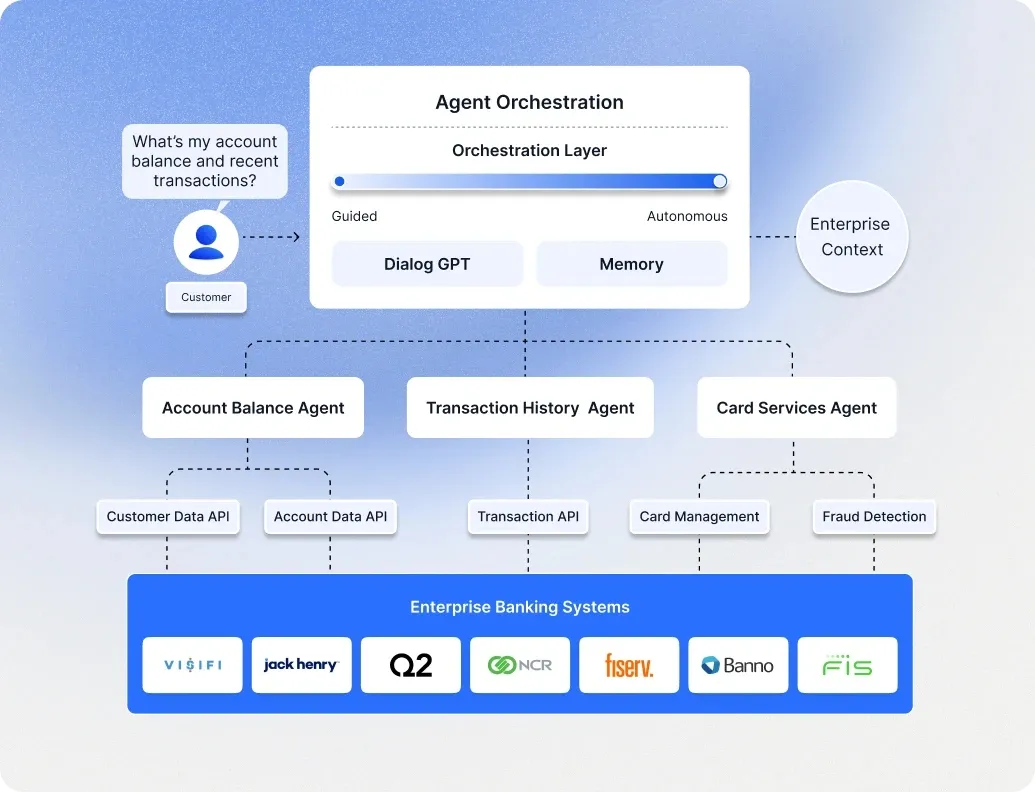
Integration solves connectivity. Orchestration solves how work actually gets done. Even when systems are connected, processes can still break down if handoffs are manual, context is lost, or decisions require constant human intervention.
This is where agentic orchestration comes in: AI agents that coordinate actions, decisions, and data flows across the enterprise in real time. The goal isn’t just to support work but to autonomously drive it.
Introducing Kore.ai’s AI for Process
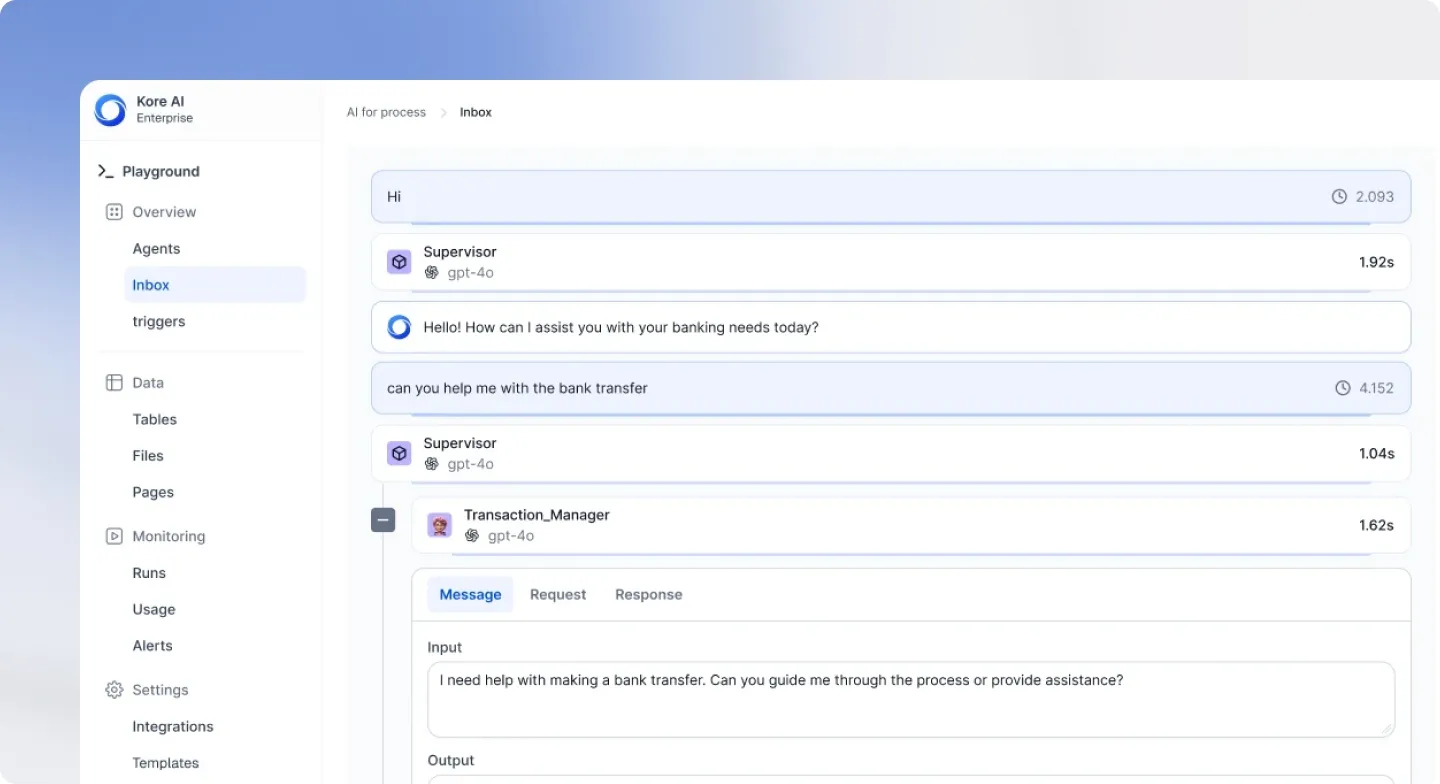
At Kore.ai, we’ve built AI for Process to address the unique challenges of today’s enterprise workflows. It’s more than just an integration tool; it’s a dynamic orchestration platform. that works across existing systems, data silos, and teams without requiring a rip-and-replace approach.
AI for Process starts by automatically discovering and mapping end-to-end processes, even when those processes span multiple disconnected systems. From there, it embeds intelligent AI agents that don’t just follow a script - they understand the context of each task, make real-time decisions, and escalate exceptions only when human judgment is required.
Human-in-the-loop interactions are orchestrated seamlessly through collaboration tools like Microsoft Teams, Slack, or custom user interfaces, so work flows naturally without constant application-switching. The platform continuously learns from execution data, feeding insights back into the process to reduce friction, increase efficiency, and improve decision-making over time.
Crucially, AI for Process provides a centralized process fabric that unifies governance and oversight. This means organizations can scale orchestration across departments while maintaining control over compliance, security, and business rules. It’s automation that doesn’t just execute - it evolves with the enterprise.
What It looks like in action
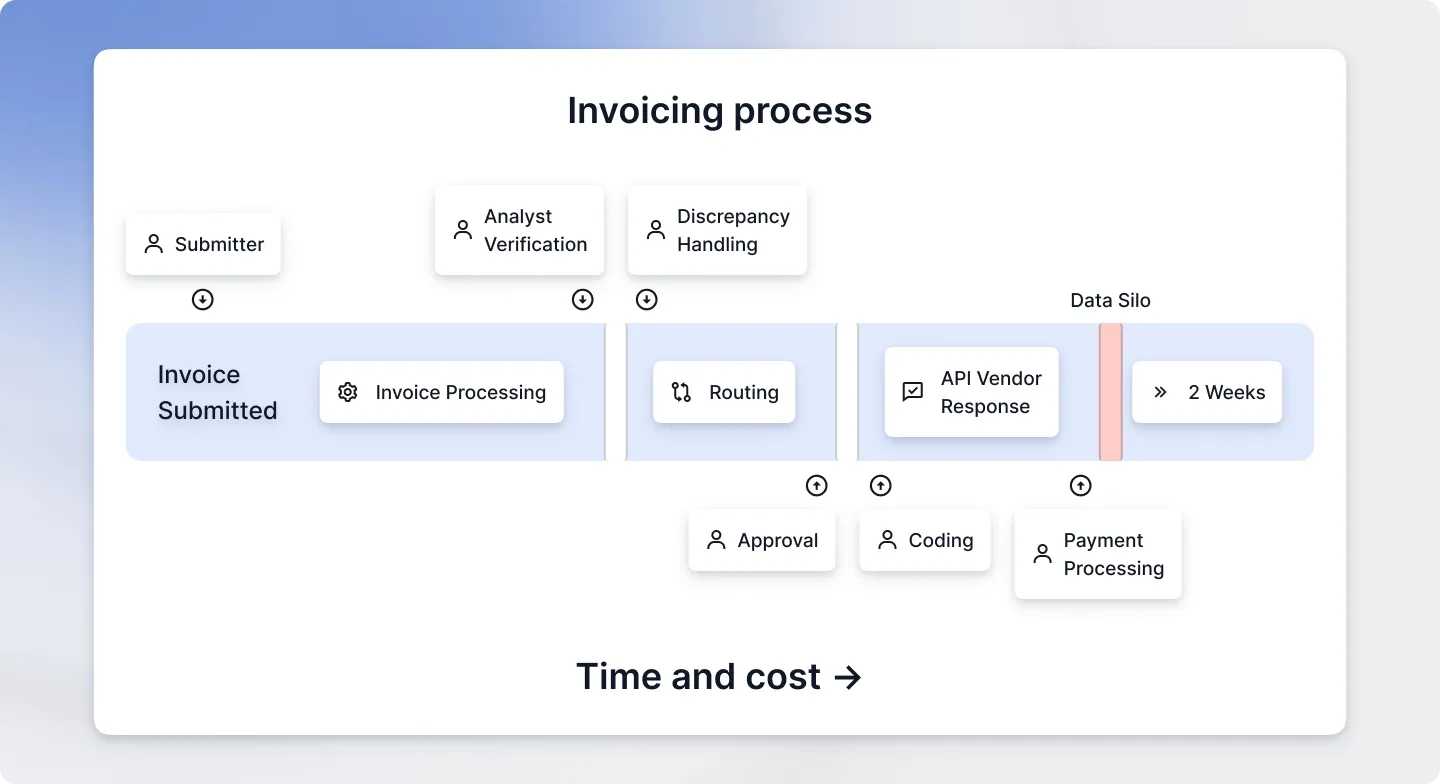
Consider a typical procure-to-pay (P2P) workflow, one of the most common yet fragmented processes in any enterprise. Traditionally, data lives across ERP systems, procurement platforms, invoice portals, shared inboxes, and spreadsheets. Handoffs are manual, approvals are delayed, and exceptions linger in email chains.
With Kore.ai’s AI for Process, the entire workflow is transformed:
- An AI agent continuously monitors invoice submissions, automatically matching them to purchase orders in the ERP system.
- When there’s a mismatch, the agent triggers an exception workflow — notifying the buyer directly in Teams, gathering any missing information, and routing it to the appropriate approver.
- Once resolved, the agent reconciles the transaction automatically, updates records across systems, and logs the transaction with complete audit trails.
- Throughout the process, it captures KPIs, SLAs, and exception patterns, delivering insights to process owners for ongoing optimization.
The result? No manual data entry, no “swivel-chair” between systems, no chasing approvals through endless email threads. Instead, you get a seamless, intelligent workflow where AI agents understand the task, the context, and the desired business outcome and can deliver it faster than any manual process.
Now, imagine applying this same model to every critical process across your enterprise, from employee onboarding and claims management to IT service management and compliance reviews. The gains in speed, accuracy, and agility compound quickly, creating a competitive advantage that’s difficult to replicate.
The future of workflows is agentic.
Disconnected applications don’t just slow down work — they stall transformation. Traditional integration and automation tools can’t match the speed, adaptability, or intelligence required today.
With Kore.ai’s AI for Process, enterprises can move beyond integration to intelligent orchestration, where workflows adapt in real time, friction is reduced, and outcomes are achieved faster. This isn’t about patching old processes. It’s about reimagining them with AI at the core.
The future of enterprise workflows is agentic, adaptive, and AI-first — and it’s here now.
¹ MuleSoft (2024) Connectivity Benchmark Report
² Forrester (2023) The Total Economic Impact™ Of Modern Integration Platforms
³ HIMSS Analytics (2023) Healthcare Integration Survey
⁴ ServiceNow (2023) The State of Work Report
⁵ McKinsey & Company (2023) Digital Manufacturing Global Survey
⁶ Gartner (2023) Market Guide for Integration Platform as a Service
⁷ IDC (2023) Enterprise Integration Spending Guide
⁸ Deloitte (2023) Digital Transformation Executive Survey
⁹ KPMG (2023) Healthcare Digital Transformation Report
Share
Tags