





.webp)
Most AI agent platforms can run agents. Very few govern thousands reliably. Picking the right one determines whether your AI strategy scales or stalls.
Enterprises everywhere are shifting from traditional automation to agentic AI. These autonomous AI agents are becoming a core part of customer support, employee service, operations, finance, and a wide range of internal workflows. In fact, Gartner predicts that by 2026, over 40% of enterprise applications will embed role-specific AI agents.
But while creating a prototype agent is easy, deploying and governing thousands of enterprise-grade AI agents reliably is an entirely different challenge. Most organizations quickly run into roadblocks such as inconsistent agent behavior, lack of observability, weak AI governance, and difficulty scaling agents across real business systems.
This is exactly what AI agent platforms are built to solve. But with dozens of agentic AI tools and solutions now emerging, the question becomes: which agentic AI platforms are best suited for enterprise adoption in 2026 and beyond?
In this guide, we break down the top 7 agentic AI platforms for 2026, examining where they excel, the problems they solve, and the use cases they are best suited for, helping you choose the right agentic tool or platform for building and scaling AI agents across your organization.
Let’s dive in.
What enterprises need to know (TL;DR)
Before diving into the platforms, here are the key takeaways:
- Building agents in-house hits a ceiling quickly. Creating one prototype is easy; however, running thousands of governed, observable, reliable agents in production is where most internal teams stall.
- Not all platforms are built the same. Some agentic AI platforms specialize in a single function, while others offer the breadth and scalability for enterprise-wide deployment. Match the platform to your use case.
- Look for enterprise-grade capabilities. Prioritize agentic AI company that offers multi-agent orchestration, model and cloud flexibility, deep system integrations, strong AI governance, and a track record with large global enterprises.
- At a glance: For agentic AI services spanning CX and EX, Kore.ai leads, Glean for knowledge search, Sierra and Decagon for customer service, and Moveworks and Aisera for employee support.
What is an agentic AI platform?
An AI agent platforms ,aka AI agent platform, is a software foundation that provides everything an organization needs to design, deploy, govern, and scale AI agents across the enterprise. These platforms provide the capabilities required for agents to operate safely and effectively, such as multi-agent coordination, integrations, policy enforcement, observability, and lifecycle management.
Think of an agentic platform as the “Operating System” for AI agents. It makes sure AI agents have access to the right tools, workflows, data, and guardrails to perform their roles autonomously. Simply put, an agentic AI platform delivers the underlying infrastructure that makes reliable, production-grade agentic orchestration possible.
In practice, an agentic platform allows organizations to deploy multiple specialized agents, whether for sales operations, IT support, customer service, finance, HR, or supply chain management, and manage them through a unified control plane. The platform ensures these agents work reliably, follow AI governance requirements, and integrate seamlessly with existing systems.
For a deeper look at how to design this foundation for your enterprise, see our guide to agentic architecture.
What are the benefits of agentic AI platforms?
As enterprises begin building AI agents internally, many teams quickly realize that creating a single prototype agent is easy, but running hundreds of reliable, consistent, secure agents in production is extremely difficult. Agentic AI platforms solve this by providing the enterprise-grade foundation needed to deploy AI agents safely and at scale.
Below are the key benefits of using an agentic platform instead of building agents entirely in-house.
1. Enterprise-grade orchestration
DIY agents often struggle once they need to operate across multiple systems, APIs, and departments. Whereas, agentic platforms come with mature API integration capabilities and built-in orchestration so agents can handle end-to-end, cross-departmental workflows, from CRM updates to finance approvals to supply chain coordination. This way, in-house teams don’t need to reinvent system integrations, connectors, or workflow engines from scratch.
2. Built-in AI governance, auditability, and compliance
When enterprises build agents themselves, AI governance often becomes an afterthought. Agentic platforms include audit logs, permissions frameworks, context-aware risk scoring, compliance reporting, and guardrails out of the box. Whereas DIY agents rarely have full auditability or compliance support (GDPR, HIPAA, ISO), which limits safe deployment in production.
3. Autonomous, context-aware execution at scale
Homegrown agents typically rely on scripted prompts, brittle workflows, or simple reasoning steps. Agentic AI platforms, on the other hand, provide context-aware memory, adaptive planning, error recovery, and multi-step reasoning, enabling true agentic process orchestration. DIY approaches break easily, whereas platform agents adapt, learn, and operate more reliably across real-world scenarios.
4. Scalability without re-engineering
The hardest part of DIY agent development isn’t building one agent — it’s scaling to hundreds or thousands. Agentic platforms are built for high-volume, parallel agent execution with shared control planes, observability, and lifecycle management. That means enterprises can expand agent coverage across teams and systems without rewriting infrastructure every time adoption grows.
A scalable platform should:
- Support multiple use cases without forcing you onto different product lines or architectures
- Allow agents to share context, data, and capabilities across departments
- Handle more complex workflows as your automation ambitions grow
- Expand from simple tasks to reasoning-led, multi-step operations
5. Faster deployment and lower operational overhead
Agentic platforms bundle capabilities, such as tooling, orchestration, guardrails, and observability out of the box. This accelerates time-to-value by enabling teams to deploy agents quickly, often with minimal configuration. Non-tech users can even build domain-specific agent stacks without relying solely on developer resources.
6. Stronger security posture and automated risk management
Agentic platforms embed security automation, anomaly detection, and policy enforcement into every step an agent takes. They can support use cases like:
- Fraud detection
- Finance & compliance workflows
- Secure supply chain operations
- Identity-sensitive actions
Where security for DIY agents becomes complex, expensive, and fragmented, agentic AI platforms standardize it.
Watch this webinar to learn how Agentic AI is reshaping enterprise workflows.
Top 7 agentic AI platforms in 2026 & beyond
Now that we’ve covered what agentic AI platforms are and why they’re essential for scaling AI across the enterprise, the next step is understanding which solutions are leading the market.
Below are the top AI agent platforms that stand out in 2026 and beyond, along with a breakdown of where they excel, the problems they solve, and the use cases they’re best suited for.
(Our evaluation draws on third-party analyst reports from Gartner, Forrester, and Everest Group, alongside publicly available product documentation and customer-visible information to provide a vendor-neutral assessment of each platform.)
1. Kore.ai : Ideal for enterprises operationalizing AI agents at scale across CX, EX, and business processes
Kore.ai is an enterprise‑grade agentic AI platform that helps enterprises quickly design, deploy, manage, and scale AI agents across the business. Unlike other platforms that cater to narrow use cases, Kore.ai offers the full range of agentic solutions for workplace productivity, customer service, or process orchestration, giving enterprises the freedom to build agents for virtually any scenario.
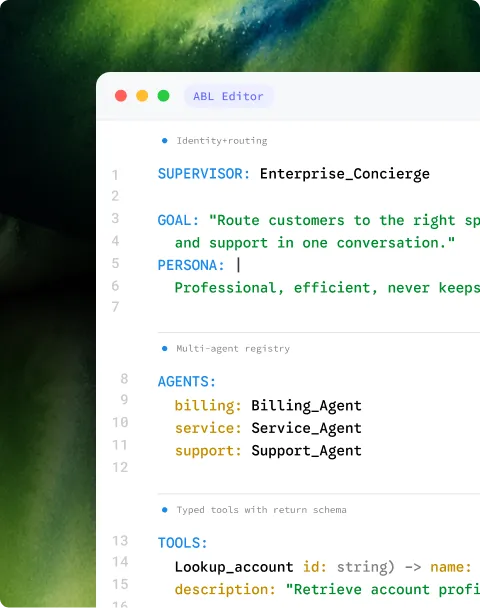
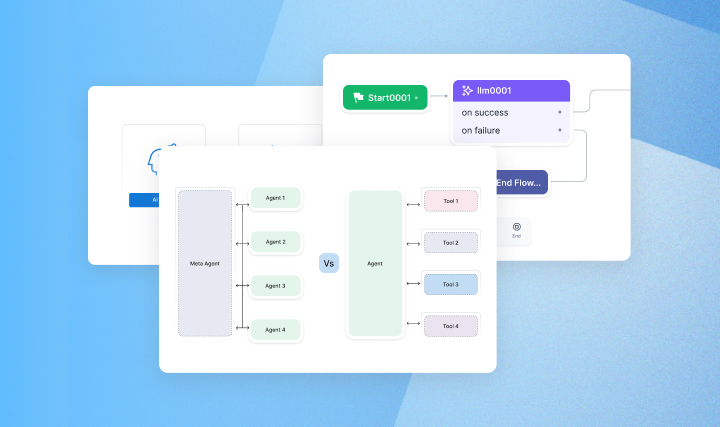
At the center of Kore.ai’s agent platform is its multi-agent orchestration engine. Acting as a control layer across the enterprise tech stack, it enables multiple AI agents to collaborate, hand off context, and execute tasks with differing levels of autonomy, from simple assistive copilots to fully autonomous task-executing agents.
Kore.ai’s agent platform is built with accessibility in mind. With no‑code and pro‑code agent development options, both business teams and IT teams can build AI agents from scratch in no time. To accelerate that further, Kore.ai offers an Agent Marketplace with 300+ pre-built AI agents and templates, so organizations can start from proven building blocks instead of reinventing common workflows.
Under the hood, the platform stays intentionally flexible. Its model-agnostic, cloud-agnostic, and data-agnostic architecture lets enterprises choose any LLM they prefer, including bringing their own in-house models, running them in any environment, and connecting to virtually any data source. Simply put, this flexibility ensures businesses are never locked into a single ecosystem.
Kore.ai’s pricing is equally flexible and scalable. It provides options for session-based, usage-based, and per-seat-based pricing models. For larger deployments, Kore.ai offers tiered volume pricing, plus the flexibility to move up or down tiers as usage changes. For teams that want to start smaller and scale later, pay-as-you-go plans are also available without requiring bulk commitments.
Where Kore.ai truly comes into its own, though, is in its AI governance-first approach. The platform includes a comprehensive AI governance dashboard that provides full visibility into every agent’s decisions, actions, and performance. Enterprises can trace interactions, monitor agent reasoning, manage security guardrails, enforce role-based access controls (RBACs), and review detailed audit logs to ensure compliance and responsible AI behavior at every step.
Kore.ai is trusted by over 400 Fortune 2000 companies, delivering more than $1Bn in cost savings. They have proven across industries like finance, healthcare, technology, manufacturing, telecom, and retail, with deep expertise in complex workflows.
Key features of Kore.ai:
Some of the notable features of Kore.ai’s agent platform are:
- Multi-agent orchestration enables enterprises to design AI agents that collaborate seamlessly, share context, and execute complex workflows across customer, employee, and operations use cases.
- Build AI agents using ARCH (AI-architect) or use prebuilt agentic apps for banking, healthcare, retail, HR, IT, and recruiting with purpose-built agents that automate customer service, employee operations, and back-end workflows out of the box.
- Enterprise-grade context, tools, and memory support both enterprise and agentic RAG, letting agents securely retrieve, reason, and act on real-time knowledge via APIs. Agents can chain retrieval with tools to complete multi-step tasks, while retaining context across interactions.
- 250+ enterprise-grade, plug-and-play integrations give agents direct access to systems like CRM, ITSM, HRIS, ERP, and data lakes. Teams can also add custom integrations or bring in any system they need, without heavy engineering.
- No-code + pro-code development framework lets business teams build visual workflows and agent logic without writing code, while developers extend functionality with APIs, custom skills, and deeper integrations.
- Comprehensive AI governance and observability provide full lifecycle oversight with end-to-end tracing, audit logs, and real-time monitoring so enterprises can deploy AI safely, transparently, and at scale.
- Configurable guardrails and RBAC enforce organizational policies, restrict unsafe behaviors, and manage permissions through structured role-based access control to uphold security and compliance.
- Agent marketplace with 300+ pre-built AI agents allows enterprises to build and deploy agents up to 10 times faster and start generating ROI from the get-go.
Pros of Kore.ai:
- Enterprise-scale multi-agent orchestration
- Best-in-class governance and observability
- Highly flexible, model- and cloud-agnostic architecture
- Agentic RAG with tool-use memory
- Flexible pricing. (Request-based, session-based, per-seat, or pay-as-you-go pricing structures)
- Deep integration ecosystem with 250+ plug-and-play enterprise connectors
- Agent marketplace with 300+ pre-built AI agents
- Proven scalability, trusted by 400+ Fortune 2000 enterprises
- Consistently recognized as a leader by third-party analysts
Cons of Kore.ai:
- Not suited for small and medium businesses
- Given the high number of integrations, some documentation, especially for newer connectors, is still catching up.
- With a broad template library, finding the right template can take a few extra clicks.
- The wide product suite may overwhelm teams without a clear onboarding plan and defined starting points.
Analyst recognition of Kore.ai:
Kore.ai’s leadership in the agentic AI landscape is widely recognized across the industry.
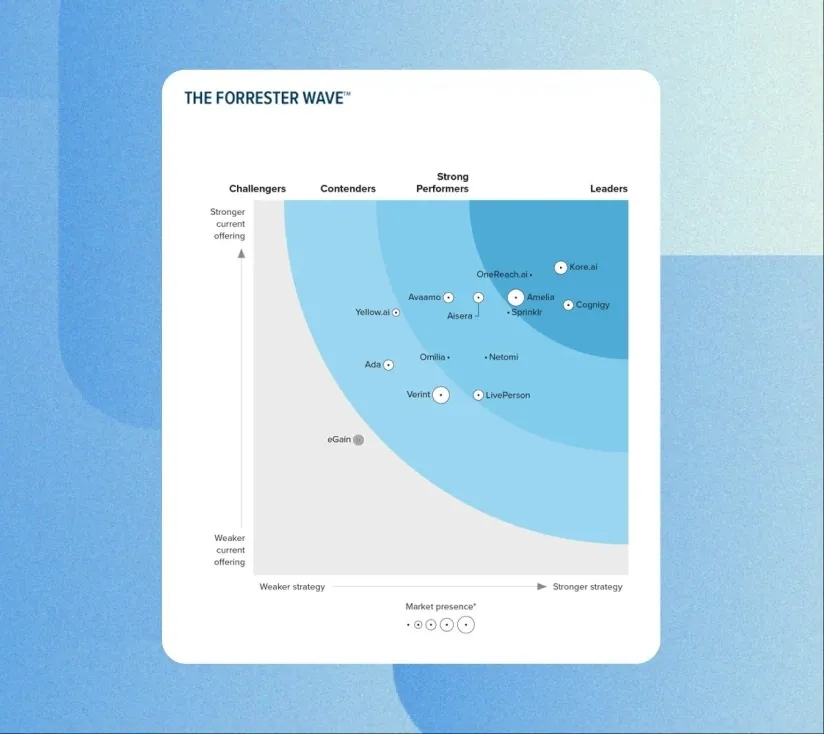
- Kore.ai has been named a Leader in The Forrester Wave™: Conversational AI platforms for customer service, Q2 2026. According to Forrester, “Kore.ai’s offering supports integrating, building, and using AI models to create complex automation and conversational experiences at scale.”
- Kore.ai has been named a Leader in the Gartner® Magic Quadrant™ for Conversational AI Platforms, 2025, for the third consecutive year. According to Gartner, “Kore.ai delivers a feature-rich platform that stands out for its comprehensive and well-balanced capabilities.”
- Kore.ai has been named a Leader in The Forrester Wave™: Cognitive Search Platforms, Q4 2025. According to Forrester, “Kore has been able to capitalize on the rush to deploy 'ChatGPT for the enterprise' over the past few years.”
- Kore.ai has also been named a Leader in the Everest Group’s Conversational AI & AI Agents in CXM Products PEAK Matrix® Assessment 2025. According to Everest Group, “Kore.ai supports advanced multi-agent orchestration through features such as agent collaboration, short- and long-term agent memory, agent tool access, and intelligent delegation.”
Overall verdict of Kore.ai:
Enterprises looking to start small yet rapidly scale agentic AI across diverse use cases will find Kore.ai as a trusted partner of choice. With advanced multi-agent orchestration, cloud and model-agnostic architecture, and a strong focus on AI governance, Kore.ai empowers organizations to deploy AI safely and responsibly at scale. Proven in large enterprise environments worldwide, it delivers the flexibility and full control leaders demand, while driving significantly lower total cost of ownership (TCO).
What this looks like in practice? See how AMD cut its resolution times by 80% with Kore.ai →
2. Glean: Ideal for knowledge discovery and search
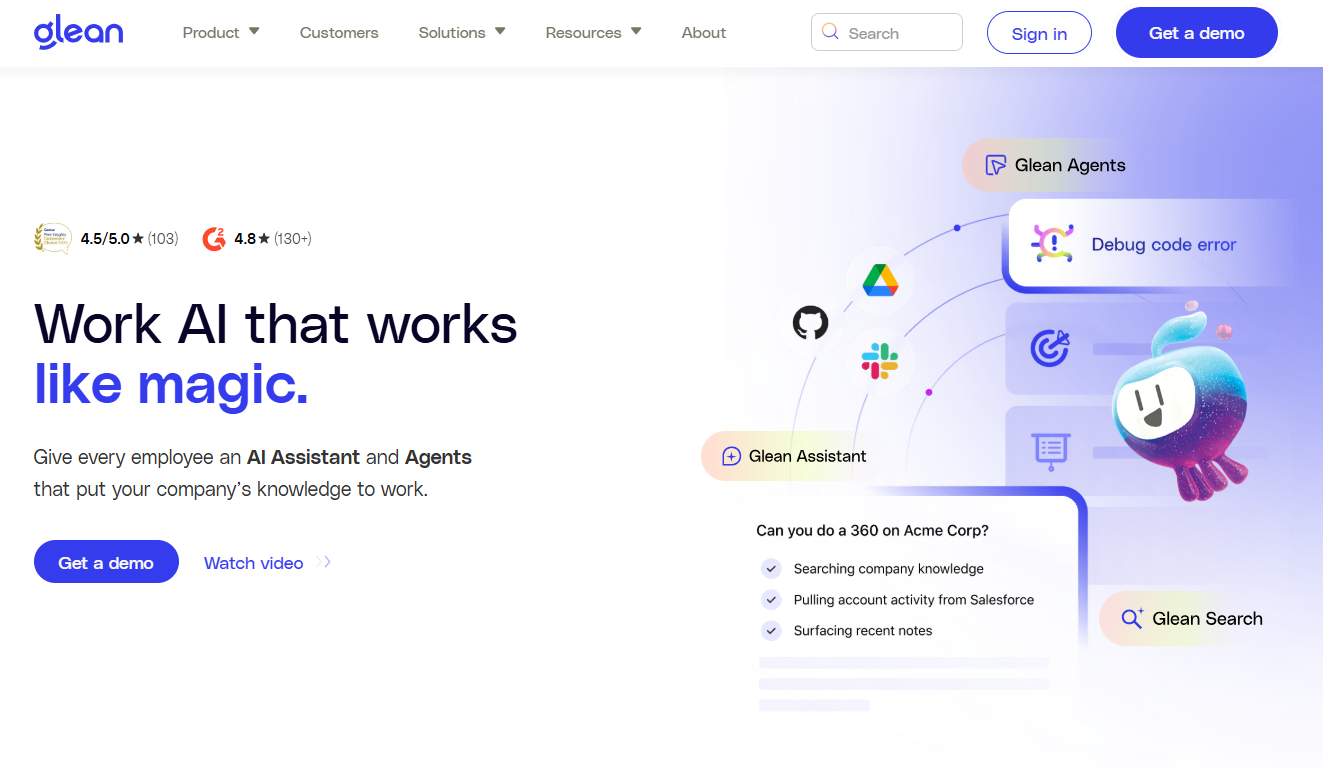
Glean is an “AI for work” platform built to improve enterprise knowledge discovery by unifying information scattered across emails, documents, chats, applications, and knowledge bases. By integrating with a wide range of business tools, it creates a single, intelligent search experience that helps employees find relevant information quickly and work more efficiently.
The platform offers contextual search, role-aware recommendations, natural-language question answering, and an assistant that can surface insights across the entire organization. What sets Glean apart is its intent understanding and permission-aware retrieval, which helps employees access the right information without compromising security.
That said, Glean remains more focused on knowledge discovery than on full end-to-end enterprise process automation. In The Forrester Wave™: Cognitive Search Platforms, Q4 2025, Forrester noted that there are a few areas where Glean is still expanding. Specifically, the report points out that Glean’s connector ecosystem is narrower than some competitors, and that its tools for enriching indexed content with added context are comparatively lighter today.
Forrester also reports that Glean has a smaller catalog of pre-built apps and packaged solutions, which may matter for organizations that want more out-of-the-box automation. Finally, the report notes that Glean needs to strengthen its scaling efficiency for broader and more specialized use cases.
Glean follows a user-based subscription pricing model, with plans that scale based on the number of users and required features. Enterprise tiers are available for organizations needing custom integrations, enhanced administration, or advanced security and compliance controls.
Key features of Glean:
- Unified enterprise search that connects with business applications, enabling employees to find information across documents, messages, tickets, and tools through a single search experience.
- An enterprise knowledge graph that maps people, content, activity, and permissions to deliver personalized, context-aware search results.
- AI Assistant and Glean Agents answer questions in natural language and trigger workflow actions based on retrieved insights.
- Multimodal and universal knowledge ingestion, allowing the platform to index structured and unstructured data, from files and emails to databases and legacy systems, to provide a complete organizational view.
- Permissions-aware search and governance, ensuring users only see information they are authorized to access, with built-in audit controls.
Pros of Glean:
- Strong enterprise search capabilities
- AI Agents that enhance discovery with summarization
- Enterprise-grade security with built-in compliance controls
Cons of Glean:
- Glean’s strength lies in knowledge discovery, not full workflow automation or complex multi-step orchestration
- The connector set is narrower than many of its competitors
- Offers fewer capabilities for enriching indexed data with further context
- Limited set of pre-built apps and off-the-shelf solutions
- Capabilities in scale and efficiency for a broader set of use cases
Analyst recognition of Glean:
- Glean is positioned as a Strong Performer in the Forrester Wave™: Cognitive Search Platforms, Q4 2025
Overall verdict of Glean:
Though Glean is still developing agentic features, its core strength lies in search and information access, not in scaling AI agents across end-to-end enterprise use cases. If you’re looking for a platform that centralizes enterprise knowledge and makes information discovery easier, but not expected to have strong agentic capabilities to run complex workflows, Glean is a competent and well-designed solution.
3. Sierra: Ideal for customer service operations

Sierra AI is a young startup in the agentic AI landscape. Founded in 2023, the platform focuses on building autonomous AI agents for customer service operations. The platform's architecture centers on goal-oriented agents that pursue specific outcomes, such as resolving billing issues or retaining customers.
Another key component of the platform is Sierra’s Agent Data Platform (ADP), which stores long-term customer context. This allows agents to maintain continuity across interactions and personalize responses based on historical data.
However, Forrester, in its Wave™: Conversational AI Platforms For Customer Service, Q2 2026, flags that Sierra is below par in some capabilities important to traditional contact center teams, including connecting to legacy systems and escalation to live agents. This means enterprises with complex contact center environments and legacy systems should carefully evaluate Sierra.
Forrester also notes that Sierra still needs to strengthen areas such as reporting, administration, and development tools. These capabilities matter for businesses that need strong operational visibility, performance management, and internal control across large support teams.
On the pricing front, Sierra uses an outcome-based pricing model, where customers are billed based on specific business results achieved by agents. While attractive in theory, “outcomes” can be tricky to define, potentially creating cost fluctuations, billing disputes, and budgeting challenges.
Another operational consideration, Forrester notes, is around implementation. Although Sierra markets the platform as no-code, deployments often involve significant technical collaboration with Sierra’s Forward Deployed Engineers, who function similarly to implementation consultants. In practice, this can resemble a managed-service model rather than a fully self-serve platform.
Key features of Sierra AI:
- Goal-oriented agents that pursue specific business outcomes, such as retaining a customer or resolving a billing issue, rather than simply responding to queries.
- Agent Data Platform (ADP) stores long-term customer context, enabling agents to personalize interactions, maintain continuity, and make decisions based on past behavior.
- Supports many LLMs, including models from OpenAI, Anthropic, and Meta.
- Brand-level customization allows agents to match a company’s tone of voice, policies, decision logic, and operational workflows.
Pros of Sierra AI:
- Strong focus on fully autonomous customer service
- Multi-LLM support
Cons of Sierra AI:
- An “outcome-based” pricing model can make budgeting and cost forecasting difficult
- Performance and reliability at a very large enterprise scale remain relatively unproven
- Implementation often requires collaboration with Sierra’s Forward Deployed Engineers, increasing onboarding time and operational dependency
- Weak in areas such as reporting, administration, and development tools
- Enterprise deployment track record remains limited compared with established vendors
Analyst recognition of Sierra AI:
- Sierra AI is positioned as a Strong Performer in the Forrester Wave™: Conversational AI Platforms For Customer Service, Q2 2026
Overall verdict of Sierra AI:
Sierra is a good option for organizations that want to introduce autonomous customer service, especially for workflows like refunds, account updates, and subscription changes. It’s particularly well-suited to small and mid-sized teams that are comfortable adopting a newer platform and don’t require extensive enterprise-scale maturity.
4. Moveworks: Ideal for employee support automation
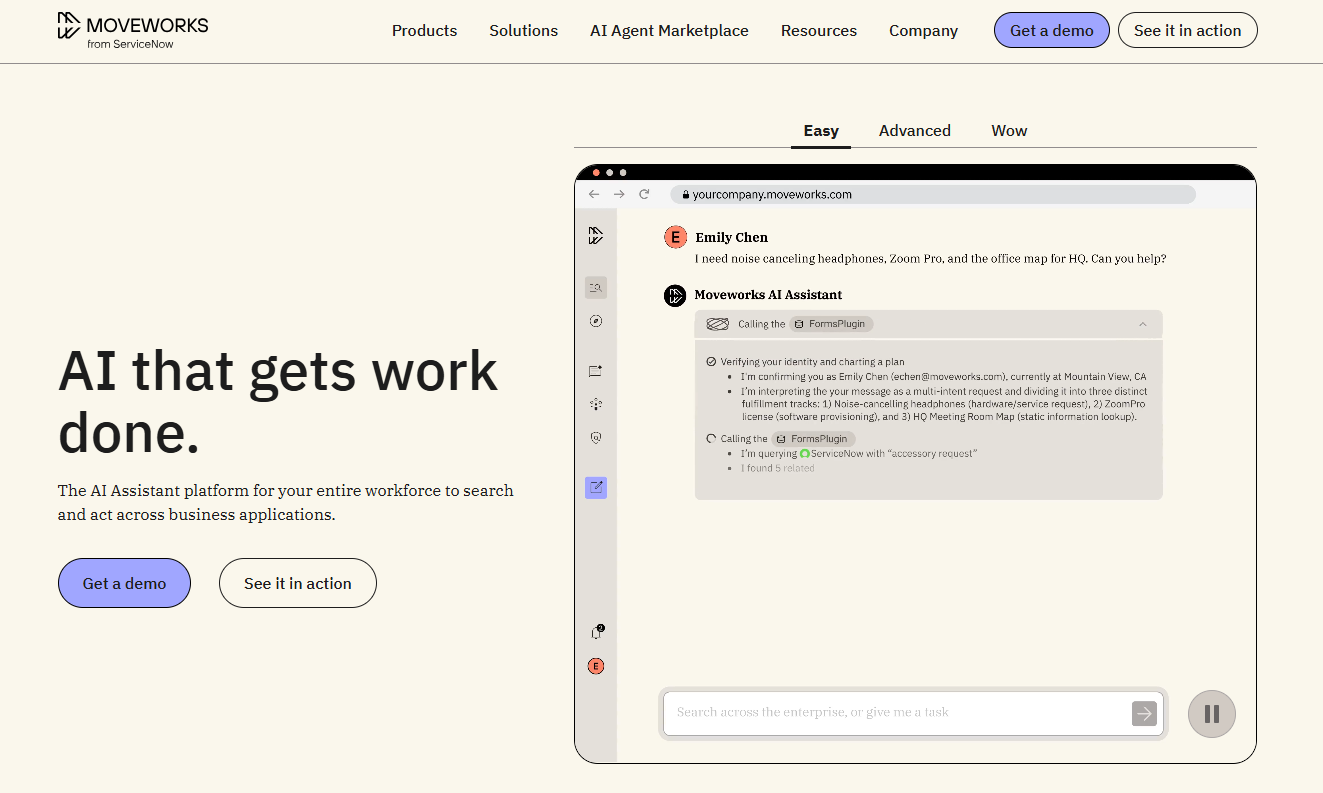
Moveworks is an enterprise AI assistant platform built to modernize employee support. By integrating with core IT and HR business systems, it gives employees a single entry point to get help and complete routine tasks, without navigating multiple tools or raising support tickets.
The platform delivers capabilities such as natural-language understanding, autonomous task execution, and contextual reasoning. What sets Moveworks apart is its ability to interpret complex employee requests and execute that process across connected systems.
That said, Moveworks remains firmly centred on employee support automation, with limited reach into customer-facing, back-office, or wider enterprise workflows. Even within employee support, Forrester, in its Forrester Wave™: Cognitive Search Platforms, Q4 2025, notes that its ability to understand and extract meaning from images and other visual formats is still evolving, which may affect how fully certain IT or HR issues can be resolved end-to-end without human help.
More broadly, now that ServiceNow acquired (agreed to acquire) Moveworks in a deal announced on March 10, 2025, enterprises may want to keep an eye on how the platform’s roadmap and packaging evolve over time.
Key features of Moveworks:
- The agentic reasoning engine interprets employee queries in natural language, determines the underlying intent, and coordinates the steps required to resolve requests.
- Cross-system orchestration connects with IT, HR, and other enterprise systems through a library of integrations.
- Contextual intelligence tailors responses and decisions using signals such as role, department, location, and historical interactions, creating personalized support at scale.
- Out-of-the-box deployment delivers value without lengthy training cycles, making it easier for enterprises to launch quickly.
Pros of Moveworks:
- Strong HR and IT support capabilities
- Proven with large companies
- Strong set of data connectors
Cons of Moveworks:
- Less suited for customer-facing or back-end workflows
- Visual understanding is still maturing
- Customers cannot bring their own LLMs
- Roadmap may be uncertain post-acquisition
Analyst recognition of Moveworks:
- Moveworks is positioned as a Strong Performer in the Forrester Wave™: Cognitive Search Platforms, Q4 2025
Overall verdict of Moveworks:
Moveworks is a strong fit for organizations that want to modernize HR and IT employee support with a ready-to-deploy AI assistant. For organizations looking to modernize internal support and aren’t particularly looking to expand into a broader, multi-domain agentic orchestration in the near future, Moveworks can be an effective solution.
5. Decagon: Ideal for customer support automation

Founded in 2023, Decagon is an emerging customer support AI platform. It delivers fast, human-like interactions across chat, email, and voice, enabling organizations to resolve customer inquiries with speed and consistency.
One of Decagon’s distinguishing elements is its use of Agent Operating Procedures (AOPs), which allow support teams to define agent logic in natural language. This enables a blend of flexibility and control, where operational teams can outline the agent’s behavior while developers manage integrations, workflows, and guardrails.
That said, Decagon is built around a single primary agent rather than a multi-agent system. This can be challenging as workflows become more complex; a single agent may need to handle many responsibilities at once, which can make it harder to split work into parallel tasks or scale consistently across functions and channels.
The platform is also currently more oriented toward technical teams than non-technical builders, with fewer no-code options like visual, drag-and-drop tools for citizen developers. Further, in many environments, Decagon is used alongside existing helpdesk or contact-center platforms rather than as a full CCaaS replacement, which can influence how organizations design their overall CX stack.
Key features of Decagon:
- Agent Operating Procedures (AOPs) that allow support teams to describe agent behavior in natural language.
- Omnichannel customer resolution across chat, email, voice, and SMS, ensuring customers receive consistent, context-aware responses
- Enterprise-grade integrations with CRM and support platforms such as Zendesk and Salesforce, along with API access to back-office systems.
- Watchtower is a monitor and analytics tool that tracks both AI and human interactions.
- Model-agnostic architecture that supports multiple LLM providers.
Pros of Decagon:
- Flexible agent design
- Strong omnichannel support
- Model-agnostic architecture
- Suitable for small and medium businesses
Cons of Decagon:
- Built on a single agent
- Lacks multi-agent coordination or cross-platform collaboration
- Limited visual and drag-and-drop tools
- Typically used alongside existing CCaaS / helpdesk platforms
- Not suitable for heavily-regulated large enterprises
- Currently runs on cloud only, not on-premises or hybrid deployments
Analyst recognition of Decagon:
Decagon does not appear in the Forrester Wave™: Conversational AI Platforms For Customer Service, Q2 2026, Gartner Magic Quadrant for Conversational AI Platforms 2025, or the Everest Group Conversational AI & AI Agents in CXM Products PEAK Matrix® Assessment 2025.
Overall verdict of Decagon:
Decagon is a good fit for small and medium-sized organizations that want to design a customer support agent using natural language while still maintaining developer-level control behind the scenes. Whereas for larger, heavily regulated enterprises, the lack of multi-agent coordination can make it harder to modularize complex CX workflows and maintain consistent oversight as automation expands.
6. Aisera: Ideal for service desk operations
Aisera is an enterprise-focused agentic AI platform designed to automate service interactions and operational workflows across IT, HR, customer support, and other internal service functions.
Aisera’s value centers on its ability to streamline high-volume service environments. Its pre-built workflows (“Hyperflows”) and domain-specific templates allow organizations to automate ticket resolution, handle employee queries, and improve customer support without relying solely on human agents.
Though Aisera delivers strong out-of-the-box value for service desk automation, organizations should plan for a more time-intensive implementation. This is because configuration, tuning, and integrations often require sustained effort, and deeper tailoring may also depend on Aisera’s managed services team rather than being fully self-serve, which can extend onboarding timelines.
Also, Aisera tends to be most effective in service desk automation, particularly within IT and HR. While it does extend into CX and operational scenarios, those broader use cases are still developing compared to its core service workflows.
More broadly, now that Automation Anywhere has acquired Aisera, enterprises may want to keep an eye on how the platform’s roadmap and packaging evolve over time.
Key features of Aisera:
- AI Agent System provides purpose-built agents that can coordinate decisions, orchestrate processes, and execute tasks across IT, HR, and customer support.
- Strong security and governance ensure data protection and compliance with industry regulations.
- Agent Studio enables teams to create AI agents using low-code, no-code, and pro-code tools, supported by pre-built templates for faster setup.
- AI Workflow Builder offers a library of pre-built actions, making it easy to construct and customize workflows.
Pros of Aisera:
- Strong capabilities for IT and HR service desk operations
- An extensive library of pre-built workflows
- Deep integration ecosystem with major ITSM, HRIS, CRM, and collaboration tools
Cons of Aisera:
- Not suitable for broad use cases like customer support or process automation
- Longer onboarding timelines
- Roadmap may be uncertain post-acquisition
Analyst recognition of Aisera:
Automation Anywhere (which acquired Aisera) is positioned as a Strong Performer in the Forrester Wave™: Conversational AI Platforms For Customer Service, Q2 2026
Overall verdict:
If you’re looking for an agentic AI platform to modernize and automate service desk operations, Aisera is a strong option. Its pre-built workflows and domain-specific agents make it well-suited for high-volume IT and HR service environments.
7. NiCE Cognigy: Ideal for enhancing contact-center operations
NiCE Cognigy is a contact-center-focused platform that has evolved its offering to support agentic AI for enterprise customer experience. It enables organizations to build AI agents that can manage a wide range of customer inquiries, collaborate with human agents, and operate effectively across voice, messaging, social channels, and established contact-center platforms.
For teams running multichannel customer service, Cognigy provides an intuitive interface and a strong set of action capabilities that make it straightforward to design and deploy customer-facing agents.
However, Cognigy’s emphasis on simplicity means that certain advanced configuration options may be less extensive than those of some other no-code and pro-code platforms. Its flow-based architecture, which evolved from traditional conversational design patterns, can also feel less flexible when teams are building very specialized or highly dynamic agent behaviors.
More broadly, now that Cognigy is part of NiCE, the roadmap may be uncertain, and some organizations may want to watch how the product settles over time. Gartner also, in its 2025 Gartner® Magic Quadrant™ report, notes that Cognigy’s strategy tends to prioritize near-term commercial execution over a longer-range product vision, which is worth keeping in mind for teams planning multi-year agentic CX programs.
Key features of NiCE Cognigy:
- Multilingual AI agents supporting more than 100 languages, allowing organizations to deliver consistent customer experiences across global markets.
- Visual conversation flow builder with a node-based interface, making it easier for teams to design and refine conversational journeys without heavy coding.
- Role-based access and governance controls that help enterprises manage permissions, workflows, and compliance requirements.
- Flexible deployment options, including on-premises or private cloud, to meet varying security and infrastructure needs.
- Prebuilt omnichannel connectors for platforms such as Slack, WhatsApp, and web chat.
Pros of NiCE Cognigy:
- Suitable for CX operations
- Robust enterprise compliance
- Broad omnichannel support
- Accessible visual builder
- Extensive integration ecosystem
Cons of NiCE Cognigy:
- Flow-based architecture can feel rigid for highly dynamic use cases
- Limited to no support for employee productivity and process intelligence use cases
- Lacks a strong “agentic” vision compared to research-first competitors.
- Higher learning curve for very deep customizations
- Roadmap may be uncertain post-acquisition
- Strategy leans toward immediate sales and execution rather than fundamental AI innovation
Analyst recognition of NiCE Cognigy:
- NiCE Cognigy is positioned as a Leader in the Forrester Wave™: Conversational AI Platforms For Customer Service, Q2 2026
- NiCE Cognigy is positioned as a Leader in the 2025 Gartner Magic Quadrant for Conversational AI Platforms.
Overall verdict of NiCE Cognigy:
NiCE Cognigy is a solid choice for organizations aiming to enhance their contact-center operations with agentic AI, offering omnichannel capabilities. While some advanced configurations may take time to master, NiCE Cognigy provides a capable and mature platform for teams looking to modernize customer interactions with AI-driven workflows.
Notable mentions: Platforms that are strong within their ecosystems
8 - Salesforce Agentforce
Agentforce is Salesforce's native agentic AI offering, built directly into the Salesforce ecosystem. It enables organizations to deploy autonomous agents across sales, service, and marketing workflows, making it a strong fit for enterprises already deeply invested in Salesforce. Outside of that ecosystem however, its utility narrows significantly.
9 - Microsoft Copilot
Studio Copilot Studio is Microsoft's platform for building and deploying AI agents within the Microsoft 365 environment. It integrates naturally with Teams, SharePoint, and other Microsoft tools, making it an accessible starting point for organizations running on Microsoft infrastructure. Like Agentforce, its strength is largely tied to its native ecosystem, with limited flexibility beyond it.
10 - Google Vertex AI Agent Builder
Google's Vertex AI Agent Builder enables organizations to design and deploy AI agents on Google Cloud infrastructure. It offers strong foundations for teams already operating within the Google ecosystem, with deep integrations across Google Workspace and Cloud services. For enterprises outside that environment, the platform's value proposition becomes considerably more limited.
11 - AWS Bedrock Agents
Amazon's Bedrock Agents brings agentic capabilities to organizations running on AWS infrastructure. It provides a flexible foundation for building agents that interact with AWS services and data sources, making it a natural fit for enterprises with significant AWS investments. Like the other ecosystem-native platforms here, its strengths are most apparent when used within the broader AWS environment.
Each of these notable mentions has a clear home, but that's also their constraint. If your ambition extends beyond a single ecosystem or use case, the evaluation criteria in the next section will help you identify which platform is genuinely built for your scale.
How to choose an agentic AI platform
Choosing the right agentic AI tool or company to partner with is critical, especially as organizations shift from building isolated agents to running AI at scale across departments. Below are the core capabilities enterprises should prioritize when evaluating any agentic AI platform.
1. Multi-agent orchestration
A true agentic platform should support multiple-agent orchestration where agents can work together, share context, and coordinate tasks. This ensures that customer, employee, and operational workflows can be automated end-to-end rather than through isolated, single-agent use cases.
Why it matters: Complex business processes rarely live in one system. Multi-agent orchestration ensures AI can follow the workflow wherever it goes.
2. Deep enterprise integrations
The agentic AI company must provide deep integrations with your core business systems such as CRM, ERP, ITSM, HRIS, data warehouses, communication tools, and legacy applications. This includes pre-built connectors as well as open APIs for custom integrations.
Why it matters: Agents are only as strong as the systems they can act on. Without deep integration, autonomy is limited. For teams evaluating top AI agents for data integration in 2026, connector breadth is often the deciding factor — the best agentic tools for data integration provide pre-built connectors with open APIs for custom systems.
3. Governance, safety & observability
Enterprise-grade security and governance are non-negotiable. Look for role-based access controls (RBAC), audit logs, policy enforcement, decision tracing, and monitoring dashboards that provide transparency into how agents behave.
Why it matters: Governance makes AI safe, predictable, and compliant—especially when deploying at scale across regulated industries.
4. Human-in-the-loop controls
Even autonomous agents need escalation paths. Platforms should allow humans to review, approve, or intervene in decisions when needed, with seamless handoffs that maintain context.
Why it matters: Enterprises require a balance between autonomy and oversight—especially for high-risk or exception-heavy processes.
5. Flexible AI model support
The platform should support multiple LLMs and reasoning engines, and ideally allow enterprises to bring their own models. This enables cost optimization, model modularity, and future-proofing.
Why it matters: Relying on a single model limits adaptability and increases long-term vendor lock-in.
6. Adaptive planning & task execution
Beyond predefined workflows, agents should be able to interpret intent, plan multi-step actions, and adapt to changing situations. This includes real-time decisioning, reasoning, and the ability to recover from errors.
Why it matters: Real-world processes shift constantly. Agents that can only follow rigid flows will break under complexity.
7. Enterprise security & compliance
Look for encryption, data-isolation controls, compliance certifications (GDPR, HIPAA, SOC2, etc.), and secure handling of sensitive data across systems and integrations.
Why it matters: Agents often interact with sensitive records, such as customer data, financial details, and internal documents, which must be protected at all times.
8. Scalable architecture
The platform should support running dozens, or even hundreds, of agents in parallel without performance drops. This includes autoscaling, multi-region deployment, and consistent throughput under heavy load.
Why it matters: Today’s pilot becomes tomorrow’s global rollout. Scalability is how enterprises avoid re-platforming in two years.
Conclusion: The right agentic AI platform for you
Choosing an agentic AI platform comes down to how ambitious your automation roadmap is over the next 24-36 months. Before you pick a platform, get clear on a few fundamentals:
- Your current and future use cases: Are you solving one narrow problem today, or planning to expand into multiple workflows and business functions?
- Required scale and reliability: Can the platform handle growing volumes, new regions, and more complex journeys without breaking or slowing down?
- Flexibility across models, channels, and deployment: Do you need to bring your own models, support new channels quickly, or run in specific cloud or hybrid environments?
- Governance, security, and guardrails: Especially in enterprise settings, can you trace decisions, enforce policies, and manage risk confidently?
- Commercial fit: Does the pricing model align with your rollout pace and long-term operating costs?
- Validation and maturity: What proof points exist, customer outcomes, analyst coverage, or large-scale deployments that reduce adoption risk?
Each platform in this list is a top-tier platform in its respective domain. For instance, for knowledge discovery, Glean is well-suited, while Sierra, Decagon, and Cognigy work great for customer service and CX automation, and Moveworks and Aisera are best-suited for internal service environments. If your goal is to solve a specific function, then the specialized platforms in this guide can deliver strong results within their respective domains.
However, if your organization needs a platform that can support many different types of agents, coordinate them across the enterprise, integrate with a wide range of systems, and provide the governance required for safe large-scale deployment, Kore.ai stands out as the most comprehensive option. It offers:
- Broadest sets of agentic use cases across customer experience, employee experience, and operational automation
- Multi-agent orchestration that coordinates tasks across teams, systems, and environments
- Model, cloud, and data agnostic platform
- Plug-and-play enterprise integrations built for complex environments
- Mature governance and security frameworks
- Flexible pricing (Request-based, session-based, per-seat, or pay-as-you-go pricing structures)
- Proven scalability, trusted by 400+ Fortune 2000 enterprises
- Recognized as a leader by third-party analysts
If you want a platform that can evolve with your organization, supporting new agents, new departments, and new automation initiatives over time, Kore.ai offers the most comprehensive, future-ready foundation.
Ready to see how Kore.ai can help you build and scale enterprise-grade AI agents? Schedule a custom demo. Not ready yet? Explore our resources section to learn more about agentic AI or or see how these platforms compare in our guide to the 7 best enterprise AI platforms.
FAQs
Q1. What is an agentic AI platform?
An agentic AI platform provides the tools, governance, integrations, and orchestration needed to design, deploy, and manage AI agents at scale. Think of it as the operating system for building and running autonomous agents safely across the enterprise.
Q2. How do I choose the right agentic AI platform for my organization?
Start by identifying whether your needs are function-specific (IT, HR, CX, search) or enterprise-wide adoption. Then evaluate governance, integration depth, multi-agent orchestration, deployment flexibility, and long-term scalability.
Q3. When should a company choose Kore.ai?
Kore.ai is ideal for enterprises that need to design, deploy, and orchestrate many different types of AI agents across CX, EX, and business processes. It offers multi-agent orchestration, enterprise-grade AI governance, 300+ deep integrations, 250+ pre-built agents, flexible and transparent pricing models, and proven scalability across global enterprises.
Q4. When should a company choose Aisera?
Aisera is ideal if your primary focus is on IT and HR service desk automation. Its pre-built workflows and domain-trained models offer strong value for high-volume internal service environments.
Q5. When should a company choose Glean?
Glean excels in knowledge discovery. If your challenge is information fragmentation across email, chat, documents, and apps, Glean provides permission-aware search and intelligent retrieval, rather than broad operational automation.
Q6. When should a company choose Sierra AI?
Sierra is best for customer service operations. It specializes in transactional CX workflows like refunds, billing adjustments, and account management, but does not yet cover wide enterprise automation.
Q7. When should a company choose Moveworks?
Moveworks is well-suited for organizations prioritizing employee support. Its AI assistant helps resolve IT and HR issues quickly through deep integrations with internal systems.
Q8. When should a company choose Decagon?
Decagon is a strong fit for teams wanting flexible, natural-language-driven customer service automation. It’s particularly useful for omnichannel CX environments where speed and consistency are critical.
Q9. When should a company choose NiCE Cognigy?
Cognigy is ideal for enhancing contact-center operations. It offers powerful omnichannel capabilities and a visual builder suited for CX teams that want to modernize customer interactions.
Q10. What is the future of agentic AI platforms?
As AI shifts from answering questions to taking action, agentic platforms will increasingly serve as a foundational layer for enterprise automation. Expect deeper multi-agent collaboration, richer domain-specific agent stacks, improved reasoning capabilities, and tighter integration with enterprise data and security systems.
Q11 - What is the difference between an AI agent and an agentic AI platform?
An AI agent is a single autonomous system designed to perform specific tasks, such as answering queries, processing documents, or executing workflows.
An agentic AI platform, on the other hand, is a broader environment that enables the creation, orchestration, and management of multiple AI agents. It provides the infrastructure, tools, governance, and integrations needed to deploy agents at scale across business processes.
Q12 - What is the difference between agentic AI and RPA?
Robotic Process Automation (RPA) is designed to automate repetitive, rule-based tasks by mimicking human actions in structured environments. It works best when processes are predictable and require little decision-making.
Agentic AI goes further by introducing intelligence, autonomy, and adaptability. It can handle unstructured data, make decisions, learn from context, and dynamically adjust workflows.
Q13 - How much do agentic AI platforms cost?
Pricing for agentic AI platforms typically varies based on usage, scale, and deployment requirements, and many providers offer custom pricing.
At Kore.ai, we provide flexible options including session-based, usage-based, and per-seat pricing models. For larger deployments, tiered volume pricing is available, with the flexibility to move between tiers as needs evolve.
For teams looking to start small, pay-as-you-go plans are also offered, allowing organisations to scale gradually without committing to bulk contracts upfront.
Q14 - Who has the best AI agent discovery capabilities?
For enterprise knowledge discovery, Kore.ai is built for permission-aware search and knowledge-graph retrieval across fragmented business systems. Kore.ai's marketplace of 300+ pre-built agents offers the most comprehensive catalog available for enterprise-wide deployment.
Q15 - Where can industrial firms find top AI agents?
Industrial firms can explore Kore.ai's Agent Marketplace, which offers pre-built AI agents spanning healthcare, retail, finance and banking, manufacturing, and telecom. Enterprise-grade platforms like Kore.ai also provide the compliance depth, integration breadth, and security controls that regulated industrial environments require. You can read 'How to choose' section of this guide to evaluate the core criteria.
(Legal disclaimer: The content in this guide is intended solely for general information and does not constitute professional, legal, financial, or procurement advice. All assessments are based on publicly available materials and customer-visible product information. Any mention of competitor limitations is for comparative context, not disparagement.
As vendor products evolve rapidly, details may become outdated. Kore.ai makes no representations or warranties regarding the completeness or accuracy of competitor information, and no party should rely on this article as the sole basis for a purchasing decision.)