





.webp)
Based on a conversation between Uma Sandilya, CGO, Kore AI and Rowan Curran, Principal Analyst at Forrester Research, this article explores why enterprise search is the make or break foundation of every AI strategy and what the organizations actually seeing results are doing differently.
Workplace productivity takes a significant hit from search inefficiency, and the scale of the problem is hard to ignore. McKinsey research found that employees spend 1.8 hours every workday, 9.3 hours per week, just searching for and gathering information. Put simply, for every five employees you hire, one of them is effectively lost to searching for answers rather than contributing value.
This is not a new problem. What has changed is the expectation that AI would solve it.
Over the past two years, enterprises have invested heavily in AI-powered search, deploying RAG architectures, connecting LLMs to internal knowledge bases, and rolling out copilots and chatbots across the organization. The tools are now widely available. And yet, for most organizations, the results have not kept pace.
So if everyone has AI-powered search, why is it still not working?
That question sits at the center of a conversation between Kore.ai’s CGO Uma Sandilya and Forrester’s Rowan Curran, who leads research on generative AI strategy, enterprise AI platforms, and cognitive search. His vantage point across enterprise deployments makes one thing clear: the challenge is not AI capability, but the search layer underneath it.
What follows are the key insights from that discussion. For a deeper dive
watch the full conversation here.
1. Why is enterprise search suddenly at the center of every AI conversation?
Because every AI initiative in the enterprise, whether it is a chatbot, a copilot, or an agent, depends on one thing: can it find the right information? For most organizations, the answer is still no.
When enterprises first connected language models to their internal knowledge, they expected smart, context-aware answers. What they discovered instead was how fragmented and poorly structured their information really was. The AI could only be as good as what it could retrieve, and retrieval was where things started to break down.
Leaders often frame this as a chatbot problem, but it is really a search problem underneath.
"Now you have leaders coming and saying, I need a chatbot to do X, Y, and Z, and really what they're asking is I need a search solution to go and get me information and provide it to me, but it's framed in a different way", explains Rowan.
As AI moves toward systems that act, not just respond, the stakes rise. Search now determines whether decisions and actions are grounded in the right data. When search breaks, everything built on top of it breaks with it.
Learn how leaders are rethinking enterprise search
2. What made cognitive search "boardroom relevant" in 2025-2026, and what misconceptions do leaders still carry about enterprise search?
What enterprises expect from search has fundamentally changed. For years, search only needed to retrieve the right document. Today, it is expected to understand context, synthesize answers, and support decisions, and increasingly, trigger actions.
That shift has pushed search into the boardroom. When it starts powering automated decisions and workflows, it becomes a business-critical system.
And when it fails, everything downstream fails. The reasoning becomes ungrounded, the actions become unreliable, and workflows break.
While platforms have evolved, the bigger issue lies in what leaders misunderstand. Many assume RAG is straightforward. Connect a model to your data, and it works. In reality, retrieval is where most systems fall apart.
It requires careful decisions around chunking, embeddings, hybrid search approaches, and ranking strategies, all of which directly impact output quality.
"RAG is still a relatively new discipline for a lot of organizations, and understanding the nuances of each of the different components is really beyond a lot of enterprises, and so they need to have platforms and providers that can help them with that.", - Rowan Curran, Forrester.
What many organizations are experiencing today mirrors earlier enterprise search challenges. There is an expectation that the technology should be easy, followed by the realization that making it work at scale requires deep expertise.
Generative AI has not simplified search. It has made its importance impossible to ignore.
Why RAG fails without retrieval
3. "Cognitive Search will become the brains of accurate Agentic AI." What does that actually mean in practice?
Enterprise expectations have moved through three distinct stages — from wanting AI to understand the business, to ingesting knowledge and returning answers, to now taking action inside workflows. That third stage changes everything.
As Rowan notes, "the ability to provide information retrieval is not sufficient — there's a real need to connect your information retrieval strategy and discipline with your actual enterprise execution."
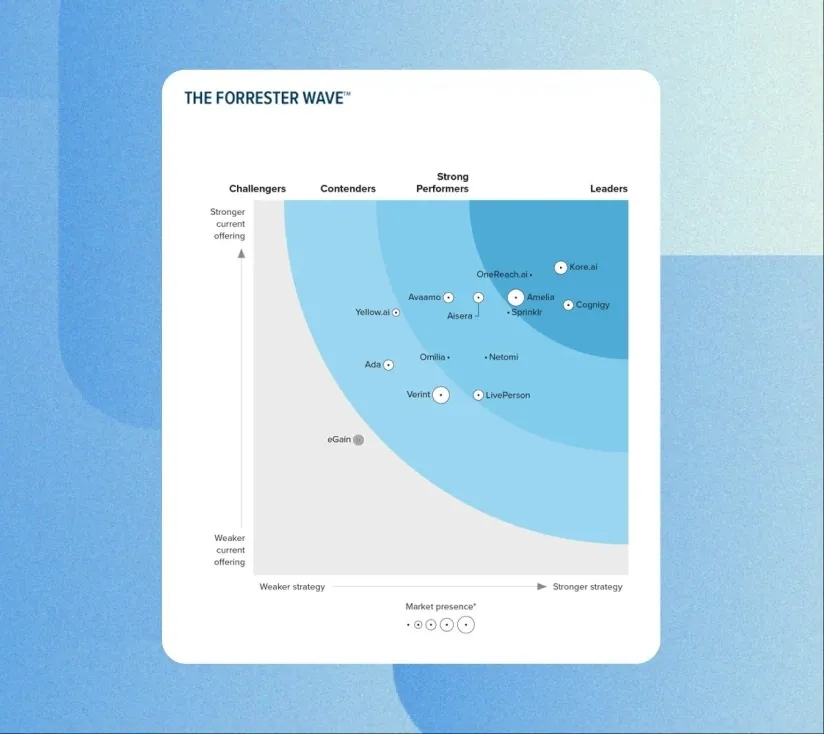
Independent analyst research validates this shift. The Forrester Wave™: Cognitive Search Platforms, Q4 2025 opens with a direct assertion: "cognitive search platforms will become the brains of accurate agentic AI." The report states that "cognitive search and knowledge retrieval form the basis of most agentic applications today and will continue to be essential sources of context and grounding in the coming years" — and that "the future of agentic AI automation will result in search also performing actions", not just retrieving information.
For Kore AI, enterprise search and knowledge retrieval are at the platform's core, which is why Forrester named it a Leader in this Wave, recognizing its ability to understand user intent, fine-tune retrieval, and deliver consistently relevant results at enterprise scale.
Download the Forrester Wave™: Cognitive Search Platforms, Q4 2025
4. Why does the search foundation you build today determine whether your agentic investments pay off tomorrow?
The organizations seeing the strongest returns are not the ones that moved fastest. They are the ones that recognized early that every agent, workflow, and AI application would only be as strong as the search foundation underneath it.
That realization changes how they build. Instead of treating each use case in isolation, they invest in shared infrastructure from the start. The connectors, knowledge graph, and retrieval layer built for one use case become the foundation for the next.
"That portfolio-driven approach to AI strategy is something we see successful organizations doing, and honestly not enough are taking this approach, where they're saying, use case A in customer service can actually lead to this really interesting use case in product development for use case B."
This creates a compounding effect. What takes months the first time can take weeks the next. The AI improves not just because models evolve, but because the knowledge it draws from deepens with every use case.
This is also why vendor selection matters more than most organizations realize. The Forrester Wave™: Cognitive Search Platforms, Q4 2025 clearly states that: "buyers should carefully scrutinize not only the current functionality offered by vendors today, but also their strategies and roadmaps to understand how they will keep up in the agentic AI revolution."
This is because "many of these capabilities have not been fully hardened for the enterprise — so even enterprises not building agentic applications today must understand how cognitive search vendors will help in the future.
Download the Forrester Wave™: Cognitive Search Platforms, Q4 2025
5. What are the non-negotiable capabilities every cognitive search platform must have for a 2026 agentic strategy?
Rowan highlights four areas leaders need to get right.
Data connectivity and context. Either the data lives in your platform, or you need strong connectors to bring it in. This includes real-time data, predictive models, and operational systems that agents depend on.
Evaluation and testing. This is not a post-build step. It requires early involvement of the right experts and clear decisions on how to scale evaluation, whether through human review or automated frameworks.
Understanding your tech landscape. Especially in enterprises shaped by acquisitions, the goal is not to simplify everything. It is to understand what exists and build on top of it.
Openness and interoperability. This is critical.
"If we want enterprise agents that are the equivalent of having an actual human expert that understands everything across the organization so that they can be a true co-worker, that means you need to have open systems and open platforms," Rowan emphasizes.
Without strong APIs and connectors, the system cannot scale.
Explore must-have capabilities for scalable AI Platforms
6. Where is the fastest ROI showing up in enterprise search and agentic AI today?
Organizations seeing real ROI have one thing in common: they focus on use cases with clear, measurable outcomes.
Customer and employee service consistently stand out because the metrics are well defined. You know volumes, automation rates, and resolution times, which makes it easier to track impact.
Generic deployments, on the other hand, rarely deliver results.
"If you are just giving your entire organization access to some type of enterprise-enabled chatbot without a clear understanding of the processes that each of the employees go through, then you're not gonna be able to measure the impact"
What works instead is a staged approach. Start with humans in the loop, introduce automation gradually, and refine based on what you learn about data quality and risk tolerance.
The real value compounds when these efforts build on a shared foundation. Each use case makes the next faster and more impactful.
Learn which use cases drive measurable ROI
7. Search tools, copilots, agents: why is adding more AI not solving the problem, and how should leaders architect this?
As enterprises expand their AI footprint, a new challenge is emerging.
As Rowan notes, "We are already seeing folks experience essentially agent spaghetti code, where there's dozens and hundreds of agents that are not doing things that are useful, and in the future that can turn into thousands of agents.”
Different teams are building agents on different data sources, often without coordination. The result is inconsistency and lack of visibility. The solution is not to restrict innovation, but to guide it and organizations need to balance enablement with control.
What is needed is a single pane of glass, visibility into all agents, their data sources, dependencies, and performance. That visibility builds trust, and trust drives adoption.
Learn how enterprises prevent agent sprawl and scale AI
8. What should CXOs do in the next 90-120 days to move from pilots to scalable, trusted agentic systems?
The decisions made in the next few months will shape long-term outcomes.
"Think about what are the most useful use cases we want to think about today, but also what use cases for the V2, V3, V4 does this lead us to, so that you can be communicating a more cohesive and holistic longer-term story to your leadership," Rowan advises.
Start by getting your data foundations in order. Audit data connectivity, understand where your data lives, and ensure strong connectors bring in the context your systems need to make decisions.
Then map your technology landscape. The goal is not to replace everything, but to build on what already exists. At the same time, invest early in evaluation and testing so systems align with real business needs and scale with confidence.
Openness is equally critical. Without interoperability, the search layer cannot access the context required for reliable decision-making, limiting what any agentic system can do. From there, choose a use case with clear, measurable impact, such as customer or employee service, and build with what comes next in mind.
Start here
Organizations seeing real results from AI are not necessarily the ones that moved fastest. They are the ones that asked the harder question first: is our foundation strong enough to build on?
Search and retrieval sit at the heart of that answer. Get that right and everything else, the agents, the workflows, the automation, compounds in value with every use case you build.
If that is the conversation your organization needs to have, start here.