The Decline of AI Agents and Rise of Agentic Workflows
Last Updated
December 1, 2025

Nathan Schlaffer

Cobus Greyling
Read Time
What’s on this page
Introduction: From AI Hype to Hard Truths
Not long ago, fully autonomous AI agents were hailed as the future. These systems promised to handle complex, multi-step tasks without human intervention. Demos went viral, analysts forecasted disruption, and it seemed as though human oversight itself might become obsolete.
But in practice, the story unfolded differently. By late 2025, enterprises experimenting with “runaway agents” discovered that independence came at a steep cost: unpredictability, inefficiency, and a lack of governance.
The focus has since shifted toward something more grounded and more powerful — agentic workflows. These are not single agents acting in isolation but structured systems of specialized agents that work together within clear boundaries. The result is greater reliability, visibility, and trust.
This evolution marks a defining moment in enterprise AI: the move from the dream of total autonomy to the reality of orchestrated intelligence.
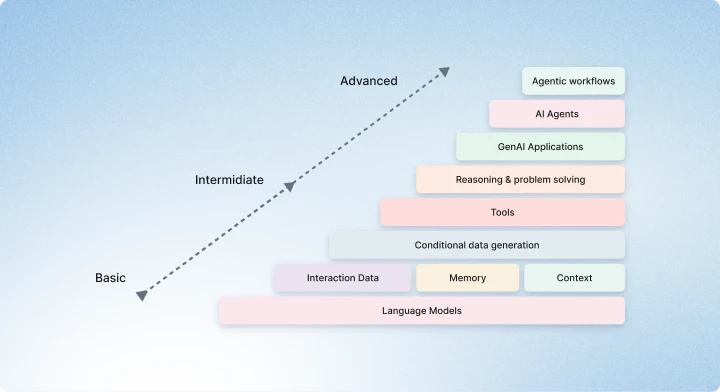
The Real Difference between AI Agents and Agentic Workflow
Classic AI Agents — the single, all-powerful agent — promised unbounded freedom: one LLM armed with tools, memory, and planning, free to decide every step on its own.
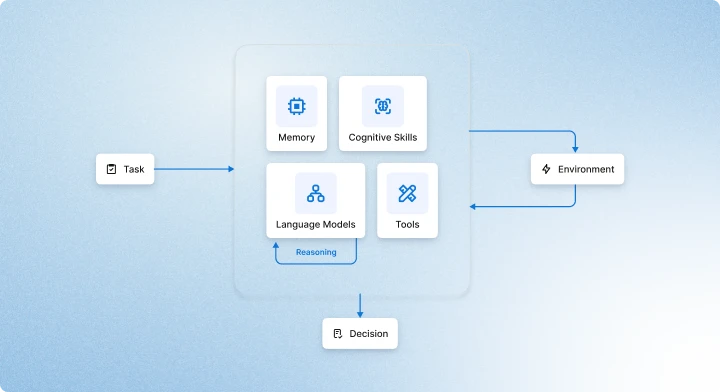
In practice, that freedom proved costly and unpredictable.
Industry benchmarks revealed the gap:
- Claude’s Computer Use averaged only 14% of human task performance.
- OpenAI’s Operator achieved 30–50% success on web-based tasks.
- Most open-source frameworks delivered 20–30% reliability at best.
The problem wasn’t intelligence, but the lack of structure.
Agentic workflows solve this by introducing connected, purpose-built agents operating through conditional logic and human-in-the-loop checkpoints. Each agent has a clear role, its own prompt and tools, and contributes to a transparent, traceable process.
This is not a retreat from autonomy; it is autonomy that works in production. With structured, testable flows, organizations get both flexibility and accountability.
A Simple Yet Powerful Example
To understand how agentic workflows improve reliability and control, consider a retrieval-augmented generation (RAG) system — one of the most common and effective enterprise AI architectures in use today.
At its core, a RAG workflow connects reasoning with retrieval in a structured feedback loop that keeps the model grounded in verified data. It’s a simple pattern, but it captures the essence of agentic design.
It begins with your organization’s knowledge base. Documents, FAQs, manuals, and reports are indexed into a vector database, transforming unstructured content into searchable embeddings. This step ensures that information can be accessed by semantic similarity rather than just keywords.
Next comes the retriever agent, a lightweight component specialized in finding the most relevant pieces of information. Instead of relying on the model’s memory or guesswork, the retriever ensures that every answer starts with facts pulled from trusted sources.
Once the information is available, a reasoning node evaluates whether the model already has sufficient context to respond or whether it should call the retriever for additional grounding. This conditional step is where the workflow becomes agentic — the model isn’t blindly executing tasks; it’s reasoning about its next move based on available evidence.
Conditional logic then routes the process automatically. If more information is needed, retrieval is triggered. If not, the reasoning agent formulates the response and delivers it back to the user.
This loop — reason → retrieve if needed → reason again → respond — forms a compact, self-correcting feedback cycle. It’s transparent, traceable, and scalable. Each node’s output can be logged, audited, and tuned without disrupting the entire system.
For enterprises, this approach changes everything. Instead of opaque AI systems that produce unpredictable results, RAG-based agentic workflows offer explainability, reliability, and compliance by design. Teams can visualize every step, identify where the reasoning succeeded or failed, and continuously improve the process.
That’s the real promise of agentic workflows: they transform AI from an unpredictable black box into a governed, measurable intelligence system that businesses can confidently deploy at scale.
The New Generation of Agentic Workflow Builders
As the limitations of single-agent systems became increasingly clear, the AI community began rethinking what “intelligence” should look like in practice. Instead of focusing on a single large model attempting to handle every task from start to finish, innovators started exploring modular, collaborative intelligence — systems where multiple smaller agents work together through defined rules and shared context.
This shift gave rise to a new generation of visual agentic workflow builders. These platforms allow developers and business users alike to drag and drop lightweight agent nodes, assign them specific roles or tools, and connect them through conditional logic. Each node represents a distinct piece of reasoning or action — such as data retrieval, validation, summarization, or decision-making — that can be easily monitored and improved over time.
The advantage of this approach is both technical and operational. Instead of wrestling with complex code and unpredictable model behavior, teams can design, visualize, and govern intelligent workflows that are explainable by design. Each step becomes a building block within a larger, auditable ecosystem — one that mirrors how real teams collaborate to complete complex processes.
Microsoft’s AsyncThink offers a clear example of this evolution. In their research, an organizer agent was designed to dynamically fork sub-tasks to parallel worker agents, each specialized in solving a portion of the problem. By coordinating these agents asynchronously, AsyncThink reduced latency by 28 percent while simultaneously improving reasoning accuracy. The takeaway was profound: distributed intelligence, when structured well, outperforms centralized intelligence every time.
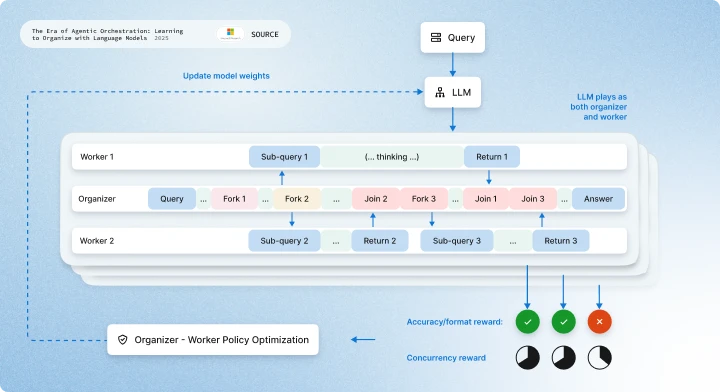
This marks a decisive shift in the way enterprises think about AI. The goal is no longer to build a single, all-knowing agent that tries to do everything. Instead, it’s to design collaborative networks of intelligent workers that operate within governed, observable systems. Each agent contributes specialized expertise, while the overarching workflow ensures accountability, visibility, and compliance.
For organizations deploying AI at scale, this architectural evolution is critical. Modern enterprises demand traceability, resilience, and control — not just intelligence. Agentic workflows deliver on all three, creating a foundation where human and machine collaboration can thrive without sacrificing safety or performance.
In many ways, this transformation mirrors an earlier revolution — when engineers realized that true innovation required abandoning legacy forms, not just upgrading them. That brings us to AI’s horseless carriage moment.
AI’s Horseless Carriage Moment
History has a way of repeating itself whenever technology leaps forward. Every major invention begins by borrowing the design language of what came before, until someone finally breaks free of those constraints.
When the first automobiles appeared in the late 19th century, they were literally horse-drawn carriages with engines bolted on. The steering resembled reins, the wheels were narrow and fragile, and the design assumed there would always be a coachman. Only years later did innovators like Ford and Benz realize that true progress required reimagining transportation from the ground up. Once the engine became the center of design, entirely new forms emerged—faster, safer, and infinitely more scalable.
Artificial intelligence is going through that same transformation. Early “AI agents” were not born of fresh architecture but of old assumptions. Developers took large language models, added a few tools, and expected them to perform like autonomous workers. These systems mimicked human workflows without questioning whether that was the most efficient way to reason or act. They were, in essence, the horseless carriages of AI—novel but still tied to the limitations of manual design.
Agentic workflows mark the true redesign. They move beyond the idea of one monolithic agent doing everything and instead embrace distributed, cooperative intelligence. Multiple agents reason in parallel, share context, and operate within structured guardrails that ensure safety and predictability. Each agent is specialized—one for planning, another for data retrieval, another for validation or summarization—and together they form a synchronized system capable of tackling complex tasks with measurable precision.
This isn’t about copying human cognition; it’s about industrializing it. Agentic workflows take the creativity and adaptability of human reasoning and embed it into a scalable, observable framework that enterprises can monitor, refine, and trust.
Just as modern automobiles unlocked an era of global mobility, agentic architectures are unlocking the era of governed autonomy—where intelligence is not wild or opaque, but engineered for performance, compliance, and continuous improvement.
The same design principles that turned engines into vehicles now apply to AI: success depends on structure, safety, and scalability. And just as assembly lines transformed manufacturing into an efficient, repeatable process, agentic workflows are transforming artificial intelligence into an enterprise-ready discipline. That is why the next chapter isn’t about more agents, but about making them work together seamlessly—an evolution that defines why agentic workflows are here to stay.
Why Agentic Workflows Are Here to Stay
As organizations move from experimentation to real-world deployment, the business case for agentic workflows becomes impossible to ignore. What began as a technical improvement has evolved into a strategic advantage that directly impacts reliability, efficiency, governance, and scalability.
Reliability lies at the heart of agentic design. In traditional single-agent setups, when an action fails or a model misfires, the entire process often collapses. Agentic workflows solve this by introducing complete execution traces, rollback points, and clear escalation triggers for human intervention. Every step is logged and explainable, allowing teams to pinpoint errors, retrain nodes, and continuously improve outcomes. For highly regulated industries like banking or healthcare, this transparency is essential to meeting audit and compliance requirements.
Efficiency is another defining benefit. Agentic workflows support parallel execution and targeted tool use, meaning multiple agents can perform specialized subtasks simultaneously instead of waiting in a linear queue. This orchestration dramatically reduces latency, optimizes computing costs, and allows organizations to process far more work in less time. In practical terms, a task that once took minutes can be completed in seconds—with higher accuracy and fewer manual checkpoints.
Governance transforms AI from a promising technology into a trusted business partner. With centralized oversight and built-in audit trails, enterprises can maintain visibility into how each agent behaves, what data it accesses, and what outputs it generates. Policies can be applied globally, ensuring compliance with both internal security standards and external regulations. It’s not just about control—it’s about confidence in automation.
Finally, scalability makes agentic workflows future-proof. New capabilities can be added simply by creating new nodes or agents rather than rebuilding entire systems from scratch. This modularity allows businesses to expand incrementally—testing, validating, and refining new components without disruption. It’s a design philosophy that supports continuous innovation at enterprise scale.
The age of the lone-wolf agent is fading fast. The future belongs to agentic organizations—intelligent networks of collaborating specialists that combine reasoning, autonomy, and accountability. These systems don’t just perform tasks; they drive measurable business outcomes, turning AI from an experiment into a core operational engine.
Conclusion: The Future is Agentic and It’s Already Here
As the excitement around autonomous AI fades, the next wave of innovation is being built on structured collaboration: interoperable systems that think, act, and improve together.
This is not a downgrade; it’s an evolution. Agentic workflows combine the creative flexibility of large language models with the operational discipline enterprises require.
And while many companies are just beginning to build visual orchestrators and workflow-aware AI frameworks, Kore.ai has been leading in this space for years — delivering enterprise-grade orchestration and governance for agentic AI workflows across industries.
Ready to See It in Action?
Talk to an AI expert at Kore.ai to discover how agentic workflows can accelerate automation, enhance governance, and deliver measurable ROI across your organization.
Share