





.webp)
The best AI agents and agentic AI platforms for retail and ecommerce in 2026 include Kore.ai, Sierra AI, Gorgias, Algolia, Clerk.io, Decagon, Insider One, and ViSenze.
Retail has always been a fast-moving industry. But the speed at which agentic AI is restructuring how brands acquire, serve, and retain customers is unlike anything the sector has experienced before.
Today, AI agents are handling product discovery, resolving customer inquiries, automating returns, optimizing inventory, and personalizing journeys at scale, without a human in the loop for every step. McKinsey estimates that agentic commerce could orchestrate up to $1 trillion in U.S. B2C retail revenue by 2030, with global potential reaching $3 trillion to $5 trillion.
The gains, however, only materialize when organizations choose the right foundation. Choosing the right agentic AI platform is a strategic decision with real consequences for customer lifetime value (CLTV), conversion rates, and operational efficiency.
In this guide, we evaluate the top 8 platforms for retail and ecommerce in 2026, examining how each one actually works, what problems it genuinely solves, and where its limitations become relevant for buyers making a real decision.
Key takeaways (The TL;DR)
- Not all “agentic AI” is equal in retail. The platforms that deliver real value can perceive context, reason across steps, take action in backend systems, and improve over time.
- The biggest differentiator is integration depth. A platform with impressive AI but shallow connections to your commerce, OMS, and CRM systems will underperform a well-integrated platform that does less.
- Scope matters as much as quality. CX specialists and full-stack platforms serve fundamentally different needs. Choosing the wrong category wastes budget and creates new integration debt.
- The top 8 agentic AI platforms for retail and ecommerce in 2026 include Kore.ai, Sierra AI, Gorgias, Algolia, Clerk.io, Decagon, Insider One, and ViSenze.
What is an agentic AI platform for retail and ecommerce?
An agentic AI platform for retail is a system where AI agents can independently perceive customer and business context, reason through multi-step problems, take action across connected systems, and adapt based on outcomes, without requiring a human to approve every individual step.
Agentic AI platforms are meaningfully different from the traditional tools that came before, such as chatbots that answer FAQs, recommendation engines that surface products based on collaborative filtering, or rule-based automation that follows rigid decision trees.
The strongest retail AI platforms in 2026 share four characteristics that separate genuinely agentic systems from well-marketed automation tools:
- Data Integration: Connecting ecommerce engines (Shopify, Magento), CRMs (Salesforce), order management systems, and live inventory to create a single foundation for agent decision-making.
- Intelligent Applications: Pre-built and configurable capabilities for use cases such as conversational search, personalized merchandising, order tracking, and dynamic returns.
- Orchestration and Automation: A workflow layer that sequences agent actions across systems, teams, and touchpoints, handling handoffs to human agents seamlessly.
- Governance and Compliance: Configurable guardrails ensuring every AI action is traceable, on-brand, and secure (protecting customer PII and payment data).
Together, these layers determine how quickly a retailer can move from AI experimentation to production-grade workflows, and how safely they can do it at scale. The platforms that get all four right are the ones worth evaluating. In this section, we will evaluate 8 platforms that are leading in enterprise retail AI deployment in 2026.
Before moving further, if you want to learn about the real-world use cases, explore agentic AI use cases in retail
Top 8 agentic AI platforms for retail and ecommerce
Below is a breakdown of the top agentic AI platforms that stand out in 2026, along with where they excel and where they fall short.
(Our evaluation draws on independent third-party analyst assessments from Gartner, Forrester, Everest Group, and IDC; verified user reviews from G2, Gartner Peer Insights, and Capterra; and publicly documented product capabilities from each vendor.)
1. Kore.ai - Best overall agentic AI platform for enterprises that need service, support, and workflow automation
Kore.ai is an enterprise-grade agentic AI platform that helps retail organizations design, deploy, manage, and scale AI agents across the entire commerce journey. With a focus on driving faster business outcomes in customer service, employee productivity, and process automation, Kore.ai gives enterprises the freedom to build secure AI agents for virtually any retail scenario.
What differentiates Kore.ai for retail enterprises is its multi-agent orchestration architecture. Rather than a single AI agent handling all interactions, it enables specialized agents, such as a product discovery agent, a post-purchase support agent, an inventory management agent, and a store associate enablement agent, to collaborate and delegate tasks across workflows that cross departmental lines.
For retail enterprises, Kore.ai's main advantage is the breadth of use cases it powers:
- Agentic commerce: create customer-centric AI agents that support shoppers across the buying journey. Kore.ai’s AI agents can understand customer queries, deliver tailored responses, help with shipment tracking, delivery updates, returns, and escalate complex cases to human agents when needed.
- Personalized experiences: The platform leverages customer profiles, transaction history, and behavioral data to deliver product recommendations and services that feel genuinely tailored.
- Human agent empowerment: For interactions that do involve human agents, Kore.ai supports them with real-time recommendations, sentiment analysis, and automation for repetitive tasks such as order placement, inventory checks, shipment tracking, and returns.
- In-store experience optimization: Kore.ai extends its agentic capabilities to store associates via mobile and tablet access, giving floor staff instant access to product information, comparisons, operational guidance, and customer context. Inventory tracking, stock replenishment, and sales reporting are also automated.
At the architecture level, Kore.ai is built for enterprise flexibility. Its model-agnostic, data-agnostic, and cloud-agnostic design allows organizations to integrate with their existing tech stack, rather than requiring them to rebuild around it. With 250+ plug-and-play integrations, it connects to the systems that retail enterprises already rely on, including Salesforce, SAP, Shopify, Zendesk, Microsoft Teams, Slack, and Twilio.
Where Kore.ai truly differentiates is in its governance-first approach to retail AI. The platform provides full audit logs and monitoring of every agent decision alongside role-based access controls and configurable guardrails that enforce safe AI behavior across customer-facing high-volume workflows.
Trusted by 400+ Fortune 2000 companies worldwide, Kore.ai brings proven enterprise scale and reliability to organizations looking to operationalize AI across retail workflows.
Kore.ai’s market credibility is supported by its recognition in the agentic AI space:
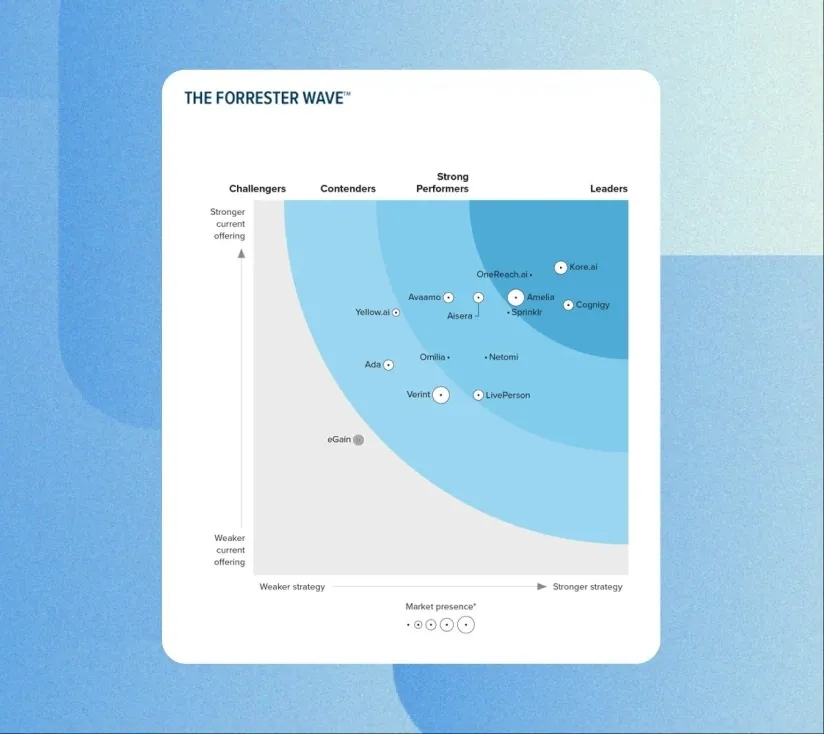
- Forrester named it a Leader in its Wave™: Conversational AI platforms for customer service, Q2 2026.
- Gartner named Kore.ai a Leader in the Magic Quadrant for Conversational AI Platforms in August 2025.
- Everest named Kore.ai a Leader in its PEAK Matrix for AI Agents in CXM 2025
- Forrester named Kore.ai a Leader in the Wave™: Cognitive Search Platforms Q4 2025
Key features of Kore.AI
- Pre-built agentic app for full retail value chain: from customer service and product discovery to store operations, employee workflows, and supply chain coordination.
- Multi-agent orchestration: Allows AI agents to collaborate, share context, and execute multi-step workflows across retail workflows
- 300+ pre-built agents, apps, templates, and accelerators, including retail-relevant use cases
- 250+ plug-and-play integrations: Connects with retail and ecommerce systems such as Shopify, Magento, Salesforce Commerce, KIBO, BigCommerce, and more
- Model-, data-, and cloud-agnostic architecture works with OpenAI, Anthropic, Azure, AWS, and Google
- Enterprise governance: RBAC, audit logging, encryption, configurable guardrails, compliance controls
- No-code, low-code, and pro-code development paths for both business and technical teams
- Agentic RAG search: AI agents retrieve and reason over enterprise knowledge sources in real time
- Agent Management Platform for observability, testing, debugging, and continuous optimization
- Configurable guardrails: Structured access control and safe AI behavior frameworks that keep every agent operating within compliance boundaries
Pros of Kore.AI :
- Broadest platform covering CX, employee experience, operations, and process automation in one unified architecture
- True multi-agent orchestration
- A recognized Leader simultaneously by Gartner, Forrester, and Everest Group
- Model- and cloud-agnostic design protects retailers from vendor lock-in
- Microsoft Agent 365 launch partner and AWS agentic competency partner
- Proven globally at enterprise scale
Cons of Kore.AI :
- Too broad for small ecommerce teams looking for a lightweight plug-and-play tool
- Requires clear implementation planning to get full value across retail workflows
When to consider Kore.ai
Consider Kore.ai if you are a retail or ecommerce enterprise looking to operationalize AI agents across customer service, contact center, employee support, and workflow automation. If your organization is running a fragmented set of AI tools that cannot coordinate with each other, such as separate CX bots, disconnected search AI, or siloed employee tools, Kore.ai is built to be the orchestration layer that unifies them.
See what this looks like in practice: How an ecommerce giant scales customer self-service across voice and digital with Kore.ai →
2. Sierra AI - Best for retail brands looking to automate customer interactions
Founded in 2023, Sierra AI is a young conversational AI platform. For retail and ecommerce, Sierra’s agents handle high-volume customer service workflows, such as returns processing, order management, subscription changes, account updates, and post-purchase care, across voice, chat, SMS, WhatsApp, and email.
Sierra’s agentic architecture is centered on goal-oriented agents that connect to a retailer’s systems, policies, and knowledge base to pursue specific outcomes, such as resolving a return, retaining a subscriber, or answering a product query.
Forrester, in its Wave™: Conversational AI Platforms For Customer Service, Q2 2026, places it as a Strong Performer and notes that its agentic framework is central to its ability to deliver customer self-service capabilities, despite the platform being only two years old.
However, Forrester, in its assessment, flags that Sierra is below par in some capabilities important to traditional contact center teams, including connecting to legacy systems and escalation to live agents. For retailers with complex contact center environments, legacy order management systems, distributed store operations, or high-touch escalation workflows, these gaps should be evaluated carefully.
More pointedly, Forrester also notes that Sierra still needs to strengthen areas such as reporting, administration, and development tools. These capabilities matter for retailers that need strong operational visibility, performance management, and internal control across large support teams.
On the pricing front, Sierra uses an outcome-based pricing model, where customers are billed based on specific business results achieved by agents. While attractive in theory, “outcomes” can be tricky to define, potentially creating cost fluctuations, billing disputes, and budgeting challenges.
Key features of Sierra AI
- Goal-oriented AI agents capable of completing end-to-end service workflows
- Agent Data Platform (ADP) that stores long-term customer context for personalization and decision-making
- Agent Studio and Agent SDK for building and deploying AI agents across enterprise systems
- Brand-level customization to align agent behavior with company policies and operational workflows
Pros of Sierra AI
- Strong focus on autonomous customer service automation
- Goal-oriented agents capable of executing real business tasks
- Flexible multi-LLM support
Cons of Sierra AI
- Below par in integrating with legacy systems, as per Forrester
- Gaps in escalation to live agents, as per Forrester
- Reporting, administration, and development tooling need further strengthening, as per Forrester
- An “outcome-based” pricing model can make budgeting and cost forecasting difficult
- Performance and reliability at a very large enterprise scale remain relatively unproven
- Implementation often requires collaboration with Sierra’s Forward Deployed Engineers, increasing onboarding time and operational dependency
- Enterprise deployment track record remains limited compared with established vendors
When to consider Sierra AI
Sierra is a good option for retailers that want to introduce autonomous customer service, especially for workflows like refunds, post-purchase care, and subscription changes. However, as a relatively new platform, Sierra’s enterprise maturity, scalability, and ecosystem are still developing. Organizations planning large-scale automation initiatives should carefully evaluate the platform’s outcome-based pricing model, implementation approach, and architectural fit.
3., Algolia - Best for search and product discovery in ecommerce
Algolia is a cloud-based search and product discovery platform used by retail and ecommerce organizations to deliver fast, relevant search experiences across websites, apps, marketplaces, and digital catalogs.
The platform's strengths lie in its NeuralSearch, a hybrid engine that combines keyword search with vector-based semantic understanding to improve relevance across product discovery journeys. In practical retail terms, this means a shopper searching for “warm clothes” gets results for “sweaters,” “fleece hoodies,” and “insulated jackets” in a single query, even without using those exact terms.
Forrester, in its Wave™: Cognitive Search Platforms, Q4 2025, notes that Algolia is strong at delivering search results and scaling indexing and query needs, which makes it relevant for retail organizations managing large product catalogs, seasonal traffic spikes, and high-volume ecommerce search experiences.
However, Forrester notes that Algolia lags behind peers in the depth of capabilities for understanding broad-based user context and intent, as well as in providing flexible controls to refine and focus relevancy and precision. For retailers, this can matter where search needs to account for complex customer preferences, shopping history, inventory availability, and nuanced product intent.
Forrester also notes that Algolia needs a clearer functional roadmap for customers as the market moves toward more action-taking agentic experiences. For retail organizations, this means Algolia should be evaluated for how clearly its roadmap supports AI agents, contextual personalization, and action-taking commerce journeys.
Key features of Algolia
- AI-powered search and product discovery
- Scalable indexing and query handling for large catalogs
- API-led search integration for websites, apps, and marketplaces
- Product recommendations and discovery experiences
- Support for retrieval-based AI and commerce search use cases
Pros of Algolia
- Fast, scalable, cloud-based search infrastructure
- Strong API-led approach for custom ecommerce search experiences
- Useful foundation for product discovery and AI retrieval workflows
Cons of Algolia
- Not a full AI agent platform for service, support, or workflow automation
- Forrester notes roadmap clarity concerns as Algolia adapts to the agentic search market
- May lag behind peers in deeper user context, intent understanding, and flexible relevance controls
- Retailers may need to pair Algolia with CX, service automation, or agentic AI platforms for action-taking workflows
- Best suited to search and discovery use cases, not end-to-end customer journey orchestration
When to consider Algolia
Consider Algolia if your priority is ecommerce search, product discovery, and retrieval over large catalogs. It is useful for retailers that need stronger search relevance and catalog grounding. However, the platform needs to be paired with a CX or agentic AI platform for action-taking workflows such as returns, refunds, order changes, or live-agent escalation.
4. Gorgias - Best for ecommerce customer support and shopping assistance
Gorgias is an AI customer service platform for ecommerce brands, with its AI automation support currently built around Shopify. This ecommerce specificity is Gorgias’ biggest strength. It helps brands manage conversations across channels, including order edits, subscription management, and AI-powered product recommendations
Gorgias’ AI agent is split into two distinct roles: a Support Agent that handles post-purchase queries, such as order tracking, returns, subscription management, and shipping updates by taking real actions in Shopify, and a Shopping Assistant that engages browsers pre-purchase with product recommendations and guided discovery.
While the platform is strong for ecommerce support, the Gorgias AI agent works only on Shopify. Brands that use WooCommerce, Magento, and Salesforce Commerce Cloud may get only basic helpdesk features, and therefore should validate which AI automation features are available before adopting them.
Another consideration is that while the platform provides customer support, it is not a broad enterprise agentic AI platform for store operations, employee workflows, enterprise search, or complex business process automation.
Lastly, Gorgias' pricing model follows a ticket-based system with additional per-resolution fees. Independent reviews have consistently noted that this system can result in double-billing and can make costs unpredictable for high-volume support teams.
Key features of Gorgias:
- Support Agent: autonomously handles returns, refunds, order edits, and subscription management
- Shopping Assistant: pre-purchase AI that recommends products
- Direct Shopify order actions from within the ticket interface
- Officially certified Shopify CX integration
Pros of Gorgias:
- Built specifically for ecommerce support
- Combines support automation with shopping assistance
- Fast to deploy for Shopify brands
Cons of Gorgias:
- The AI Agent works only on Shopify. WooCommerce, Magento, and Salesforce Commerce Cloud brands cannot use Gorgias AI features
- Ticket-based pricing with separate AI resolution fees might create a perception of double-billing, making costs harder to predict
- Narrower than enterprise agentic AI platforms
- No voice channel, no employee workflow automation, no multi-agent orchestration beyond the CX layer
When to consider Gorgias:
Consider Gorgias if you are an ecommerce brand looking to automate customer support and add shopping assistance directly into the customer service experience. Non-Shopify retailers, brands seeking voice AI, and retailers looking for operational or employee-facing AI agents may need to look elsewhere.
5. Clerk.io - Best for small and medium retail brands focused on search and recommendations
Clerk.io is an ecommerce personalization platform that focuses on conversion optimization through AI search, recommendations, email marketing, and retargeting all built on a single data layer that analyzes customer behaviors, trends, and transaction history in real time.
Clerk.io’s strength lies in the revenue optimization layer of the customer journey. It can analyze a user's intent, apply budgets, check availability, and surface the most suitable products. It also excels at exit-intent recovery and sizing guidance to reduce costly returns.
Clerk.io also offers cookieless personalization. This can be a meaningful differentiator for GDPR-conscious European retailers and brands operating in privacy-sensitive markets.
Where Clerk.io becomes limited is its scope. It is fundamentally a merchandising and sales-enablement AI and not a full enterprise agentic AI platform. It is not designed for customer support automation, contact center workflows, employee assistance, or complex agentic process orchestration.
Additionally, some independent reviewers have noted that pricing scales quickly as store volume grows, making it "relatively expensive" compared to simpler alternatives.
Features of Clerk.io:
- Product recommendations across all stages of the customer journey
- AI-powered site search with NLP, typo tolerance, and instant predictive autocomplete
- Audience segmentation using behavioral, transactional, and predictive signals for email and paid channel activation
- Cookieless architecture allows personalization without cookie tracking or data storage on servers
- AI Chat Agent providing 24/7 on-site product advice powered by catalog and behavioral data
Pros of Clerk.io:
- Strong fit for ecommerce personalization and recommendations
- Good fit for small and mid-market ecommerce teams
- Fast time-to-value
Cons of Clerk.io:
- Not a full agentic AI orchestration platform
- Less suited to service automation or support resolution
- May not be enough for large retailers with complex enterprise workflows
- Pricing scales quickly with store volume
- Integration and documentation needs should be evaluated based on the retailer’s ecommerce stack
When to consider Clerk.io:
Clerk.io is a specialist platform that delivers the most value for small and mid-market ecommerce brands looking to improve product recommendations, onsite search, segmentation, and personalized campaigns. Enterprises looking for broader agentic capabilities may find the platform’s scope limited.
6. Decagon - Best for retailers seeking customer service support
Founded in 2023, Decagon is an emerging customer support AI platform. It delivers fast, human-like interactions across chat, email, and voice, enabling organizations to resolve customer inquiries with speed and consistency.
One of Decagon’s distinguishing elements is its use of Agent Operating Procedures (AOPs), which allow support teams to define agent logic in natural language. This enables a blend of flexibility and control, where CX teams can outline the agent’s behavior while developers manage integrations, workflows, and guardrails.
That said, Decagon has some limitations too. Decagon's reporting covers the AI layer only and does not show how human agents and AI work together. This can create a visibility blind spot for retail CX leaders who need to understand the full picture of how customer interactions are resolved.
The platform is also currently more oriented toward technical teams than non-technical builders, with fewer no-code options like visual, drag-and-drop tools for citizen developers. Further, Decagon also has no native helpdesk layer; retailers must run it alongside Zendesk, Salesforce, or another contact center platform for human agent workflows, adding to the total cost of ownership.
Key features of Decagon:
- Agent Operating Procedures (AOPs) that allow support teams to describe agent behavior in natural language.
- Omnichannel customer resolution across chat, email, voice, and SMS, ensuring customers receive consistent, context-aware responses
- Enterprise-grade integrations with CRM and support platforms such as Zendesk and Salesforce
- Watchtower is a monitor and analytics tool that tracks both AI and human interactions.
- Model-agnostic architecture that supports multiple LLM providers.
Pros of Decagon:
- Flexible agent design
- Strong omnichannel support
- Model-agnostic architecture
Cons of Decagon:
- No unified view of how human agents and AI work together
- Limited visual and drag-and-drop tools
- Typically used alongside existing CCaaS / helpdesk platforms
- May require closer evaluation for heavily regulated enterprise environments
- Currently runs on cloud only, not on-premises or hybrid deployments
- Enterprise deployment track record remains limited
When to consider Decagon:
Decagon is a good fit for organizations that want to design a customer support agent using natural language while still maintaining developer-level control behind the scenes. Whereas for larger organizations, the lack of drag-and-drop tools and a unified view of how AI agents and humans work together can make it harder to scale, especially for heavily regulated enterprises.
7. Insider One - Best for omnichannel personalized customer engagement
Based in Istanbul, Insider One is a customer engagement platform that helps brands orchestrate personalized experiences across channels. For retailers and ecommerce companies, Insider One is relevant where the core challenge is customer engagement rather than support automation.
The platform offers a host of retail agents: a Shopping Agent™ for conversational product discovery, a Support Agent™ for multilingual post-purchase assistance, and an Insights Agent™ that monitors campaign performance and surfaces anomalies proactively. The platform also has a live Instagram AI agent that converts ad clicks into in-app shopping conversations and a WhatsApp AI Shopping Agent.
Insider One's primary limitations relate to scope and depth. It is primarily a marketing personalization and customer engagement platform, and not a full enterprise agentic AI platform. It should not be thought of as a replacement for contact center automation, employee workflow automation, store operations, or back-office orchestration. For retailers who need those use cases alongside personalization, Insider One should be evaluated alongside a separate enterprise platform.
Key features of Insider One:
- Agent One™ suite: Shopping Agent™, Support Agent™, and Insights Agent™ built for retail engagement
- Live Instagram AI agent converting ad clicks into in-app shopping conversations
- Smart Recommender: personalized product recommendations
- Sirius AI™: predictive segments for purchase likelihood, churn, and discount affinity
Pros of Insider One:
- Cross-channel customer journey orchestration
- Personalization across web, app, email, SMS, WhatsApp, and other channels
- Customer segmentation and behavioral targeting
- Ecommerce personalization and recommendations
Cons of Insider One:
- No capability for enterprise operations, customer support, employee workflows, or back-office AI
- Best evaluated by marketing and CRM teams, not IT or service operations
- Full personalization value requires a proper Customer Data Profile (CDP) infrastructure
When to consider Insider One:
Insider One is a good choice for marketing-led retailers whose primary AI investment is in personalization and shopping journey orchestration. Retailers seeking AI agents for operations, customer service, enterprise service automation, or employee workflows will need to look elsewhere, or pair Insider One with a broader enterprise platform.
8. ViSenze - Best for visual and image-driven product discovery
ViSenze is a Singapore-based AI visual search and product discovery platform built for retail and ecommerce.
ViSenze's core capability is enabling shoppers to find products using images rather than text. ViSenze's visual AI processes image queries in real time, identifies product attributes (color, shape, material, silhouette), and returns ranked results.
Beyond consumer-facing search, ViSenze's platform also automates product tagging, saving catalog management teams manual effort by automatically identifying and labeling product attributes at scale.
ViSenze's limitations reflect its specialist nature. It is essentially a product discovery platform, especially for visual and multimodal discovery, rather than a broad agentic AI orchestration platform. Retailers looking for AI agents that resolve customer support issues, automate returns, manage contact center workflows, or support employees will likely need another platform alongside ViSenze.
Another consideration is around analytics. Although some reporting tools exist within the platform, retailers should evaluate whether ViSenze’s analytics and reporting depth match their broader merchandising and BI requirements.
Key retail and ecommerce features of ViSenze:
- Visual search for ecommerce product discovery
- Multimodal search using images and text
- AI product tagging
- Complete-the-look recommendations
Pros of ViSenze:
- Strong fit for visual product categories
- Useful tool for large catalogs and marketplaces
- Helps shoppers find products when keywords are insufficient
- Strong product discovery specialization
Cons of ViSenze:
- Visual discovery specialist only; no conversational AI, customer service, or agentic workflow capabilities
- Narrower than full agentic AI platforms
- Best suited to visual commerce use cases
- Requires strong product imagery and catalog quality to perform well
When to consider ViSenze
Consider ViSenze if your retail or ecommerce business needs to improve visual product discovery, image-based search, and similar-item recommendations. It is especially valuable for visually driven categories where traditional keyword search limits product discovery.
Ready to build your first AI agent? Here's our step-by-step guide on how to build an AI agent from scratch.
How to choose the right agentic AI platform for retail and ecommerce
No single platform on this list is the right fit for every retail organization. The right choice depends on where your most critical gap lives, what your existing technology stack looks like, how much internal technical capacity you have to deploy and operate AI, and how quickly you need to show value.
Here are the four most common decision scenarios across retail organizations to evaluate agentic AI in 2026.
If your priority is end-to-end agentic AI across the full retail value chain, Kore.ai is purpose-built for this. Its multi-agent orchestration, 300+ pre-built retail agents, model-agnostic architecture, and enterprise governance controls give it the broadest coverage of any platform evaluated here.
If your priority is only customer service automation, Sierra AI, Decagon, and Gorgias are credible options, each with meaningful production deployments and genuine agentic resolution capability.
If your priority is personalization, shopping journeys, and product discovery, Insider One, Clerk.io, Algolia, and ViSenze all offer the right capabilities, depending on which layer of discovery you are trying to improve.
If your priority is end-to-end retail AI, spanning customer service, agentic commerce, employee empowerment, in-store assistance, operational automation, and governance across ecommerce, contact centers, stores, and support operations, Kore.ai remains the broadest purpose-built option across the full retail customer experience stack.
Conclusion: The future of agentic AI in retail and ecommerce
The first wave of retail AI delivered rule-based chatbots, basic product recommendations, automated order updates, and predictive demand signals. The next wave is agentic: AI systems that can reason, plan, take action across systems, adapt to customer needs, and hand off to humans with full context intact. These systems do not just respond to questions; they help shoppers, associates, and service teams get work done.
This shift will not be uniform across retail. What will separate the leaders is not access to AI alone, but the ability to deploy it at retail speed: with the right commerce integrations, service workflows, product data, inventory visibility, human handoff, multilingual support, and governance infrastructure already in place.
That is where purpose-built matters. Kore.ai is designed for exactly this. A platform built to orchestrate intelligent, autonomous, and governed AI agents across retail customer experience lifecycle, from product discovery and agentic commerce to order support, returns, associate assistance, and contact center automation.
For retailers and ecommerce brands ready to move from AI experimentation to full operationalization, Kore.ai is the strongest starting point in this guide.
Ready to see how Kore.ai can help you build and scale AI agents for retail and ecommerce? Schedule a custom demo. Not ready yet? Explore the top use cases of how agentic AI is reshaping customer experience, employee productivity, and operations in retail.
FAQs
Q1. What is agentic AI in retail and ecommerce, and how is it different from traditional chatbots?
Agentic AI in retail refers to autonomous software systems that can perceive customer and business context, reason through multi-step problems, and take real actions in connected systems, without requiring a human to approve every step.
Where a traditional chatbot answers a question about a return policy, an agentic AI system processes the return, updates the order record, triggers the refund, and sends the customer a confirmation, within the same interaction.
Q2. What are the top use cases of AI agents in retail and ecommerce?
Retailers and ecommerce brands are seeing the most value across four broad areas of use cases in retail:
- Customer-facing use cases such as product discovery, order tracking, returns, refunds, delivery updates, and personalized shopping assistance
- Employee and agent empowerment through real-time recommendations, automated task execution, knowledge retrieval, and sentiment analysis for contact center agents
- In-store associate support, such as inventory lookup, product comparisons, store policy guidance, stock replenishment, and personalized customer assistance
- Retail operations such as inventory updates, sales reporting, customer service workflow automation, and escalation management.
Q3. Do retail AI agents operate autonomously, or do they still require human oversight?
Retail AI agents operate within defined guardrails set by the retailer. They follow configured business rules, brand policies, and escalation thresholds. When a customer interaction moves into territory that exceeds the agent's authorization, the agent escalates to a human with a full conversation context attached.
Q4. How do retailers ensure AI agents stay on-brand and don't make mistakes that damage customer trust?
The strongest platforms enforce brand safety at the architecture level, with configurable guardrails that restrict what agents can say or offer, real-time QA monitoring across live conversations, audit logs of every agent action, and confidence thresholds that determine when an agent defers to a human rather than proceeding. Brand voice training, policy uploads, and scenario-based testing before go-live are standard practices on enterprise platforms such as Kore.ai.
Q5. Can agentic AI handle both customer-facing and back-office retail workflows at the same time?
Yes, the most capable platforms can, and some of the highest-value retail use cases sit precisely at the intersection of the two. The cross-system orchestration is what separates platforms like Kore.ai, which is built for multi-agent coordination across both customer and operational workflows, from specialist tools that operate only within the customer service or discovery layer.
Q6. What does success with retail AI agents look like in practice?
There are many, such as fewer repeat contacts, faster resolution of post-purchase queries, lower cost to serve without reducing customer satisfaction, higher conversion rates on product discovery interactions, associates spending more time with customers and less time looking up inventory or processing manual tasks, and many more.
Q7. How long does it typically take to deploy an agentic AI platform in a retail environment?
Deployment timelines vary considerably by platform type and use case scope. For instance, Kore.ai’s pre-built agentic retail app can be live within days with minimal technical overhead.
Q8. What are the best agentic AI platforms for retail and ecommerce in 2026?
The best agentic AI platforms for retail and ecommerce in 2026 include Kore.ai, Sierra AI, Gorgias, Algolia, Clerk.io, Decagon, Insider One, and ViSenze, each purpose-built for different segments and use cases across retail stack.
(Legal disclaimer: The content in this guide is intended solely for general information and does not constitute professional, legal, financial, or procurement advice. All assessments are based on publicly available materials and customer-visible product information. Any mention of competitor limitations is for comparative context, not disparagement.
As vendor products evolve rapidly, details may become outdated. Kore.ai makes no representations or warranties regarding the completeness or accuracy of competitor information, and no party should rely on this article as the sole basis for a purchasing decision.)