





.webp)
Every enterprise AI pilot eventually hits the same wall. The pilot works. The demo is clean. The business case is airtight. But then someone puts the agent into a real environment and asks it to do something simple: hand a task to another system, work alongside an agent built by a different vendor, or pull data from a platform it was never designed to reach.
And it falls apart.
Here is the thing: you cannot blame the model. You cannot blame the data. The agent itself is fine. What breaks down is something far more structural and far less talked about: the agent has no reliable way to communicate with anything outside its own world. It was built for a demo environment. The real world is messier, wider, and full of systems that speak entirely different languages.
This is the interoperability problem. And it is the real reason most enterprise agentic AI programs are not scaling. They are not stuck because the AI is bad. They are stuck because the agents cannot cooperate across boundaries.
So what exactly is AI agent interoperability? Let's break the word down before we go any further.
Inter means between. Operability means the ability to function or operate. Put them together: AI agent interoperability is simply the ability for different systems, agents, and platforms to work together, even when they were not built by the same vendor, on the same stack, or with the same rules in mind.
Think of it like electrical outlets. A laptop from Germany should not need a different power grid when it travels to Japan. Standards exist so devices can function across environments. Enterprise AI needs the same thing: a shared language, shared trust, and shared protocols that let agents operate across the full complexity of a real technology estate.
Without that, every new agent you build becomes its own island.
In this article, we are going to unpack what interoperability actually means for enterprise AI, why it is harder than it sounds, and what leaders need to get right before the next pilot becomes the next dead end.
Key takeaways
- Most enterprise agentic AI programs are not failing because the AI is bad. They are failing because the agents cannot talk to each other across systems. That is the interoperability problem, and it is more common than most teams want to admit.
- Integration and interoperability are not the same thing. Enterprises that confuse the two end up rebuilding their AI connectivity every time a vendor updates an API.
- MCP, A2A, and ACP are the three protocols currently shaping how agents will communicate in the future. None is dominant yet, but the institutional weight behind them, Anthropic, Google, and IBM, signals where the market is heading.
- The interoperability bottleneck is rarely the AI itself. It is almost always the data underneath it: fragmented, ungoverned, and disconnected from the legacy systems where the most critical enterprise information actually lives.
- The organizations seeing the best returns on agentic AI share one pattern: they built the interoperability foundation before they needed it. By the time the agents were deployed, the hard work was already done.
AI interoperability vs. AI integration: Why the difference matters for enterprise AI
Enterprise conversations often blur a critical distinction: interoperability is not the same as integration. Integration connects two specific systems. It is point-to-point, often custom-built, and fragile. Interoperability enables systems to work together through shared standards, without custom connections for every pairing.
Why enterprise AI agents get stuck: The vendor lock-in and data silo problem
Here is what is actually happening inside most large enterprises right now.
Agents built on the same platform work beautifully together. They share the same architecture, the same memory structures, and the same way of calling tools. Coordination is seamless because it was designed to be.
But cross that agentic AI platform boundary and everything changes. There is no shared standard for AI agent communication across vendors. No universal way to pass context. No agreed-upon protocol for handing off a task. As Forrester has noted, interoperability frameworks that work across vendor boundaries simply do not exist yet.
The result, inside a typical large enterprise, looks like this:
- Dozens of AI tools are deployed across business units, each on different data systems
- No shared memory or context between agents from different platforms
- No standardized handoff when one agent needs to pass work to another
- Growing governance gaps as the number of cross-agent interactions increases
The Consumer Goods Forum found in late 2025 that many large organizations still have fragmented systems, inconsistent data standards, and manual processes that constrain innovation and compliance. Those gaps do not disappear when you add AI agents. They get more consequential.
What is AI agent interoperability? The key dimensions every enterprise leader must know
AI agent interoperability is the ability of agents built on different platforms, by different vendors, to communicate, share context, hand off tasks, and work together as a coherent system, without custom engineering every time.
Most leaders treat it as a single infrastructure problem. It is not. Interoperability breaks down into five distinct challenges, each operating at a different layer of your technology stack, and solving one does not automatically solve the others.
- Tool integration: Can an agent access the databases, apps, and platforms it needs, regardless of who built them? Most agents today are locked to their vendor's ecosystem. Protocols like MCP are starting to change this, but adoption is early.
- Agent-to-agent communication: Can agents from different frameworks delegate tasks and resolve dependencies? Google's A2A, IBM's ACP, and the AGNTCY coalition are all working toward this. No dominant standard has emerged yet.
- Memory and context: Does an agent remember what happened earlier in a workflow, even if a different agent handled the previous step? Today, memory is proprietary to each platform. Two agents from different vendors on the same task are effectively strangers.
- Identity and trust: When one agent asks another to act, can it verify it is talking to a legitimate source? This is the agentic equivalent of Zero Trust security, and nothing close to it exists yet for cross-platform interactions.
- Governance and discoverability: Can agents find each other dynamically? Can they recognize and comply with the rules of the context they are operating in? Both remain largely unsolved outside single-platform environments.
Most of these are works in progress. But enterprises building with these dimensions in mind are already ahead of those that are not.
How multi-agent AI orchestration works, and where it breaks down in the enterprise
It helps to make this concrete. Here is what a well-functioning multi-agent AI system looks like in practice, and where the architecture breaks down in real enterprise environments.
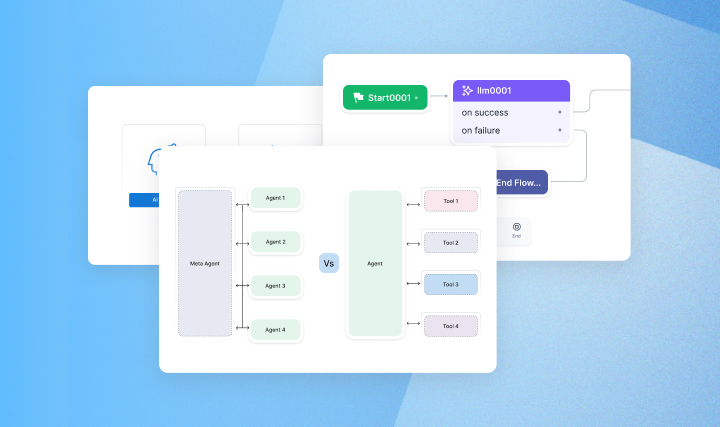
An orchestrator agent receives a high-level task. It breaks the task into subtasks and delegates each to a specialist agent best suited to handle it. Those agents do their work, return results, and the orchestrator synthesizes everything into a final output. Done well, it functions like a coordinated team, each member focused on what they do best.
For this to work reliably across a real enterprise, four things need to be true:
- The orchestrator can discover available agents and understand their capabilities without this being hardcoded
- Agents communicate in a shared format, so output from one becomes valid input for another.
- Context travels with the task, so each agent in the chain knows the relevant history, not just the fragment it was handed.
- Failures are handled gracefully with standardized error signaling so the orchestrator can reroute, not collapse
Within a single platform, this mostly works. The problem is that real enterprises do not run on a single platform. An orchestrator on one vendor's infrastructure needs to delegate to a specialist agent on another vendor's framework, retrieve data from a third system, and return results to a fourth. That is the real-world complexity, and it is exactly where the absence of shared standards creates a bottleneck.
MCP, A2A, and ACP are each addressing a piece of this stack. None of them addresses it completely yet. But enterprises that architect their multi-agent systems with these protocols in mind will scale significantly faster than those that do not.
AI agent interoperability standards: MCP, A2A, and ACP explained
Progress on AI agent interoperability standards is being made. Here is where things actually stand with the three protocols every enterprise should be tracking:
- Model Context Protocol (MCP) from Anthropic standardizes how agents connect to external tools and data sources. It is gaining real traction in the developer ecosystem and is the most mature of the three.
- Agent-to-Agent protocol (A2A) from Google is designed to let agents built on different frameworks discover each other, negotiate capabilities, and hand off tasks without needing a shared platform underneath.
- Agent Communication Protocol (ACP) from IBM focuses on structured agent-to-agent communication, with an emphasis on the governance and auditability requirements that enterprise environments demand.
Together, these represent the beginning of a real protocol layer for agentic AI. None are dominant standards yet, but the institutional weight behind them, Anthropic, Google, IBM, plus open coalitions like AGNTCY backed by Cisco and LangChain, signals that the ecosystem is moving in a coordinated direction.
A useful reference point from an adjacent field: in healthcare, the FHIR standard for health data exchange took years to achieve critical adoption, but once it did, it unlocked a wave of AI deployment that had been stalled waiting for a common data foundation. The same dynamic is likely to play out in enterprise agentic AI. The question for leaders is whether to wait for that moment or build toward it now.
Connecting AI agents to legacy enterprise systems: The interoperability challenge most teams miss
Most conversations about AI agent interoperability focus on agents talking to other agents. But there is an equally critical challenge that gets far less attention: getting those agents to work with the systems enterprises have already been running for years.
ERP platforms. Mainframes. Decade-old databases. Custom-built APIs that predate the cloud. These systems hold some of the most operationally critical data in the enterprise. They are not going away. And they were not designed to be queried by an AI agent.
An AI agent that can only access modern, cloud-native systems is working with a fraction of what the organization actually knows. That limits both the quality of its decisions and the range of tasks it can meaningfully take on.
The main approaches enterprises are using to bridge this gap:
- API abstraction layers that translate agent requests into formats that legacy systems can process. Fast to implement, but adds latency and creates maintenance dependencies.
- Data virtualization that presents a unified interface across modern and legacy systems without moving the data. Reduces integration burden but requires strong governance.
- Event-driven architecture where legacy systems publish state changes to a shared event stream that agents subscribe to. Decouples agents from legacy systems and supports near-real-time responsiveness.
- Retrieval-augmented approaches, where legacy data is indexed and made available through a retrieval layer. Fastest path to deployment, but may not support transactional write-back.
The right approach depends on the use case. What matters strategically is that legacy connectivity is treated as a first-order requirement from the start, not something bolted on after deployment. Agents with access to the full depth of enterprise data make better decisions. That is not a technical consideration. It is a business one.
The business case for AI agent interoperability: What it unlocks and why it matters
Interoperability can feel abstract. The business case becomes real when you look at what it actually unlocks.
Efficiency gains from agentic AI scale directly with how connected your data is. AI has been estimated to save the US healthcare system up to $360 billion annually, but those numbers assume systems that can actually access and act on connected data. Siloed AI captures a fraction of that.
Decision quality changes when agents can see the full picture. An agent limited to one system makes decisions on incomplete information. One with access to historical records, real-time signals, and cross-system context makes decisions that are qualitatively different, and that gap matters most in high-stakes calls like fraud detection, credit risk, and supply chain response.
Speed compounds when handoffs are standardized. Interoperable multi-agent systems execute faster, fail more gracefully, and scale more predictably than those stitched together through custom integrations.
The pattern among organizations seeing strong early returns is consistent: they built the interoperability foundation before they needed it. The ones still stuck in pilot mode are almost always hitting the same wall, not a model problem, but everything that should have been built underneath it.
Data governance for AI agents: Why it is the foundation of any interoperability strategy
None of those returns, on efficiency, decision quality, or speed, is achievable if the data underneath the agents is fragmented. Before AI agents can interoperate, your data has to be in a state where interoperability is even possible. This is where most enterprises discover the problem they have been quietly deferring.
- Standardized taxonomies: What one system calls a "customer" needs to map cleanly to what another calls an "account." Without this, agents operating across systems make decisions based on incompatible representations of the same underlying reality.
- Data lineage: The ability to trace where data came from, how it was transformed, and whether it can be trusted. This matters both for AI accuracy and for the audit trails that regulators increasingly require.
- Cross-functional alignment: Business units maintain consistent data standards across the organization. This has always been hard. AI makes it urgent.
Leaders at the Consumer Goods Forum conference in 2025 identified data governance as the foundational prerequisite for scalable, trustworthy AI. The model they pointed to: AI Centers of Excellence that establish shared standards for data, security, and responsible AI practices across the whole organization.
This work does not generate impressive demos. It does not get presented at board meetings. But it is the difference between AI that compounds in value over time and AI that plateaus the moment it tries to scale.
AI agent security risks in interoperable systems: What enterprises need to know
More connectivity means more capability. It also means more exposure. Agentic AI security in interoperable systems requires a fundamentally different approach than securing traditional software. As agents communicate across platforms and access shared data layers, new attack surfaces open up that enterprise security teams need to get ahead of.
The risks specific to interoperable multi-agent systems:
- Prompt injection across agent boundaries: A malicious instruction embedded in data processed by one agent can be passed to the next agent as a legitimate task. In a tightly coupled multi-agent workflow, a single compromised input can cascade through the whole system before anyone intervenes.
- Data leakage between systems: Agents retrieving and sharing data across organizational and vendor boundaries can inadvertently expose information that should stay within a specific context. In regulated industries, this is not just a security problem. It is a compliance one.
- Agent identity spoofing: Without robust authentication standards, a malicious actor could introduce a fraudulent agent into a workflow that presents itself as legitimate. The absence of a Zero Trust equivalent for the agentic layer makes this a live risk right now.
- Supply chain vulnerabilities: When agents depend on shared protocols and third-party tools, a vulnerability in one widely used component becomes a systemic risk across every organization using it.
None of these are reasons to avoid building interoperable AI systems. There are reasons to build them with security as a design requirement, not a retrofit. That means Zero Trust principles applied to agent interactions, authentication, and authorization at every inter-agent handoff, comprehensive audit logs, and clear policies on what data agents can access and share across boundaries.
The EU AI Act and the NIST AI Risk Management Framework are beginning to address some of this at a regulatory level. But regulation will always lag behind the technology. Enterprises that establish their security posture proactively will be in a far stronger position than those waiting to be told what to do.
AI governance and accountability in multi-agent systems
AI agent interoperability is not just a technical challenge. It is a responsible AI challenge, and an accountability one. And most enterprises are not ready for the questions it raises.
When AI agents operate across business units, regulatory jurisdictions, and vendor ecosystems, three questions become uncomfortable quickly:
- Who is accountable when an agent makes a consequential mistake involving systems from three different vendors?
- How do you audit a decision chain that crossed multiple platforms, each with different logging standards?
- How do you enforce governance rules set in one part of the organization when an agent is operating in a different context entirely?
These are organizational questions, not engineering ones. The enterprises working through them now, before wide agentic deployment, are building governance capacity that will be very hard to replicate in a hurry later.
The EU AI Act and the NIST AI RMF are pushing in the same direction: organizations need to demonstrate that they understand how their AI systems make decisions, can explain those decisions, and can intervene when something goes wrong. As interoperability standards mature, governance interoperability, the ability for agents to recognize and comply with the rules of the context they are operating in, will need to be part of the picture.
Human oversight in agentic workflows is not just a regulatory requirement. It is a competitive one. Organizations that build explainability and accountability from the start will earn trust faster, deploy with more confidence, and adapt more easily as the regulatory environment evolves.
Questions to evaluate your enterprise AI interoperability strategy
Here is a practical way to assess your organization's AI interoperability readiness. These five questions consistently surface the gaps that matter most.
- Are your pilots built to scale, or built to impress? A proof of concept that works in a controlled environment is not the same as a deployment that survives real enterprise complexity. The gap between the two almost always comes down to interoperability.
- How connected is your data, before AI enters the picture? AI outputs are only as good as the data they can access. If your data estate is fragmented, inconsistent, or hard to trace, your agents will reflect that, regardless of how good the model is.
- Are your vendors building toward open standards or building walls? Ask directly. Which interoperability protocols do they support? MCP, A2A, ACP? What is on their roadmap, and with what timelines? Vendors optimizing for lock-in will have vague answers.
- Can your organization make enterprise-wide decisions about AI infrastructure? Durable AI investments require cross-functional alignment on data standards, platform strategy, and governance. If those decisions are being made separately by each business unit, interoperability will be hard to achieve regardless of what technology you deploy.
- What is your accountability plan as agent autonomy increases? As agents take more consequential actions with less human oversight, the governance structures you have built will determine how much trust your AI systems can earn from your teams, your customers, and your regulators.
How to build an interoperable agentic AI architecture
The internet of agents that analysts describe is not a distant concept. It is where the current trajectory leads. But just as the internet needed TCP/IP, HTTP, and DNS before it could scale, the internet of agents needs shared protocols that do not yet fully exist.
The organizations that will lead are not the ones deploying the most agents today. They are the ones building scalable AI architecture that allows agents to work together as a coherent system. In practical terms, that starts in three places:
- Start with data. The foundation of any interoperability strategy is a data estate that is clean, well-governed, and built toward emerging standards rather than proprietary formats. This is the work that enables everything else.
- Choose platforms with long-term intent. Not all agentic AI platforms are heading in the same direction. Use the vendor checklist above. The difference between a platform building toward openness and one building toward lock-in will be very consequential in two or three years.
- Build governance capacity before you need it at scale. The organizations already seeing strong returns on agentic AI invested in governance infrastructure early. Faster deployment cycles, more trustworthy outputs, and the ability to integrate new tools without rebuilding. That is what governance done right looks like in practice.
How Kore.ai enables enterprise AI agent interoperability at scale
Kore.ai was built around a simple belief: enterprise AI has to work within the real complexity of how organizations actually operate, not within the walls of a single vendor's platform.
The Kore.ai Agent Management Platform (AMP) is an enterprise AI orchestration platform designed to coordinate AI agents across heterogeneous environments: different frameworks, different vendors, different enterprise systems, different data architectures. Rather than asking enterprises to rebuild around a new proprietary ecosystem, AMP is built to work with what already exists while pointing toward where the industry is heading.
AMP supports compatibility with MCP and A2A today, and is architected to evolve as the protocol landscape develops. It includes pre-built connectors across enterprise systems, including legacy environments, so agents are not limited to cloud-native data. In practice, this means an agent handling a customer inquiry can pull context from a decade-old CRM, hand off to a compliance agent on a separate framework, and log the full interaction in an auditable trail, without any of that requiring custom engineering. Governance, explainability, and audit capabilities are built into the platform architecture, not bolted on after.
If you need to manage agents across multiple vendors today while keeping the flexibility to bring in new capabilities tomorrow, that openness is not a differentiator. It is the only AI strategy that holds up over time.
The most durable AI infrastructure is not the kind that deepens dependency on one vendor. It is the kind that keeps your options open as standards evolve, new protocols emerge, and the technology continues to change.
Conclusion: Agentic AI success depends on interoperability
Agentic AI is an ecosystem. Ecosystems only create value when their parts work together. The organizations treating interoperability as a foundational requirement, not a downstream problem, are the ones moving from isolated pilots to enterprise-wide impact. The ones that are not will keep hitting the same walls with each new agent they deploy.
The standards are still being written. The protocols are still maturing. But the organizations that treat interoperability as a strategic priority today, not a technical problem for later, are the ones that will define what enterprise AI looks like at scale. The window to get ahead of this is open. It will not stay open indefinitely.
FAQs
Q1: What is AI agent interoperability?
AI agent interoperability is the ability of AI agents built on different platforms, by different vendors, to communicate with each other, share context, hand off tasks, and work together as a coordinated system, without requiring custom engineering every time a new connection is needed.
Q2: How is AI agent interoperability different from AI integration?
Integration connects two specific systems through a custom, point-to-point link. Interoperability enables systems to work together through shared standards, so new agents can be added without rebuilding existing connections. Integration creates technical debt. Interoperability creates scale.
Q3: Why are enterprise AI pilots failing to reach production?
The most common reason is not a model problem or a data quality problem. It is that agents built for a controlled demo environment cannot operate across the real complexity of an enterprise technology estate. When an agent is asked to work with systems, tools, or agents it was never designed to reach, the absence of shared standards causes it to break down.
Q4: What are MCP, A2A, and ACP?
These are the three emerging agent protocols working to standardize how AI agents communicate across boundaries. MCP, from Anthropic, standardizes how agents connect to external tools and data sources. A2A, from Google, enables agents on different frameworks to discover each other and hand off tasks. ACP, from IBM, focuses on structured agent communication with governance and auditability built in. None is a dominant standard yet, but all three represent where the industry is heading.
Q5: What role does data governance play in AI agent interoperability?
Data governance is the foundation. Before agents can interoperate, the data they depend on needs to be clean, consistently labeled, and traceable across systems. If one system calls something a "customer" and another calls it an "account," agents operating across those systems will make decisions based on incompatible information. Interoperability at the agent layer cannot compensate for fragmentation at the data layer.
Q6: How do enterprises secure AI agents that operate across multiple systems?
Security in interoperable multi-agent environments requires treating every agent interaction as a potential risk boundary. That means applying Zero Trust principles to inter-agent communication, requiring authentication and authorization at every handoff, maintaining comprehensive audit logs, and defining clear policies on what data agents can access and share across vendor and organizational boundaries.