





.webp)
Multi-agent systems outperform single-agent systems, but they’re not universally better. They are architectural tools, best suited to problems that match their strengths.
Most enterprises deploying multi-agent systems today are making the same mistake, and it has nothing to do with the technology they choose. It is the assumptions they bring to it.
And why wouldn't they? More specialized agents working together, each doing what they're best at, dividing the work and reducing the complexity. It mirrors how high-performing human teams operate, so it feels like sound logic.
The data, however, tells a different story. Recent research from Google DeepMind shows that while well-thought-out multi-agent systems can outperform single-agent systems by as much as 81%, poorly structured multi-agent setups can amplify errors by more than 17 times. Same technology. Completely opposite outcomes.
This is the Multi-Agent Fault Line: the point where an architecture that looks solid on paper cracks under the weight of real enterprise operations. And in most enterprises, that fault line is not being identified before deployment. The break happens quietly, often long after the system has gone live and the damage is done.
The good news is that the fault line is knowable and avoidable. In this blog, we'll explore when enterprises actually need multi-agent systems and the conditions under which they justify their gains.
Key takeaways (The TL;DR)
- More agents ≠ Better outcomes. Poorly structured multi-agent systems can amplify errors up to 17x and cost over $500,000 annually in hidden overhead.
- Three “right problems” justify the overhead. Multi-agent systems earn their complexity when workflows cross system boundaries, operate under different compliance requirements, or require context-dependent routing.
- Readiness is organizational, not technical. Enterprises need observability infrastructure, clean data, assigned failure ownership, and compliance teams who understand probabilistic AI outputs.
- Match ambition to maturity. Start at the level your organization can operate reliably and build upward deliberately rather than targeting full autonomy from day one.
The fault lines: where multi-agent systems break down
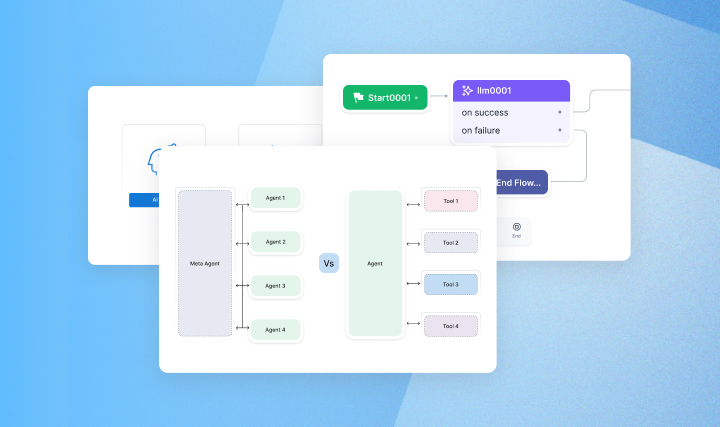
Most enterprise AI deployments today already involve dozens, sometimes hundreds, of agents. The question is, how do you organize them? In practice, there are two agentic architectural models.
In a single-agent model, there is one central decision-making loop. That single agent calls tools, retrieves data, delegates to sub-processes, and synthesizes outputs, but every decision routes back through one reasoning unit. For straightforward AI workflow automation, this is often sufficient and significantly easier to govern. But as workflows grow in complexity, crossing multiple systems or requiring different types of reasoning, it becomes a bottleneck.
A multi-agent system is an AI architecture where multiple autonomous agents, each with their own reasoning loop and decision-making capability, collaborate to complete a workflow, rather than routing everything through a single centralized model.
In theory, the idea of distributing decision-making across multiple AI agents makes total sense. But distributing decision-making has two MAJOR fault lines:
Fault Line 1: The compounding error
When multiple agents are arranged in a pipeline where each agent relies on the output of the previous one, small mistakes can quietly propagate through the workflow. Instead of cancelling out, they compound.
For example, consider a loan underwriting pipeline built on four sequential agents:
- Agent 1 (Document Parser) extracts income data from the applicant's submitted pay slips and bank statements.
- Agent 2 (Risk Classifier) assesses the applicant's debt-to-income ratio and assigns a risk band.
- Agent 3 (Policy Matcher) maps the risk band to an eligible loan product under the bank's current lending policy.
- Agent 4 (Decision Agent) generates the approval recommendation and triggers the offer letter.
An applicant submits documents showing a base salary alongside a quarterly performance bonus.
Agent 1 classifies the entire amount as fixed income rather than separating the variable component. It is a subtle misread. While the total figure is correct, only the income type is wrong. But here is where it gets interesting.
Agent 2 never sees the original documents. It considers Agent 1’s classification as ground truth – no questions asked, no verification, no second look. With a higher fixed income on record, the debt-to-income ratio looks healthier than it actually is, and the applicant is placed in a lower risk band.
Agent 3 matches that band to a premium loan product the applicant wouldn't otherwise qualify for. Agent 4 issues the approval.
Just like that, the decision is made.
The bank has made a lending decision that violates its own credit policy. Not through fraud, not through any conventional system failure, but because four autonomous agents each did their job correctly based on what they were handed. None of them had the full picture. None of them was designed to question what arrived from upstream. That is the fault line. And it was invisible the entire time.
Even if an agent completes its task with 95% accuracy, ten sequential steps down the line, the overall reliability of the system drops to around 60%. This is called the Compounding Decay of Reliability. Each agent in the workflow may perform well on its own. But the system as a whole does not.
Fault Line 2: The hidden cost of coordination
Accuracy is only one side of the equation. For enterprises operating under fixed compute budgets, the cost consequences of a poorly architected multi-agent system are very real, and almost always underestimated.
The DeepMind study found that as you add more agents, the more tokens they burn. In fact, multi-agent architectures can use 1.6X to 6.2X more tokens than comparable single-agent workflows. Here’s how it plays out at an enterprise scale.
Take a large financial services institution running an AI-powered customer service operation. Each interaction on a single-agent system consumes roughly 25,000 tokens. Shift to a six-agent architecture and token consumption climbs to 150,000 tokens per interaction a 6X jump, before a single thing goes wrong.
But a mid-tier national bank with 10-15 million customers typically has more than 100,000 interactions per day. At $0.05 per million tokens, that's $275,000 in additional API spend annually. And that assumes everything runs perfectly. If you consider retries, failures, and operational overheads, the total cost of a poorly architected multi-agent customer service system at this scale is over $500,000 annually.
Most pilot evaluations never model this. By the time they do, the architecture is already locked in. The question for enterprises is not whether to use multiple agents. It is whether the architecture earns its overhead.
Three conditions where multi-agent systems justify the investment
If the data suggests that multi-agent systems are prone to error and expensive to run, it would be easy to conclude that enterprises should simply avoid multi-agent systems altogether. That would be the wrong conclusion. The DeepMind research shows that when deployed in the right architecture and against the right problem, multi-agent systems outperform single-agent systems by as much as 81%.
The operative phrase is "right problem.” The key insight is that multi-agent systems are not universally better; they are architectural tools, best suited to specific problem shapes.
There are three conditions under which multi-agent systems consistently justify their overhead in enterprise environments:
1. When the workflow crosses system boundaries
The strongest case for multi-agent systems is not in task complexity, but in system fragmentation. Most processes in large organizations often require retrieving data from multiple sources, applying logic from separate systems, and writing outputs to different downstream platforms.
A single agent attempting to navigate different systems simultaneously becomes difficult to maintain, debug, and audit. Distributing that responsibility to one agent per system produces a more modular architecture where failures are easier to isolate, and integrations are easier to update independently.
For example, in financial services, a mortgage origination workflow pulls from a CRM, external property valuation APIs, credit bureau data, and internal lending policy systems. Similarly, in healthcare, a prior authorization workflow spans EHR systems, insurance eligibility databases, and clinical guidelines repositories.
In both cases, it is the system boundaries that justify the multi-agent approach, not the task complexity.
2. When different types of expertise are required
Many enterprise processes combine multiple forms of reasoning for different regulatory obligations.
Take a finance lending workflow, for example. The agent retrieving transaction history operates under data access controls, while the agent applying credit policy operates under fair lending regulations. Lastly, the agent generating the executive summary operates under different documentation requirements entirely.
Separating these into distinct agents is not just an architectural convenience; it is a governance decision.
An MAS allows each reasoning layer to be independently audited, independently updated when regulations change, and independently restricted based on data access permissions.
This is a case that resonates most with compliance and risk function, not because it makes the system more capable, but because it makes the system more governable. A single agent that retrieves data, applies policy, and generates output in one pass is harder to audit than three agents with explicit, inspectable handoffs between them.
3. When routing decisions depend on context
Some enterprise workflows cannot be defined entirely in advance. The path a task takes depends on what is discovered along the way.
Customer support operations are a good example. A large bank may handle hundreds of thousands of daily interactions spanning account queries, fraud disputes, loan servicing, and complaints, each requiring a different resolution path, different data retrieval, and different compliance handling.
A single agent attempting to handle all routing and resolution becomes a bottleneck that is difficult to scale and costly to retrain when products or policies change.
A supervisor-and-specialist architecture, where an intake agent classifies and routes, and specialist agents handle resolution within their domain, scales horizontally and allows individual agents to be updated without rebuilding the entire system.
The common thread across all three conditions is that multi-agent systems earn their overhead when they reflect a genuine structural property of the problem.
When none of those conditions are present, say when the workflow is linear, the data is unified, and the reasoning type is consistent, a well-designed single agent might outperform a multi-agent system.
Organizational requirements to prepare for multi-agent systems
Most enterprises ask the wrong question when evaluating multi-agent AI. They always ask, "Can we build this?" Of course, you can — the tooling exists, the models are capable, and vendors are eager to help.
The real question is, "Are we ready to operate this?" Before committing to a multi-agent architecture, enterprise teams should be able to answer four questions honestly.
1. Do you have the observability infrastructure to trace failures?
In a traditional software system, a failure produces a log entry, an error code, and a stack trace. In a multi-agent system, a failure often produces a confident, well-formatted output that is simply wrong, because the error occurred three agents upstream and every downstream agent treated it as ground truth.
If your answer is No, then do not deploy a multi-agent system into production until you have agent-level observability in place. Operating a multi-agent system without distributed tracing is the equivalent of running a financial reconciliation process with no audit trail.
2. Are your underlying data systems clean enough for agents to consume reliably?
Multi-agent systems inherit the data quality problems of the systems they connect to and amplify them. An agent retrieving customer records from a CRM where 15% of fields are incomplete or inconsistently formatted will introduce that noise into every downstream agent it feeds.
If your answer is No, then prioritize data quality in the systems your agents will touch before expanding agent scope. A single-agent system with clean inputs will consistently outperform a multi-agent system operating on unreliable data.
3. Is ownership of failure clearly assigned?
When a multi-agent system produces an incorrect output, say a wrong loan decision, a miscommunicated customer resolution, or a flawed regulatory filing, the question of accountability becomes complicated.
Was it the model? The orchestration layer? The AI agent that retrieved the wrong data? The team that designed the pipeline? This is why your enterprise needs clear ownership of failure.
If your answer is No, then define a RACI for agent failure before deployment. This is not a technical problem, but a governance problem, and it requires input from legal, compliance, and risk functions, not just engineering.
4. Do your compliance and legal teams understand how agent decisions differ from rule-based system decisions?
Traditional automated decision systems, such as credit scoring models, rules engines, and workflow automation, produce outputs that are traceable and auditable. The same input will always produce the same output, and the logic can be inspected.
AI agents do not behave this way. Outputs can vary between runs on identical inputs. The reasoning chain is probabilistic, not deterministic.
If your answer is No, then engage your compliance and legal teams before architecture decisions are made, not after. The cost of retrofitting explainability into a deployed multi-agent system is significantly higher than designing for it from the outset.
Build upwards: A maturity model
For enterprises that can answer yes to all four questions, the next decision is where to start. This is where a maturity model can help. It tells you where you are, what risks you carry at each level, and what the path forward looks like.
Rather than targeting Level 4, you should target the level at which your organization can operate reliably and build upward deliberately.
Conclusion: The fault line is avoidable
Multi-agent systems are not inherently good or bad. They are powerful when the problem calls for them, and expensive when it doesn't. The fault line lies in the gap between how enterprises assume these systems will behave and how they actually do under real operational conditions.
The enterprises getting this right aren't necessarily the ones with the biggest AI budgets or the most sophisticated models. They're the ones who asked whether their systems were clean enough and whether failures could be traced when they happened.
The organizations that do it upfront are the ones that end up with multi-agent systems that compound in value over time.
If you're at that stage and ready to move to deployment, Kore.ai is built for exactly this transition. From multi-agent orchestration and enterprise-grade observability to governance controls and pre-built workflows, it's designed to deploy AI agents that work reliably in real enterprise environments.
Frequently answered questions
Q1. What is a multi-agent system?
A multi-agent system is an AI architecture where multiple specialized agents collaborate on a workflow, each handling a distinct responsibility, data retrieval, analysis, policy application, and output generation, rather than relying on a single model to do everything. In enterprise environments, this mirrors how human teams divide and coordinate work across functions.
Q2. When should an enterprise not use a multi-agent system?
When the workflow is linear, the data is unified, and the reasoning type is consistent throughout. In these cases, a well-designed single agent will outperform a multi-agent system on cost, reliability, and maintainability.
Multi-agent systems earn their overhead only when the problem has genuine structural complexity, fragmented systems, separated compliance obligations, or high-volume routing variability.
Q3. How do you calculate whether a multi-agent system is cost-justified?
Start with your token consumption per interaction on a single-agent baseline, then apply the 1.6X - 6.2X multiplier the DeepMind research found for multi-agent architectures. Multiply by daily interaction volume and annualize.
Then add the hidden costs most pilots ignore, such as retry loops, observability tooling, engineering overhead for debugging coordination failures, and orchestration infrastructure. The total cost of architecture is what determines whether the system earns its overhead.
Q4. What is compound reliability decay?
It is the cumulative effect of small errors propagating through a sequential agent pipeline. Even if each agent completes its task with 95% accuracy, ten sequential steps produce an overall system reliability of approximately 60%. Each agent treats the previous agent's output as ground truth, so errors don't cancel out; they compound.
Q5. How do you evaluate and select a multi-agent platform for enterprise use?
Five criteria matter most in an enterprise context:
- Native support for human-in-the-loop intervention at decision boundaries
- Distributed tracing and agent-level observability out of the box
- Role-based access controls that can reflect your compliance structure
- Pre-built connectors for the enterprise systems you already run (CRM, ERP, core banking, EHR)
- Vendor track record in your specific industry vertical