AI Solutions
AI Solutions
AI for Work

Search across silos. Automate workflows. Orchestrate AI agents. Govern with confidence.

learn more
features
Enterprise SearchIntelligent OrchestratorPre-Built AI AgentsAdmin ControlsAI Agent Builder
Departments
SalesMarketingEngineeringLegalFinance
PRE-BUILT accelerators
HRITRecruiting
AI for Service

Leverage Agentic capabilities to empower customers and create personalized experiences.

learn more
features
AI agentsAgent AI AssistanceAgentic Contact CenterQuality AssuranceProactive Outreach
PRE-BUILT accelerators
RetailBankingHealthcare
AI for Process

Streamline knowledge-intensive business processes with autonomous AI agents.

learn more
features
Process AutomationAI Analytics + MonitoringPre-built Process Templates
Use Cases
Zero-Touch IT Operations Management
Top Resources
Scaling AI: practical insights
from AI leaders
AI use cases: insights from AI's leading decision makers
Beyond AI islands: how to fully build an enterwise-wide AI workforce
QUICK LINKS
About Kore.aiCustomer StoriesPartnersResourcesBlogWhitepapersDocumentationAnalyst RecognitionGet supportCommunityAcademyCareersContact Us
Agent Platform
Agent Platform
Agent Platform

Your strategic enabler for enterprise AI transformation.

learn more
FEATURES
Multi-Agent Orchestration
AI Engineering Tools
Search + Data AI
AI Security + Governance
No-Code + Pro-Code Tools
Integrations
GET STARTED
AI for WorkAI for ServiceAI for ProcessAgent Marketplace
LEARN + DISCOVER
About Kore.aiCustomer StoriesPartnersResource HubBlogWhitepapersAI Research ReportsNewsroomAnalyst RecognitionDocumentationGet supportAcademy
GET INVOLVED
AI PulseEventsCommunityCareersContact Us
upcoming event

CCW Berlin brings together international experts, visionary speakers, and leading companies to explore the future of customer experience, AI, and digital transformation in a dynamic blend of congress and exhibition

Berlin
4 Feb
register
Recent AI Insights
The AI productivity paradox: why employees are moving faster than enterprises
AI INSIGHT
12 Jan 2026
The Decline of AI Agents and Rise of Agentic Workflows
AI INSIGHT
01 Dec 2025
AI agents and tools: Empowering intelligent systems for real world impact
AI INSIGHT
12 Nov 2025
Agent Marketplace
More
More
Resources
Resource Hub
Blog
Whitepapers
Webinars
AI Research Reports
AI Glossary
Videos
AI Pulse
Generative AI 101
Responsive AI Framework
CXO Toolkit
support
Documentation
Get support
Submit RFP
Academy
Community
COMPANY
About us
Leadership
Customer Stories
Partners
Analyst Recognition
Newsroom
Events
Careers
Contact us
Agentic AI Guides
forrester cx wave 2024 Kore at top
Kore.ai named a leader in The Forrester Wave™: Conversational AI for Customer Service, Q2 2024
Generative AI 101
CXO AI toolkit for enterprise AI success
upcoming event

CCW Berlin brings together international experts, visionary speakers, and leading companies to explore the future of customer experience, AI, and digital transformation in a dynamic blend of congress and exhibition

Berlin
4 Feb
register
Talk to an expert
Not sure which product is right for you or have questions? Schedule a call with our experts.
Request a Demo
Double click on what's possible with Kore.ai
Sign in
Get in touch
Background Image 1
Blog
Conversational AI
FIT-RAG

FIT-RAG

Published Date:
November 11, 2024
Last Updated ON:
November 14, 2025

FIT-RAG: Are RAG Architectures Settling On A Standardised Approach?

As RAG is being used, vulnerabilities are emerging & solutions to these problems are starting to look very much alike.

Introduction

It is interesting to see that as technology advance, most everyone converges on what is deemed as a good design.

Taking for example prompt engineering, prompts evolved into templates with placeholders where variables could be injected.

This evolved into prompt chaining, and eventually autonomous agents which have multiple tools at its disposal.

Hence RAG is going through very much the same trajectory…initially RAG as such was deemed sufficient. However, now additional intelligence is being added to the RAG stack, together with a number of other elements forming part of the RAG architecture.
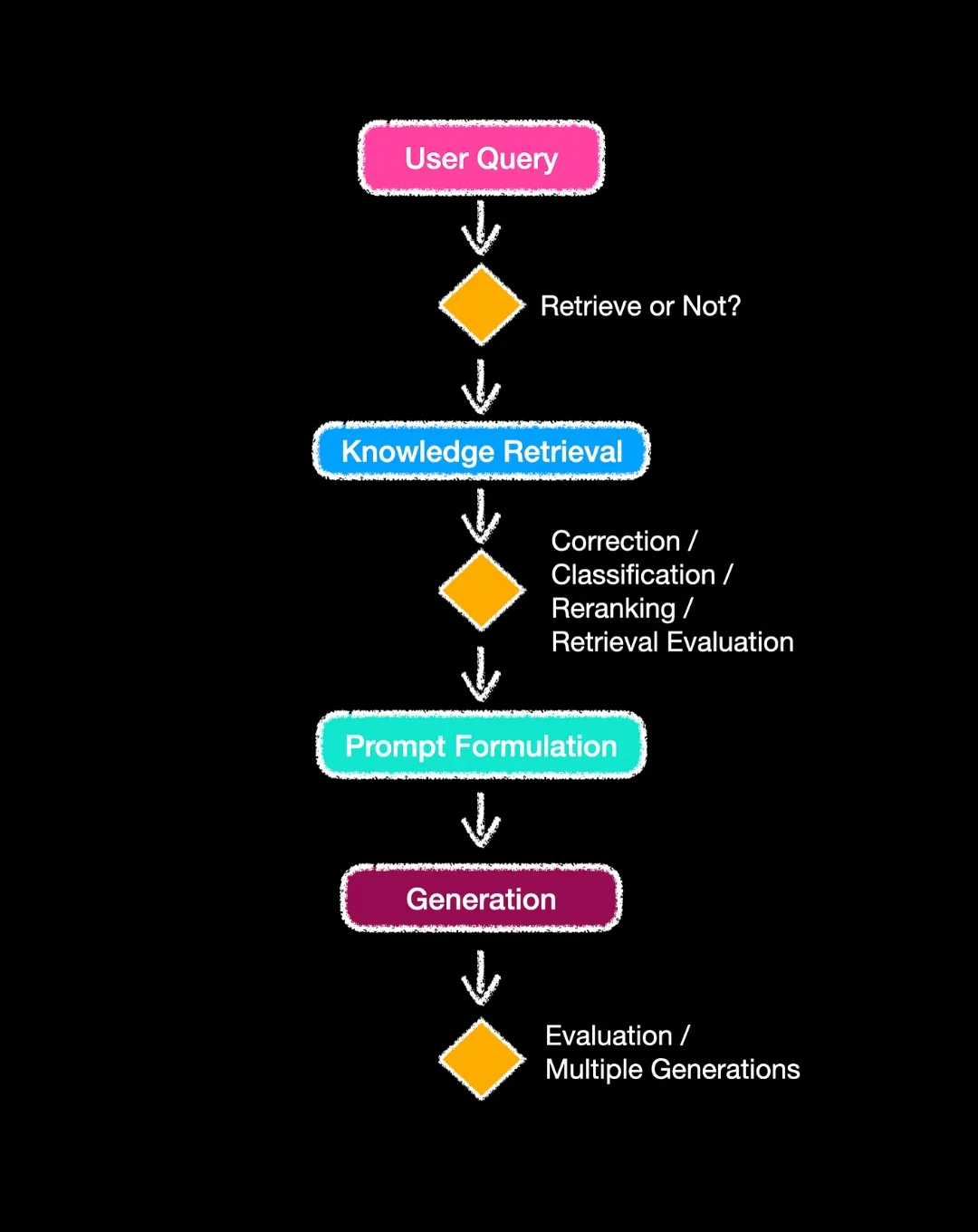
 Flow diagram illustrating the user acquisition process, detailing steps from outreach to conversion.
Detailing steps from outreach to conversion

Four initial considerations

Firstly, as you will see in the article below, the prompt structure is becoming increasingly important in RAG architectures, and prompting techniques like Chain-of-Thought, amongst others are being introduced.

Merely injecting the prompt with contextual reference data is not enough anymore, and prompt wording is being leveraged to optimise the performance.

Secondly, it is being recognised that RAG is static in two regards. The first element is that RAG does not necessarily take into consideration the context of the conversation, or at least consider the context spanning over a number of dialog turns.

Added to this, the decision to retrieve or not, is often based on a set of static rules, which lacks flexibility.

Thirdly, unnecessary overhead is becoming a consideration, with unneeded and un-optimised retrievals, additional text adding unwanted cost and inference latency.

Fourthly, multi-step approaches and classifiers are used to decide on the best response to select. Or to make use of multiple data stores or merely classify the user request. These classifiers are often dependant on annotated data which is used to train a model for this specialised task.
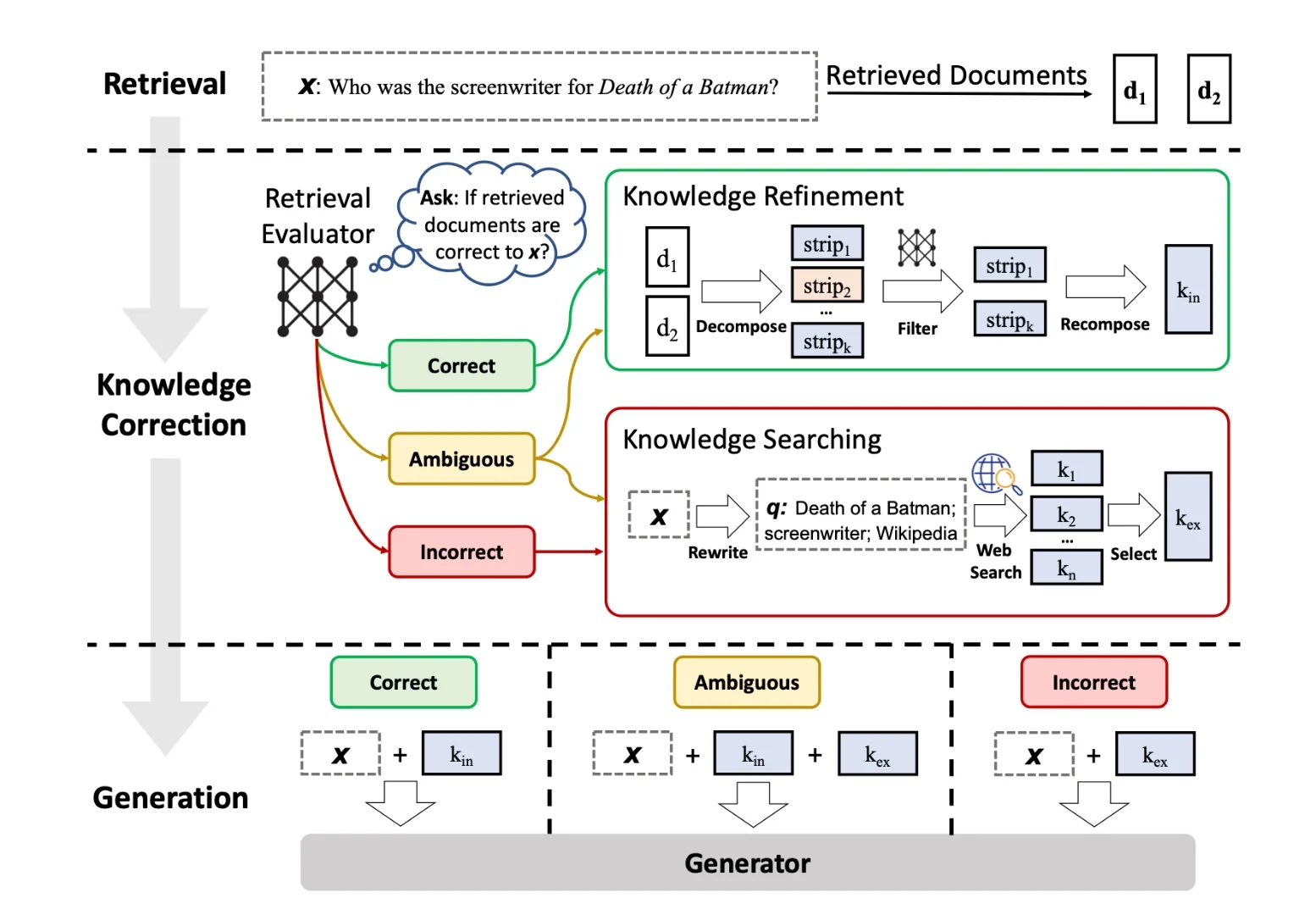
Visual representation of different information types stored in a database, such as text, images, and numerical data.
Steps of generation of an answer to the prompt

CRAG, is a lightweight retrieval evaluator which assesses the overall quality of retrieved documents, providing a confidence degree to trigger different knowledge retrieval actions.

And as I have stated before, RAG is moving towards a state which LlamaIndex refers to as Agentic RAG. Where a RAG based agent is used to manage the retrieval of data making use of multiple sub-agents or tools.

FIT-RAG

The FIT-RAG study identifies two problems considering LLMs and factual data…

Lack of Factual Data: The desired documents in LLMs might lack the necessary factual information for the specific query, potentially leading the retriever astray and undermining the effectiveness of black-box RAG.

Token Overload: Merging all retrieved documents indiscriminately results in an excess of tokens used for LLMs, diminishing the efficiency of black-box RAG.

FIT-RAG leverages factual information by devising a bi-label document scorer. This scorer incorporates factual information and LLM preferences as distinct labels.

Additionally, FIT-RAG implements token reduction strategies, including a self-knowledge recogniser and a sub-document-level token reducer. These innovations aim to minimise unnecessary augmentation and significantly decrease augmentation tokens, enhancing FIT-RAG’s efficiency.

Out-of-date and long-tail knowledge lead to LLMs struggling with hallucinations and factual errors, especially in knowledge-intensive tasks.

~ Source

Components of FIT-RAG

Considering the image below, FIT-RAG comprises of five integral components:

  1. A similarity-based retriever,
  2. A bi-label document scorer,
  3. Bi-faceted self-knowledge recogniser,
  4. Sub-document-level token reducer, and
  5. Prompt construction module.

Notably, the bi-label document scorer is designed to adeptly capture alignment with both LLM preferences and factual information, mitigating the risk of factual ignorance.

Moreover, the bi-faceted self-knowledge recogniser and sub-document-level token reducer play pivotal roles in minimising input tokens, thus averting token wastage.
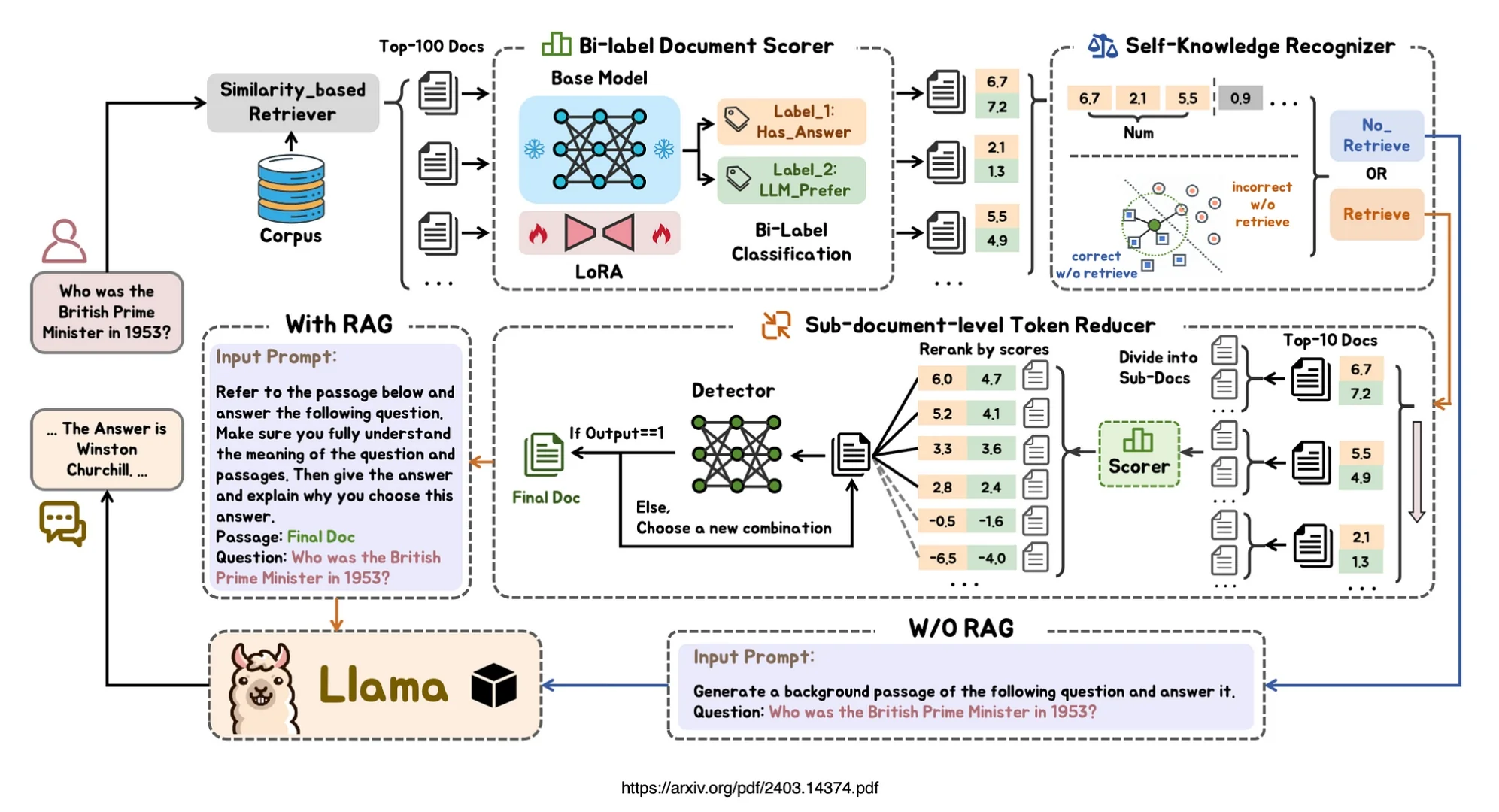
Infographic showing the method for leveraging cloud computing to enhance data management and accessibility.
Using cloud computing to enhance data management and accessibility

The bi-label document scorer is trained using bi-label learning, which involves two labels:

  1. Factual information (Has_Answer) and
  2. LLM preference (LLM_Prefer).

The Has_Answer label indicates if the document contains the answer to the question, while LLM_Prefer indicates if the document helps the LLM generate an accurate response.

However, there’s a significant data imbalance between these labels, which can impact the performance of bi-label learning. To address this, the paper proposes a data-imbalance-aware bi-label learning method.

This method assigns different weights to the data, which are automatically learned using hyper-gradient descent. This approach effectively tackles the data imbalance issue, enabling the bi-label document scorer to provide a comprehensive evaluation of retrieved documents.

The bi-faceted self-knowledge recogniser assesses whether the LLM necessitates external knowledge by evaluating two facets: whether the question pertains to long-tail or outdated information, and whether the question’s closest counterparts possess self-knowledge.

Meanwhile, the sub-document-level token reducer removes redundant sub-documents by choosing combinations from the retrieved documents with fewer sub-documents but still capable of enhancing the LLM’s ability to provide accurate answers.

FIT-RAG prompting

The image below shows how the prompt wording is optimised…
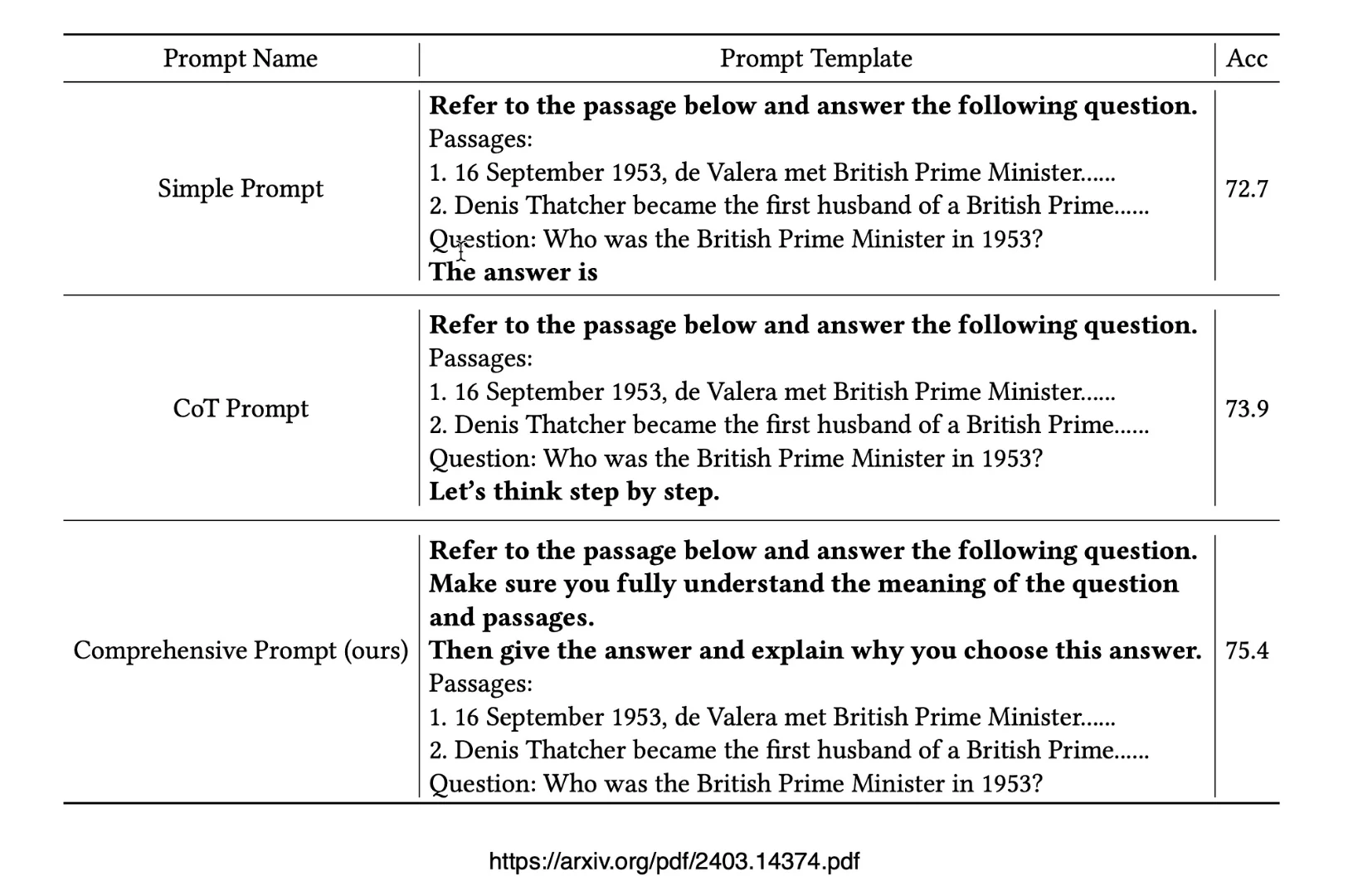
Prompt template showing how to construct a proper prompt.
How to prompt comprehensively

Conclusion

Integrating agentic capabilities into your RAG (Retriever-Reader-Generator)pipeline can significantly enhance its capacity to tackle intricate queries and reasoning tasks. By augmenting your pipeline with agentic capabilities, you empower it to handle a broader range of complex questions and scenarios.

However, one significant challenge faced by agents is the inherent lack of steerability and transparency in their decision-making processes. When confronted with a user query, an agent may resort to a chain-of-thought or planning approach, necessitating repeated interactions with large language models (LLMs) to navigate through the problem space effectively.

This reliance on iterative interactions with LLMs not only introduces computational overhead but also impedes the agent’s ability to provide transparent explanations for its decisions.

Consequently, there arises a pressing need to develop mechanisms that enhance the steerability and transparency of agentic systems, enabling users to better understand and influence their behaviour.

Addressing these pain points would not only improve the efficiency and effectiveness of agentic systems but also foster greater trust and collaboration between humans and AI agents in tackling complex tasks and problem-solving scenarios.

Read the full study here. 

Share
Link copied
authors
Cobus Greyling
Cobus Greyling
Chief Evangelist
Forrester logo at display.
Kore.ai named a leader in the Forrester Wave™ Cognitive Search Platforms, Q4 2025
Access Report
Gartner logo in display.
Kore.ai named a leader in the Gartner® Magic Quadrant™ for Conversational AI Platforms, 2025
Access Report
Stay in touch with the pace of the AI industry with the latest resources from Kore.ai

Get updates when new insights, blogs, and other resources are published, directly in your inbox.

Subscribe
Thank you! Your submission has been received!
Oops! Something went wrong while submitting the form.

Recent Blogs

View all
Agentic AI in Retail: Transforming Customer Experience & Operations 
January 23, 2026
Agentic AI in Retail: Transforming Customer Experience & Operations 
Top Glean Alternatives (2026 Guide)
January 23, 2026
Top Glean Alternatives (2026 Guide)
AI Agents in 2026: From Hype to Enterprise Reality
January 16, 2026
AI Agents in 2026: From Hype to Enterprise Reality
Start using an AI agent today

Browse and deploy our pre-built templates

Marketplace
Reimagine your business

Find out how Kore.ai can help you today.

Talk to an expert
Background Image 4
Background Image 9
You are now leaving Kore.ai’s website.

‍

Kore.ai does not endorse, has not verified, and is not responsible for, any content, views, products, services, or policies of any third-party websites, or for any verification or updates of such websites. Third-party websites may also include "forward-looking statements" which are inherently subject to risks and uncertainties, some of which cannot be predicted or quantified. Actual results could differ materially from those indicated in such forward-looking statements.


Click ‘Continue’ to acknowledge the above and leave Kore.ai’s website. If you don’t want to leave Kore.ai’s website, simply click ‘Back’.

CONTINUEGO BACK
Reimagine your enterprise with Kore.ai
English
Spanish
Spanish
Spanish
Spanish
Get Started
AI for WorkAI for ServiceAI for ProcessAgent Marketplace
Kore.ai agent platform
Platform OverviewMulti-Agent OrchestrationAI Engineering ToolsSearch and Data AIAI Security and GovernanceNo-Code and Pro-Code ToolsIntegrations
ACCELERATORS
BankingHealthcareRetailRecruitingHRIT
company
About Kore.aiLeadershipCustomer StoriesPartnersAnalyst RecognitionNewsroom
resources
DocumentationBlogWhitepapersWebinarsAI Research ReportsAI GlossaryVideosGenerative AI 101Responsive AI frameworkCXO Toolkit
GET INVOLVED
EventsSupportAcademyCommunityCareers

Let’s work together

Get answers and a customized quote for your projects

Submit RFP
Follow us on
© 2026 Kore.ai Inc. All trademarks are property of their respective owners.
Privacy PolicyTerms of ServiceAcceptable Use PolicyCookie PolicyIntellectual Property Rights
|
×