Designing conversational UIs that match user intent
Last Updated
October 7, 2026

Cobus Greyling
Read Time
What’s on this page
In this article I illustrate how to achieve intent alignment by making use of the Kore.ai XO Platform Intent Discovery Tool.
Introduction
According to Gartner, by 2028 Generative AI, digital customer service, and conversational UIs will revolutionise customer care.
In this article I want to delve deeper into conversational UI design, with specific focus on alignment of user intents with developed intents to craft relevant, intuitive and impactful conversational experiences.
Whether you’re a conversation designer, developer, or business analyst, this guide serves as your compass for mastering the art of creating chatbot interactions that literally meets user intent.
Decoding intents
The key to effective chatbot development
In the domain of Natural Language Understanding (NLU) and natural language processing (NLP), intents are at the frontline of classifying user input. It can be described as the North Star of the dialogue systems, chatbot development, and any application dealing with understanding and interpreting human language.
What are intents?
In Natural Language Understanding (NLU) and natural language processing (NLP), an intent refers to the intention or purpose behind a user’s input or query. It is a key concept in dialogue systems, chatbot development, and other applications that involve understanding and interpreting human language.
Intents at the frontline
Pre-defined conversation classifications
Here’s the problem... Conversational designers are busy crafting engaging dialogues, usually centred around products and services with a well defined conversational UI. Their process revolves around enhancing conversations by refining the design of the conversational flow. But here’s the twist. It’s like putting the cart before the horse, as this is most probably not the conversation users want, when user intents doesn’t align with the developed intents. Intent misalignment is a stumbling block to a great user experience. For an exceptional conversational user experience, the secret sauce lies in aligning user intents with business intents; as seen below:
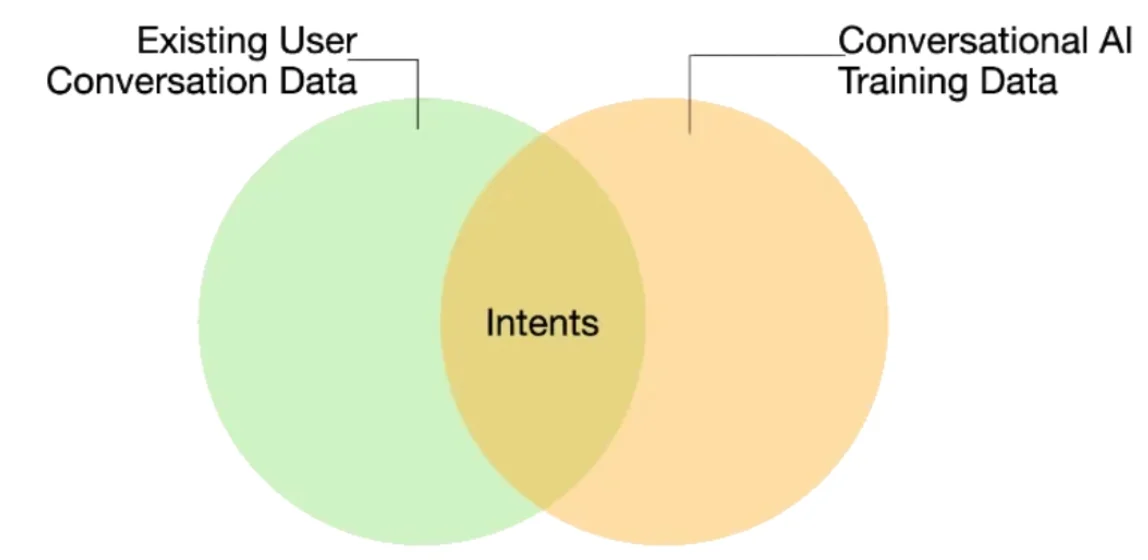
Considering the Venn diagram above…
- The area of overlap is the conversation you users want to have.
- These highly relevant and applicable intents are constituted by the delta of two corpuses of information.
- Discovering this intent delta demands two crucial steps.
First, leverage a data discovery tool to unearth existing intents within ongoing customer conversations.
Second, aligning conversational AI training data with these discovered intents.
It’s the roadmap to ensuring that the conversation users desire aligns seamlessly with the developed intents.
Why aligning intents matters
Aligning customer intents with developed intents is a crucial aspect of chatbot development, ensuring a seamless and effective interaction between users and the chatbot.
Customer intents represent the varied reasons why a user engages with the chatbot, while developed intents are the predefined actions and responses the chatbot has been programmed to perform.
Here are key considerations for aligning customer intents with developed intents:
Understanding Customer Intents
Begin by conducting thorough research to understand the diverse intents customers may have when interacting with the chatbot.
Start by analysing customer inquiries, feedback, and historical data to identify common queries, trends, customer speak and more.
Define clear and relevant developed intents
Based on customer insights, define a set of clear and relevant intents that cover a broad spectrum of user needs. Each developed intent should address a specific customer query or goal, ensuring a focused and effective response.
Regularly update developed intents
Follow an agile approach to chatbot development by regularly updating and expanding the set of developed intents to accommodate evolving customer needs.
Monitor customer interactions to identify new intents or changes in user behaviour and adjust the chatbot accordingly.
Multi-intent recognition
Train the chatbot to recognise and handle multiple intents within a single user query, as conversations often involve a mix of topics. Prioritise intents based on user input to deliver the most relevant and timely information.
A number of chatbot development frameworks have implemented a more granular approach to intent classification with sub-intents and nested intents.
Design conversations that matter
Design vs desired Conversation paths
With intent-driven conversation design, a crucial aspect lies in navigating the divergence between the designed path and desired user interactions.
Intents lie embedded within the intricacies of existing customer conversations. However, these conversations pose a challenge as they are presented in the form of highly unstructured data from diverse sources.
Moreover, when chatbot conversations are crafted with a focus solely on business intents rather than aligning with user intents, a noticeable gap emerges between the intended design and the actual user experience.
The ultimate goal is for these two paths to converge seamlessly, where the designed conversation aligns perfectly with the conversation users truly desire.
This alignment ensures that the chatbot experience resonates authentically with users, fostering user engagement and satisfaction.
The XO solution
Intent discovery
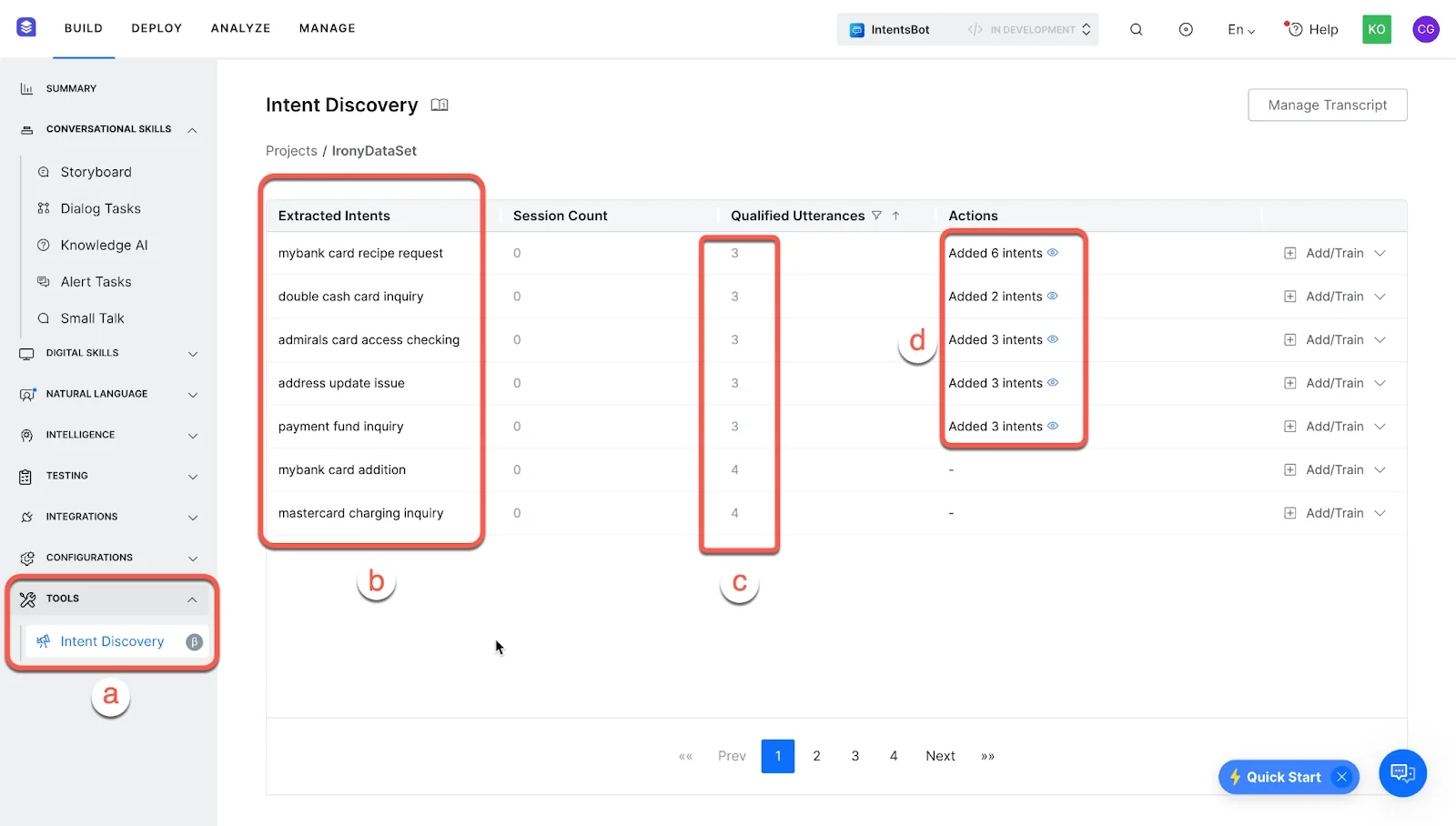
Considering the image below, XO has a built-in intent discovery tool which comes standard with the XO solution. Under tools, the Intent (a) Discovery Tool can be found. Any unstructured data can be imported into the XO platform, the unstructured data is then segmented according to (b) extracted intents. These intents can be considered as semantic clusters; where sentences which are semantically similar, are clustered together. The clusters are also given a name, which can be used as the intent name, or modified. The number of qualified utterances are (c) listed for each intent cluster. The number of utterances per intent can be considered as a weight indicating how important an intent is.
Intents with more qualified utterances most probably need to be broken down into nested or sub-intents. This is also a feature which is available within XO, to create sub or nested intents for a higher level of granularity in managing conversations. From this view under Actions (d) utterances can be added to intents; and assigned intents can be viewed.
Continuous improvement
Continuous intent development for chatbots is important for several reasons, and it plays a crucial role in ensuring the chatbot remains effective, relevant, and capable of meeting evolving user needs.
As seen below, within Kore.ai’s XO platform, data can be explored based on date filters.
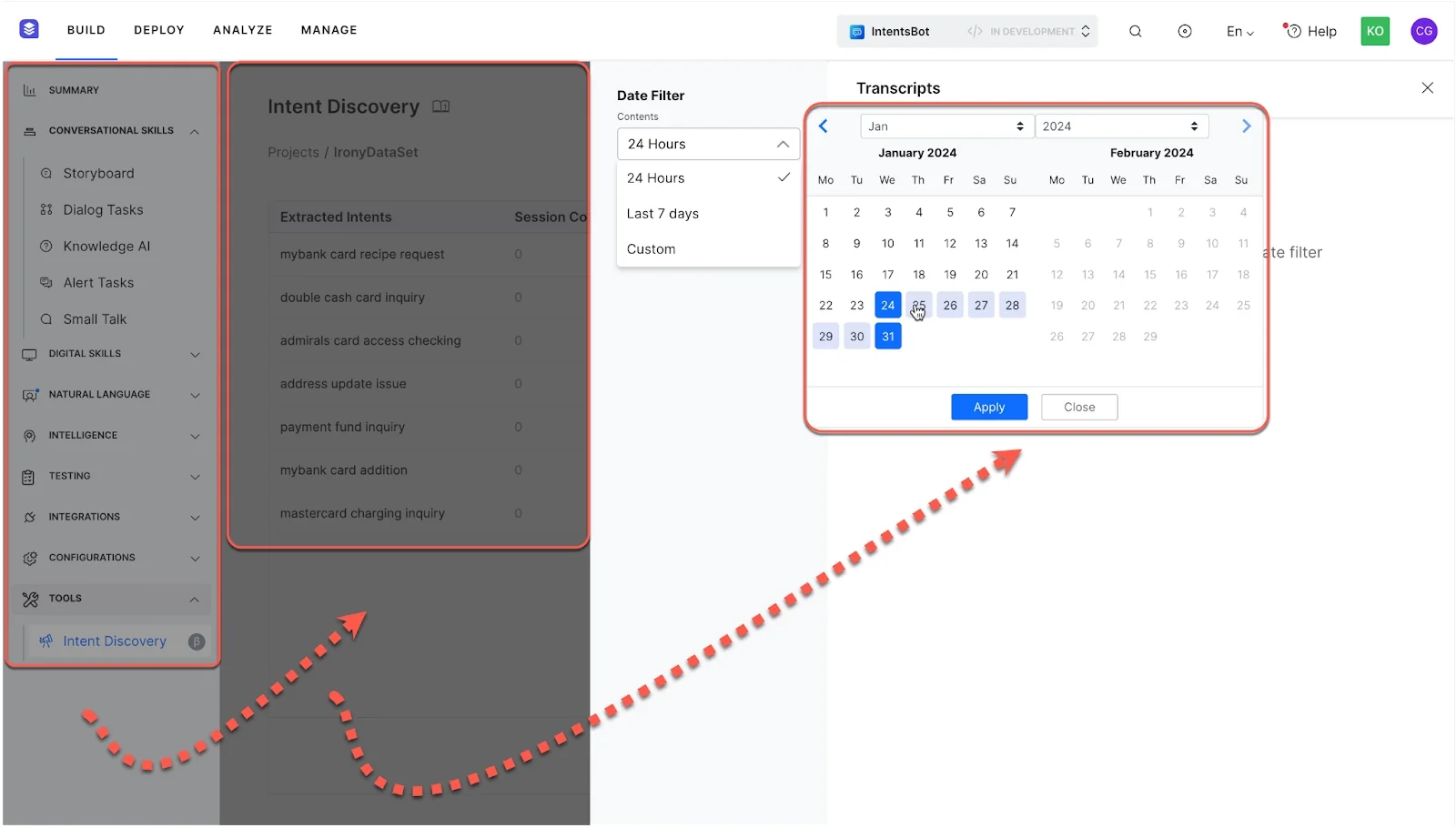
This is important for a cadence of transcript inspection for the following reasons:
- Adaptability to Changing User Behaviour
- Detecting New User Intents
- Improving Accuracy and Precision
- Staying Relevant in Dynamic Products and Services Environments
- Enhancing Natural Language Understanding (NLU)
- Catering to Seasonal or Event-Specific Intents
The link between intent and conversation context is fundamental to the effective functioning of chatbots. Understanding this relationship is crucial for developing chatbots that can engage in meaningful and context-aware conversations.
Here’s how intent and conversation context are interconnected
Intent represents the user’s goal or purpose behind a specific message or query. Intents indicate what the user wants to achieve; hence the user’s intent. In the context of a conversation, each user input is associated with a particular intent. The chatbot uses this identified intent to determine the appropriate action or response. The intent serves as a guiding factor for the chatbot to fulfil the user’s request or provide relevant information. The context of the conversation significantly impacts how intents are interpreted. Previous user inputs and the chatbot’s responses contribute to the ongoing context. With Kore.ai’s XO Platform, users can drill down from an intent cluster, into the dialog turns as seen in the image below.
The transcript view presents a dialog turn view to present conversational designers with a conversational, contextual view.
Conclusion
Seamless Intent Alignment
In conclusion, let’s reflect on the journey towards aligning customer intents with developed intents in chatbot development.
Traditionally, the intent discovery process follows the red line in the graph below. Here, chatbots are often fixed post-launch as conversations break down. This approach results in a high effort, high-stress ordeal, ultimately impacting the user experience. In contrast, the blue line represents the XO approach, where intents are proactively detected, defined, and planned for. From day one, the developed intent is meticulously aligned with customer intent. This proactive strategy ensures that chatbots are finely tuned to meet user needs, fostering a seamless and satisfying conversational experience from the outset.
Share
Tags