





.webp)
Enterprise search software is undergoing its biggest evolution in decades. What used to be a simple tool for retrieving information out of document repositories is now becoming the knowledge layer that sits behind how organizations access knowledge and execute work.
What’s changed most in the last couple of years is how search creates value. Where traditional search largely matched keywords to files, AI-powered enterprise search is built to understand intent and surface usable answers with the right context.
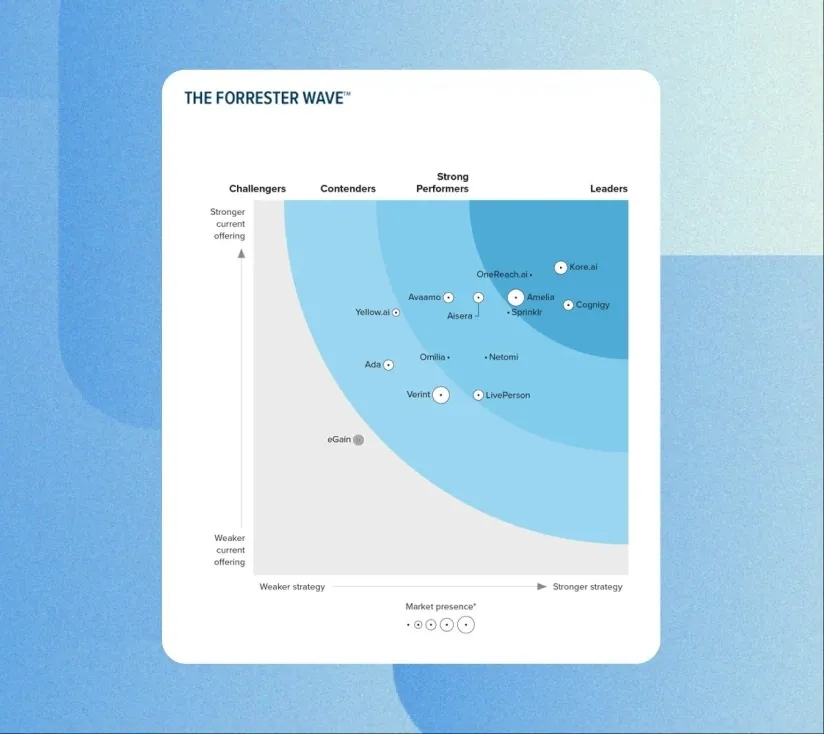
And because more companies are building AI assistants and agents on top of internal knowledge, search has become even more critical. As Forrester, in its Forrester Wave™ Cognitive Search Platforms, Q4 2025 report puts it, cognitive search platforms are increasingly the “Brains” behind accurate AI-driven work, because whatever your AI produces is only as reliable as what it can retrieve.
That’s exactly where AI enterprise search platforms change the equation. The right AI enterprise search software connects to the systems where knowledge lives, respects permissions, delivers high-precision context, and makes that knowledge usable for both humans and AI.
In this guide, we’ll walk through the top 8 enterprise search platforms to consider in 2026, what they’re best at, where they fall short, and which kinds of enterprise needs they fit best. Let’s get into it.
What enterprises need to know (TL;DR)
Before diving into the platforms, here are the key takeaways:
- Enterprise search is the foundation of AI-driven work. As AI agents become part of day-to-day operations, their accuracy increasingly depends on retrieving high-quality context from across the business.
- Not all “AI search” platforms are the same. Some excel at workplace knowledge discovery, others at service workflows or embedded app search, and a few support action-ready, agentic search journeys.
- Enterprise-grade capability beats feature lists. When comparing enterprise search solutions, prioritize deep connectors and ingestion, hybrid retrieval (lexical + vector), intent-aware query handling, evaluation tooling, and audit-ready AI governance.
- Plan for the next 24-36 months, not just the pilot. If your roadmap includes multi-step workflows and agents operating across systems, look for multi-turn context, tool integrations, and proven scalability.
- At a glance: Best AI enterprise search companies in 2026 include Kore.ai, Glean, Elastic, Coveo, Moveworks, Lucidworks, Algolia, and Google Cloud Search.
What is an enterprise search platform?
An enterprise search platform acts as a unified enterprise search engine that connects to your organization’s internal systems (documents, email, chat, apps, and databases), indexes that content, and retrieves the most relevant, permission-safe information through a single search experience. Modern platforms use NLP and retrieval techniques such as RAG to improve understanding and answer quality.
Think of an AI enterprise search software as your organization’s private ChatGPT, which is trained on your internal knowledge, aware of user roles and permissions, and designed to return reliable answers so employees and AI agents can act with confidence.
Learn how AI enterprise search is reshaping everyday work.
Why does your organization need an AI enterprise search software?
As organizations adopt AI agents, one reality becomes clear very quickly: AI agents are only as effective as the knowledge they can access. When information is fragmented across tools, formats, and teams, both employees and AI systems struggle to work intelligently. This is where AI enterprise search becomes essential.
AI powered enterprise search connects structured and unstructured data across systems, breaks down silos, and provides consistent, governed access to knowledge. For people, this means less time searching and more time doing. For AI agents, it means reliable context, grounded reasoning, and the ability to operate safely within real business workflows.
AI agents, in particular, depend on a trusted, continuous flow of information. To understand intent, reason across multiple steps, and surface meaningful insights, they need a search layer that can retrieve the right context at the right time, with relevance and permissions enforced. Without this foundation, agents become error-prone or constrained to narrow, low-value use cases.
While it’s possible to assemble AI driven enterprise search using open-source engines, vector databases, and custom pipelines, doing so at scale introduces significant complexity. Teams must build and maintain connectors, relevance tuning, security models, evaluation frameworks, and AI governance, all while keeping pace with rapidly evolving AI expectations. The right enterprise search platform absorbs this complexity. They provide the speed, reliability, and standardization required when search becomes a critical capability for both humans and AI agents, including:
- Faster deployment, with prebuilt connectors and production-ready retrieval pipelines
- Built-in scalability, designed for growing data volumes, users, and agent workloads
- Lower operational and maintenance overhead, reducing ongoing engineering effort
- Native AI governance and auditability, with permissions, traceability, and compliance baked in
Put simply, an AI enterprise search platform is the knowledge backbone that allows both people and AI agents to work intelligently and at scale.
Watch this webinar to learn how Agentic AI is reshaping enterprise workflows.
Top 8 AI Enterprise search platforms in 2026
Now that we’ve covered what AI enterprise search platforms are and why they’re essential for AI agents, the next step is understanding which solutions are leading the market. Below are the top 8 enterprise search platforms that stand out in 2026 and beyond, along with a breakdown of where they excel, the problems they solve, and the capabilities they offer.
1. Kore.ai: Ideal for enterprises building conversation-first agentic search
Kore.ai is an enterprise-grade agentic AI platform that combines conversation-first enterprise search with a full execution layer for AI agents. Unlike platforms focused purely on knowledge discovery, Kore.ai enables a “ChatGPT for the enterprise” experience where search results can directly drive actions across CX, EX, and business processes.
What sets Kore.ai apart is how it treats enterprise knowledge as the backbone for agent-led workflows. This means search is not merely for “finding information” but acts as a grounding layer that allows AI agents to understand intent, reason, maintain context, and act within governed, auditable workflows.
In The Forrester Wave™ Cognitive Search Platforms, Q4 2025 report, Forrester highlights Kore.ai’s strength in true multi-turn conversational search, with deep tooling to understand user intent across interactions, preserve context over time, and shape experiences dynamically. This allows both employees and AI agents to move beyond one-off queries into guided journeys where knowledge retrieval naturally leads to decisions and actions.
Forrester also notes Kore.ai’s use of behavior-driven relevance optimization, where the platform continuously fine-tunes ranking based on real usage patterns. This gives AI agents more reliable context to reason with and reduces the risk of acting on incomplete or misleading information.
For teams building production-grade AI enterprise search, Forrester calls out Kore.ai’s mature development and evaluation toolset for traditional enterprise search alongside robust capabilities to build, test, and evaluate RAG and hybrid search pipelines. This is essential when search is not just serving humans, but acting as the grounding layer for AI agents that must retrieve, reason, and then safely execute tasks.
Beyond retrieval, what further distinguishes Kore.ai from traditional enterprise search platforms is how search results are operationalized. Its multi-agent orchestration engine enables AI agents to:
- collaborate and hand off context
- chain search-driven reasoning with tools
- execute tasks with varying levels of autonomy
Under the hood, the platform stays intentionally flexible. Its model-agnostic, cloud-agnostic, and data-agnostic architecture lets enterprises choose any LLM they prefer, including bringing their own in-house models, running them in any environment, and connecting to virtually any data source. Simply put, this flexibility ensures businesses are never locked into a single ecosystem.
Kore.ai’s pricing is equally flexible and scalable. It provides options for session-based, usage-based, and per-seat-based pricing models. For larger deployments, Kore.ai offers tiered volume pricing, plus the flexibility to move up or down tiers as usage changes. For teams that want to start smaller and scale later, pay-as-you-go plans are also available without requiring bulk commitments.
Kore.ai’s leadership in the agentic AI landscape is widely recognized across the industry. The platform has been named a Leader in the Gartner® Magic Quadrant™ for Conversational AI Platforms, 2025, for the third consecutive year. According to Gartner, “Kore.ai delivers a feature-rich platform that stands out for its comprehensive and well-balanced capabilities.”
Similarly, Kore.ai has been named a Leader in The Forrester Wave™: Cognitive Search Platforms, Q4 2025. According to Forrester, “Kore has been able to capitalize on the rush to deploy 'ChatGPT for the enterprise' over the past few years.”
Kore.ai has also been named a Leader in the Everest Group’s Conversational AI & AI Agents in CXM Products PEAK Matrix® Assessment 2025. According to Everest Group, “Kore.ai supports advanced multi-agent orchestration through features such as agent collaboration, short- and long-term agent memory, agent tool access, and intelligent delegation.”
Kore.ai is trusted by over 400 Fortune 2000 companies, delivering more than $1Bn in cost savings. They have proven across industries like finance, healthcare, technology, manufacturing, telecom, and retail, with deep expertise in complex workflows.
Key features of Kore.ai
Some of the notable features of Kore.ai’s enterprise search are:
- Multi-turn conversational enterprise search that preserves context across interactions and supports resolution, not just retrieval.
- Multi-agent orchestration enables enterprises to design AI agents that collaborate seamlessly, share context, and execute complex workflows across customer, employee, and operations use cases.
- Build AI agents using ARCH (AI-architect) or use prebuilt agentic apps for banking, healthcare, retail, HR, IT, and recruiting with purpose-built agents that automate customer service, employee operations, and back-end workflows out of the box.
- Deep intent understanding and journey orchestration, allowing search experiences to adapt dynamically based on user goals.
- Behavior-driven relevance optimization improves retrieval quality for both employees and AI agents over time.
- Enterprise-grade RAG and hybrid search pipelines, with strong development and evaluation tooling for production use.
- 250+ enterprise-grade, plug-and-play integrations give agents direct access to systems like CRM, ITSM, HRIS, ERP, and data lakes. Teams can also add custom integrations or bring in any system they need, without heavy engineering.
- Agent marketplace with 300+ pre-built AI agents allows enterprises to build and deploy agents up to 10 times faster and start generating ROI from the get-go.
- No-code + pro-code development framework lets business teams and developers build AI agents at speed.
- Strong roadmap and sustained R&D investment, signaling long-term commitment to agentic enterprise search.
Pros of Kore.ai:
- Conversation-first search designed for multi-step, action-oriented workflows
- Strong intent and behavioral understanding for high-precision retrieval
- Mature tooling for building and evaluating agent-ready RAG pipelines
- Clear vision of search as an agentic knowledge and execution layer
- Enterprise-scale multi-agent orchestration
- Best-in-class AI governance and observability
- Highly flexible, model- and cloud-agnostic architecture
- Flexible pricing. (Request-based, session-based, per-seat, or pay-as-you-go pricing structures)
- Deep integration ecosystem with 250+ plug-and-play enterprise connectors
- Agent marketplace with 300+ pre-built AI agents
- Proven scalability, trusted by 400+ Fortune 2000 enterprises
- Consistently recognized as a leader by third-party analysts
Cons of Kore.ai:
- Not suited for small and medium businesses with limited data
- Teams not looking to extend enterprise search into agent-driven workflows may find advanced agentic capabilities overwhelming.
- Given the number of integrations, some documentation, especially for newer connectors, is still catching up.
- With a broad template library, finding the right agent template can take a few extra clicks.
Forrester’s rating:
Current offering: 4.08/5
Strategy: 3.70/5
Kore.ai scored the highest points of all platforms, both in current offerings and long-term strategy.
Overall verdict:
Enterprises that want AI agents to do more than retrieve documents, and instead use enterprise knowledge to reason, guide decisions, and take action will find Kore.ai as the most sought-after choice in 2026. Its combination of conversational search, behavioral relevance tuning, multi-agent orchestration, and AI governance makes it especially well-suited for organizations using enterprise search as the foundation for scalable, agent-driven workflows, not just information discovery.
Learn how Kore.ai can help you build and scale enterprise-grade AI agents.
2. Elastic: Ideal for developer-led, open-source search foundations
Elastic’s enterprise search capabilities are built on Elasticsearch, an open-source search engine, alongside Logstash and Kibana. Together, they support a wide range of search-driven use cases with strong observability and compliance tooling, making the platform particularly appealing to organizations that value open-source foundations.
Forrester highlights Elastic’s strength in relevance tuning and results refinement, with deep control over query processing, execution, and ranking. The platform also performs well on scale and efficiency, with flexible deployment options across cloud, hybrid, and self-managed environments.
The trade-off is that Elastic is less focused on delivering a packaged enterprise search experience and more on providing developers with the building blocks to design and tune search to their specific needs. In The Forrester Wave™: Cognitive Search Platforms, Q4 2025, Forrester notes that Elastic’s native intent and context understanding is less extensive than some peers, which can require building additional context engineering or external layers to deliver guided or conversational search experiences.
Because Elastic follows an open-source, developer-first model, more responsibility often sits with the enterprise to assemble the full “enterprise experience layer.” In practice, this can mean that enterprises may need to invest more heavily in security configuration, access control design, auditability, and operational AI governance, particularly when deploying search across multiple teams or business units.
Forrester also reports that while Elastic is a technically mature platform, extracting its full value typically requires significant expertise in search engineering and ongoing optimization. This means teams should plan for continued operational work, such as schema evolution, re-indexing, and pipeline updates, which can become more involved at scale.
Key features of Elastic:
- Open-source search engine
- Controls for relevance tuning, ranking, and query execution
- Strong scalability and performance for large data volumes
- Flexible deployment options, including cloud, hybrid, and self-managed
- Developer-focused roadmap with advanced vector search and LLM controls
Pros of Elastic:
- Excellent fit for developer-led teams and open-source environments
- Strong performance and efficiency
- Highly customizable search behavior and ranking logic
- An open-source approach provides a flexible infrastructure
Cons of Elastic:
- An open-source, developer-first model can require greater customer ownership of security, AI governance, and operations
- More of a build-your-own search platform than a packaged enterprise solution
- Limited native intent understanding and conversational depth compared to some peers
- Out-of-the-box apps, workflows, and agent-ready experiences are relatively limited
- Achieving enterprise-grade experiences typically requires specialized expertise and ongoing effort
Forrester’s rating:
Current offering: 3.66/5
Strategy: 3.40/5
Overall verdict:
Elastic is best understood as a search infrastructure rather than a turnkey enterprise search or agentic platform. It is a strong choice for organizations that want a scalable, open-source search foundation and have the engineering maturity to design and operate custom search experiences securely. However, enterprises looking for a business-ready or agentic enterprise search platform, with faster time to value and built-in AI governance, should carefully assess Elastic’s open-source, developer-centric approach.
3. Coveo: Ideal for enhancing search within apps
Founded in 2005, Coveo is an enterprise search platform that is used to enhance search inside platforms such as Salesforce, SAP, and Adobe. It helps organizations surface relevant knowledge directly within the tools employees and customers already use.
Forrester notes that the platform is effective at delivering accurate results at scale and offers a customizable connector set tailored to key enterprise data sources. Rather than relying on a native knowledge graph, Coveo takes an alternative approach to understanding entities and intent, which Forrester observes can work well for handling complex user queries.
However, Coveo remains more focused on knowledge retrieval than on differentiated agentic capabilities. In The Forrester Wave™: Cognitive Search Platforms, Q4 2025, Forrester notes that while Coveo’s vision includes supporting agentic experiences, it still has some catching up to do in agentic AI innovation.
It’s also worth noting that Coveo’s conversational experiences are typically delivered via integrations (for example, within application ecosystems) rather than through a standalone native chat interface.
Additionally, Coveo does not provide a native knowledge graph, which may be a consideration for enterprises that prefer graph-based architectures for modeling relationships across people, content, and systems.
Key features of Coveo:
- Hybrid lexical and vector search with strong relevance and reranking models
- Broad, customizable enterprise connectors, especially within major app ecosystems
- Scalable, cloud-based cognitive search architecture
- Advanced intent handling without a native knowledge graph
- Developer-friendly tooling and implementation support
Pros of Coveo:
- Strong relevance and reranking across hybrid search modes
- Broad connector coverage with deep customization options
- Scalable cloud deployment and implementation support
Cons of Coveo:
- Agentic vision is not strongly differentiated in the current market
- Innovation focus remains largely on retrieval rather than orchestration or execution
- No native knowledge graph, which may not suit all enterprise architectures
- Conversational search experiences are typically integration-led rather than native
Forrester’s rating:
Current offering: 3.10/5
Strategy: 3.10/5
Overall verdict:
Coveo is a good choice for enterprises looking for a cloud-based search platform that can improve search within platforms like Salesforce, SAP, and Adobe. However, enterprises seeking a more agentic-first platform, with native orchestration and execution capabilities, should assess whether Coveo’s retrieval-centric roadmap aligns with their longer-term AI ambitions.
4. Lucidworks: Ideal for commerce-focused search experiences
Lucidworks is a search platform designed to manage, search, and analyze data from diverse digital sources. It gives organizations the tools to build search applications that help users access information efficiently. The platform supports a broad range of use cases and is now mainly focusing on commerce-oriented search experiences.
Forrester notes that Lucidworks has strong relevance, accuracy, and tunability. The report also highlights rich usage analytics and an approach designed for resilient global search, which can be valuable for organizations running distributed search experiences across regions.
However, Forrester, in its The Forrester Wave™: Cognitive Search Platforms, Q4 2025, notes that Lucidworks must strengthen native governance and orchestration to better meet emerging agentic needs. This matters for enterprises that want search to serve as a governed foundation for multi-step, action-taking workflows, not just information retrieval.
Forrester also flags that Lucidworks’ agentic positioning is still taking shape and lacks clarity of vision on how it will differentiate in the agentic space, especially as it doubles down on commerce-related agentic capabilities.
Key features of Lucidworks:
- Relevance tuning and hybrid search controls (keyword + vector weighting).
- Usage analytics and behavioural signal capture to support ongoing optimization.
- Search patterns aimed at global deployments.
- Configurable processing/query pipelines for building tailored retrieval experiences.
- Security-oriented capabilities such as authentication and security trimming patterns.
Pros of Lucidworks:
- Commerce-focused search experiences
- Provides control over relevance tuning
- Designed for global deployments
Cons of Lucidworks:
- Needs stronger native governance and orchestration
- Agentic differentiation and roadmap clarity remain a work in progress
- Extending beyond native capabilities can be difficult, per the Forrester report
- Increasing commerce focus may be less aligned for teams prioritizing broader enterprise workflows
Forrester’s rating:
Current offering: 3.38/5
Strategy: 2.60/5
Overall verdict:
Lucidworks is a good fit for enterprises prioritizing commerce search agents, especially when search quality and global deployments are central requirements. However, organizations aiming to use enterprise search as a broader agentic foundation with strong native governance and orchestration should closely evaluate how Lucidworks’ evolving roadmap aligns with those longer-term needs.
5. Google Cloud Search: Ideal for organizations already invested in Google Cloud
Google Cloud Search is a software that allows organizations to search information across Google Workspace sources such as Gmail, Drive, Calendar, and other Google applications. More recently, Google Cloud has increased its focus on enterprise search and is aiming to build on its strengths in consumer search.
From a strategy standpoint, Google Cloud’s portfolio contains Vertex AI search and Agentspace. Vertex AI Search provides a developer-centric foundation, while Agentspace extends this into RAG-based experiences that can be used both by developers and less-technical users. Forrester notes that Google Cloud draws its heritage from knowledge graphs, with strengths in data enrichment and answer grounding.
That said, while Google has decades of experience in search, its enterprise cognitive search offerings are still relatively new compared to more established enterprise-focused vendors. Forrester, in its The Forrester Wave™: Cognitive Search Platforms, Q4 2025, notes that Google Cloud currently supports a limited set of industry-specific and horizontal enterprise use cases and needs to support a broader set of use cases.
It is also worth noting that since Agentspace has only been available since late 2024, connector breadth and packaged integrations are still developing, which can increase implementation effort for organizations with complex technology environments.
Key features of Google Cloud Search
- Semantic and vector-based enterprise search built on Google’s search infrastructure
- Developer-centric tooling for building custom search experiences
- Agentspace for creating agentic RAG and foundational agent workflows
- Strong data enrichment and knowledge-graph-driven context
- Integration with third-party data services for grounding search and responses
Pros of Google Cloud Search:
- Tight integration with the Google ecosystem
- Flexible developer tooling for customer search
- Strong data enrichment capabilities
Cons of Google Cloud Search:
- Enterprise search offerings are relatively new compared to established peers
- Limited out-of-the-box connectors and pre-packaged integrations
- Fewer industry-specific and horizontal enterprise use cases today
- Agentic capabilities are still maturing, with most deployments focused on retrieval today
Forrester’s ratings:
Current offering: 3.42/5
Strategy: 2.40/5
Overall verdict:
Google Cloud Search is a practical choice for organizations that are heavily invested in the Google Cloud ecosystem and are looking to build developer-led search experiences that can evolve towards agentic capabilities over time. However, teams seeking a more turnkey enterprise search platform, especially with broad out-of-the-box integrations, industry-ready use cases, mature agent orchestration, and years' worth of experience in enterprise search, may need to assess whether Google Cloud’s roadmap aligns with their near- and mid-term requirements.
6. Moveworks: Ideal for search in employee service environments
Moveworks approaches enterprise search from the IT and employee service domain. Its platform is built to support internal help and service workflows, with search embedded beneath a conversational interface.
Forrester notes that Moveworks’ core search capabilities are competitive in employee service environments. Its connector depth and its ability to semantically link content using a knowledge graph are on par with the market, making it a good fit for service-heavy internal support scenarios.
However, Forrester is clear that extending beyond its service-desk roots will require meaningful expansion. To credibly support search and workflows across broader business domains, Moveworks must broaden both its horizontal and vertical expertise. In The Forrester Wave™: Cognitive Search Platforms, Q4 2025, Forrester also flags that the platform’s roadmap lacks clarity and will need a stronger focus on implementation depth.
There are functional gaps to consider as well. While Moveworks handles textual and structured data effectively, Forrester notes it must expand its ability to understand and index images, charts, and graphs, which are increasingly common in enterprise knowledge environments.
Finally, enterprises may factor in the uncertainty around Moveworks’ longer-term direction following ServiceNow’s announced intent to acquire the company on March 10, 2025, particularly in areas such as roadmap continuity and product priorities.
Key features of Moveworks
- Enterprise search rooted in IT and employee service workflows
- Multiturn conversational search
- Knowledge-graph-based contextualization for improved relevance
- Strong connectors for text, structured data, and common document formats
- Low-touch deployment with infrastructure complexity handled by the platform
Pros of Moveworks
- Excellent fit for HR, IT, and employee service desk use cases
- Competitive connector and knowledge graph capabilities
- Proven with large companies
Cons of Moveworks
- Strengths are concentrated in service and support, not broad enterprise search
- Limited multimodal understanding (images, charts, graphs)
- Requires expansion beyond current depth
- ServiceNow acquisition introduces uncertainty around future platform direction
Forrester’s rating:
Current offering: 2.48/5
Strategy: 3.10/5
Overall verdict:
Moveworks is a good choice for enterprises seeking search experiences tightly integrated with HR and IT service workflows. Its ability to resolve queries within a single conversational flow is a clear strength. However, organizations that want to use enterprise search as a scalable agentic foundation across diverse business domains should assess Moveworks’ offerings closely, particularly its expansion beyond service-desk use cases and how its platform direction evolves post-acquisition.
7. Glean: Ideal for workplace knowledge discovery
Glean is a search platform designed to improve workplace knowledge discovery. It helps surface information spread across emails, documents, chats, intranets, and common business applications, making it easier for employees to find relevant content.
Forrester notes that Glean’s core strength lies in its enterprise knowledge graph, which maps people, content, activity, and permissions to deliver personalized and permission-aware results. Its ability to understand user intent and determine relevance makes it well-suited for intranet-style use cases where discoverability is a key priority.
However, Glean’s current strengths remain concentrated in knowledge access rather than agentic workflows. In The Forrester Wave™: Cognitive Search Platforms, Q4 2025, the report points out that Glean’s connector ecosystem is narrower than many competitors, and that its capabilities for enriching indexed data with deeper contextual signals are comparatively limited today. This can matter for organizations looking to use enterprise search as a foundation for more extensive AI-driven workflows.
The platform also offers a smaller set of prebuilt applications and packaged solutions, which may increase the effort required for teams seeking more out-of-the-box automation. Forrester further notes that Glean will need to strengthen its scale and efficiency to support more specialized or high-volume enterprise use cases over time.
On pricing, Glean typically follows a user-based subscription pricing model, with enterprise tiers available for organizations requiring advanced administration, security, or custom integrations.
Key features of Glean:
- Unified enterprise search that connects with business applications, enabling employees to find information across documents, messages, tickets, and tools through a single search experience.
- An enterprise knowledge graph that maps people, content, activity, and permissions to deliver personalized, context-aware search results.
- AI Assistant and Glean Agents answer questions in natural language and trigger workflow actions based on retrieved insights.
- Multimodal and universal knowledge ingestion, allowing the platform to index structured and unstructured data, from files and emails to databases and legacy systems.
- Permissions-aware search and AI governance, ensuring users only see information they are authorized to access.
Pros of Glean:
- Strong enterprise search capabilities
- AI Agents that enhance discovery with summarization
- Enterprise-grade security with built-in compliance controls
Cons of Glean:
- Primarily focused on knowledge discovery, not full workflow automation or complex multi-step orchestration
- The connector set is narrower than many of its competitors
- Offers fewer capabilities for deep data enrichment and context modeling
- Limited set of pre-built apps and off-the-shelf solutions
- Capabilities in scale and efficiency for a broader set of use cases
Forrester’s rating:
Current offering: 2.62/5
Strategy: 2.70/5
Overall verdict:
Glean is best suited to enterprises that want to improve workplace knowledge discovery through strong relevance and intent-driven search. While it is building toward agentic capabilities, organizations looking primarily for centralized information access may find Glean a good fit, particularly when complex agentic workflow execution is not the immediate goal.
8. Algolia: Ideal for e-commerce / retail search experiences
Founded in 2017, Algolia is a cloud-based platform that powers e-commerce and retail search experiences. It helps businesses deliver fast, relevant, and scalable search experiences across websites, apps, and internal systems.
Forrester highlights Algolia’s ability to deliver search results quickly and query workloads. Its API-first approach makes it relatively easy for developers and admins to embed search into customer-facing applications, which is especially valuable in retail scenarios where responsiveness and high query volumes are non-negotiable.
However, Forrester points out that Algolia is less competitive than some peers in deep user context and intent understanding, and offers fewer flexible controls to refine relevance and precision in complex enterprise scenarios. From a strategic perspective, Forrester also flags challenges in Algolia’s adaptation to the agentic era. It notes that Algolia needs a clearer functional roadmap and sharper differentiation as search shifts from “retrieval only” toward action-taking, agentic flows.
Key features of Algolia
- Strong fit for digital, knowledge-site, and commerce search use cases
- Cloud-based, API-first search platform
- Early innovation in vector search and RAG-style retrieval
- High-speed indexing and query performance at scale
- Broad support for common enterprise content formats
Pros of Algolia
- Fast and scalable cloud search performance
- Quick to implement
- Solid vector-search foundations
- Well-suited for user-facing search applications
Cons of Algolia
- Limited native user context and intent understanding compared to peers
- Fewer flexible controls for fine-grained relevance tuning
- Roadmap clarity concerns noted by customers and Forrester
- Agentic capabilities remain more retrieval-centric than execution-oriented
Forrester’s rating:
Current offering: 1.78/5
Strategy: 1.40/5
Overall verdict:
Algolia is a good choice for enterprises that prioritize speed and ease of integration for cloud-based search, particularly in commerce-driven scenarios. However, organizations looking to use enterprise search as a broader agentic foundation, with deeper intent awareness, workflow execution, and a clearly articulated evolution path, should carefully assess whether Algolia’s roadmap aligns with those goals.
What capabilities should an AI enterprise search platform have? (& how to choose)
As enterprise search becomes a core foundation for AI-driven work, and as organizations evaluate everything from a basic enterprise search engine to a full enterprise LLM search optimization platform, leaders need to look beyond surface features and evaluate whether a platform is built for scale, AI governance, and an agentic future. Below are 6 essential capabilities pillars to use when evaluating AI enterprise search platforms in 2026.
1. Data and system integration
Enterprise knowledge lives across a complex mix of structured and unstructured systems, from file stores and intranets to CRMs, ERPs, ITSM tools, data platforms, and custom applications. A strong AI enterprise search platform must integrate deeply across this landscape.
Look for platforms that offer:
- a broad range of prebuilt enterprise connectors
- flexibility to extend or customize integrations with minimal effort
- native ingestion of metadata, identity, and permissions, not just content
As search becomes agentic, integration should go beyond read-only access. Platforms increasingly need to support bidirectional interaction, allowing agents to write back to systems, trigger actions, and complete workflows, a capability that sets leading enterprise search tools apart from basic retrieval systems.
2. Knowledge ingestion, enrichment, and indexing
Raw enterprise data is rarely ready for high-quality search. AI enterprise search platforms should include robust ingestion pipelines that transform fragmented content into governed, searchable knowledge.
Key capabilities include:
- Normalization, such as text extraction, language handling, and format conversion
- Analysis, including entity detection and structural understanding
- Classification, such as tagging, sensitivity labelling, and ontology mapping
- Security binding, preserving original access controls end-to-end
This processed knowledge should then be stored in hybrid search indexes, combining keyword-based and vector-based structures, to support both precision and semantic retrieval at scale.
3. Retrieval intelligence
How a platform understands and executes queries is as important as what it indexes. Modern enterprise search must go far beyond literal keyword matching. Strong platforms provide:
- NLP-driven intent understanding, handling ambiguity, and phrasing variation
- hybrid query execution across lexical and vector indexes
- advanced relevance ranking, informed by metadata, behavior, and business rules
- permission-aware result trimming, ensuring secure access for every query
This retrieval intelligence determines whether users and AI agents receive genuinely useful context or just more noise, and why getting it right is the difference between agentic AI that works and infrastructure that bottlenecks it.
4. Agentic RAG and action readiness
Cognitive search increasingly underpins RAG-based AI and agentic workflows. As such, platforms must be designed to serve both humans and machines. Evaluate whether the platform supports:
- RAG pipelines with citations and traceability
- multi-turn retrieval that maintains context across steps
- integration with tools so agents can act on retrieved knowledge
- evaluation and tuning tools to improve retrieval quality over time
This ensures search can safely support AI systems that reason, decide, and execute — not just answer questions.
5. Enterprise-scale deployment and cost control
Search that works in a pilot often breaks down at enterprise scale. Vector retrieval, security complexity, and global usage introduce new operational demands. An enterprise-ready platform should demonstrate:
- proven scalability across large data volumes and high query loads
- support for multi-region or distributed deployments
- predictable performance as hybrid and vector search usage grows
- transparency and control over operational cost and efficiency
This is especially important when AI agents rely on search continuously, not occasionally.
6. A clear and credible product roadmap
Finally, leaders must assess where the platform is going, not just where it is today. Gartner and Forrester both emphasize that cognitive search will remain a core building block for agentic applications, even as expectations evolve. Look for vendors that demonstrate:
- a clear roadmap for agentic and AI-driven capabilities
- continued investment in enterprise hardening, AI governance, and scale
- transparency around upcoming features and architectural direction
Even organizations not deploying agents today should choose a platform that will support tomorrow’s AI-driven workflows without requiring a complete re-platforming.
Conclusion: What is the right enterprise search platform for you?
Choosing the right AI driven enterprise search solution comes down to how ambitious your organization's agentic roadmap is over the next 24–36 months. Before you commit, it helps to get clear on a few fundamentals:
- Your use cases now and next: Are you solving one narrow search problem today, or do you expect search to power multiple workflows across teams and functions?
- Scale and reliability: Can the platform handle growing data volumes, new regions, and more complex journeys without performance or relevance breaking down?
- Integration depth: Does it connect to the systems where your knowledge actually lives, and can it evolve from read-only retrieval into action-taking workflows?
- Intent, context, and multi-turn journeys: Will users and agents get one-off answers, or guided, context-aware journeys that lead to resolution?
- AI governance and security: Can you enforce permissions, trace outputs, audit behavior, and manage risk with confidence as usage scales?
- Commercial fit: Does the pricing model align with your rollout pace and long-term operating costs?
- Proof and maturity: When comparing enterprise search companies, what evidence, such as customer outcomes, large-scale deployments, and analyst validation, exists that reduces adoption risk?
Each platform in this guide is strong in its own lane. If your goal is simply to improve information discovery, several platforms here can do that well, for example, Glean for workplace knowledge discovery, Moveworks for HR and IT service workflows, Algolia for commerce and retail search, Coveo for enhancing search inside major application ecosystems, or Elastic when you want an open-source developer-led search foundation.
However, if your organization wants enterprise search to become the knowledge-and-action layer for AI agents, spanning customer experience, employee experience, and operational workflows, then the decision criteria change. At the agentic scale, it’s not enough to retrieve the right answer. You need a platform that can ground AI with trustworthy context, orchestrate multi-step workflows, integrate deeply across systems, and provide the AI governance required for safe deployment at scale.
That’s where Kore.ai stands out as the most comprehensive option, combining enterprise search with the execution, orchestration, and AI governance needed for agentic work:
- Broadest sets of agentic use cases across customer experience, employee experience, and operational automation
- Conversation-first search designed for multi-step, action-oriented workflows
- Strong intent and behavioral understanding
- Mature tooling for building and evaluating agent-ready RAG pipelines
- Multi-agent orchestration that coordinates tasks across teams, systems, and environments
- Model, cloud, and data agnostic platform
- 250+ Plug-and-play enterprise integrations built for complex environments
- Mature AI governance and security frameworks
- Flexible pricing (Request-based, session-based, per-seat, or pay-as-you-go pricing structures)
- Proven scalability, trusted by 400+ Fortune 2000 enterprises
- Recognized as a leader by third-party analysts
If your goal is to make enterprise knowledge usable for both people and AI agents, and turn retrieval into governed, action-ready workflows at scale, Kore.ai is built for that future.
Ready to see how Kore.ai can help you build and scale an enterprise-grade AI enterprise search? Schedule a custom demo. Not ready yet? Explore our resources hub to learn how AI enterprise search is becoming the foundation for agent-driven work across the enterprise.
FAQs
Q1. What is an AI enterprise search platform?
An AI enterprise search platform connects to an organization’s internal systems, understands user intent, and retrieves permission-safe, high-precision knowledge. Modern platforms go further by grounding AI assistants and agents with trusted context so retrieval can safely lead to decisions and actions.
Q2. What is enterprise AI search and how does it differ from traditional search?
Enterprise AI search uses natural language processing, vector retrieval, and large language models to understand user intent and return precise, permission-safe answers — rather than simply matching keywords to documents. Unlike traditional search, enterprise AI search can handle ambiguous queries, maintain context across multi-turn conversations, and serve as a grounding layer for AI agents that need to reason and act on internal knowledge.
Q3. What are the best AI search engines for enterprise search and discovery?
The leading AI search engines for enterprise search and discovery in 2026 include Kore.ai, Glean, Elastic, Coveo, Moveworks, Lucidworks, Algolia, and Google Cloud Search. Each serves a different need: Kore.ai leads for agentic, multi-step workflows; Glean excels at workplace knowledge discovery; Elastic suits developer-led, open-source environments; and Coveo is strongest for enhancing search inside platforms like Salesforce and SAP.
Q4. Why is enterprise search critical for AI agents?
AI agents depend on accurate, governed context to reason and act. Without enterprise search, agents lack visibility into internal knowledge, permissions, and system state, making them unreliable, brittle, or limited to narrow use cases.
Q5. How do I choose the right AI enterprise search platform?
Start with your future scope, not just today’s problem:
- Will search power one use case or many workflows?
- Do you need multi-turn, intent-aware journeys or simple retrieval?
- Will AI agents need to act on retrieved knowledge?
- Can the platform scale securely with governance and auditability?
- Does the roadmap support agentic use cases over the next 24–36 months?
Q6. When should an organization choose Kore.ai?
Choose Kore.ai when enterprise search needs to do more than retrieve information. It is best suited for enterprises that want search to power agent-led workflows, support multi-turn, intent-aware journeys, and safely enable AI agents to take action across CX, EX, and operational systems, with enterprise-grade AI governance, orchestration, and scale.
Q7. When should an organization choose Glean?
Glean is a good choice when the primary goal is workplace knowledge discovery. If your company wants to improve how employees find information across documents, email, chat, and intranets, without needing complex workflow execution or agent orchestration, Glean is a strong option.
Q8. When should an organization choose Elastic?
Elastic is best suited for developer-led teams that want an open-source search foundation and have the engineering capacity to design, secure, and operate custom search experiences. It works well when flexibility and control matter more than fast time-to-value or packaged, agent-ready capabilities.
Q9. When should an organization choose Coveo?
Coveo is a good fit when the goal is to enhance search within existing enterprise applications such as Salesforce, SAP, or Adobe. Organizations looking to improve relevance and retrieval inside established ecosystems, rather than build a standalone, agentic search layer, will find Coveo effective.
Q10. When should an organization choose Moveworks?
Moveworks is well-suited for organizations focused on HR and IT employee service workflows. If the priority is resolving internal support issues through a conversational interface, with low-touch deployment and strong service-desk integrations, Moveworks can deliver value. It is less suited for broad, multi-domain enterprise search.
Q11. Which enterprise search solution is most reliable for large organizations and internal support teams?
Kore.ai has been named a Leader in Forrester's Cognitive Search Wave (Q4 2025) and Gartner's Magic Quadrant for Conversational AI (2025), deployed across 400+ Fortune 2000 companies. Elastic suits large orgs with in-house engineering capacity; Coveo suits those enhancing search inside Salesforce or SAP. Moveworks is proven in IT/HR service environments, though its ServiceNow acquisition adds roadmap uncertainty. Glean and Algolia are less built for this scale.
Q12. Where can I find enterprise search platforms built for customer service teams?
Moveworks and Kore.ai are built with service workflows in mind. Moveworks suits IT and employee service desks, with strong knowledge-graph contextualization. Kore.ai's conversation-first, multi-turn search can also trigger actions — its deployment for Alaska Airlines cut agent research time by 30% and improved first-call resolution by 20%. Coveo fits if you just need search inside a CRM like Salesforce.
Q13. Which platforms stay fast and precise as knowledge bases grow?
Algolia and Elastic are built for high-speed, high-volume performance — Algolia for commerce, Elastic for developer-tuned environments. For performance combined with intent understanding, Kore.ai and Coveo apply hybrid lexical-plus-vector retrieval. Kore.ai's behavior-driven relevance optimization adjusts ranking based on real usage patterns, helping keep large, fast-growing knowledge bases precise as they scale.
Q14. Which platforms offer the broadest connector coverage across SaaS apps like Slack, SharePoint, and Google Drive?
Kore.ai offers the deepest connector library here — 250+ integrations spanning CRM, ITSM, HRIS, ERP, and workplace tools like Slack and Google Drive. Glean also indexes workplace communication tools well, though its connector set is comparatively narrower, per Forrester. Coveo offers broad coverage within ecosystems like Salesforce and SAP. Always confirm each vendor's data-handling policies directly before committing.
Q15. What's the difference between a knowledge base and an enterprise search platform?
A knowledge base is a repository you maintain manually — articles or wikis someone writes and organizes. An enterprise search platform indexes and retrieves from knowledge bases and dozens of other systems at once, using AI to interpret intent rather than exact keywords. Glean focuses on this kind of workplace discovery; Kore.ai adds agentic RAG so retrieval can also trigger a next action.
Q16. Which enterprise search solutions offer strong security, compliance, and audit trails?
Kore.ai's AI governance framework includes traceability and audit-ready controls built for HIPAA, GDPR, and SOX. Elastic supports strong observability and compliance tooling but expects your team to configure much of the governance layer, given its open-source model. If zero data retention is a hard requirement, confirm each vendor's specific policy directly, since terms vary by deployment.
Q17. How do I evaluate and buy the right enterprise search solution for my team?
Run a proof-of-concept using your own data and queries, not vendor demos, since relevance varies by how messy your content is. Look for platforms with built-in evaluation tooling — Kore.ai includes this for testing RAG pipelines pre-rollout. Pricing is typically sold directly by vendor sales teams; Kore.ai offers session-based, usage-based, and per-seat models. Talk to an expert for a scoped quote.
Q18. Which platform offers the best multimodal AI search capabilities?
Multimodal search — indexing images, charts, and graphs, not just text — is still emerging across the market. Moveworks has a known gap here per Forrester. Google Cloud Search offers strong data enrichment through its knowledge-graph heritage, though multimodal capabilities are still maturing. Vector-based semantic search, used by Kore.ai, Elastic, and Coveo, is the foundation this is built on.
Q19. What's the best way to use enterprise search as a technical building block for AI applications, with hybrid search and RAG?
Google Cloud's Vertex AI Search offers a developer-centric API foundation for this. For hybrid search, Forrester calls out Coveo's reranking across hybrid modes and Kore.ai's pipelines built for agentic RAG. Kore.ai's model-, cloud-, and data-agnostic architecture lets you plug in any LLM and connect retrieval into agent workflows. Elastic also supports hybrid search but needs more manual tuning to get right.
Q20. Which multi-agent systems work best when one agent retrieves answers, another verifies sources, and another starts a workflow?
This is exactly what Kore.ai's multi-agent orchestration engine is built for. Agents collaborate, hand off context, and chain search-driven reasoning with tools across varying levels of autonomy, from retrieval through verification to action. This is a step beyond Glean or Coveo, which are built primarily for retrieval.
Q21. Which enterprise search solution is best for engineering documentation?
Elastic is a strong fit if your team has the engineering capacity to build and tune a custom search layer across Jira, Confluence, GitHub, and ServiceNow. Kore.ai also supports these connectors natively and adds conversational, multi-turn search on top, useful for plain-language queries.
As vendor products evolve rapidly, details may become outdated. Kore.ai makes no representations or warranties regarding the completeness or accuracy of competitor information, and no party should rely on this article as the sole basis for a purchasing decision.)