Agentic AI in retail: Transforming customer experience & operations
Last Updated
September 29, 2026

Harsh Rathour
Read Time

Summary
Agentic AI in retail enables AI agents to reason, coordinate, and autonomously execute workflows across customer experience and retail operations. This article explores inventory management, dynamic pricing, personalized marketing, search, delivery planning, returns, workforce management, and omnichannel service, highlighting multi-agent orchestration, real-time adaptation, autonomous execution, and governance. Kore.ai supports retail deployments with multi-agent orchestration, enterprise integrations, prebuilt templates, and governed AI workflows.
What’s on this page
Consider this: It's 11 AM on a Saturday, and your flagship store is already showing cracks in the customer experience. A shopper stands at the entrance, phone in hand, staring at your website that shows a product "in stock" that your associate can't locate. Meanwhile, the contact center is flooded with chat requests from online shoppers who can't complete checkout. In the back office, your procurement team is reconciling conflicting inventory data between your e-commerce platform and warehouse management system, trying to prevent tomorrow's stockouts.
You've seen this before. You've invested in solutions to fix it, predictive analytics to forecast demand, recommendation engines to personalize the website, chatbots to handle customer service, automation tools to streamline operations. You've deployed AI across multiple functions, hired data scientists, and launched digital transformation initiatives.
Yet the gap between what customers expect and what your systems can deliver keeps widening.
The problem isn't that you haven't invested in AI. It's that the AI you've deployed wasn't designed for what retail has become: a hyper-connected, real-time environment where a single customer journey touches a dozen systems, generates hundreds of decisions, and demands the kind of intelligent coordination that traditional automation simply cannot provide.
What if your AI could actually think several steps ahead? What if it could understand a shopper's intent from their behavior, check inventory across all locations, adjust recommendations based on what's actually available, optimize pricing dynamically, coordinate with your supply chain, and execute all of this in seconds, without waiting for a human to approve every decision? That's not a future vision. That's what's happening right now in retail operations powered by agentic AI.
Learn more - AI in Retail
The $1.7 trillion problem: Why your current AI isn't enough
The retail industry is drowning in data but starving for intelligence. According to Gartner's 2026 CIO Agenda, 85% of retail CIOs list improving customer experience as their top priority, yet 47% admit they're falling short of CEO expectations. The disconnect isn't about effort or investment. It's about the fundamental limitations of traditional AI.
Here's what you're working with today:
Traditional retail AI, the predictive analytics, recommendation engines, and rule-based chatbots you've deployed, operates in silos. Your inventory forecasting tool doesn't talk to your pricing engine. Your personalization system doesn't know what your customer service team just promised a shopper. Your demand planning happens on a different timeline than your promotional calendar. Each AI tool optimizes for its own narrow function, but none of them can reason across systems or coordinate decisions in real time.
The result? Your AI makes decent predictions, but it can't act on them fast enough. It surfaces good recommendations, but doesn't adapt when inventory shifts. It automates repetitive tasks, but can't handle the complex, multi-step decisions that define modern retail operations.
Consider the scale of what this is costing you:
- $1.7 trillion lost annually across the industry to inventory distortion alone
- $890 billion in returns processed in 2024 (16.9% of total sales)
- $2 trillion in abandoned e-commerce sales due to poor product discovery
- Digital interactions up 30% year-over-year, while conversion rates remain flat because systems can't respond intelligently to context
You're not alone in this struggle. The entire retail industry is hitting the ceiling of what traditional AI can deliver. Customer expectations are evolving faster than siloed AI systems can adapt. Operational complexity is growing faster than rule-based automation can handle. Competitive pressure is intensifying while margins are shrinking.
The hard truth: you've outgrown the AI that got you here.
Enter Agentic AI: The retail intelligence that actually thinks and acts
This is where agentic AI fundamentally changes the equation. Unlike the AI tools you're currently using, agentic AI doesn't just analyze data or follow predetermined rules. It can:
- Understand goals and work backward to determine the best path forward
- Reason through complex, multi-step problems that involve trade-offs across competing priorities
- Make autonomous decisions in real time without requiring human approval for every action
- Coordinate across multiple systems to orchestrate workflows that traditional AI can't touch
- Adapt dynamically as conditions change, whether that's inventory levels, customer behavior, or competitive moves
Think of it this way: if your current AI is a calculator that waits for you to input the equation, agentic AI is more like an experienced store manager who understands your business goals, evaluates the situation, considers your constraints, and takes intelligent action, across inventory, pricing, customer service, merchandising, and operations, all working together in real time.
This isn't incremental improvement. It's a fundamental shift from automation to autonomy. And it's why agentic AI in retail is projected to become a $40+ billion market, with traffic to AI-driven platforms growing exponentially.
The question isn't whether agentic AI will transform retail. The market has already answered that. The question is whether your organization will lead this transformation or be forced to catch up after your competitors pull ahead.
Let's explore exactly what makes agentic AI different, and why it's the only technology capable of closing the gap between customer expectations and operational reality.
What is agentic AI in retail?
Agentic AI represents a fundamental shift from automation to autonomy. Unlike traditional retail AI that executes tasks based on pre-programmed rules, agentic AI can perceive context, reason through multi-step problems, make decisions, and take action, all without constant human intervention.
Think of it this way: Traditional AI is like a vending machine. It waits for input, follows a script, and delivers a predetermined output. Agentic AI is like an experienced store manager who understands customer intent, evaluates inventory constraints, considers business rules, and makes intelligent decisions that balance competing priorities in real time.
The core capabilities of agentic AI for retail:
- Goal-Driven Reasoning: Unlike rule-based systems, AI agents work backward from desired outcomes (e.g., "maximize customer satisfaction while minimizing markdown losses") and determine the best path forward.
- Multi-Agent Orchestration: Different AI agents collaborate across merchandising, supply chain, customer service, and operations, sharing context and coordinating actions seamlessly.
- Real-Time Adaptation: Agentic AI continuously monitors signals across channels and adjusts strategies dynamically as conditions change, from inventory levels to competitor pricing to customer sentiment.
- Autonomous Execution: Once deployed with proper guardrails, agentic AI can execute complex workflows, from dynamic repricing to returns processing, without requiring human approval for every decision.
This isn't theoretical. Retailers are already deploying agentic commerce systems, and the results are transforming industry benchmarks. BCG reports that digital interactions in retail have increased 30% year-over-year, and only agentic AI has proven capable of converting this volume into meaningful business outcomes.
The market recognizes this shift. 76% of retailers are actively investing in AI shopping agents, even as 50% of consumers remain cautious about the technology.
The gap between early adopters and laggards is widening. Retailers implementing agentic AI are seeing 3x higher engagement, 20% faster delivery times, and up to 42% improvement in forecast accuracy. Those relying on traditional automation are struggling to keep pace with customer expectations that evolve daily.
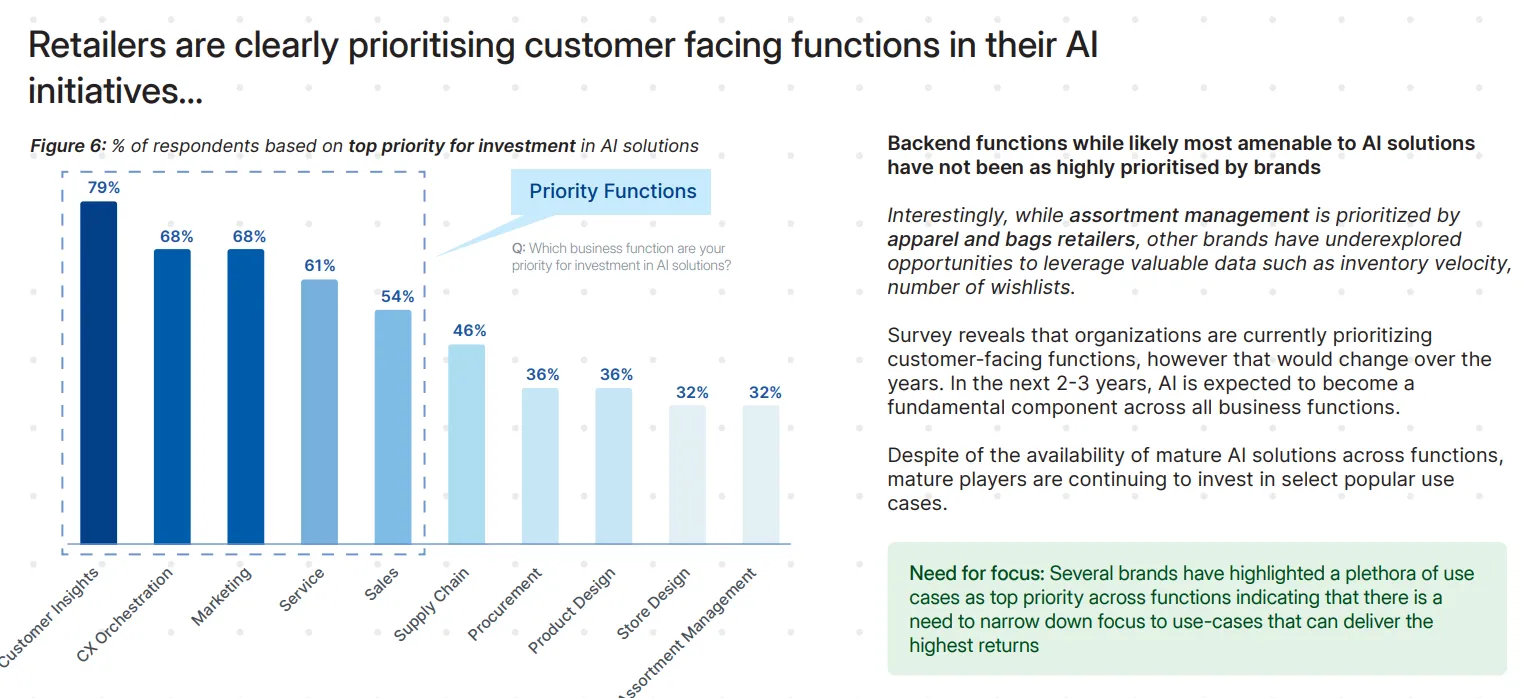
Here are a few stats to know:
- Adoption is expanding rapidly, but business maturity lags: The retail sector is undergoing its most significant transformation since e-commerce. The global retail market is projected to grow 23% annually, reaching $40.2 billion by 2030, as brands race to deliver faster, smarter, and more personalized shopping experiences. 30% of global digital commerce (~$17.5T) will be influenced by Agentic AI by 2030. Read More
- Retailers deploying AI-generated marketing content for micro-segments report 20–30% higher campaign conversion and greater customer retention. Yet, most retailers are still in experimentation mode, 46% describe themselves as “exploring or piloting” AI, with early wins limited to marketing and customer engagement functions. Read More
- Data, integration, and trust remain the make-or-break foundations: AI’s impact depends on the quality and accessibility of enterprise data. 40% of retail AI projects fail to meet planned ROI due to fragmented data ecosystems, disconnected POS, CRM, and inventory systems prevent unified insights. Fragmentation also limits scaling. Even brands with strong front-end AI often lack back-end readiness. Read More
According to Gartner,
- Retailers remain committed to spending on AI. On average, spending on AI and GenAI in 2026 is set to increase by 36% and 38%, respectively, while 48% of retail respondents will deploy agentic AI in 2026.
- By 2029, single, semiautonomous AI agents for discrete store inventory management tasks will be a prerequisite for staying in business.
- By 2029, 50% of leading retailers will address talent scarcity by leveraging academic ecosystem partnerships to develop AI capabilities and build future talent pipelines.
- By 2029, 25% of all consumer purchases made online will be initiated by AI shopping agents.
- By 2028, 10% of retailers will face greater brand damage from AI failures than cyberattacks, requiring urgent investment in responsible AI.
- By 2029, at least three of the top 10 global Tier 1 grocery retailers will implement smart cart technology at scale, requiring others to follow suit or risk falling behind.
Why the retail industry needs agentic AI right now
Retail operates at the intersection of rising customer expectations, tightening margins, and unprecedented operational complexity. The systems that powered the industry a decade ago, or even three years ago, simply cannot handle the pace and volume of decisions required today.
1. Customer journeys have become impossibly nonlinear
A single shopper might discover a product on Instagram, research it on your website, check reviews on a third-party marketplace, verify in-store availability via your app, visit the store to see it in person, chat with customer service about sizing, and finally purchase through a mobile checkout, all within 48 hours.
Each touchpoint generates decisions: What should we recommend next? Is this item actually available? Should we offer a promotion? How do we personalize the chat response? What's the optimal delivery window?
Traditional systems handle these decisions in isolation, creating friction and inconsistency. Agentic AI connects them into one intelligent flow, carrying context across every interaction.
2. Labor constraints are permanent, not cyclical
Retail turnover hovers near 60%, and 77% of store associates report that poor scheduling directly causes lost sales. Hiring more people isn't solving the problem, it's compounding costs. Retailers need technology that amplifies existing teams rather than replacing them.
Agentic AI provides this amplification. It handles the cognitive load of routine decisions, inventory checks, returns routing, promotional recommendations, so human teams can focus on judgment-based work that builds customer relationships.
3. Legacy systems are becoming competitive liabilities
Many retailers still run on fragmented technology stacks: outdated POS systems, rigid ERP platforms, disconnected e-commerce engines. These systems weren't designed for omnichannel coordination or real-time decisioning.
According to Gartner, only 39% of retailers have both a data strategy and the operating model to support it. The remaining 61% struggle to extract value from AI because their data infrastructure can't deliver the unified intelligence that agentic systems require.
Retailers can't afford to wait for full modernization. Agentic AI offers a bridge, working across existing systems to create intelligence and coordination that legacy infrastructure alone cannot provide.
4. The AI investment surge signals an inflection point
Retail CIOs are increasing AI funding by 36% and generative AI by 38% from 2025 to 2026, the highest increase across all technology categories. This isn't an experimental budget. It's a strategic investment in survival. Meanwhile, 48% of retailers plan to deploy AI agents within the next 12 months. The question is no longer "Should we adopt agentic AI?" but "How quickly can we scale it before competitors pull ahead?"
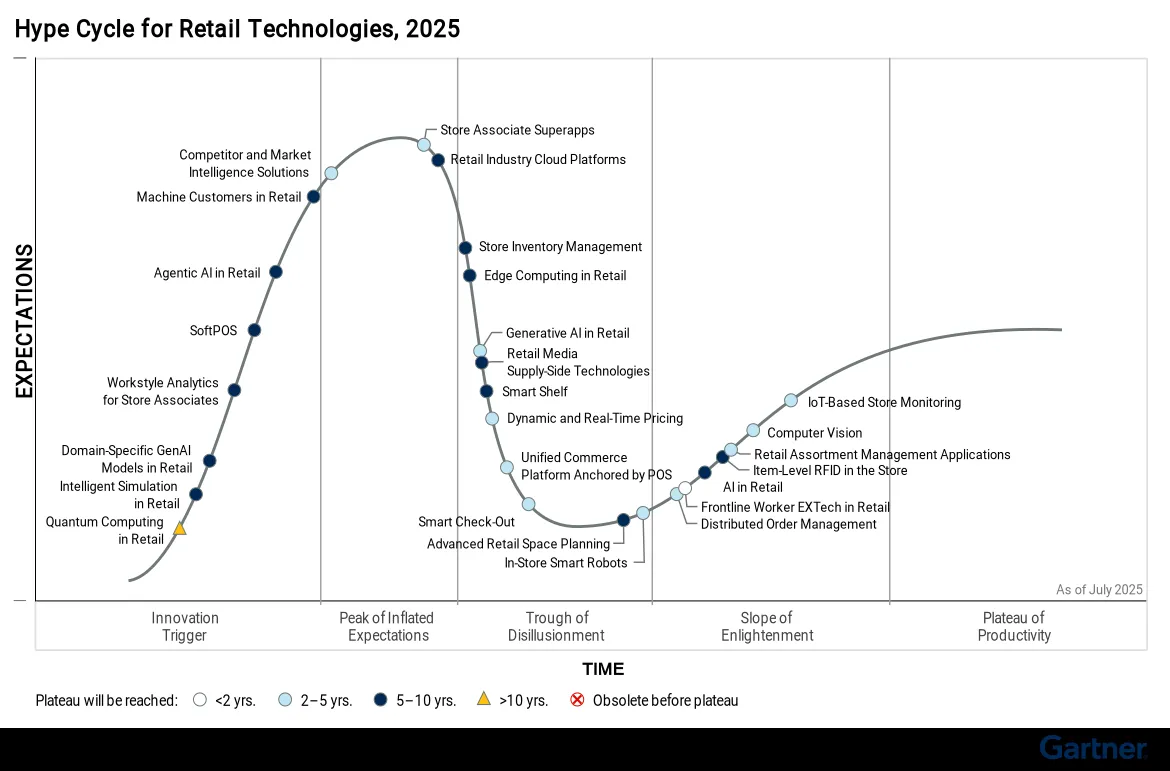
Agentic AI use-cases delivering measurable ROI in retail
The business case for agentic AI isn't hypothetical. Retailers across segments are deploying AI agents to solve specific, high-value problems, and the ROI is quantifiable. Here's a comprehensive overview of the use cases driving the most significant impact.
What makes these use-cases work:
The power of agentic AI isn't just in solving individual problems, it's in how these use cases connect and compound. When inventory management agents share context with dynamic pricing agents, which coordinate with delivery planning agents, the entire retail operation becomes more intelligent and responsive.
A shopper browsing your website triggers a cascade of intelligent decisions: the search agent surfaces relevant products based on real-time intent, the personalization agent adjusts recommendations based on browsing patterns, the inventory agent confirms availability and suggests alternatives if needed, the pricing agent optimizes the offer based on demand and stock levels, and if the customer purchases, the delivery planning agent immediately calculates the optimal route.
This orchestration, impossible with traditional systems, is what transforms retail from reactive to proactive, from fragmented to unified, and from struggling to thriving
Benefits of agentic AI in retail: Delivering compounding value
The use cases above demonstrate tactical wins, but the strategic value of agentic AI extends far beyond individual workflows. Here's why retailers who deploy agentic systems see compounding returns over time:
1. Hyperpersonalization that adapts instantly
Capgemini's research on agentic commerce shows that retailers delivering highly personalized discovery journeys achieve up to 3x higher engagement and improved conversion. Agentic AI doesn't just recommend products based on past behavior, it interprets intent in real time, correlates it with inventory signals, and adjusts recommendations as shoppers browse, compare, and evaluate.
2. Consistent, intelligent service across every channel
Service quality no longer varies by channel, time of day, or associate availability. Agentic AI handles routine questions, resolves issues autonomously, and escalates only when human judgment is required. This consistency strengthens loyalty, particularly critical when 85% of retail CIOs identify customer experience as their top priority.
3. Reduced Cognitive Load, Better decisions
Retail teams face constant decision pressure across pricing, content, promotions, and availability. Agentic AI reduces this load by evaluating signals, running scenarios, and selecting actions autonomously. This is essential as data volume explodes and only 39% of retailers have the infrastructure to support rapid decision-making at scale.
4. Operational efficiency without added complexity
Even though customer experience drives investment, operational efficiency determines whether retailers can scale intelligently. Agentic AI supports planning, allocation, and replenishment by autonomously identifying risks, resolving mismatches, and routing tasks to the right teams. Gartner reports that 48% of retailers plan to deploy AI agents within the next 12 months, signaling a clear shift toward autonomy across both customer-facing and operational functions.
5. Seamless connection between digital and physical retail
Today's shoppers don't differentiate between channels. They expect journeys to feel consistent whether browsing online, picking up in-store, or asking for help on chat. Agentic AI connects these touchpoints by carrying context, understanding preferences, and adapting experiences as customers move between environments. This unification strengthens every part of the journey, creating experiences that feel natural rather than fragmented.
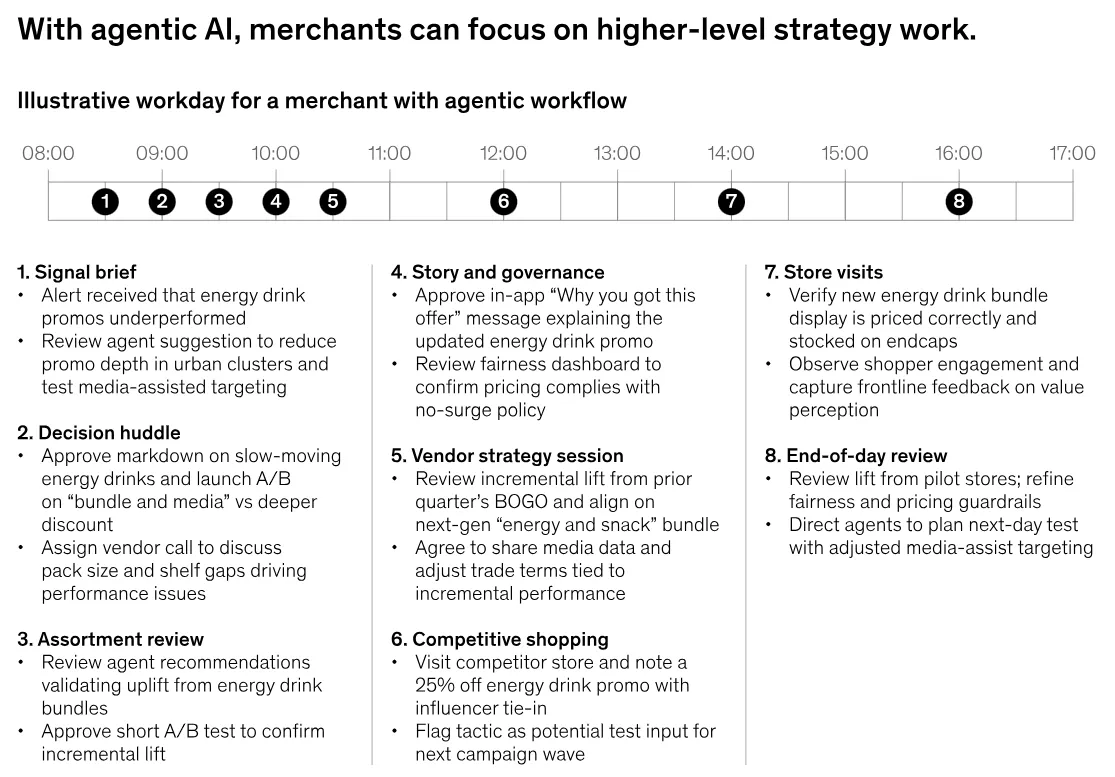
Real-world proof: How a leading e-commerce giant transformed with agentic AI
Theory is one thing. Results are another. Here's how one of the world's largest e-commerce platforms used Kore.ai's agentic AI to transform operations and customer experience simultaneously.
The challenge:
The retailer faced mounting pressure from customer service volume, inconsistent support quality across channels, and operational inefficiencies that slowed response times and frustrated both customers and agents.
The solution:
Kore.ai deployed a multi-agent AI system across customer service, order management, and back-office workflows. AI agents handled routine inquiries autonomously, orchestrated complex issue resolution across systems, and provided associates with real-time insights to accelerate case closure.
The results:
- Seamless omnichannel experience with consistent service quality across web, app, chat, and voice
- Faster issue resolution through autonomous handling of routine requests
- Improved agent productivity as AI handled cognitive load and surfaced relevant context
- Higher customer satisfaction driven by reduced wait times and more accurate responses
Learn more about this transformation →
This isn't a pilot. It's enterprise-scale deployment proving that agentic AI delivers measurable outcomes when implemented with the right platform and strategy.
The challenges: What stands between pilots and scale
Despite the compelling ROI, many retailers struggle to move from early experimentation to enterprise-wide deployment. Here are the obstacles slowing adoption, and how to overcome them.
1. Fragmented data & disconnected systems
For most retailers, the biggest barrier to agentic AI isn't the model, it's the data environment. Customer interactions, product details, inventory positions, and service history often live in separate systems that don't communicate in real time.
The Fix: Unified data strategies and integration platforms that connect commerce engines, warehouse management systems, CRM platforms, and service tools into one intelligent layer.
2. Immature AI governance & responsible AI frameworks
Agentic AI introduces new levels of autonomy, which require stronger oversight than traditional models. Retailers must define what actions agents can take, what decisions require approval, and how outcomes will be monitored.
The Fix: Start with clearly defined use cases, establish guardrails for agent behavior, and implement monitoring dashboards that provide visibility into decisions and outcomes.
3. Skills & organizational readiness
The shift from predictive models to reasoning agents requires new capabilities in AI orchestration, data engineering, prompt governance, and feedback loops. Many teams know the outcomes they want but lack the technical fluency to get there.
The Fix: Partner with platforms that offer both no-code and pro-code flexibility, enabling business teams to design workflows while technical teams extend functionality.
4. Legacy systems that limit transformation speed
Many retailers rely on legacy commerce engines, outdated POS platforms, and rigid back-office systems that can't support fluid decision-making. According to Gartner, funding for on-premise infrastructure is declining by 10% as retailers move toward cloud-first systems to support modern AI workloads.
The Fix: Deploy agentic AI as a layer that works across existing systems rather than waiting for full modernization. This approach delivers value immediately while creating a bridge to future-state architecture.
5. Difficulty scaling beyond pilots
Many retailers run early AI pilots that work well in controlled environments but fail when scaled across channels, geographies, or teams. Scaling requires clean data pipelines, clear governance, orchestration across systems, and cultural readiness. Gartner reports that 48 percent of retailers plan to deploy AI agents in the next 12 months, but many remain in pilot mode because they cannot align the data, processes and teams required for full-scale deployment (Source: Gartner 2026 CIO Agenda for Retail)
The Fix: Start with high-impact, low-complexity use cases (like document processing or search optimization), prove ROI, and expand methodically across adjacent workflow
Why Kore.ai's 'AI for Service' (Retail) is purpose-built for retail
Not all agentic AI platforms are created equal. Retail requires specific capabilities that generic AI tools simply can't deliver. Here's why leading retailers choose Kore.ai:
1. Multi-agent orchestration across retail workflows
AI agents coordinate across merchandising, supply chain, customer service, and store operations, passing context between tasks like forecasting, vendor approvals, and returns processing. This coordinated intelligence is what separates enterprise-grade systems from point solutions.
2. No-code / pro-code flexibility for retail teams
Operations teams can design, launch, and scale AI-powered processes, invoice handling, workforce scheduling, promotions planning, using a visual builder without writing code. Developers can extend with pro-code options to support complex enterprise needs.
3. 75+ prebuilt templates for various operations
Accelerate adoption with templates tailored for markdown optimization, inventory reconciliation, HR onboarding, and more. Each template is customizable to handle high-volume, time-sensitive workflows with speed and consistency.
4. Enterprise-ready integrations (250+ connectors)
Connect instantly with ERP, POS, WMS, HR, and CRM systems. Integration Studio maps data flows across merchandising, supply chain, and store systems, ensuring AI agents operate with full visibility into retail context.
5. Flexible model options with enterprise security
Run open-source or commercial LLMs securely in the cloud or on-premises. Use Prompt Studio to refine responses for tone, accuracy, and compliance across vendor communication, product content generation, and customer service documentation.
The platform adheres to SOC 2 and ISO 27001 standards, with role-based access, audit trails, and PII masking ensuring customer data, vendor contracts, and financial records remain protected.
6. Real-time analytics & process visibility
Monitor throughput, error rates, and automation coverage across departments. Pinpoint bottlenecks, track ROI, and continuously improve workflows with built-in observability.
Explore Kore.ai's AI for Retail solution →
The path forward: Your roadmap to Agentic AI adoption
Deploying agentic AI doesn't require a complete digital transformation overnight. The most successful retailers follow a phased approach that balances quick wins with long-term capability building.
Phase 1: Establish the foundation (Months 1-3)
Audit your data readiness: Identify where customer, product, and operational data lives. Assess integration gaps and data quality issues.
Define high-impact use cases: Start with workflows that generate measurable ROI quickly, document processing, search optimization, or customer service automation.
Set governance guardrails: Establish what actions agents can take autonomously and what requires human approval.
Choose the right platform: Select enterprise-grade infrastructure that supports multi-agent orchestration, not just isolated chatbots.
Phase 2: Pilot & prove value (Months 3-6)
Deploy 1-2 focused agents: Launch in controlled environments with clear success metrics (cost savings, accuracy improvement, time reduction).
Monitor performance rigorously: Track agent decisions, measure outcomes, and refine prompts and logic based on real-world behavior.
Demonstrate ROI to stakeholders: Use tangible results to build organizational confidence and secure budget for scale.
Phase 3: Scale across workflows (Months 6-12)
Expand to adjacent use cases: Once initial agents prove value, extend to complementary workflows (e.g., from inventory management to dynamic pricing).
Build cross-functional agent networks: Enable agents to collaborate across departments, sharing context and coordinating decisions.
Invest in team upskilling: Train operations, merchandising, and IT teams on AI orchestration, monitoring, and continuous improvement.
Phase 4: Achieve enterprise-wide autonomy (12+ Months)
Embed agentic AI into core operations: Make AI-driven decision-making the default for inventory, pricing, service, and logistics.
Optimize continuously: Use analytics to identify new automation opportunities and refine existing agents.
Lead the industry: Position your organization as an AI-native retailer that sets the standard for customer experience and operational excellence.
The competitive divide: AI-native retailers vs. everyone else
McKinsey's research on agentic commerce highlights an emerging divide: retailers who embed agentic intelligence into customer journeys see compounding gains, while those relying on isolated AI features struggle to scale improvements.
As consumer expectations continue to rise and operational complexity increases, the gap between leaders and laggards will widen. Retailers that deploy agentic AI today will be better positioned to create experiences that feel natural, relevant, and effortless. Those that wait will find themselves competing against standards they can no longer meet.
The window for competitive advantage is closing. The question isn't whether agentic AI will transform retail, it's whether your organization will lead that transformation or be disrupted by it.
Take the next step: Transform your retail operations with agentic AI
The retail industry has outgrown the systems that once supported it. Customer expectations, operational complexity, and competitive pressure demand a new foundation, one built on intelligence, autonomy, and real-time decisioning.
Agentic AI isn't an optional enhancement. It's the technology that makes modern retail possible.
Ready to explore how agentic AI can transform your operations?
Schedule a strategic consultation →
Get a custom walkthrough of how leading retail teams are reimagining operations with Kore.ai's AI for Retail platform, and discover how you can deliver the same results.
Explore Kore.ai's Retail solutions →
See how our platform helps retailers cut costs, streamline operations, and deliver smarter customer experiences across every touchpoint.
Read the full E-Commerce case study →
Learn how a global e-commerce leader transformed customer service and operations with Kore.ai's multi-agent AI system.
FAQ
Q1. What is agentic AI in retail?
Agentic AI refers to autonomous AI systems that can perceive context, reason through multi-step problems, make decisions, and take action across retail operations without constant human intervention. Unlike traditional AI that follows predefined rules, agentic AI adapts dynamically to changing conditions and orchestrates workflows across merchandising, supply chain, customer service, and operations.
Q2. How is agentic AI different from traditional retail automation?
Traditional retail automation executes tasks based on fixed rules and historical patterns. Agentic AI goes further by understanding intent, reasoning through complex scenarios, and making autonomous decisions in real time. It can coordinate multiple systems, adapt to changing conditions, and optimize outcomes across competing priorities, capabilities that rule-based systems cannot deliver.
Q3. What's the ROI of implementing agentic AI in retail?
ROI varies by use case, but proven results include: 20-30% reduction in inventory costs, up to 10% profit increase from dynamic pricing, 25% reduction in last-mile delivery costs, 15-25% reduction in return processing costs, up to 40% revenue increase from personalization, and 5-15% reduction in labor costs through optimized workforce management.
Q4. What are the main challenges in adopting agentic AI?
The biggest barriers include fragmented data across disconnected systems, immature AI governance frameworks, skills gaps in AI orchestration and engineering, legacy systems that limit real-time decisioning, and difficulty scaling beyond pilots. Success requires unified data strategies, clear governance guardrails, and platforms designed for enterprise-scale deployment.
Q5. How does Kore.ai's platform differ from other retail AI solutions?
Kore.ai's AI for Retail is purpose-built for retail with multi-agent orchestration across merchandising, supply chain, and operations. Unlike point solutions, it offers no-code/pro-code flexibility, 75+ prebuilt process templates, 250+ enterprise connectors (ERP, POS, WMS, CRM), and the ability to run models securely on-premises or in the cloud, all with SOC 2 and ISO 27001 compliance built in.
Q6. Is Kore.ai secure and compliant for retail use?
Yes. Kore.ai adheres to SOC 2 and ISO 27001 standards with role-based access controls, audit trails, PII masking, and encrypted data transmission. The platform supports GDPR, CCPA, and industry-specific regulations, and can be deployed on-premises or in private cloud environments for maximum control.
Q7. Do I need technical expertise to use Kore.ai?
No. Kore.ai's no-code visual drag and drop builder allows operations teams to design, launch, and scale AI-powered processes, from invoice handling to workforce scheduling, without writing code. For complex enterprise needs, developers can extend functionality with pro-code options. The platform also includes 75+ prebuilt templates for common retail workflows.
Share
Tags