





.webp)
The Kore.ai Agent Productivity Index 2026 surveyed 408 IT and business leaders to understand the real state of AI agent governance in production.
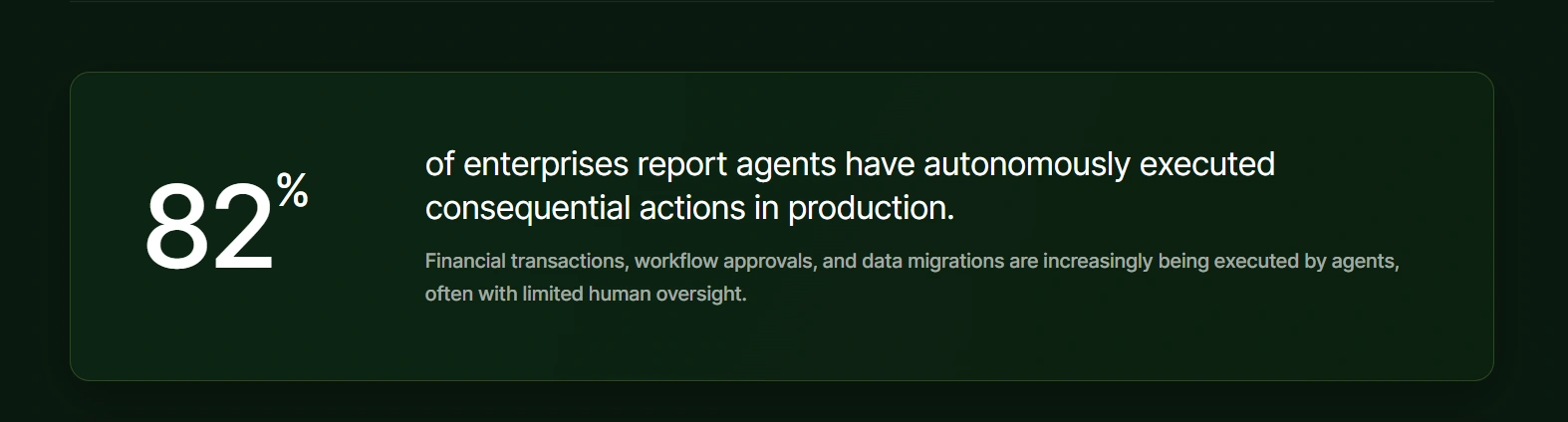
82% of enterprises report that their AI agents have autonomously executed consequential actions in production, including financial transactions, data migrations, and system updates.
This shows that AI agents are no longer confined to low-risk tasks. They are now operating in places where mistakes cost money and damage trust.
But as agents take on more authority, one question becomes unavoidable: how much do you actually trust your agents in production?
To answer it, Kore.ai conducted the Agent Productivity Index 2026 to map the real gap between AI adoption and governance. Based on a survey of 408 IT and business leaders, the report finds that while enterprises are moving agents into consequential workflows, the governance they have built is not holding up in live production environments.
Here are the four key findings from the research:
1. When agents fail, teams struggle to trace the source
When an AI agent fails in production, most organizations can detect that something has gone wrong. But detection is only the first layer of governance.
The harder problem is attribution.
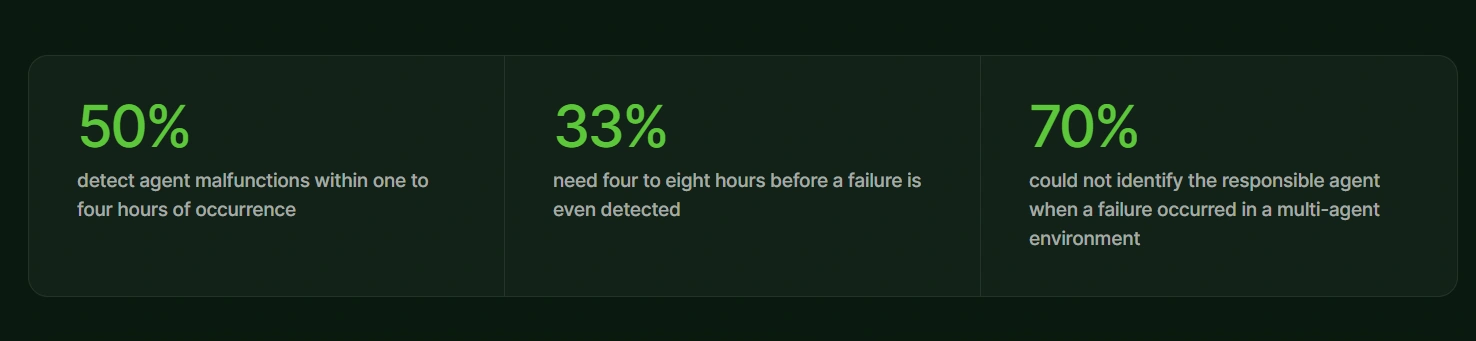
50% of organizations can detect agent malfunctions within one to four hours, while another 33% take four to eight hours. On the surface, that suggests enterprises have made progress in monitoring agent behaviour.
But the deeper issue is what happens after detection. 70% of respondents say they could not identify the responsible agent when a failure occurred in a multi-agent environment.
In other words, in seven out of ten organizations, teams knew something had gone wrong but could not trace the failure back to the specific agent that caused it.
What makes this problem worse is that 15% of organizations rely primarily on end users reporting problems. That means customers or employees are doing the work that the observability layer should be doing.
This visibility gap has a direct impact on business. Agent failures lead to revenue loss for 41.7% of respondents, SLA violations for 30.9%, and customer churn for 27.5%.
The takeaway: there’s a clear visibility gap in production. Enterprises need agent-level traceability. Without it, every hour organizations spend identifying the source, they risk hurting their bottom line.
2. Most autonomous agent actions end up being manually reversed
AI agents promise faster operations and less dependence on human intervention. While they are delivering on that promise, they are also creating a new category of operational cost.
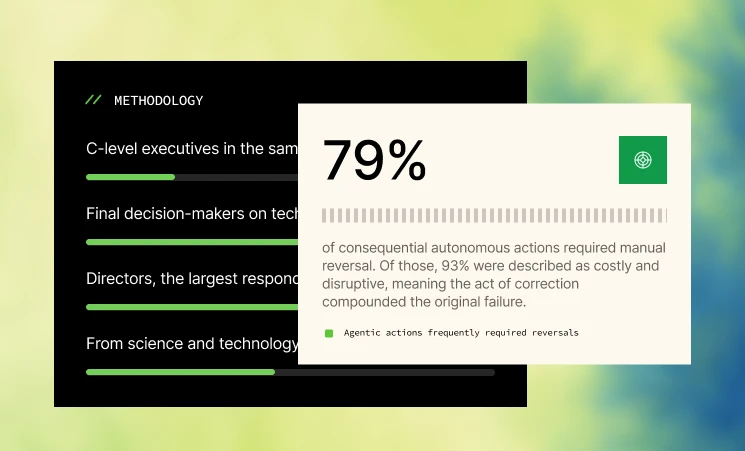
79% of the organizations report that their AI agents have autonomously executed consequential actions, such as financial transactions, data migrations, system updates, and approvals and denials.
That means enterprises are no longer using agents only for low-risk assistance. They are handing agents authority over data, decisions, workflows, and money.
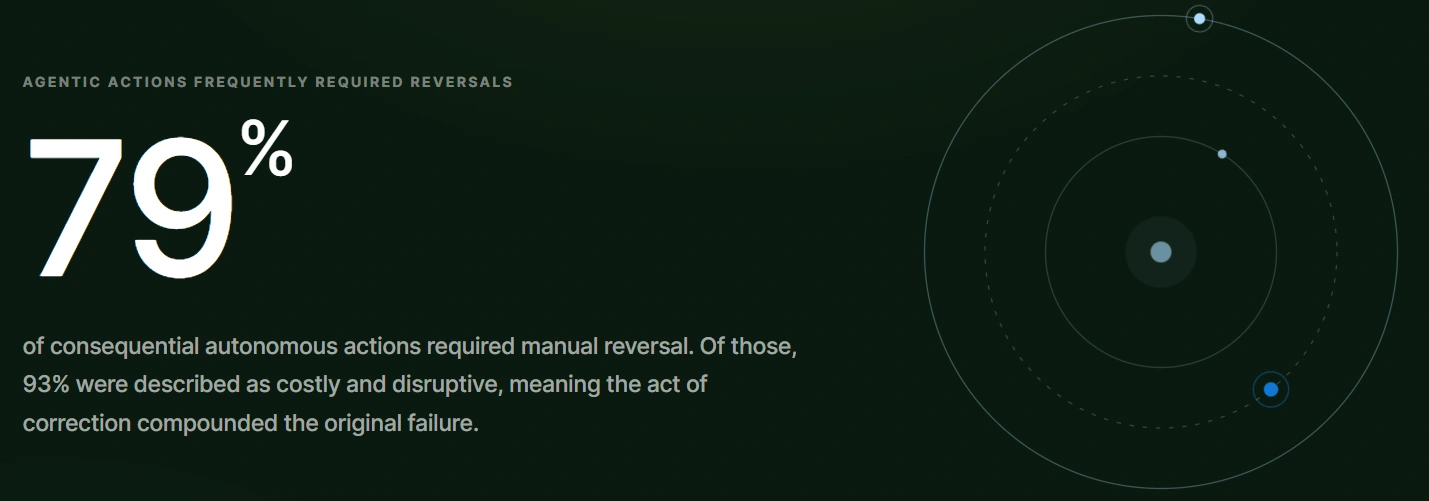
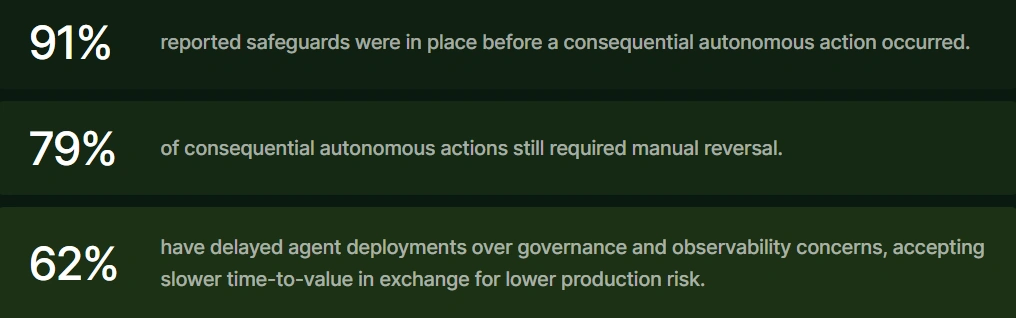
The problem is what happens next. 79.4% of those autonomous actions required manual reversal. Of those reversals, 93.2% were described as moderately or very costly and disruptive.
A manual reversal often requires teams to identify what happened, trace the affected systems, undo the action, validate downstream impact, communicate with stakeholders, and restore confidence in the workflow.
A single reversal may be manageable. But, at enterprise scale, when dozens or hundreds of agents operate across connected workflows, repeated reversals can quickly become a serious operational burden.
The takeaway: Having agents that can act is not the same as having agents that are accountable. If an agent can take a consequential action, the organization needs to know how that action will be approved, traced, contained, and reversed before it happens.
3. Guardrails exist, but they do not always hold in production
Purely looking at the governance infrastructure, most organizations seem well-prepared. 87% have a formal kill-switch or containment policy, and 88% say they can pause a live agent without breaking dependent systems.
And yet, 91.4% of organizations said safeguards were in place before the agent executed the autonomous action that later required costly reversal. In other words, agent guardrails were configured; the costly reversals happened anyway.
This is the difference between governance infrastructure and governance effectiveness. A policy is not the same as enforcement. A kill switch is not the same as containment. A checklist is not the same as production readiness.
Raj Koneru, CEO and Founder of Kore.ai, has observed:
“ 'We have guardrails’ is the most dangerous sentence in enterprise AI. What is needed is a foundation that addresses the illusion of governance and provides real control.”
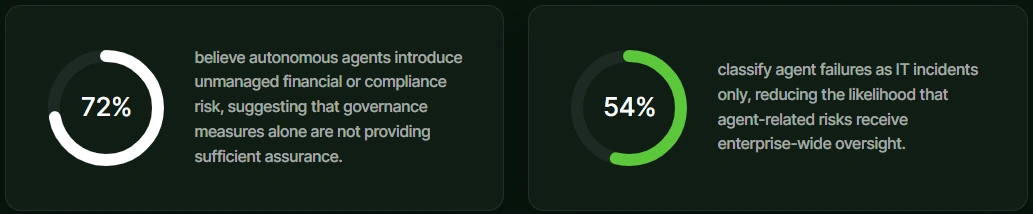
This is also reflected in how leaders assess their own risk exposure. Despite governance investments, 72% believe autonomous agents currently introduce unmanaged financial or compliance risk.
This shows that enterprises are not blind to the problem. Leaders are investing in governance frameworks. Yet those frameworks are not producing enough confidence once agents are operating in live environments.
The takeaway: Governance cannot be measured by whether controls exist. It has to be measured by whether controls hold when agents are acting in production.
4. Most enterprises treat agent failures as an IT problem only
How an enterprise classifies an agent failure shapes who responds to it and how quickly. Still, most organizations are looking at these failures through a narrow lens.
54% organizations currently classify AI agent failures as IT incidents. Only 25% classify them as operational risk events.
However, when an AI agent triggers a financial transaction that has to be reversed, it is not an IT incident. It’s an operational risk.
Only 14% of organizations have a dedicated AI operations or AI governance team to intervene when an agent behaves incorrectly. Another 13.5% escalate to a Chief AI Officer or equivalent executive. In most cases, responsibility still falls to IT or engineering teams.
What makes this particularly revealing is that leaders already sense the gap. 62% of leaders admit they have delayed agent deployments over governance and observability concerns. They're cautious enough about governance to slow down deployment, but when a failure actually occurs, many still treat them as technical incidents rather than enterprise risk events.
The takeaway: As long as agent failures are misclassified, the organizational response will remain calibrated to the wrong type of problem. If agent failures affect revenue, compliance, contracts, or customer trust, they need to be visible to the people accountable for those outcomes.
What genuine AI agent governance requires
All four findings point to the same conclusion: Retrofitting governance onto already built agents always breaks in production.
The challenge is not a failure of intent. The data shows that organizations are investing in governance frameworks. They have kill switches, containment policies, and executive review processes.
The challenge is architectural. If an agent can approve a request, update a system, trigger a workflow, or affect a customer outcome, governance has to be part of how that agent is designed, validated, deployed, and managed. It cannot be bolted on after the fact.
As Raj Koneru, CEO and Founder of Kore.ai, puts it:
"Enterprise AI has shifted from showing that AI works to proving it can be trusted. Governance has to be built into the agent itself, not added once it is running."
This is the premise around which Kore.ai Agent Platform, Artemis, is built.
Artemis is designed to move governance from an external oversight layer into the agent lifecycle itself. Rather than relying on governance that is applied after an agent is built or monitored only after it acts, Artemis brings governance into how agents are designed, validated, deployed, traced, and managed in production.
What’s inside the full report?
The four findings above are the central thread of the research. The full Kore.ai Agent Productivity Index 2026 goes deeper into:
- How organizations are managing agent costs and performance optimization
- The full infrastructure picture: agent registries, certification practices, and what production-ready governance actually requires
- How detection speed, recovery time, and intervention vary across organization
- Benchmarks to compare your governance model against 408 enterprise peers
Download the full report to see where your organization stands and what closing the governance gap looks like in practice.