



Agentic AI Apps
AI Solutions
Pre-built Applications

Ready-to-deploy applications across industries and functions.

AI for Banking
AI for Healthcare
AI for Retail
AI for IT
AI for HR
AI for Recruiting
Application Accelerators

Leverage pre-built AI agents, templates, and integrations from the Kore.ai Marketplace.

Kore.ai Marketplace
Pre-built agents
Templates
Integrations
Tailored Applications

Design and build applications on our Agent Platform using our enteprise modules.

Platform
Agent Platform

Your strategic enabler for enterprise AI transformation.

Learn more
Enterprise Modules
AI for Work
AI for Service
AI for Process
Top Resources
From search to action: what makes agentic AI work in practice
AI use cases: insights from AI's leading decision makers
Beyond AI islands: how to fully build an enterwise-wide AI workforce
QUICK LINKS
About Kore.aiCustomer StoriesPartnersResourcesBlogWhitepapersDocumentationAnalyst RecognitionGet supportCommunityAcademyCareersContact Us
Agent Platform
Agent Platform
Agent Platform

Your strategic enabler for enterprise AI transformation.

learn more
PLATFORM MODULES
Multi-Agent Orchestration
AI Engineering Tools
Search + Data AI
Observability
No-Code + Pro-Code Tools
AI Security + Governance
Agent Management Platform
Integrations
Enterprise Modules
For Service
AI AgentsAgent AI AssistanceAgentic Contact CenterQuality AssuranceProactive Outreach
For Work
Modules
Enterprise SearchIntelligent OrchestratorPre-Built AI AgentsAdmin ControlsAI Agent Builder
Departments
SalesMarketingEngineeringLegalFinance
For Process
Process AutomationAI Analytics + MonitoringPre-built Process Templates
upcoming event
Recent AI Insights
What's new in AI for Work: features that drive enterprise productivity
AI INSIGHT
20 Feb 2026
Parallel Agent Processing
AI INSIGHT
16 Jan 2026
The AI productivity paradox: why employees are moving faster than enterprises
AI INSIGHT
12 Jan 2026
Agent Marketplace
More
More
Resources
Resource Hub
Blog
Whitepapers
Webinars
AI Research Reports
AI Glossary
Videos
AI Pulse
Generative AI 101
Responsive AI Framework
CXO Toolkit
Private equity
support
Documentation
Get support
Submit RFP
Academy
Community
COMPANY
About us
Leadership
Customer Stories
Partners
Analyst Recognition
Newsroom
Events
Careers
Contact us
Agentic AI Guides
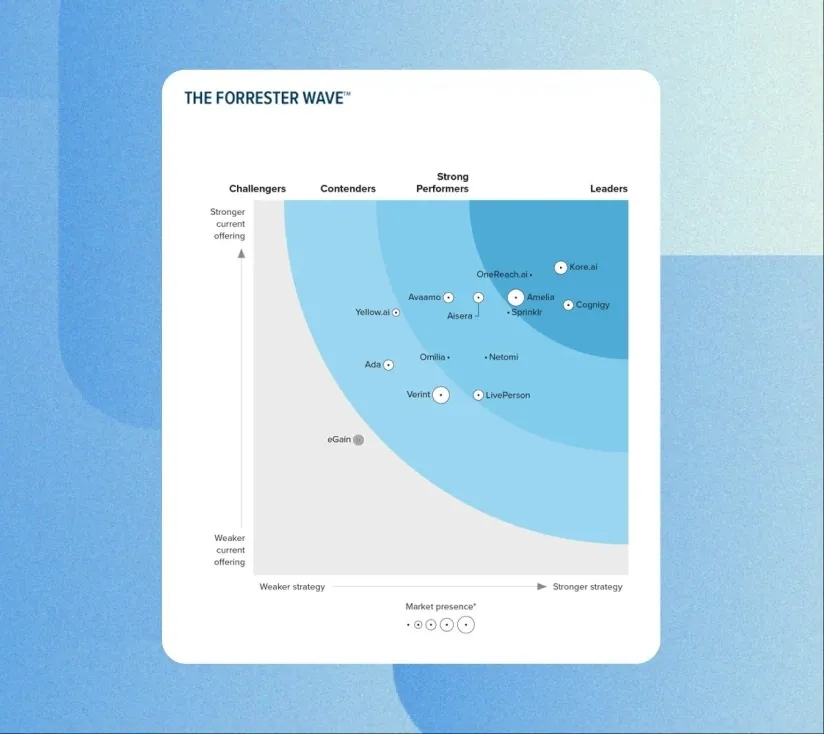
forrester cx wave 2024 Kore at top
Kore.ai named a leader in The Forrester Wave™: Conversational AI for Customer Service, Q2 2024
Generative AI 101
CXO AI toolkit for enterprise AI success
upcoming event

HumanX is one of the leading global conferences focused on artificial intelligence (AI) — designed for senior leaders, technologists, investors, and decision-makers shaping enterprise deployment of AI technologies.

San Francisco
6 Apr
register
Talk to an expert
Not sure which product is right for you or have questions? Schedule a call with our experts.
Request a Demo
Double click on what's possible with Kore.ai
Sign in
Get in touch
Background Image 1
Blog
Conversational AI
Time-Aware Adaptive RAG (TA-ARE)

Time-Aware Adaptive RAG (TA-ARE)

Published Date:
May 7, 2025
Last Updated ON:
September 8, 2025

Understanding time-aware adaptive retrieval (TA-ARE)

Introduction

With the advent of Large Language Models (LLMs) there was the concept of emergent capabilities. The premise or assumption was that LLMs have hidden and unknown capabilities which are just waiting to be discovered. And entrepreneurs were eager to discover some competitive advantage in LLMs no-one knew about.
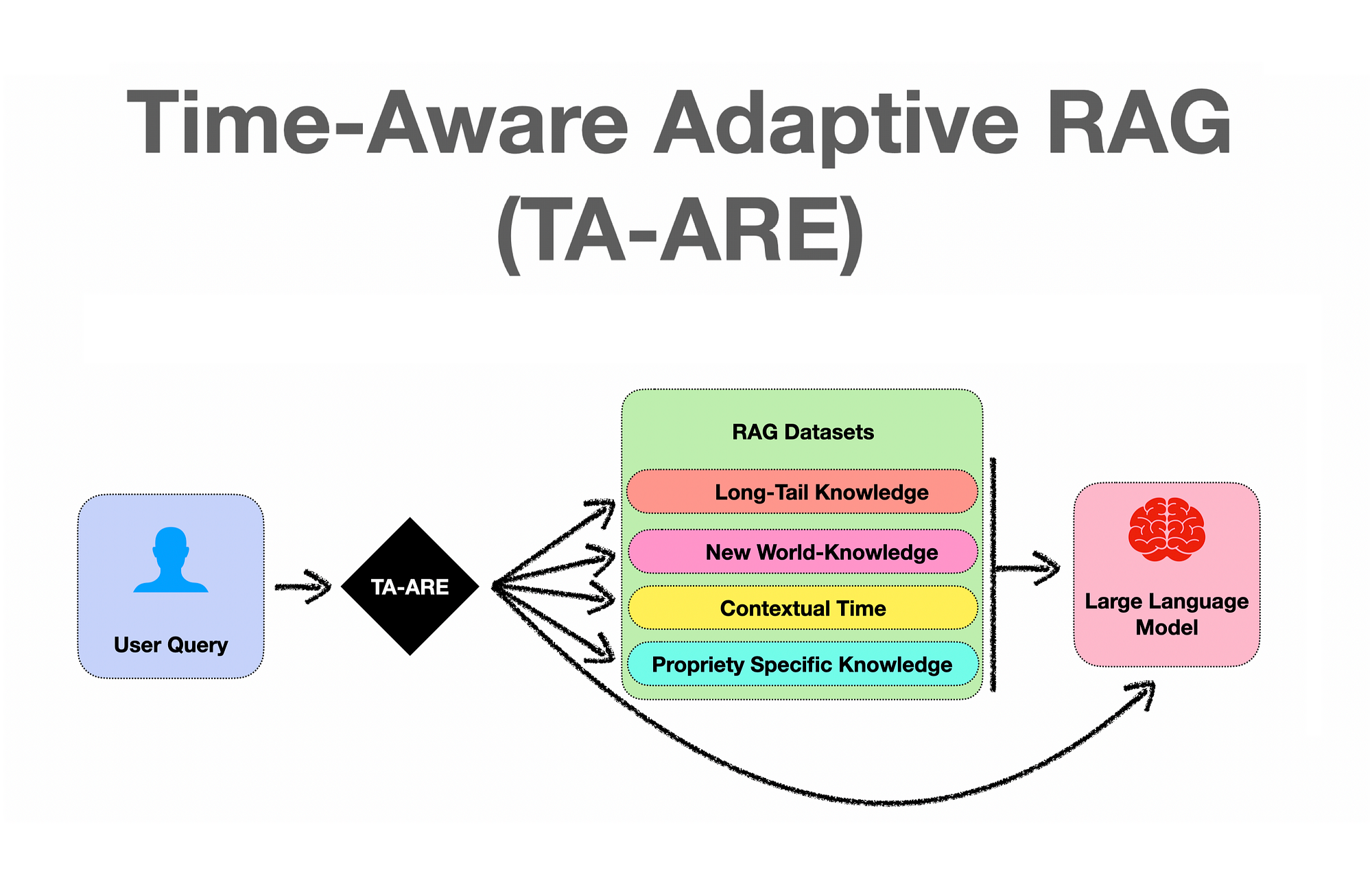

Emergent capabilities turned out to be a mirage. But the special ability of LLMs which was discovered was In-Context Learning (ICL). LLMs have the ability, when supplied with contextual data at inference, to reference the contextual data in generating their response. Hence, on instruction via the prompt, the LLM will discard model training data, and utilise the inference-data.Time-Aware Adaptive REtrieval (TA-ARE) is a simple yet effective method that helps LLMs assess the necessity of retrieval without calibration or additional training.

Retrieval augmented generation (RAG)

Delivering contextual data to LLMs at inference became known as RAG. The notion that LLM response generation is supplemented or augmented with supplementary data retrieved at inference.

Standard RAG always retrieves regardless of the input question, while adaptive retrieval only retrieves when necessary.

Time-aware adaptive RAG (TA-ARE)

Study findings

The study mentions that RAG generally improves the performance of question answering. This has been confirmed over and over again and is now seen as a given.

  • Time awareness, the study identified that many queries are time related and users ask questions while specifying the time-frame as a function to defined their question.
  • The effectiveness of vanilla prompting varies and does not scale with model sizes. Considering the image below, in order for prompts to scale well, complexity needs to be introduced; from step 1 up to step 8.
  • Even though LLMs can be described as Knowledge Intensive, LLMs do struggle with knowledge intensive user tasks; for two reasons.
  1. LLMs generally lack and hold no knowledge of what can be termed new world knowledge.
  2. Long-Tail Knowledge is harder to address; this problem is akin to the long tail of intent distribution.

TA-ARE

Standard RAG methods conduct retrieval indiscriminately, and do not perform triage on input queries. This blanket approach can lead to suboptimal task performance.
Inference cost can also be exacerbated by this.
The concept of adaptive RAG dynamically determines retrieval necessity and relies only on LLMs’ parametric knowledge when deemed unnecessary.
ARAG approaches can be categorised into calibration-based and model-basedjudgement. The problem is that tuning is required for thresholds for different datasets and models to balance task performance and inference overheads.
TA-ARE investigates to what extent LLMs can perform calibration-free adaptive retrieval via prompting.
To answer this question, evaluations is required whether LLMs retrieve only when necessary.
This requests a benchmark that distinguishes between questions that can be answered using LLMs’ parametric knowledge and those that require external information through retrieval.

Study contribution

A new dataset RetrievalQA is created to assess Adaptive RAG (ARAG) for short-form open-domain QA.
Benchmarking existing methods finding that vanilla prompting is insufficient in guiding LLMs to make reliable retrieval decisions.
TA-ARE is conceptualised, a simple and effective method to help LLMs assess the necessity of retrieval without calibration or additional training.

Conclusion

Something which is evident is that complexity needs to be introduced in order for frameworks to scale.
Adaptive RAG where user input is triaged prior to assigning a process requires the calibration of a threshold of sorts.
The promise of Time-Aware Adaptive REtrieval (TA-ARE) is that it is a simple yet effective method that helps LLMs assess the necessity of retrieval without calibration or additional training.
The study states that the code will be available soon at https://github.com/hyintell/RetrievalQA.

I’m very much intrigued as to how TA-ARE is achieving the description in the study.

The study can be found here.
Share
Link copied
authors
Cobus Greyling
Cobus Greyling
Chief Evangelist
Forrester logo at display.
Kore.ai named a leader in the Forrester Wave™ Cognitive Search Platforms, Q4 2025
Access Report
Gartner logo in display.
Kore.ai named a leader in the Gartner® Magic Quadrant™ for Conversational AI Platforms, 2025
Access Report
Stay in touch with the pace of the AI industry with the latest resources from Kore.ai

Get updates when new insights, blogs, and other resources are published, directly in your inbox.

Subscribe
Thank you! Your submission has been received!
Oops! Something went wrong while submitting the form.

Recent Blogs

View all
Top 8 AI agents for customer service | Tested & reviewed (2026)
March 17, 2026
Top 8 AI agents for customer service | Tested & reviewed (2026)
AI agents in retail: 12 proven use cases & examples (2026)
March 5, 2026
AI agents in retail: 12 proven use cases & examples (2026)
The end of manual AP: Zero-Touch invoice processing with AI for Process
February 20, 2026
The end of manual AP: Zero-Touch invoice processing with AI for Process
Accelerate time-to-value from AI

Find out how Kore.ai can help

Talk to an expert
Start using an AI agent today

Browse and deploy our pre-built templates

Marketplace
Background Image 4
Background Image 9
You are now leaving Kore.ai’s website.

‍

Kore.ai does not endorse, has not verified, and is not responsible for, any content, views, products, services, or policies of any third-party websites, or for any verification or updates of such websites. Third-party websites may also include "forward-looking statements" which are inherently subject to risks and uncertainties, some of which cannot be predicted or quantified. Actual results could differ materially from those indicated in such forward-looking statements.


Click ‘Continue’ to acknowledge the above and leave Kore.ai’s website. If you don’t want to leave Kore.ai’s website, simply click ‘Back’.

CONTINUEGO BACK
Agentic AI applications for the enterprise
English
Spanish
Spanish
Spanish
Spanish
Pre-Built Applications
BankingHealthcareRetailRecruitingHRIT
Kore.ai agent platform
Platform OverviewMulti-Agent OrchestrationAI Engineering ToolsSearch and Data AIAI Security and GovernanceNo-Code and Pro-Code ToolsIntegrations
 
AI for WorkAI for ServiceAI for ProcessAgent Marketplace
company
About Kore.aiLeadershipCustomer StoriesPartnersAnalyst RecognitionNewsroom
resources
DocumentationBlogWhitepapersWebinarsAI Research ReportsAI GlossaryVideosGenerative AI 101Responsive AI frameworkCXO Toolkit
GET INVOLVED
EventsSupportAcademyCommunityCareers

Let’s work together

Get answers and a customized quote for your projects

Submit RFP
Follow us on
© 2026 Kore.ai Inc. All trademarks are property of their respective owners.
Privacy PolicyTerms of ServiceAcceptable Use PolicyCookie PolicyIntellectual Property Rights
|
×