AI Solutions
AI Solutions
AI for Work

Search across silos. Automate workflows. Orchestrate AI agents. Govern with confidence.

learn more
features
Enterprise SearchIntelligent OrchestratorPre-Built AI AgentsAdmin ControlsAI Agent Builder
Departments
SalesMarketingEngineeringLegalFinance
PRE-BUILT accelerators
HRITRecruiting
AI for Service

Leverage Agentic capabilities to empower customers and create personalized experiences.

learn more
features
AI agentsAgent AI AssistanceAgentic Contact CenterQuality AssuranceProactive Outreach
PRE-BUILT accelerators
RetailBankingHealthcare
AI for Process

Streamline knowledge-intensive business processes with autonomous AI agents.

learn more
features
Process AutomationAI Analytics + MonitoringPre-built Process Templates
Use Cases
Zero-Touch IT Operations Management
Top Resources
Scaling AI: practical insights
from AI leaders
AI use cases: insights from AI's leading decision makers
Beyond AI islands: how to fully build an enterwise-wide AI workforce
QUICK LINKS
About Kore.aiCustomer StoriesPartnersResourcesBlogWhitepapersDocumentationAnalyst RecognitionGet supportCommunityAcademyCareersContact Us
Agent Platform
Agent Platform
Agent Platform

Your strategic enabler for enterprise AI transformation.

learn more
FEATURES
Multi-Agent Orchestration
AI Engineering Tools
Search + Data AI
AI Security + Governance
No-Code + Pro-Code Tools
Integrations
GET STARTED
AI for WorkAI for ServiceAI for ProcessAgent Marketplace
LEARN + DISCOVER
About Kore.aiCustomer StoriesPartnersResource HubBlogWhitepapersAI Research ReportsNewsroomAnalyst RecognitionDocumentationGet supportAcademy
GET INVOLVED
AI PulseEventsCommunityCareersContact Us
upcoming event

CCW Berlin brings together international experts, visionary speakers, and leading companies to explore the future of customer experience, AI, and digital transformation in a dynamic blend of congress and exhibition

Berlin
4 Feb
register
Recent AI Insights
The AI productivity paradox: why employees are moving faster than enterprises
AI INSIGHT
12 Jan 2026
The Decline of AI Agents and Rise of Agentic Workflows
AI INSIGHT
01 Dec 2025
AI agents and tools: Empowering intelligent systems for real world impact
AI INSIGHT
12 Nov 2025
Agent Marketplace
More
More
Resources
Resource Hub
Blog
Whitepapers
Webinars
AI Research Reports
AI Glossary
Videos
AI Pulse
Generative AI 101
Responsive AI Framework
CXO Toolkit
support
Documentation
Get support
Submit RFP
Academy
Community
COMPANY
About us
Leadership
Customer Stories
Partners
Analyst Recognition
Newsroom
Events
Careers
Contact us
Agentic AI Guides
forrester cx wave 2024 Kore at top
Kore.ai named a leader in The Forrester Wave™: Conversational AI for Customer Service, Q2 2024
Generative AI 101
CXO AI toolkit for enterprise AI success
upcoming event

CCW Berlin brings together international experts, visionary speakers, and leading companies to explore the future of customer experience, AI, and digital transformation in a dynamic blend of congress and exhibition

Berlin
4 Feb
register
Talk to an expert
Not sure which product is right for you or have questions? Schedule a call with our experts.
Request a Demo
Double click on what's possible with Kore.ai
Sign in
Get in touch
Background Image 1
Blog
Conversational AI
Teaching LLMs To Say, “I don’t know”

Teaching LLMs To Say, “I don’t know”

Published Date:
June 14, 2024
Last Updated ON:
August 19, 2025

Instead of stating that it does not know, LLMs hallucinate. Hallucination can best be described as highly plausible, succinct & reasonable responses from a LLM, but which is factually incorrect.

Introduction

A few years back IBM Watson Assistant introduced functionality to define and detect user requests which falls outside of the chatbot’s domain. I believe this was one of the first forays into the realm of defining what the ambit of the chatbot was.

Chatbots in the early days were plagued by the problem of getting stuck on “Sorry, I can’t help you with that”. And subsequently encouraging the user to rephrase their input without any attempt from the chatbot to facilitate the progression of the conversation.

Fast Forward To LLMs

With Large Language Models (LLMs) we are on the other side of the spectrum, where the Conversational UI always responds with an answer and rarely says, I don’t know.

Compared to traditional chatbot architecture and performance, LLMs mesmerise us with their outstanding ability of fluency, coherence and ability to maintain context. But, LLMs are still likely to hallucinate unfaithful and nonfactual responses.

The image below lends some guidance on how LLMs can be guided via prompt engineering to yield better responses. Some prompting techniques require the introduction of complexity and structure to be implemented.

Image adapted from Source

Model Cutoff Date

LLMs have a definite time-stamp and cut-off date for their models based on the data it was trained on. It has been proven that LLMs perform better when a query is related to data the LLM have seen during training. As apposed to data the model is seeing for the first time.

Consider the response below from ChatGPT where a question is asked about the weather which is highly contextual demanding recent information.

ChatGPT

When models are trained to create the base model, a large volume of data (parametric knowledge) is embedded in the LLM.

Fine-tuning, involves knowledge which most probably does not form part of the parametric knowledge. Fine-tuned knowledge will most probably include company and industry specific information and are often supplemented with RAG, In-Context Learning (ICL).

Pre-training embeds a large volume of parametric knowledge, while fine-tuning may involve knowledge that is not necessarily in the parametric knowledge. Hence the study focusses on exploring the benefits of differentiating instruction tuning data based on parametric knowledge.
Back To The Study

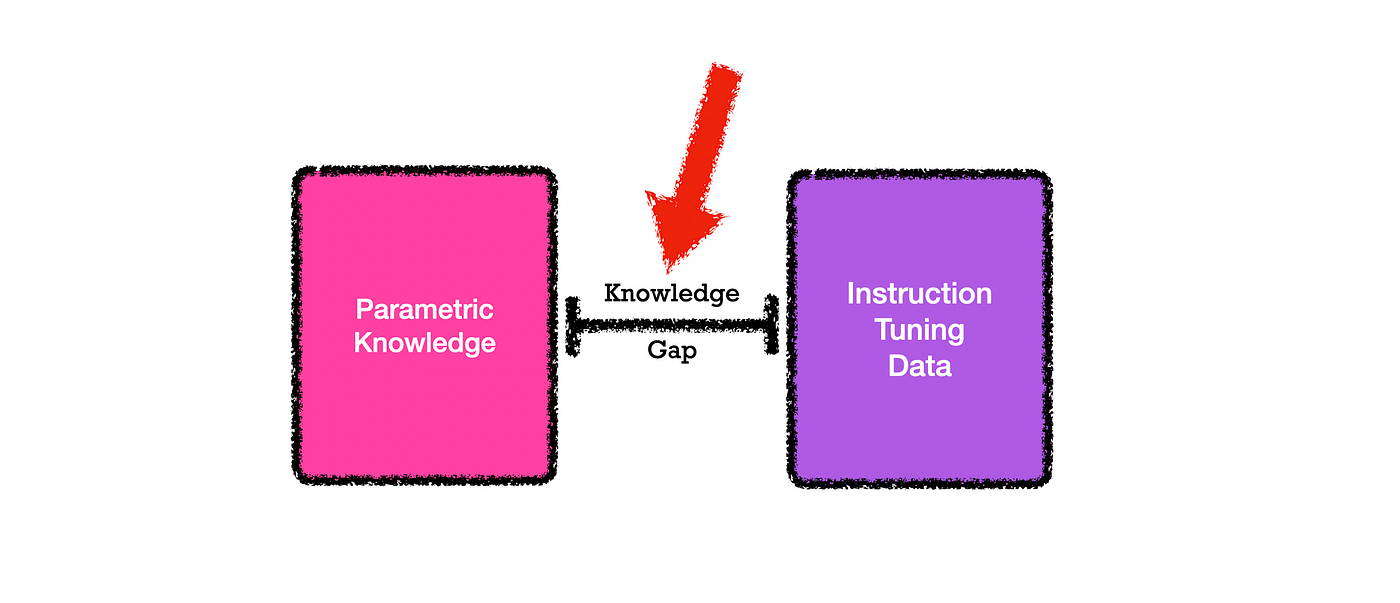
Considering the image below, the study looks at the gap between knowledge the model has and knowledge the model is not trained on.

Identifying and measuring the gap between existing knowledge and data submitted at inference can help the model to avoid hallucination and respond appropriately.
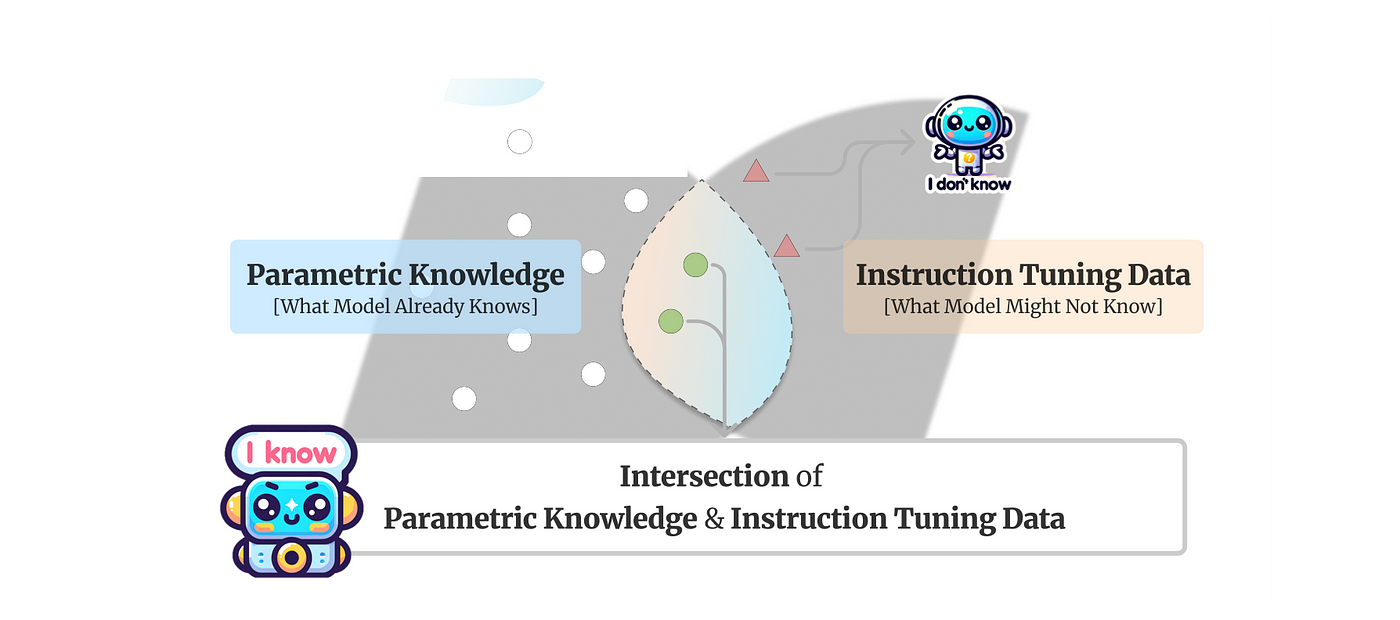
Training a model exclusively on correct answers inadvertently teaches the LLM to guess an answer rather than admit its ignorance.

The study states that if a model is not trained to articulate “I don’t know” as a response, it remains unequipped to do so when confronted with unknowns.

Models trained on the intersection of parametric knowledge and the instruction tuning data, leading to a model refusing to answer unknown questions.


The study introduces Refusal-Aware Instruction Tuning (R-Tuning).

R-Tuning aims to train the model with refusal-aware answering ability by recognising when they should claim knowledge, or plainly state the knowledge is not available.

R-Tuning has two steps:

  1. Measure the knowledge gap between parametric knowledge and the instruction tuning data, and identify uncertain questions.
  2. Construct the refusal-aware data by padding the uncertainty expression after the label words, and then fine-tune the model on the refusal-aware data.

Mitigating Hallucination

The study attributes hallucination to the significant gap between the knowledge of human-labeled instruction tuning datasets and the parametric knowledge of LLMs.

Even-though is approach might not be implemented in the detail described in the study, the way model hallucination is described and the basic principles defined are immensely useful.

Considering hallucination, current and popular approaches are:1. Retrieval-Based Methods2. Verification-Based Methods3. In-Context Learning

Conclusion

This paper introduces a method called R-Tuning, aiming to enhance large language models in rejecting unfamiliar questions.

R-Tuning identifies discrepancies between instruction tuning data and the model’s knowledge, dividing the training data into certain and uncertain parts.

It then appends uncertainty expressions to create refusal-aware data.

Empirical results demonstrate R-Tuning’s superior performance over traditional instruction tuning in terms of AP score, striking a balance between precision and recall.

R-Tuning not only exhibits refusal proficiency on known data but also showcases generalisability to unfamiliar tasks, emphasizing refusal as a fundamental skill abstracted through multi-task learning, referred to as a meta-skill.

Further examination of perplexity and uncertainty in training datasets provides insight into the proposed method’s rationale.

Link to research paper.

This article was previously published on Medium.

Share
Link copied
authors
Cobus Greyling
Cobus Greyling
Chief Evangelist
Forrester logo at display.
Kore.ai named a leader in the Forrester Wave™ Cognitive Search Platforms, Q4 2025
Access Report
Gartner logo in display.
Kore.ai named a leader in the Gartner® Magic Quadrant™ for Conversational AI Platforms, 2025
Access Report
Stay in touch with the pace of the AI industry with the latest resources from Kore.ai

Get updates when new insights, blogs, and other resources are published, directly in your inbox.

Subscribe
Thank you! Your submission has been received!
Oops! Something went wrong while submitting the form.

Recent Blogs

View all
Agentic AI in Retail: Transforming Customer Experience & Operations 
January 23, 2026
Agentic AI in Retail: Transforming Customer Experience & Operations 
Top Glean Alternatives (2026 Guide)
January 23, 2026
Top Glean Alternatives (2026 Guide)
AI Agents in 2026: From Hype to Enterprise Reality
January 16, 2026
AI Agents in 2026: From Hype to Enterprise Reality
Start using an AI agent today

Browse and deploy our pre-built templates

Marketplace
Reimagine your business

Find out how Kore.ai can help you today.

Talk to an expert
Background Image 4
Background Image 9
You are now leaving Kore.ai’s website.

‍

Kore.ai does not endorse, has not verified, and is not responsible for, any content, views, products, services, or policies of any third-party websites, or for any verification or updates of such websites. Third-party websites may also include "forward-looking statements" which are inherently subject to risks and uncertainties, some of which cannot be predicted or quantified. Actual results could differ materially from those indicated in such forward-looking statements.


Click ‘Continue’ to acknowledge the above and leave Kore.ai’s website. If you don’t want to leave Kore.ai’s website, simply click ‘Back’.

CONTINUEGO BACK
Reimagine your enterprise with Kore.ai
English
Spanish
Spanish
Spanish
Spanish
Get Started
AI for WorkAI for ServiceAI for ProcessAgent Marketplace
Kore.ai agent platform
Platform OverviewMulti-Agent OrchestrationAI Engineering ToolsSearch and Data AIAI Security and GovernanceNo-Code and Pro-Code ToolsIntegrations
ACCELERATORS
BankingHealthcareRetailRecruitingHRIT
company
About Kore.aiLeadershipCustomer StoriesPartnersAnalyst RecognitionNewsroom
resources
DocumentationBlogWhitepapersWebinarsAI Research ReportsAI GlossaryVideosGenerative AI 101Responsive AI frameworkCXO Toolkit
GET INVOLVED
EventsSupportAcademyCommunityCareers

Let’s work together

Get answers and a customized quote for your projects

Submit RFP
Follow us on
© 2026 Kore.ai Inc. All trademarks are property of their respective owners.
Privacy PolicyTerms of ServiceAcceptable Use PolicyCookie PolicyIntellectual Property Rights
|
×