AI Solutions
AI Solutions
AI for Work

Search across silos. Automate workflows. Orchestrate AI agents. Govern with confidence.

learn more
features
Enterprise SearchIntelligent OrchestratorPre-Built AI AgentsAdmin ControlsAI Agent Builder
Departments
SalesMarketingEngineeringLegalFinance
PRE-BUILT accelerators
HRITRecruiting
AI for Service

Leverage Agentic capabilities to empower customers and create personalized experiences.

learn more
features
AI agentsAgent AI AssistanceAgentic Contact CenterQuality AssuranceProactive Outreach
PRE-BUILT accelerators
RetailBankingHealthcare
AI for Process

Streamline knowledge-intensive business processes with autonomous AI agents.

learn more
features
Process AutomationAI Analytics + MonitoringPre-built Process Templates
Use Cases
Zero-Touch IT Operations Management
Top Resources
Scaling AI: practical insights
from AI leaders
AI use cases: insights from AI's leading decision makers
Beyond AI islands: how to fully build an enterwise-wide AI workforce
QUICK LINKS
About Kore.aiCustomer StoriesPartnersResourcesBlogWhitepapersDocumentationAnalyst RecognitionGet supportCommunityAcademyCareersContact Us
Agent Platform
Agent Platform
Agent Platform

Your strategic enabler for enterprise AI transformation.

learn more
FEATURES
Multi-Agent Orchestration
AI Engineering Tools
Search + Data AI
AI Security + Governance
No-Code + Pro-Code Tools
Integrations
GET STARTED
AI for WorkAI for ServiceAI for ProcessAgent Marketplace
LEARN + DISCOVER
About Kore.aiCustomer StoriesPartnersResource HubBlogWhitepapersAI Research ReportsNewsroomAnalyst RecognitionDocumentationGet supportAcademy
GET INVOLVED
AI PulseEventsCommunityCareersContact Us
upcoming event

CCW Berlin brings together international experts, visionary speakers, and leading companies to explore the future of customer experience, AI, and digital transformation in a dynamic blend of congress and exhibition

Berlin
4 Feb
register
Recent AI Insights
The AI productivity paradox: why employees are moving faster than enterprises
AI INSIGHT
12 Jan 2026
The Decline of AI Agents and Rise of Agentic Workflows
AI INSIGHT
01 Dec 2025
AI agents and tools: Empowering intelligent systems for real world impact
AI INSIGHT
12 Nov 2025
Agent Marketplace
More
More
Resources
Resource Hub
Blog
Whitepapers
Webinars
AI Research Reports
AI Glossary
Videos
AI Pulse
Generative AI 101
Responsive AI Framework
CXO Toolkit
support
Documentation
Get support
Submit RFP
Academy
Community
COMPANY
About us
Leadership
Customer Stories
Partners
Analyst Recognition
Newsroom
Events
Careers
Contact us
Agentic AI Guides
forrester cx wave 2024 Kore at top
Kore.ai named a leader in The Forrester Wave™: Conversational AI for Customer Service, Q2 2024
Generative AI 101
CXO AI toolkit for enterprise AI success
upcoming event

CCW Berlin brings together international experts, visionary speakers, and leading companies to explore the future of customer experience, AI, and digital transformation in a dynamic blend of congress and exhibition

Berlin
4 Feb
register
Talk to an expert
Not sure which product is right for you or have questions? Schedule a call with our experts.
Request a Demo
Double click on what's possible with Kore.ai
Sign in
Get in touch
Background Image 1
Blog
Conversational AI
Random Chain-Of-Thought For LLMs, Distilling Self-Evaluation Capability

Random Chain-Of-Thought For LLMs, Distilling Self-Evaluation Capability

Published Date:
February 20, 2025
Last Updated ON:
November 20, 2025

Here I discuss the five emerging architectural principles for LLM implementations & how curation & enrichment of inference data will take centre stager.

Introduction

Considering most of the LLM-related studies which have been released in the last few months, there are a few trends which are emerging. These trends can be seen as general consensus on which research is setting in terms of how generative apps are most effective.

1. Complexity

Complexity is being introduced in the way inference data is processed and prepared, and delivered to the LLM. The general approach of decomposing a task into sub-tasks is becoming the de facto standard; while performing prompt engineering techniques like self-explaining, planning and other data related tasks.

Application based on LLMs are making use of prompt pipelines, agents, chaining and more.

2. LLM-based tasks

Some of the data and other outcome related tasks are offloaded to the LLMs. This is a sort of LLM orchestration where tasks which in the past might have been supervised by humans or managed via other processes, are given to LLMs to handle.

For instance, where data lacks, LLMs can be used to generate synthetic data, generating explanations, decomposition of tasks and planning. Contrastive chains, and more.

3. In-Context learning (ICL)

A new study argues that Emergent Abilities are not hidden or unpublished model capabilities which are just waiting to be discovered, but rather new approaches of In-Context Learning which are being developed.

To successfully leverage in-context learning, highly contextual reference information needs to be delivered to the LLM at inference.

4. Human feedback

Recent studies are starting to emphasise the importance of a data centric approach with making use of human inspected and labeled data. Especially with fine-tuning becoming more accessible a good data practice will become essential.

5. Inspectability and observability

LLM-based implementations can widely be divided into two categories; gradient and non-gradient.

Data can be delivered to a LLM at two stages, during model training (gradient) or at inference time (gradient-free).

Model training creates, changes and adapts the underlying ML model. This model is also referred to as a model frozen in time with a definite time-stamp. This is generally an opaque process with limited inspectability and observability.

The reason why non-gradient approaches are favoured is the transparent and observable nature of this approach.

Inference is the moment the LLM is queried and where the model subsequently generates a response. This is also referred to as a gradient-free approach due to the fact that the underlying model is not trained or changed.

Recent research and studies have found that providing context at inference is of utmost importance and various methods are being followed to deliver highly contextual reference data with the prompt to negate hallucination. This is also referred to as prompt injection.

Context and conversational structure can be delivered via RAG, prompt pipelines, Autonomous Agents, Prompt Chaining and prompt engineering techniques.

Considering random CoT

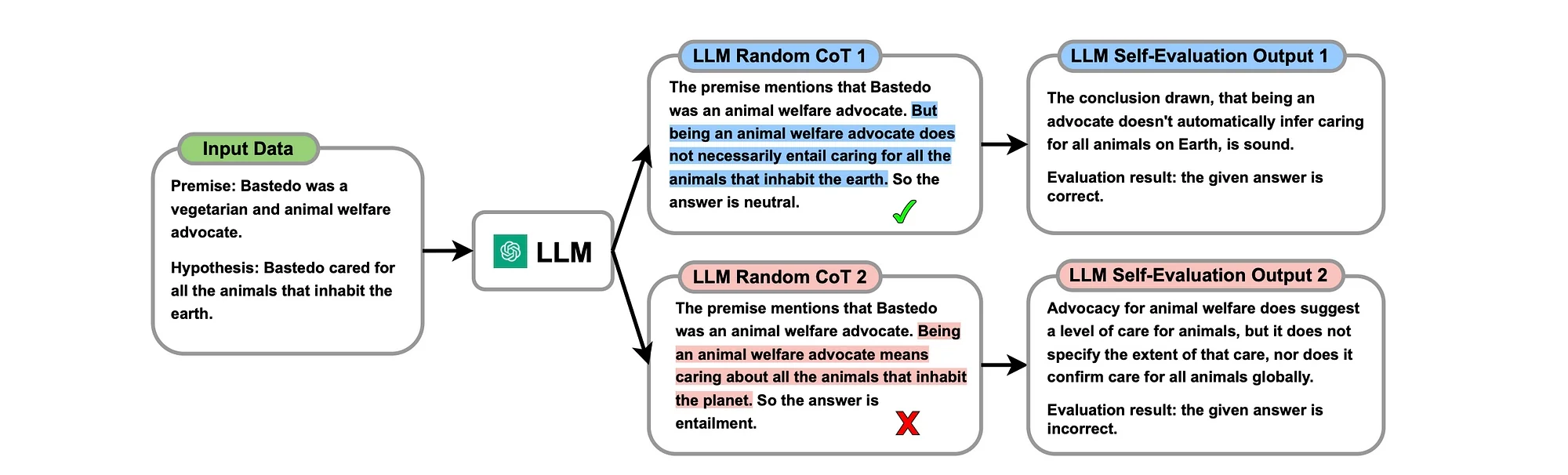
Considering the image below, multiple CoT responses are generated by the LLM together with self-evaluation. These responses are generated via natural language at inference.

The study states that LLM human-like self-evaluation enables the LLM to evaluate for itself the correctness of the generated CoT reasoning; and ascertain what is correct (highlighted in blue) or incorrect (highlighted in red).
Flowchart depicting the research paper writing process, highlighting key phases like topic selection, research, and editing.
Diagram of LLM generating self-evaluated CoT responses

 This concept again illustrates how the principles I described earlier in this article is applied to leverage LLMs for tasks to improve inference results.

Distilling self-evaluation capability and comprehensive thinking

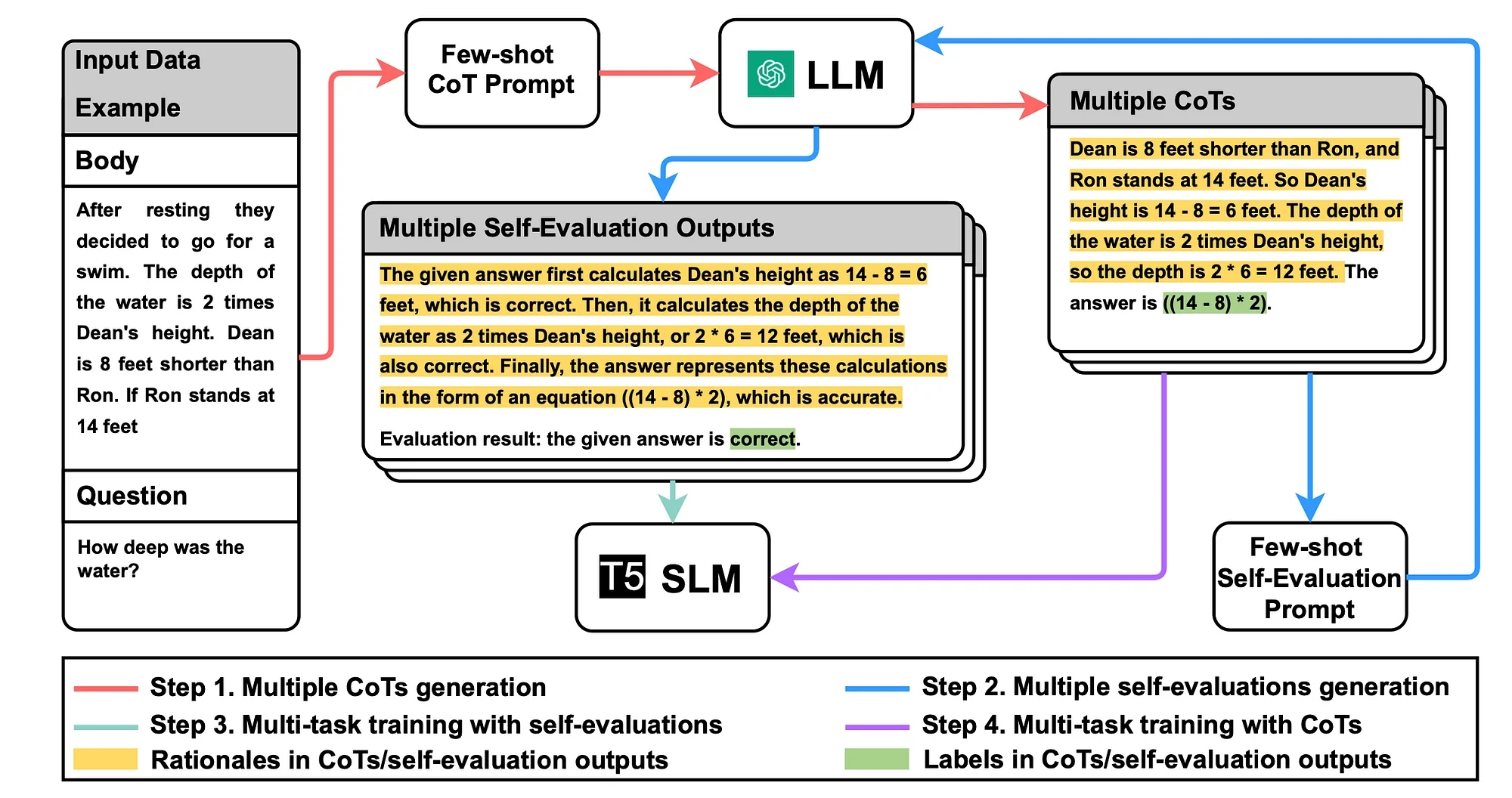
Considering the image below…

Step 1

Multiple COTs are obtain from the LLM.

An unlabelled dataset is used, to devise a CoT prompt template describing how the task should be approached.

The prompt template contains examples for few-shot CoT. Following the CoT method, each example comprises of a triplet with:

  1. Example input
  2. Pseudo labels
  3. and user-provided rationale explaining the classifications.

Step 2

Obtain multiple self-evaluation outputs from the LLM.

Step 3

Train the SLM with multiple self-evaluation outputs, empowering the SLM to distinguish right from wrong.

Step 4

Train the SLM with multiple CoTs to give the SLM comprehensive reasoning capabilities.

Upon successfully incorporating the self-evaluation capability, the focus shifts to harnessing the various CoTs obtained from the LLM, aiming to train the SLM to internalise diverse reasoning chains.

This two-pronged training regimen ensures that the SLM is not merely parroting the capabilities but is rather steeped in introspective self-evaluation and a nuanced understanding of diverse reasoning, mirroring the advanced cognitive faculties of the LLM.
Flowchart detailing the process of utilizing the LLM function for linear modelling.
Flowchart showing distillation of self-evaluation to SLMs

After generating diverse CoTs and their corresponding self-evaluation outputs using the LLM, the process begin to train the SLM.

The training methodology for SLMs first emphasises distilling self-evaluation capability to lay the foundation for reducing the impact of errors in CoTs on SLMs, followed by incorporating comprehensive reasoning capability through diverse CoTs distillation.

Distillation

This study illustrates an important method, called distillation…

LLM distillation includes various methods that leverage one or more large models to instruct a smaller model in accomplishing a specific task. In the context of this study, it’s referred to as a SLM (Small Language Model)…

In its most basic form, LLM distillation is initiated by instructing an LLM to assign labels to previously unlabelled data. This labelled dataset becomes the training set for a smaller model.

This approach can be used to leverage less capable, smaller, cheaper or less-capable models. The NLG prowess and basic logic of the model is leveraged, while the absence of a knowledge-intensive NLP (KI-NLP) component is lacking.

Data preparation is again key for this approach, pseudo-labels generated by the LLM can be used for to instruct smaller models, but preferably human- annotated labels should be used; or at least human supervision.

Find the studies here:

arxiv.org

Distilling Step-by-Step! Outperforming Larger Language Models with Less Training Data and Smaller…

Deploying large language models (LLMs) is challenging because they are memory inefficient and compute-intensive for…

arxiv.org

Share
Link copied
authors
Cobus Greyling
Cobus Greyling
Chief Evangelist
Forrester logo at display.
Kore.ai named a leader in the Forrester Wave™ Cognitive Search Platforms, Q4 2025
Access Report
Gartner logo in display.
Kore.ai named a leader in the Gartner® Magic Quadrant™ for Conversational AI Platforms, 2025
Access Report
Stay in touch with the pace of the AI industry with the latest resources from Kore.ai

Get updates when new insights, blogs, and other resources are published, directly in your inbox.

Subscribe
Thank you! Your submission has been received!
Oops! Something went wrong while submitting the form.

Recent Blogs

View all
Agentic AI in Retail: Transforming Customer Experience & Operations 
January 23, 2026
Agentic AI in Retail: Transforming Customer Experience & Operations 
Top Glean Alternatives (2026 Guide)
January 23, 2026
Top Glean Alternatives (2026 Guide)
AI Agents in 2026: From Hype to Enterprise Reality
January 16, 2026
AI Agents in 2026: From Hype to Enterprise Reality
Start using an AI agent today

Browse and deploy our pre-built templates

Marketplace
Reimagine your business

Find out how Kore.ai can help you today.

Talk to an expert
Background Image 4
Background Image 9
You are now leaving Kore.ai’s website.

‍

Kore.ai does not endorse, has not verified, and is not responsible for, any content, views, products, services, or policies of any third-party websites, or for any verification or updates of such websites. Third-party websites may also include "forward-looking statements" which are inherently subject to risks and uncertainties, some of which cannot be predicted or quantified. Actual results could differ materially from those indicated in such forward-looking statements.


Click ‘Continue’ to acknowledge the above and leave Kore.ai’s website. If you don’t want to leave Kore.ai’s website, simply click ‘Back’.

CONTINUEGO BACK
Reimagine your enterprise with Kore.ai
English
Spanish
Spanish
Spanish
Spanish
Get Started
AI for WorkAI for ServiceAI for ProcessAgent Marketplace
Kore.ai agent platform
Platform OverviewMulti-Agent OrchestrationAI Engineering ToolsSearch and Data AIAI Security and GovernanceNo-Code and Pro-Code ToolsIntegrations
ACCELERATORS
BankingHealthcareRetailRecruitingHRIT
company
About Kore.aiLeadershipCustomer StoriesPartnersAnalyst RecognitionNewsroom
resources
DocumentationBlogWhitepapersWebinarsAI Research ReportsAI GlossaryVideosGenerative AI 101Responsive AI frameworkCXO Toolkit
GET INVOLVED
EventsSupportAcademyCommunityCareers

Let’s work together

Get answers and a customized quote for your projects

Submit RFP
Follow us on
© 2026 Kore.ai Inc. All trademarks are property of their respective owners.
Privacy PolicyTerms of ServiceAcceptable Use PolicyCookie PolicyIntellectual Property Rights
|
×