Agentic AI Apps
AI Solutions
Pre-built Applications

Ready-to-deploy applications across industries and functions.

AI for Banking
AI for Healthcare
AI for Retail
AI for IT
AI for HR
AI for Recruiting
Application Accelerators

Leverage pre-built AI agents, templates, and integrations from the Kore.ai Marketplace.

Kore.ai Marketplace
Pre-built agents
Templates
Integrations
Tailored Applications

Design and build applications on our Agent Platform using our enteprise modules.

Platform
Agent Platform

Your strategic enabler for enterprise AI transformation.

Learn more
Enterprise Modules
AI for Work
AI for Service
AI for Process
Top Resources
Scaling AI: practical insights
from AI leaders
AI use cases: insights from AI's leading decision makers
Beyond AI islands: how to fully build an enterwise-wide AI workforce
QUICK LINKS
About Kore.aiCustomer StoriesPartnersResourcesBlogWhitepapersDocumentationAnalyst RecognitionGet supportCommunityAcademyCareersContact Us
Agent Platform
Agent Platform
Agent Platform

Your strategic enabler for enterprise AI transformation.

learn more
PLATFORM MODULES
Multi-Agent Orchestration
AI Engineering Tools
Search + Data AI
AI Security + Governance
No-Code + Pro-Code Tools
Observability
Integrations
Enterprise Modules
For Service
AI AgentsAgent AI AssistanceAgentic Contact CenterQuality AssuranceProactive Outreach
For Work
Modules
Enterprise SearchIntelligent OrchestratorPre-Built AI AgentsAdmin ControlsAI Agent Builder
Departments
SalesMarketingEngineeringLegalFinance
For Process
Process AutomationAI Analytics + MonitoringPre-built Process Templates
upcoming event

Join the first generation of leaders who are designing, governing, and leading the truly intelligent organization.

Orlando
12 May
register
Recent AI Insights
What's new in AI for Work: features that drive enterprise productivity
AI INSIGHT
20 Feb 2026
Parallel Agent Processing
AI INSIGHT
16 Jan 2026
The AI productivity paradox: why employees are moving faster than enterprises
AI INSIGHT
12 Jan 2026
Agent Marketplace
More
More
Resources
Resource Hub
Blog
Whitepapers
Webinars
AI Research Reports
AI Glossary
Videos
AI Pulse
Generative AI 101
Responsive AI Framework
CXO Toolkit
Private equity
support
Documentation
Get support
Submit RFP
Academy
Community
COMPANY
About us
Leadership
Customer Stories
Partners
Analyst Recognition
Newsroom
Events
Careers
Contact us
Agentic AI Guides
forrester cx wave 2024 Kore at top
Kore.ai named a leader in The Forrester Wave™: Conversational AI for Customer Service, Q2 2024
Generative AI 101
CXO AI toolkit for enterprise AI success
upcoming event

Join the first generation of leaders who are designing, governing, and leading the truly intelligent organization.

Orlando
12 May
register
Talk to an expert
Not sure which product is right for you or have questions? Schedule a call with our experts.
Request a Demo
Double click on what's possible with Kore.ai
Sign in
Get in touch
Background Image 1
Blog
Conversational AI
Meta taxonomy of large language model correction & refinement

Meta taxonomy of large language model correction & refinement

Published Date:
July 3, 2024
Last Updated ON:
February 18, 2026

Introduction

This study surfaces a very insightful and comprehensive taxonomy for improving LLM output. The taxonomy includes wide ranging elements, which can be used in isolation, or an approach can be multifaceted.

There is no single correct way to refine and correct LLM output; here are some key considerations:

  1. The availability of annotated data and people to perform annotation.
  2. The extent to which a data productivity suite is available to accelerate data discovery and annotation.
  3. The level to which different LLMs are available to orchestrate the process of critique and refinement.
  4. Access to people, technology and processes for refinement approaches like in-context learning (RAG), RLHF, Supervision, etc.
  5. If correction will be performed during or after inference.
  6. The number of accessible LLMs, token usage considerations, inference latency, etc.

LLM Structure

When building Gen-Apps two approaches are emerging…

The first approach is where the LLM-itself is leveraged as much as possible; hence the reliance on external data, frameworks and models are avoided.

Here the idea is to be resource efficient and leverage the LLM as much as possible. Negatives here are the inability to scale, difficulty when adding complexity, inspectability and observability.

The second approach is where a framework is at the centre, and not the LLM. The LLM is treated as a utility and the heavy lifting is offloaded as much as possible to an external framework; often human annotated data is used to improve accuracy and in-context learning.

Emerging LLM Techniques

The arrival of LLMs have seen the emergence of a number of classes of LLM related techniques. These techniques and classes most often did not exist in its current form a few months ago.

Amongst others, these emerging classes or techniques include, RAG, In-Context Learning, Prompt Pipelines or runnable, autonomous agents, prompt chaining and also self-correction.

The dangers of LLMs include hallucination, unfaithful reasoning, and toxic content.

One approach to solve for this is self-correction.

Self correction can be performed by an LLM; the same LLM can be used to check and verify its outputs. Or an external LLM can be utilised for correction.

Self-Correction is one of the emerging classes of LLM related techniques.

A prevailing strategy to rectify these undesired behaviours of LLMs is learning from feedback. — Source

Self-Correction

The two extremes of the self-correction spectrum has 100% human involvement at the one end, and 100% model involvement at the other hand.

The optimal solution lies somewhere in the middle where an approach is followed of AI augmented / AI accelerated humans by making use of a latent space / data productivity suite.
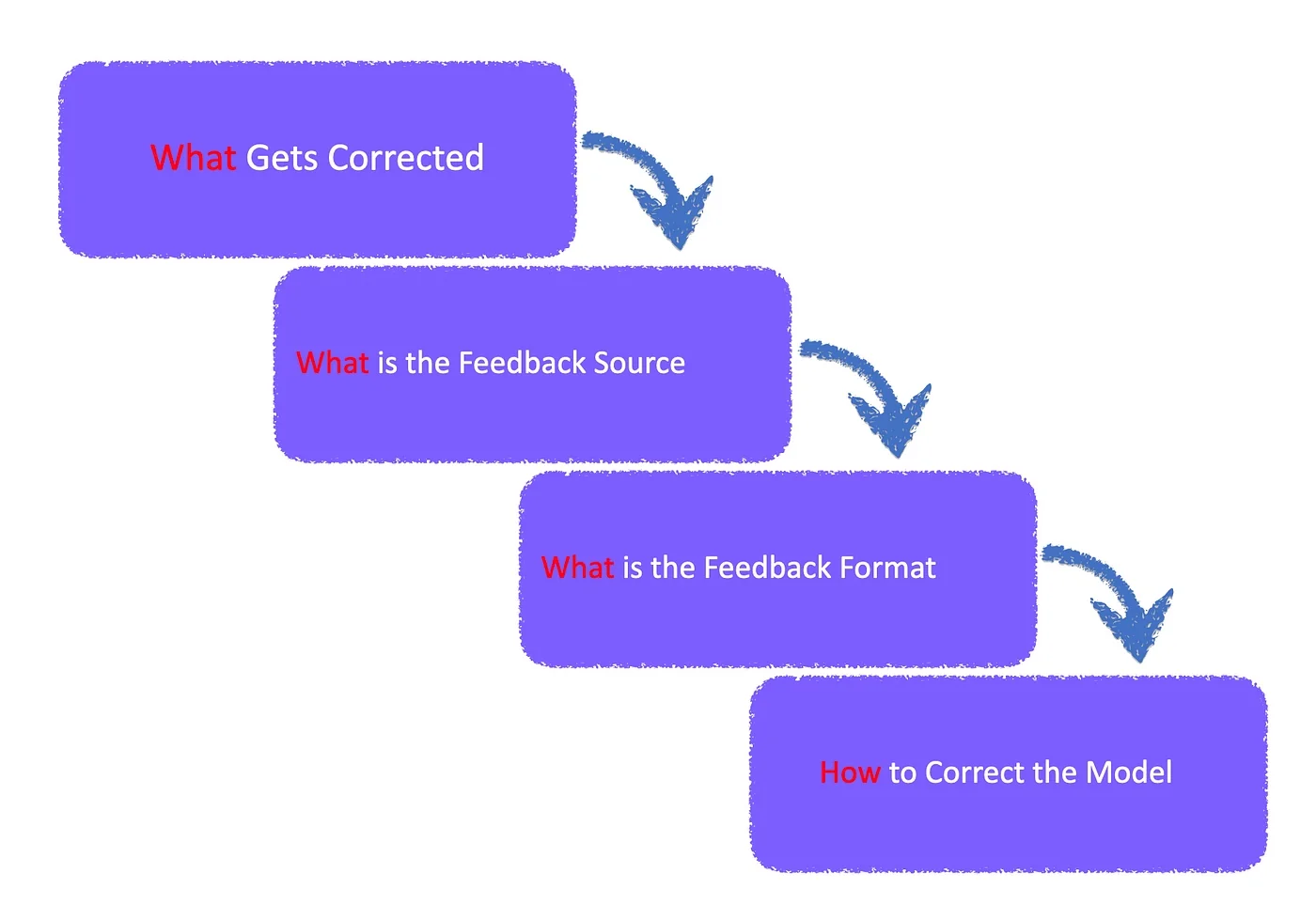
Self-correction

Considering the image above, four questions need to be answered.

These questions involve what needs to be corrected. A process is required to determine what data or output is incorrect and required correction.

The source of the feedback needs to be established together with the format of the feedback.

And lastly how to correct the model; the method of delivery of the feedback.
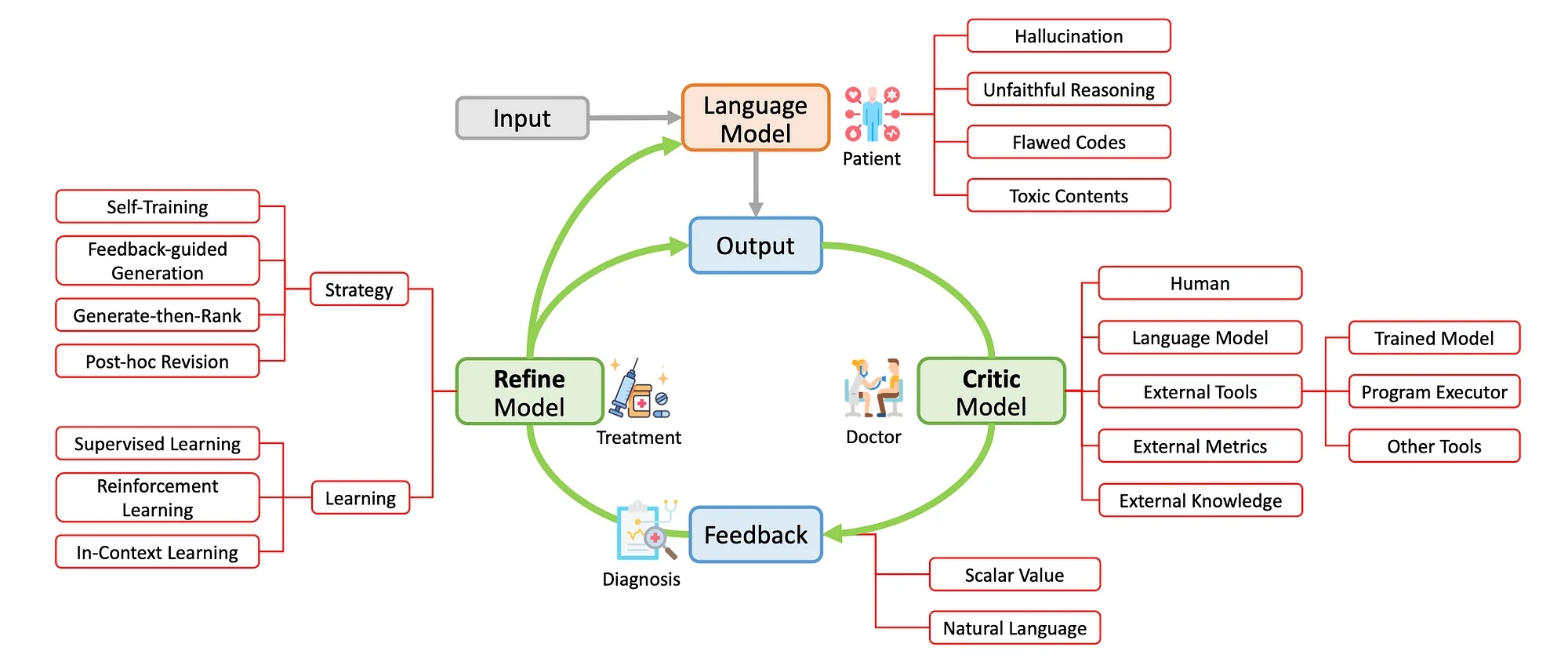
Visual representation of the process stages, detailing each step and its connections within the overall workflow.

The image above shows a conceptual taxonomy for self-correcting LLMs, with automated feedback.

The Language Model which performs a specific task by mapping an input text to an output text.

The Critic Model analyses the output and provides feedback.

And the Refine Model provides treatment to either the output or the language model.

Existing works are taxonomised using this conceptualisation along five key aspects: the problem to be corrected, the source and format of the feedback, and the strategy and learning method of the refine model.

The What & How
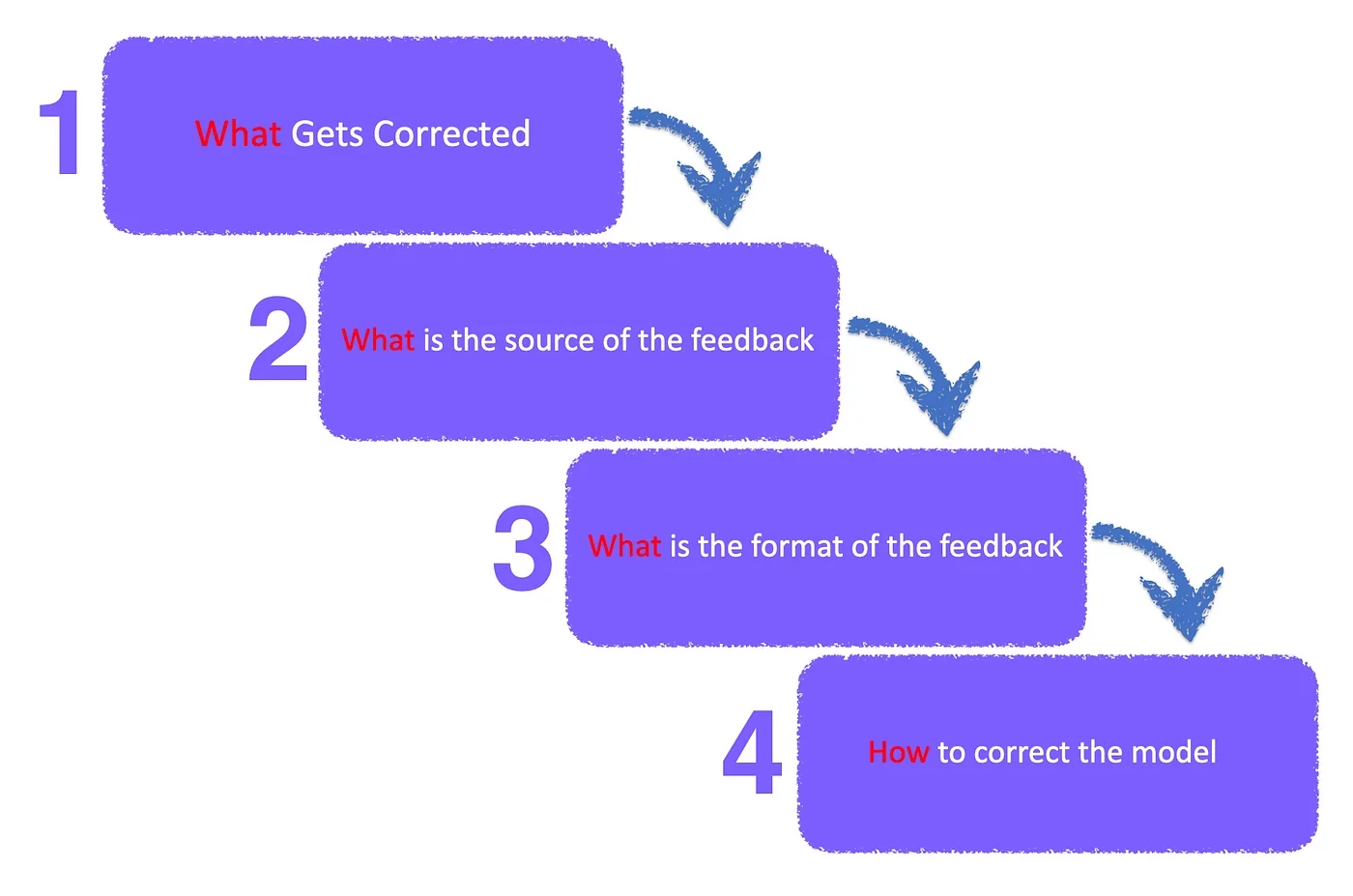
what and how of Self-correction

What Gets Corrected

  • Hallucination,
  • Unfaithful Reasoning,
  • Toxic, Biased, and Harmful Content
  • Flawed Code

From which Feedback Source

  • Self-Feedback; the LLM itself can be utilised as a feedback provider.
  • External Feedback; other trained models, external tools, external knowledge sources, external evaluation metrics, etc.

In What Format

The data format can include natural language, unstructured data, scalar data and more.

How to Correct

Training-time Correction. The ideal scenario is to rectify a flawed model during training, prior to its deployment for use.

Human feedback is typically used for training-time correction, as exemplified by the widely adopted RLHF approach.
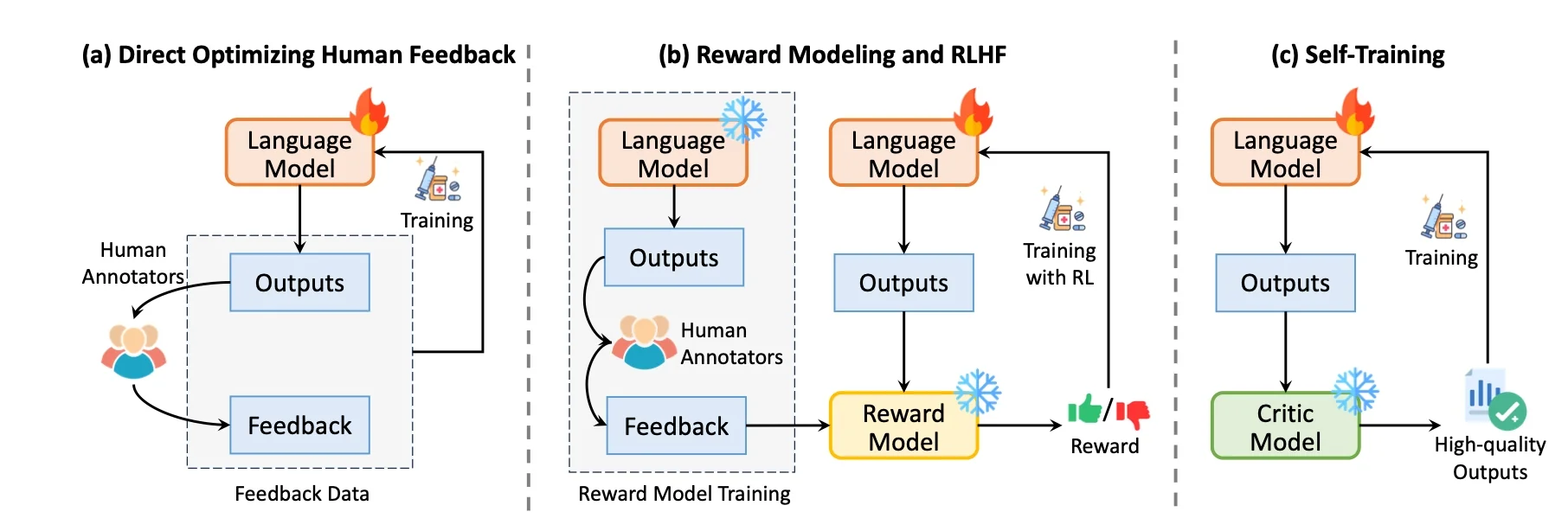
Visual representation of the software development process stages: planning, design, implementation, testing, and maintenance.

The image above shows three typical strategies of training-time correction.

a. Direct optimisation with human feedback,

b. Training a reward model that approximates human feedback,

c. Self-training with automated feedback.

Generation-time Correction. This strategy utilises automated feedback to guide the language model during generation

post-hoc correction involves refining the model output after it has been generated, without updating the model parameters.
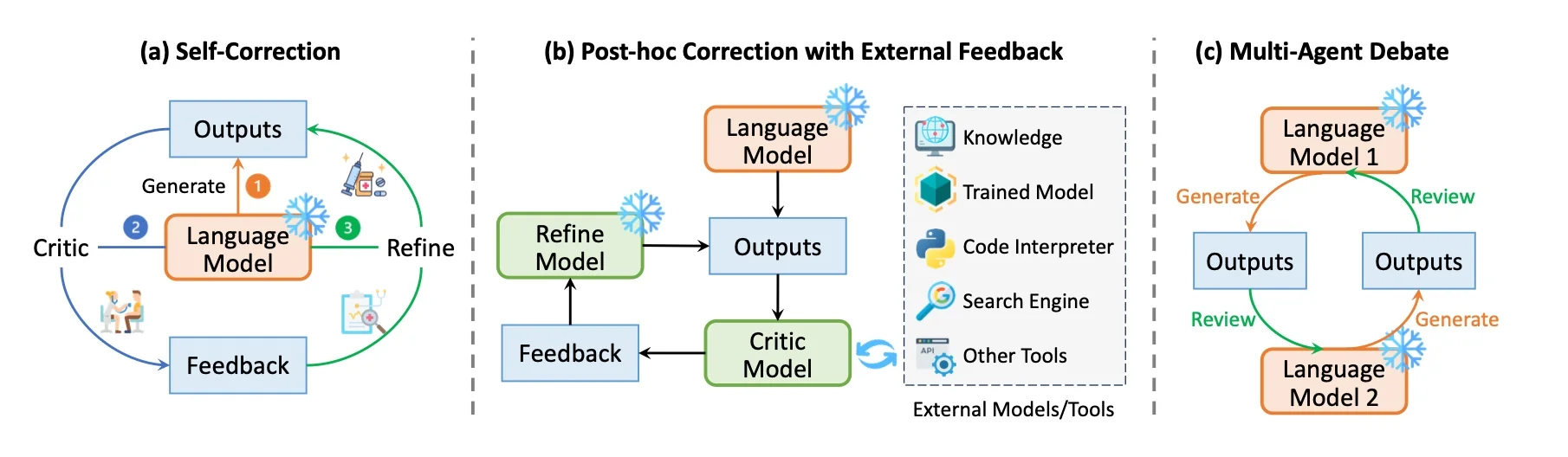
Diagram depicting the workflow for creating an application using cloud services, showcasing essential stages and resources.

Three typical strategies of post-hoc correction:

a. Self-correction

b. Correction with external feedback

c. multi-agent debate
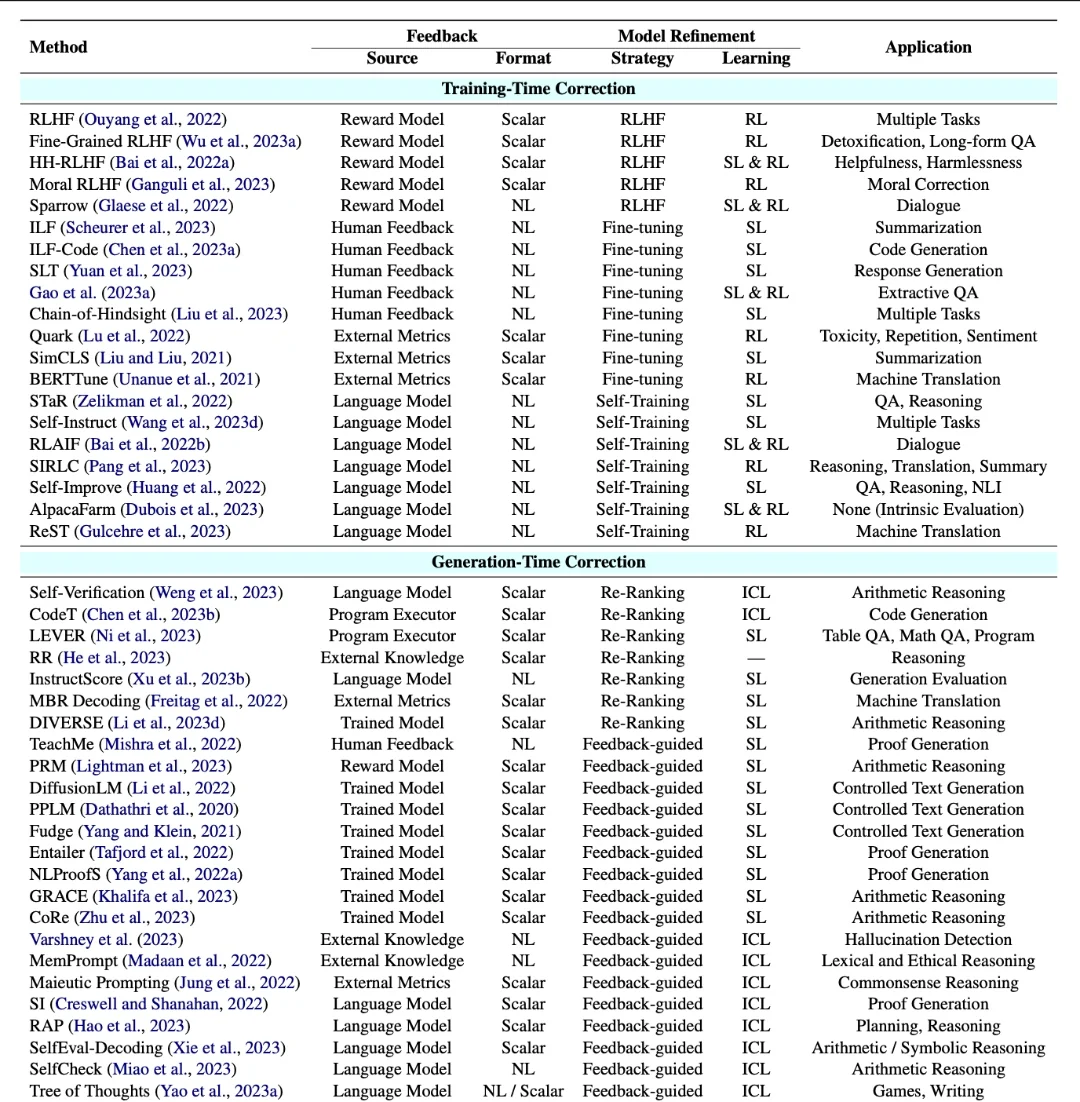
Methods and their applications of different models.

Considering the image above, an invaluable list of resources and approaches to LLM correction is given. The list is split between training-time and generation-time correction.

Finally

The link below leads to a comprehensive list of research papers for Self-Correcting Large Language Models with Automated Feedback.

GitHub - teacherpeterpan/self-correction-llm-papers: This is a collection of research papers for…

github.com

Find the paper here. 

Previously published on Medium. 

Share
Link copied
authors
Cobus Greyling
Cobus Greyling
Chief Evangelist
Forrester logo at display.
Kore.ai named a leader in the Forrester Wave™ Cognitive Search Platforms, Q4 2025
Access Report
Gartner logo in display.
Kore.ai named a leader in the Gartner® Magic Quadrant™ for Conversational AI Platforms, 2025
Access Report
Stay in touch with the pace of the AI industry with the latest resources from Kore.ai

Get updates when new insights, blogs, and other resources are published, directly in your inbox.

Subscribe
Thank you! Your submission has been received!
Oops! Something went wrong while submitting the form.

Recent Blogs

View all
AI agents in retail: 12 proven use cases & examples (2026)
March 5, 2026
AI agents in retail: 12 proven use cases & examples (2026)
The end of manual AP: Zero-Touch invoice processing with AI for Process
February 20, 2026
The end of manual AP: Zero-Touch invoice processing with AI for Process
AI Agent governance: A practical guide to risk, trust, and compliance
February 20, 2026
AI Agent governance: A practical guide to risk, trust, and compliance
Accelerate time-to-value from AI

Find out how Kore.ai can help

Talk to an expert
Start using an AI agent today

Browse and deploy our pre-built templates

Marketplace
Background Image 4
Background Image 9
You are now leaving Kore.ai’s website.

‍

Kore.ai does not endorse, has not verified, and is not responsible for, any content, views, products, services, or policies of any third-party websites, or for any verification or updates of such websites. Third-party websites may also include "forward-looking statements" which are inherently subject to risks and uncertainties, some of which cannot be predicted or quantified. Actual results could differ materially from those indicated in such forward-looking statements.


Click ‘Continue’ to acknowledge the above and leave Kore.ai’s website. If you don’t want to leave Kore.ai’s website, simply click ‘Back’.

CONTINUEGO BACK
Agentic AI applications for the enterprise
English
Spanish
Spanish
Spanish
Spanish
Pre-Built Applications
BankingHealthcareRetailRecruitingHRIT
Kore.ai agent platform
Platform OverviewMulti-Agent OrchestrationAI Engineering ToolsSearch and Data AIAI Security and GovernanceNo-Code and Pro-Code ToolsIntegrations
 
AI for WorkAI for ServiceAI for ProcessAgent Marketplace
company
About Kore.aiLeadershipCustomer StoriesPartnersAnalyst RecognitionNewsroom
resources
DocumentationBlogWhitepapersWebinarsAI Research ReportsAI GlossaryVideosGenerative AI 101Responsive AI frameworkCXO Toolkit
GET INVOLVED
EventsSupportAcademyCommunityCareers

Let’s work together

Get answers and a customized quote for your projects

Submit RFP
Follow us on
© 2026 Kore.ai Inc. All trademarks are property of their respective owners.
Privacy PolicyTerms of ServiceAcceptable Use PolicyCookie PolicyIntellectual Property Rights
|
×