




.webp)
Imagine a world where your queries, concerns, and everyday interactions are seamlessly handled by chatbots and virtual assistants. According to Gartner, by the year 2031, this vision will no longer be a mere fantasy. In this not-so-distant future, conversational AI chatbots and virtual assistants are projected to take the reins, managing a whopping 30% of interactions that, until recently, would have fallen under the purview of human agents. It's a remarkable leap from the humble 2% they managed in 2022! The potential of this shift is staggering, and so is the need to ensure their excellence.
Now, let's paint a different picture: your organization offers a top-notch chatbot for customers to shop conveniently. But, when it counts most, the bot misunderstands a user and serves up wrong info. The user gets frustrated and quits. It's not just a user hassle; it tarnishes your organization's reputation and erodes trust in your chatbot. This highlights the undeniable importance of thorough testing and quality assurance to ensure your chatbot consistently delivers the intended user experience.
And that's precisely why we're embarking on a journey to explore the realm of chatbot testing. This blog serves as your guide, leading you through the essential principles and practices that underpin effective chatbot testing—a crucial step before introducing these intelligent bots to a discerning audience. We'll address the questions that should linger in your mind as you prepare to launch your chatbot:
- Does it identify the intended user requests accurately?
- How gracefully does it respond when intent remains elusive?
- And, most importantly, what's the user experience like?
It's important to note that, before beginning testing, you should acquire an understanding of your clients and end-users, their conversational preferences, and your organizational terminologies. This knowledge will be invaluable as we proceed with testing. So, join us as we navigate the landscape of chatbot testing to ensure that your chatbots not only function but flourish in the real world.
It's time to ensure your chatbot is not just a piece of tech but a valuable asset in your organization's growth!
Getting the basics right
Welcome to the first section of our journey through mastering chatbot testing. Here, we'll dive into the fundamentals that lay the groundwork for successful chatbot testing. Our aim is to equip you with the essential knowledge and techniques needed to ensure your chatbot performs at its best.
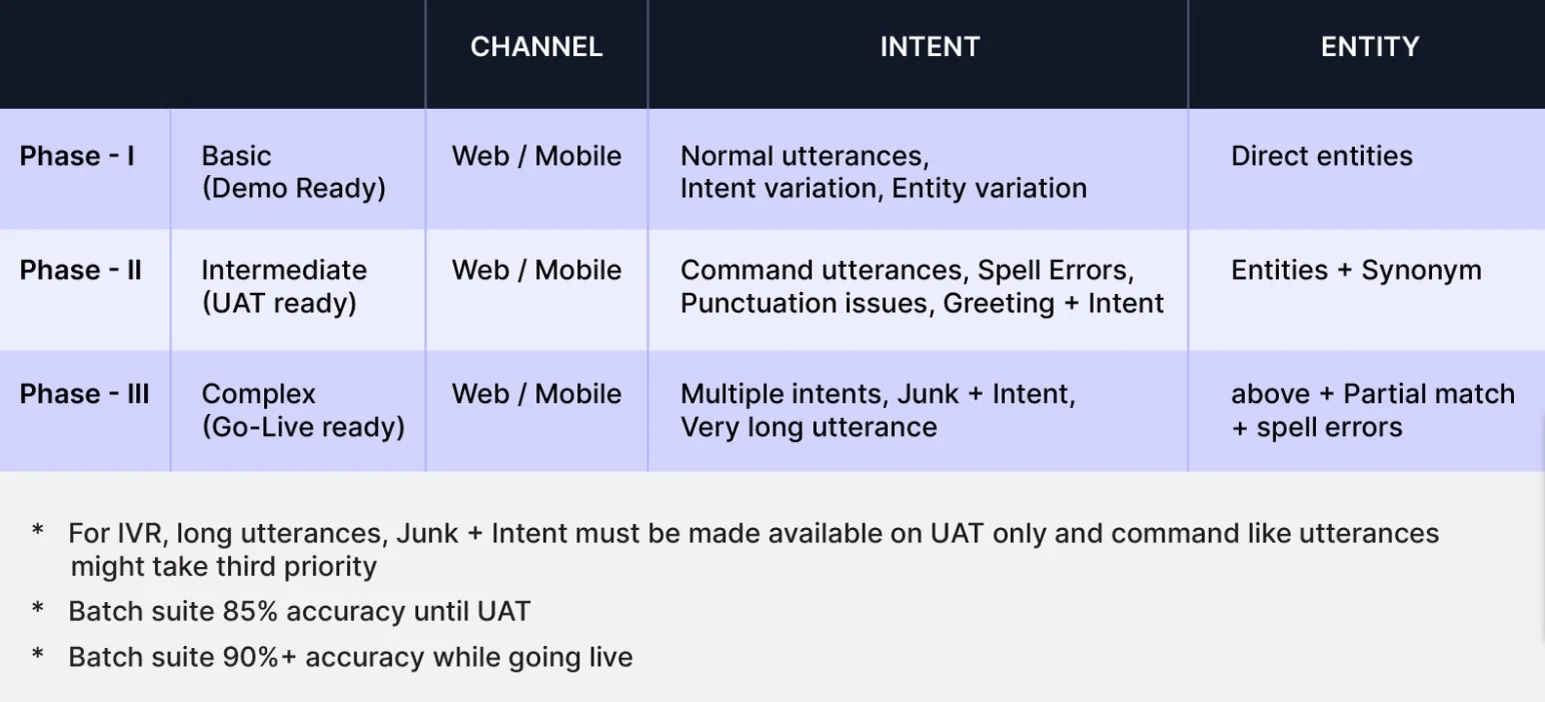
1. Intent identification testing
Before we embark on the practical aspects of chatbot testing, it's crucial to grasp the heart of chatbot functionality: intent identification.
Intent identification is the process of recognizing what the user wants or intends to do based on their input or utterance. It's essentially the chatbot's ability to understand the user's purpose behind the conversation, and it's at the core of everything your chatbot does. It forms the bedrock of a chatbot's functionality, dictating how it responds to user queries.
Also, when it comes to testing, let's start by diving into Batch Testing!
Batch testing
Batch Testing is a handy feature that is all about assessing how well your bot understands what users are saying. Think of it as a series of tests to gauge just how sharp your bot's AI brain is. Using Batch suites is a great way to kick off your evaluation of how well your bot can recognize intents and entities. But remember, it's just the beginning. For a dialog with 100 ML utterances, you'll want to have a minimum of 200 test utterances, covering a wide range of variations.
Here's the key takeaway: While Batch testing is incredibly useful, it's not the sole measure of bot accuracy. Keep refining your Batch suites, and continuously challenge your bot's machine learning and natural language processing capabilities. It's all about making your bot smarter and more proficient over time! If you have any further questions or need more information about Batch Testing, explore it further here.
Let's delve into what these suites should include:
1. Frequently used utterances
Put yourself in the shoes of your users. Think about all the scenarios they might encounter. The goal is to cover the full spectrum of possible interactions. Whether it's a brief question or a lengthy query, include them all.
Example: "Who is my manager?"
2. Command-like utterances
Users don't always follow proper sentence structure. Some prefer shortcuts with just a few words. Don't forget to account for these abrupt commands.
Example: "Get manager name," "Manager?"
3. Short forms and specific terms
Every organization has its jargon. If there are specific abbreviations or terms used in your domain, make sure they're included in the testing.
Example: "I want to redeem my salaam points," "I want to redeem my Zeta points"
4. Utterances with noise words
One essential aspect is addressing utterances that contain noise words or pleasantry words. Noise words are those less critical words within a sentence that users employ to convey their intentions.
For example, you might encounter phrases like "I would like to know the name of my manager" or "Can you get my manager's details?" These expressions often contain noise words, and it's important to account for them in your bot's responses.
5. Spelling mistake
Let's keep in mind that users often use casual language and may include extra words or make minor spelling mistakes in their interactions. After all, not everyone is obsessed with perfect grammar! This is a very common occurrence, and it's important to include these variations in your batch suite.
It's also important to note that not all spelling mistakes are automatically corrected by a chatbot. Some genuine spelling errors, which a significant number of users might make, should be thoroughly tested and integrated into your testing process. For instance, you might come across phrases like "how to raise tickets," where the word "tickets" is misspelled. These instances should be considered to ensure that your bot can effectively handle such input.
6. Long utterances
In the world of voice interactions, users tend to be more expressive. Prepare for lengthy inputs and even irrelevant context.
Example: "I have been trying to identify this for the past 3 days. But it isn't working. Actually, I just wanna know how to raise tickets."
Negative testing
Now, let's explore the other side of the coin: negative testing. This involves ensuring your chatbot doesn't wrongly identify intent in certain cases.
1. Out of scope utterances
These are user requests that do not align with the intended scope of our services. To ensure a smooth user experience, we should handle these requests as "True Negatives" (TN) in our batch suites. It's important to note that some of these out-of-scope requests might not be immediately recognizable as TN. In such cases, we should guide users with friendly messages to ensure their experience is not disrupted.
For instance, let's consider a scenario where our service only handles hardware equipment orders and status checks, excluding troubleshooting: User Scenario: The user encounters issues with a newly ordered monitor. User Utterance: "I ordered a new monitor, but it's not working properly. Can anyone help? "Bot Response: I regret to inform you that I cannot assist you with troubleshooting your monitor, but I am here to assist you in placing orders for new equipment. How can I assist you with that?
2. Out of domain utterance
Sometimes, users might make inquiries that don't align with the intended purpose of the bot. In such cases, it's essential to handle these out-of-domain utterances gracefully without compromising the user experience. We refer to these as True Negatives (TN) in batch suites. For instance, if a user asks for something unrelated to IT equipment, like "I am looking for a chair," the bot should respond with understanding. Here's a friendly and informative response:
User: "I am looking for a chair."
Bot: I appreciate your query, but I specialize in assisting with IT equipment. If you could describe the IT item or service you need in a different way, I'd be happy to assist you further.
It's important to note that batch suite testing might not always accurately reflect the bot's performance in all real-world scenarios. Therefore, it's crucial to validate bot responses to ensure a positive user experience.
For example, in the "Article search" dialog within the IT domain, the bot is designed to help users find IT-related documents. However, if a user requests an article search on a non-IT subject, the bot may still route them to the "Article search" dialog due to its ML training. In such cases, the bot can respond with: User: "Find articles about gardening." Bot: Sorry, I cannot find any related articles on this topic.
Although this response may be marked as a False Positive (FP) in batch suite testing, it's acceptable from an end-user perspective as it maintains a polite and informative tone while guiding the user toward the bot's primary domain.
Keeping it real
Remember, Batch suite testing has its limitations. It might not always reflect real-world user experiences. Validate both responses to ensure they align with user expectations.
Example Scenario
Imagine an "Article Search" dialog. If a user asks for an article on an unrelated topic, the bot should politely inform them that it can't find relevant content. From the user's perspective, this is fine, but Batch suite testing might mark it differently.
2. Entity extraction testing
Now, let's delve into the intricacies of entity extraction a critical aspect of chatbot proficiency. We'll explore how entities, the keywords or data within user utterances, play a pivotal role in achieving a seamless user experience.
Unveiling entity magic
Entities are the vital components that make chatbots truly intelligent. They represent keywords or data in user inputs. Entity extraction ensures your bot understands and utilizes these entities effectively.
Testing entity waters
To ensure your chatbot excels at entity extraction, you should consider various testing scenarios:
Invalid entity values
Testing for invalid entity values is essential. How does your bot respond when faced with data that doesn't align with expected values? Ensuring that your chatbot handles these situations gracefully is key.
Entity synonyms
Entities often have synonyms that users might use interchangeably. For instance, consider a bot with a "Yes or No" button. Testing synonyms such as "Ya," "Ok," and "Go ahead" for "Yes" and "nope" or "Not Ok" for "No" ensures comprehensive coverage.
Entity extraction within subintents
Entities can be present within subintents. Ensure your bot identifies these entities correctly for more complex user queries.
Entity values of varied length
Entities can come in all shapes and sizes, ranging from brief snippets to more extensive pieces of information. It's important to check how your chatbot handles entity values of different lengths to ensure it consistently collects data, whether it's a quick request or a detailed query.
For instance, let's take the scenario of searching for an article. You should test utterances with varied lengths to make sure your bot can extract the relevant information. For example: A shorter request like: "I'm searching for a testing article." Or a longer, more detailed query such as: "I'm looking for an article that covers the fundamentals of chat bot testing."
By doing so, you'll ensure that your chatbot can handle a wide range of user inputs effectively.
Special Consideration: String and Person Name EntitiesSome entities, like "String" and "Person name," require special attention. These entities should be rigorously tested with values of varying lengths and positioned differently within the structure of user utterances. For example, "I would like to order a laptop" compared to "I would like to order a Dell Inspiron 15 3593 C560510WIN9."
By exploring these aspects of entity extraction, you'll equip your chatbot to comprehend user input comprehensively and provide a top-notch conversational experience.
3. Multi-channel testing
Cover all the bases: testing across every channel
Now, let's talk about something that can truly make or break your chatbot: multi-channel testing. In this digital age, your chatbot doesn't just operate on one platform—it's everywhere, from web browsers to mobile apps and IVR systems. To ensure a seamless and consistent user experience, it's vital to put your chatbot through its paces on all these channels.
So, whether it's the web, mobile, IVR, or any other platform, take it for a test drive. Let's make sure there are no glitches, and everything is rendering just as it should. Your users will thank you for the seamless experience!
4. Localization testing
Embracing linguistic diversity
When it comes to localization, things get interesting. Different regions bring their unique linguistic flavours, including variations in grammar, gender, person, age, and more. Users express themselves using their own distinct linguistic twists when conversing with a chatbot.
For instance:
In English: "What is my manager's name?"
In Hindi: "मेरे प्रबंधक का नाम क्या है?"
This linguistic diversity means your batch test suites should encompass these variations. It's not just about identifying user intents or extracting entities; it's about understanding the intricacies of language in each context.
Navigating the mix: hybrid language testing
And here's the twist users can be wonderfully unpredictable. They might mix multiple languages within a single conversation. It's crucial to define, scope, and meticulously document the boundaries of language support. Writing test cases to handle these mixed-language scenarios is paramount.
While we've used Hindi for our examples, remember that these principles apply universally, irrespective of the language. Whether it's a mix of two languages, Hindi written in English, or English words and phrases in Hindi:
User: "मेरे Account में कितना पैसा है?"
User: "Mere account mein kitna paisa hain?"
User: "मेरे अकाउंट में कितना पैसा है?"
Understanding and effectively testing these language intricacies will set your chatbot up for success in any linguistic landscape.
Beyond the basics
As we delve deeper into the testing nuances, remember that your chatbot's success lies not only in functionality but also in its ability to engage users naturally. Small talk and emoji testing are vital steps toward achieving this seamless interaction. These might sound like minor components, but they play a pivotal role in enhancing your chatbot's conversational finesse.
Small talk testing
Small talk, the art of casual conversation, deserves a spotlight in your testing regimen. Why? Because it's not just about users' queries and commands; it's also about their need for a human touch in the interaction.
Small talk can take on multiple layers, and here's why it matters:
Sample Conversation Demonstrating Small Talk
User: How are you?
Bot: I am doing fine, how about you?
User: I am doing great.
Bot: Great to hear that. How can I help you today?
Small talk, when not handled correctly, can clash with user intents or frequently asked questions (FAQs). It's about striking that balance between being friendly and staying on topic.
Emoji testing
Emojis, those expressive little icons, have become a universal language. Depending on the level of emoji support your chatbot provides, it's essential to prepare robust test cases for these vibrant characters. Emojis can convey emotions, actions, and even complex sentiments, making them a potent tool in user interactions.
Here's a snippet:
User:
Bot: "Hello There! How can I help you today?"
Emojis can add a layer of nuance to conversations, but they also bring potential challenges. Ensuring that your chatbot interprets and responds to emojis correctly is crucial for delivering a top-notch user experience.
Other valuable testing tips
Going the Extra Mile
While small talk and emojis add a layer of charm to your chatbot, there are other crucial aspects to consider:
- Understanding Bot Functionality: To truly master chatbot testing, it's not just about following a checklist. It's about understanding your bot's functionality inside out. This deep knowledge enables you to craft test scenarios that push the boundaries, ensuring your bot remains reliable in all situations.
- Dialogs with Closely Related Use Cases: Some dialogs and use cases are like siblings - closely related but with subtle differences. These require special attention and thorough testing to ensure that your chatbot can distinguish between them effectively.
Unlocking testing efficiency with ChatGPT
In the ever-evolving landscape of AI-powered chatbot testing, staying ahead of the curve is paramount. Fortunately, the advent of ChatGPT has revolutionized the way we approach test data generation.
Say goodbye to manual utterance creation
Gone are the days when analysts spent endless hours crafting test utterances. With ChatGPT, this process is streamlined and accelerated, freeing up valuable time for more strategic endeavors.
The essence of ChatGPT
ChatGPT is more than just a tool; it's your testing ally. This web interface harnesses the immense power of an ever-evolving state-of-the-art language model. It's a tool generating test utterances tailored to your specific use cases and scenarios.
Savings in both time and effort
Imagine effortlessly creating a wide array of test utterances, from simple and direct commands to more intricate and complex requests. It's all within ChatGPT's capabilities. The secret sauce? Prompt engineering.
A practical example:
Let's dive into a real-world scenario within the IT domain. The process begins by establishing the context, providing ChatGPT with the domain and scenario details. But ChatGPT doesn't stop there. It can even furnish you with a comprehensive list of modules within a domain, serving as a valuable starting point for crafting use cases.
ChatGPT can give a list of all modules in a domain which can be used to come up with use cases as shown below.
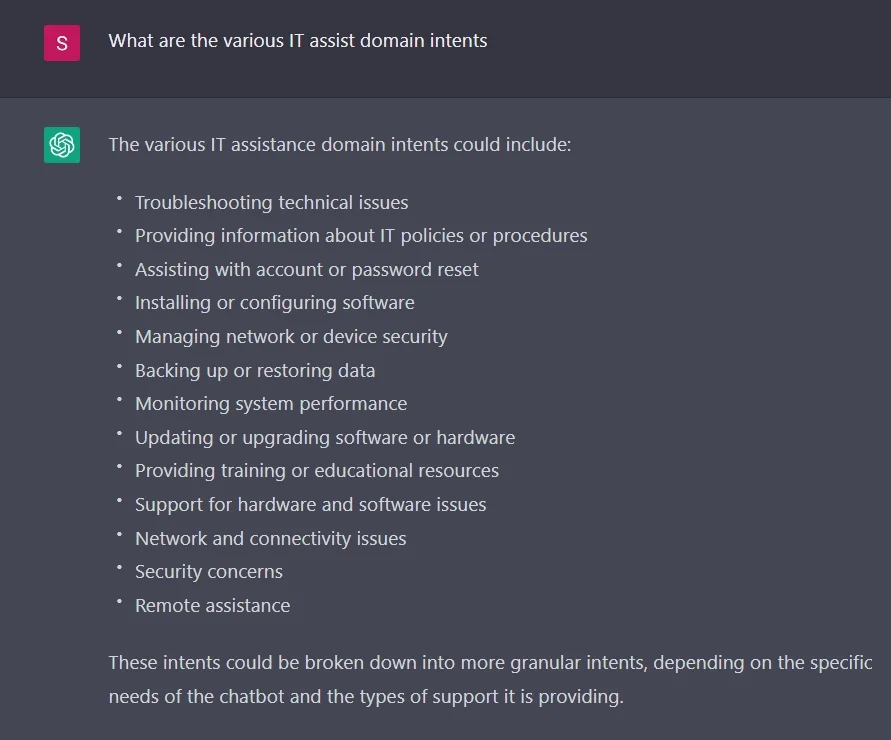
Here we have narrowed it down to list intents of a specific module:

Exploring various utterance generation techniques
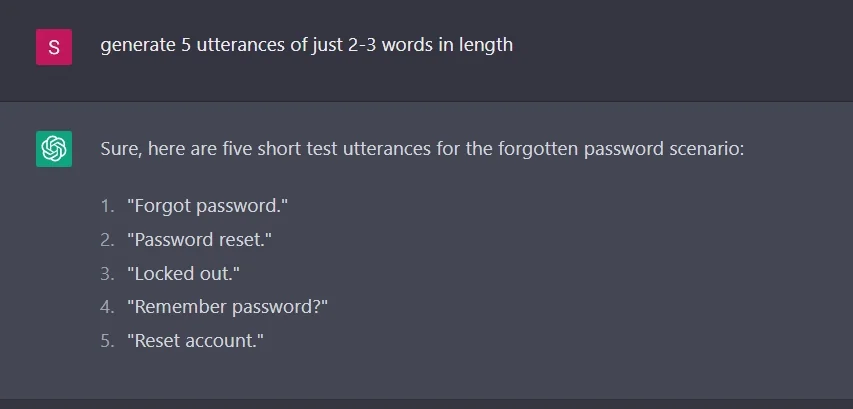
ChatGPT offers a toolbox of techniques for generating test utterances. From command-driven instructions to nuanced interactions, it adapts to your testing needs seamlessly.
Here are the various ways of generating utterances:
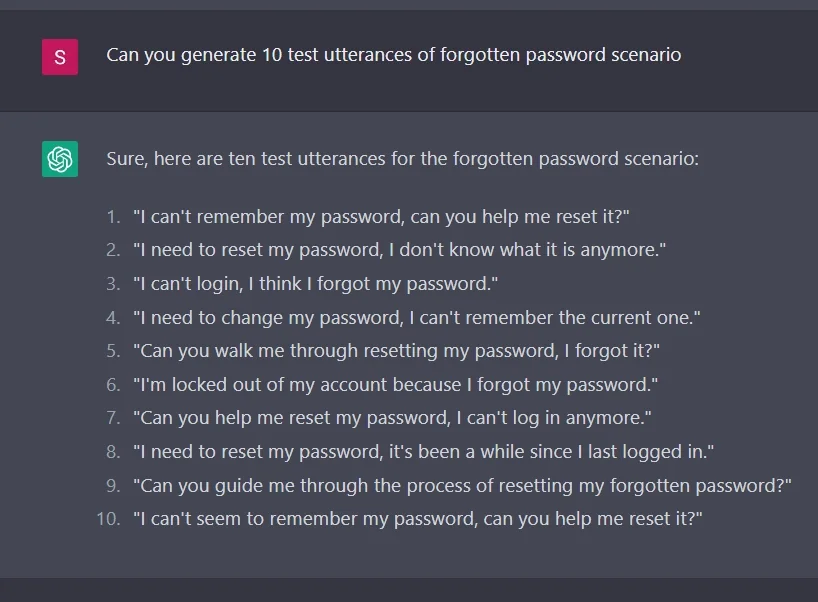
Generation of command utterances:

Entity extraction simplified
ChatGPT doesn't just stop at generating utterances; it's a pro at identifying entities within them. With remarkable precision, it recognizes entity types, making your testing process more robust.
Note: In the given example, we have already set the chatGPT context to Retail domain:

Now, we are asking it to generate random utterances which will make use of the entities.
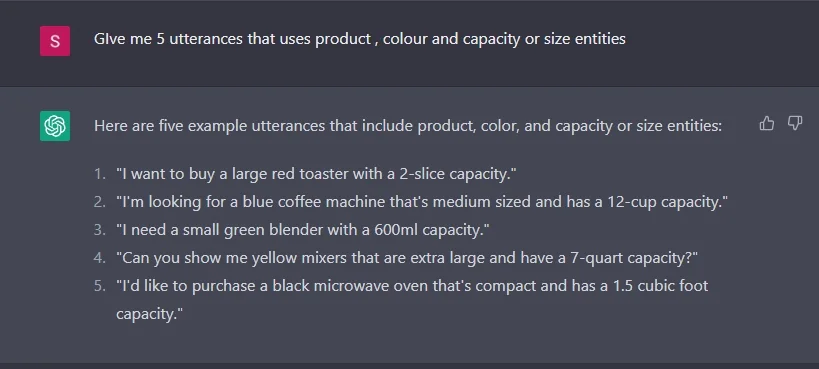
With ChatGPT by your side, gathering test utterances becomes an efficient and dynamic process. It's time to embrace this AI-powered testing ally and explore the endless possibilities it offers.
Navigating conversational flow and bot behavior
Conversation flow testing
Now, we're diving deep into the heart of chatbot mastery: conversation flow. It's all about ensuring that the dialog between the user and the bot unfolds seamlessly, covering every possible use case and path defined by the client.
Exploring every nook and cranny
Imagine your chatbot as a complex maze of dialog templates and buttons. To make sure it's user-ready, you need to venture into every nook and cranny. That means clicking on each and every button, at least once, to verify that nothing is broken.
The loop limit challenge
Entity nodes play a significant role in this journey. These nodes should be designed to provide clear, user-friendly messages when a user enters incorrect values multiple times. It's about keeping the conversation smooth even when hiccups occur.
Testing the vital scenarios
As you traverse the conversation flows, certain scenarios deserve special attention.
These include:
- The Welcome Message: Setting the right tone from the start.
- Entity Extraction: Ensuring your chatbot understands various formats of user input.
- Handling Invalid Inputs: Testing how your chatbot responds when users provide invalid entity values. Clarity is key.
Embracing automation
In the world of efficiency, automation is your ally. We recommend automating these flows whenever possible. The conversation recorder tool within the platform can be a valuable asset in this endeavour.
Conversation testing
Conversation Testing is a feature on Kore platform which enables you to simulate end-to-end conversational flows to evaluate the dialog task execution or perform regression. You can create Test Suites to capture various business scenarios and run them at a later time to validate the assistant’s performance. You can find more information here.
Elevating chatbot design with ChatGPT
Imagine this: You have a specific scenario in mind, and you want to craft the perfect conversation flow around it. That's where ChatGPT steps in, ready to assist. All you need to do is provide ChatGPT with the scenario, and it will work its magic, generating a seamless conversation flow effortlessly. In the realm of chatbot development, there's a powerful ally that every Business Analyst should have in their toolkit: ChatGPT. Not only can it identify modules within a domain, but it can also dissect them into detailed use cases and scenarios. What's more, it excels at crafting coherent and intuitive conversation flows, making the life of a Business Analyst significantly easier.
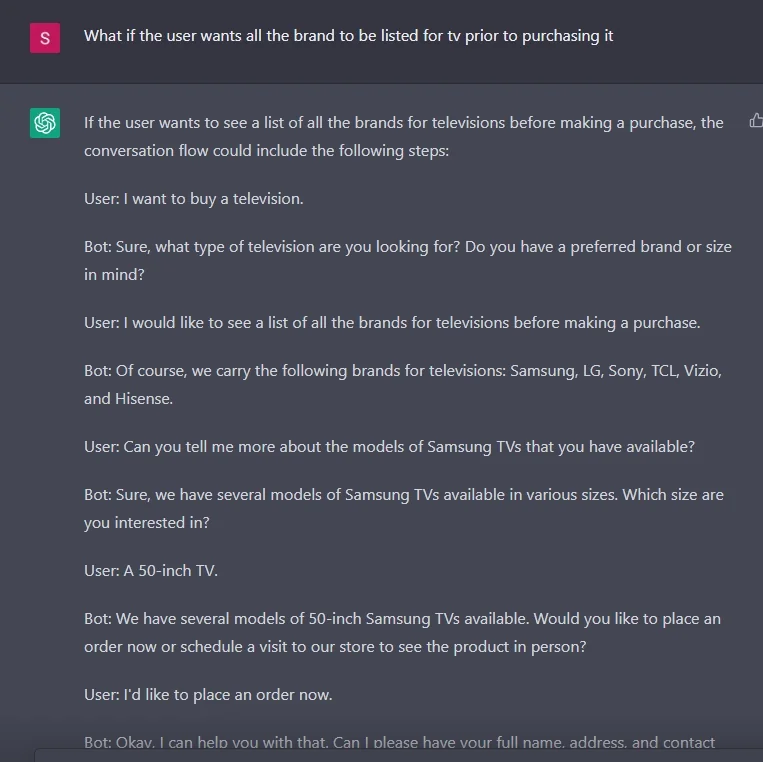
Let's say you're working on an e-commerce chatbot, and you want to design a conversation flow for users looking to purchase a television. ChatGPT simplifies the process:
Scenario 1: Shopping for a Specific Television
Your users want to purchase a television, and they're particular about the size and brand. Craft this scenario, and ChatGPT will weave a conversation flow that guides users seamlessly through the process.

Scenario 2: Exploring TV Options
Now, consider a scenario where your users are in the mood for a new TV, but they're open to suggestions. They want to explore various brands and models. ChatGPT can craft a conversation flow that gently leads users through the world of TV options.
But wait, there's more to ChatGPT's magic.
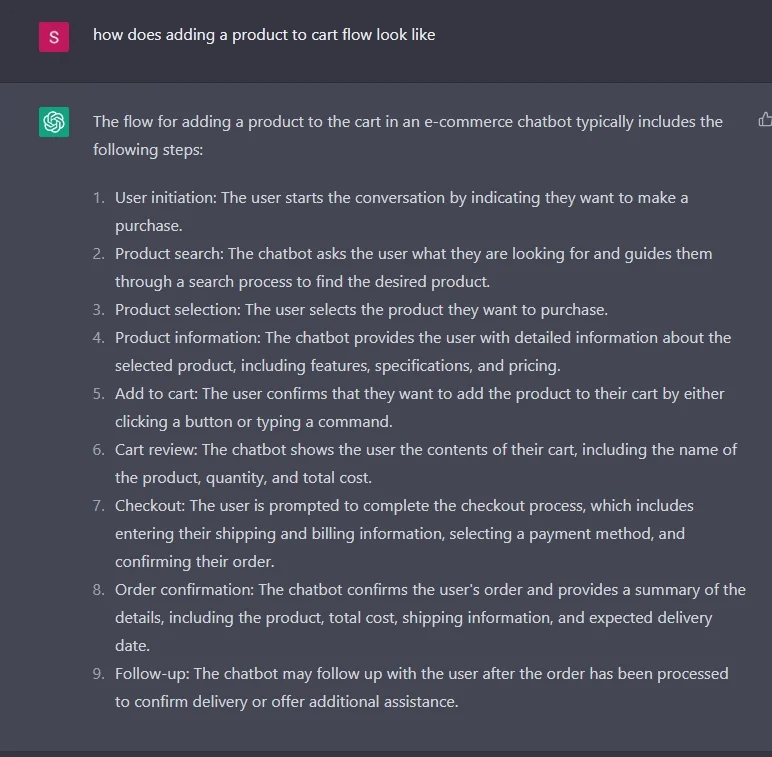
Functionality Flow: Navigating the E-commerce Landscape
Not only can ChatGPT design engaging conversations, but it can also map out the functional journey a user takes. Let's take an example in the Retail domain:
Scenario: Adding a Product to the Cart
Your user has found the perfect product and wants to make a purchase. ChatGPT can list out the precise steps—step by step—that your user will go through, from the initial selection to finalizing the purchase.
Bot interruptions
In the world of chatbot interactions, flexibility is key. Enter the "Interruption" feature—a game-changer that enables users to seamlessly switch context while in the midst of a task. But let's dive deeper into this feature, understanding its nuances:
- Bot Level Setting: Here's where it all begins. At the bot level, you can set the rules for interruptions.
- Dialog Level Setting: Now, suppose you want specific dialogs to have their interruption rules. Dialog level settings step in and override the bot-level settings.
- Node Level Setting: Precision matters. At the most granular level, the node level setting takes precedence. If you've turned off interruptions for a particular node, context switching won't be allowed there.
Click here for more information on interruptions.
Amend feature
Amendments can be game-changers. They allow users to tweak entity values during a conversation. But with great power comes great responsibility. Here's how to ensure they work as expected:
- Bot-Level Amendments: Set at the global level.
- Task-Level Amendments: A more granular approach.
For more information on Amend entity, click here.
Ambiguous intent
This pertains to a situation where a user's expression lacks clarity or possesses multiple possible interpretations. An ambiguous utterance is one whose meaning is not explicitly defined and can be understood in more than one way.
In such instances, if the system identifies more than one relevant intent, both intents should be presented to the user for selection. These situations are labelled as ambiguous intents, denoted as TP (True Positive).
Testing procedures should encompass utterances capable of triggering ambiguity.
For instance, in a banking context,
consider chat bot to have 2 intents "checking account balance" and "checking card balance."
If a user's utterance is "I want to check my balance," the bot should display both intents for the user to choose from.
Maximizing value in chatbot testing
Now, we're stepping into the realm of maximizing value in chatbot testing. Our aim is to ensure that your testing efforts not only validate the bot's functionality but also enhance its performance and user satisfaction. Let's uncover some advanced strategies that will not only elevate your testing game but also ensure your chatbots stand strong amidst complexity.
Universal bots and managing ambiguity
Picture a chatbot that manages multiple child bots, all from a single channel. This is the essence of a Universal Bot. To effectively test such a creation, understanding the use cases of each linked child bot becomes paramount. It's akin to mastering a symphony of bots, each with its unique role and purpose.
Yet, with great power comes the potential for ambiguity. When bots with closely related dialogs are in play, the waters can get muddy. Dialogs that resemble each other too closely need special attention. Take, for instance:
Dialog 1: "Requesting for leave"
Dialog 2: "Checking leave balance"
Navigating through these potentially confusing scenarios requires a keen eye and a strategic testing approach.
Automation and ongoing enhancement
Automation is your trusty sidekick in the world of chatbot testing. It's the tool that empowers you to streamline processes, save time, and ensure consistency.
So, what can you automate, you ask? The possibilities are endless. Let's dive into a few key areas:
- Enhancing Your Batch Suites
Batch suites, the stalwart soldiers of intent identification and entity extraction testing, should be continuously enhanced. It's all about keeping them sharp and up-to-date. Automation can help you achieve this effortlessly.
- Permutations and Combinations Galore
When testing an entity node, don't limit yourself to the ordinary. Automation allows you to explore the extraordinary by trying various permutations and combinations. This means you can test if the entity gets extracted accurately, even when it's nestled within complex phrases. For instance:
For a chatbot with a date entity:
"I am planning to travel tomorrow."
"I am traveling on Dec 10."
- Break the Bot (In a Good Way)
Here's a fun twist: think like an end user and try to break the bot! Okay, not literally break it, but push it to its limits. Focus on frequently used utterances that real users would employ. Automation lets you simulate user interactions at scale, ensuring your chatbot is as robust as it needs to be.
- Continuous Improvement: The Key to Long-Term Success
But automation is just the beginning of our journey. To truly master chatbot testing, you must understand the essence of continuous improvement. It's not a one-time affair; it's a way of life for your chatbot.
In the dynamic world of conversational AI, your chatbot is never truly "finished." It evolves, adapts, and improves over time. Continuous improvement ensures your chatbot not only survives but thrives.
Conclusion: charting the path forward
Imagine a world where human-machine interactions become almost indistinguishable from human-human conversations. A world where chatbots seamlessly grasp our intentions, quirks in language, and serve up precisely what we need. This vision isn't a distant dream; it's closer than you might realize. Gartner's insightful research paints an exciting picture of what's to come. By 2025, an astonishing 50% of enterprises are projected to embrace AI orchestration platforms, marking a significant leap from the less than 10% who dared to venture into this AI-driven territory in 2020. It's a clear testament to the transformative power of artificial intelligence.
So, what's next for you?
Beyond the invaluable insights you've gleaned here, an expansive realm of possibilities beckons. This isn't just about being a spectator in the AI revolution; it's about taking the reins and shaping the future of chatbot technology.
With the evolving landscape of chatbot technology, embrace the upcoming wave of chatbot evolution with confidence. As you step forward, stay agile and open to emerging technologies. Adapt to changing user expectations, and remain innovative in your approach. Just as chatbots are destined to evolve, so is your role in ensuring their excellence!
Ready to Elevate Conversations? Let's Get Started!
Let's elevate your conversations together!
.jpeg)