Agentic AI Apps
AI Solutions
Pre-built Applications

Ready-to-deploy applications across industries and functions.

AI for Banking
AI for Healthcare
AI for Retail
AI for IT
AI for HR
AI for Recruiting
Application Accelerators

Leverage pre-built AI agents, templates, and integrations from the Kore.ai Marketplace.

Kore.ai Marketplace
Pre-built agents
Templates
Integrations
Tailored Applications

Design and build applications on our Agent Platform using our enteprise modules.

Platform
Agent Platform

Your strategic enabler for enterprise AI transformation.

Learn more
Enterprise Modules
AI for Work
AI for Service
AI for Process
Top Resources
Scaling AI: practical insights
from AI leaders
AI use cases: insights from AI's leading decision makers
Beyond AI islands: how to fully build an enterwise-wide AI workforce
QUICK LINKS
About Kore.aiCustomer StoriesPartnersResourcesBlogWhitepapersDocumentationAnalyst RecognitionGet supportCommunityAcademyCareersContact Us
Agent Platform
Agent Platform
Agent Platform

Your strategic enabler for enterprise AI transformation.

learn more
PLATFORM MODULES
Multi-Agent Orchestration
AI Engineering Tools
Search + Data AI
AI Security + Governance
No-Code + Pro-Code Tools
Observability
Integrations
Enterprise Modules
For Service
AI AgentsAgent AI AssistanceAgentic Contact CenterQuality AssuranceProactive Outreach
For Work
Modules
Enterprise SearchIntelligent OrchestratorPre-Built AI AgentsAdmin ControlsAI Agent Builder
Departments
SalesMarketingEngineeringLegalFinance
For Process
Process AutomationAI Analytics + MonitoringPre-built Process Templates
upcoming event

Join the first generation of leaders who are designing, governing, and leading the truly intelligent organization.

Orlando
12 May
register
Recent AI Insights
What's new in AI for Work: features that drive enterprise productivity
AI INSIGHT
20 Feb 2026
Parallel Agent Processing
AI INSIGHT
16 Jan 2026
The AI productivity paradox: why employees are moving faster than enterprises
AI INSIGHT
12 Jan 2026
Agent Marketplace
More
More
Resources
Resource Hub
Blog
Whitepapers
Webinars
AI Research Reports
AI Glossary
Videos
AI Pulse
Generative AI 101
Responsive AI Framework
CXO Toolkit
Private equity
support
Documentation
Get support
Submit RFP
Academy
Community
COMPANY
About us
Leadership
Customer Stories
Partners
Analyst Recognition
Newsroom
Events
Careers
Contact us
Agentic AI Guides
forrester cx wave 2024 Kore at top
Kore.ai named a leader in The Forrester Wave™: Conversational AI for Customer Service, Q2 2024
Generative AI 101
CXO AI toolkit for enterprise AI success
upcoming event

Join the first generation of leaders who are designing, governing, and leading the truly intelligent organization.

Orlando
12 May
register
Talk to an expert
Not sure which product is right for you or have questions? Schedule a call with our experts.
Request a Demo
Double click on what's possible with Kore.ai
Sign in
Get in touch
Background Image 1
Blog
Conversational AI
FaaF: Facts as a function for evaluating RAG

FaaF: Facts as a function for evaluating RAG

Published Date:
November 15, 2024
Last Updated ON:
February 18, 2026
There has been instances where another Language Model is used to vet the RAG output, which fails to detect incorrect and incomplete generated data.

The problem

Practical factual recall evaluation in RAG systems are problematic for the following reasons:

  1. Not much attention has been given to automatically verifying truthful, independent statements in poorly generated text and simulating low-quality Retrieval Augmented Generation (RAG) scenarios. As compared to focusing on accuracy in language model generated text.
  2. Given that a single generated text may contain multiple facts requiring verification, the current method of verifying each fact independently can be overly time-consuming and resource-intensive.
  3. RAG systems involve numerous components, such as knowledge base, retrieval, prompt formulation, and language model, which demand substantial tuning. Therefore, efficiency is crucial for practical implementation.
  4. Exact matching of ground truth text in the generated text is susceptible to false negatives because the ground truth information might exist in the generated text but expressed differently.
  5. And when the ground truth information is longer than a few words, the chances of exact match become too slim.

The solution (FaaF)

  1. A complete factual recall evaluation framework which is tailored to RAG systems. Which can be used to create a test dataset and perform automated factual recall evaluation.
  2. Evaluation data is augmented with ground truth facts and human annotation. WikiEval features question and answer pairs with answers of variable factual quality which enable simulating deficient RAG responses.
  3. Facts as a Function (FaaF) is a new fact verification formulation which out-performs fact verification via prompting in all examined conditions and reduces the required number of LM calls and completion tokens by more than 5 times.

Considering the image below, a constructor dynamically creates a function object from a set of facts.

Function calling allows LMeval to verify all facts within a single call when provided with an input text.

FaaF reduces the error rate in identifying unsupported facts by up to 40 percentage points compared to prompting whilst reducing the number of LMeval calls and output tokens by more than 5 times.
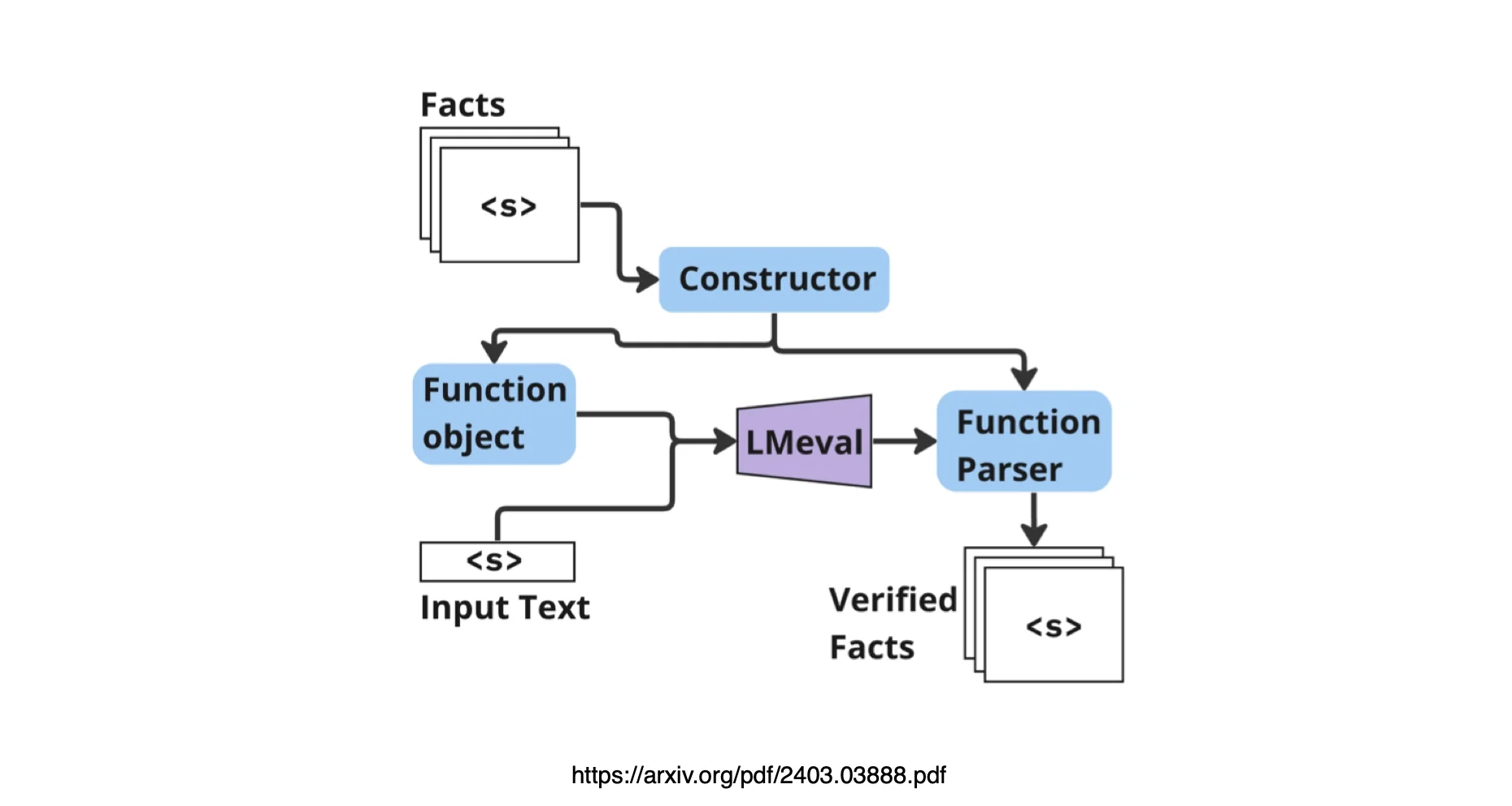
A flowchart showing facts processed by a constructor into a function object, combined with input text in LMeval, then parsed into verified facts by a function parser.
FaaF builds a fact‑function to verify many claims at once

And considering the image below, given a set of ground truth Answers, facts are extracted via LMf. The Hypothesised responses of the RAG (in this instance Ungrounded Answer and Poor Answer) are then tested for recall against the extracted facts.
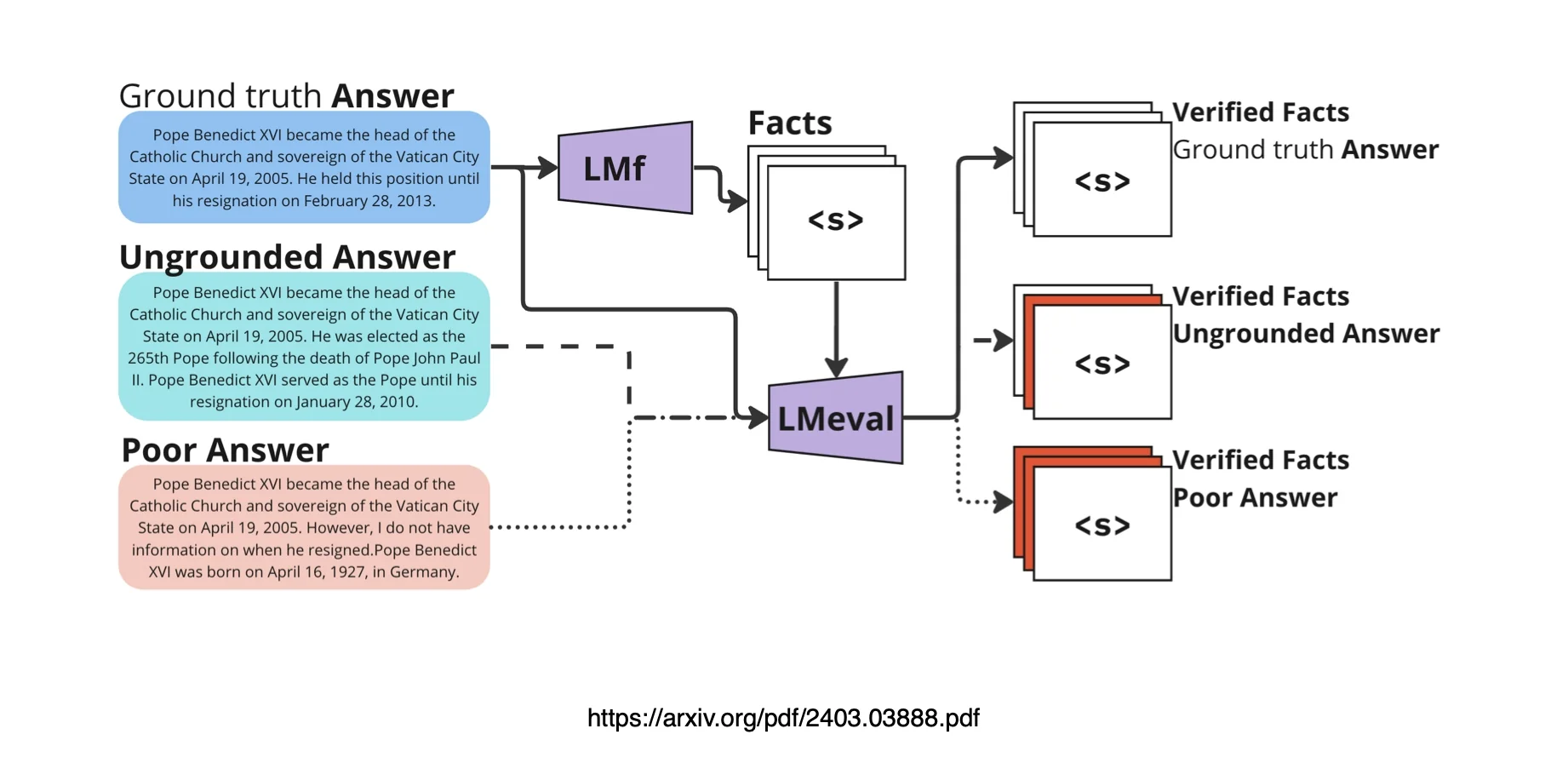
A flowchart showing the verification process of facts in LMF and LMeval, using ground truth, ungrounded, and poor answers, with arrows indicating data flow between components.
Prompt‑only verification overestimates truthfulness

In Conclusion

The study found that relying on prompts for fact verification can often overestimate the truthfulness of statements, especially when the text lacks important information.

This method can have error rates as high as 50% when dealing with incomplete texts.

However, presenting facts as a function to the language model (LM) greatly improves the accuracy and efficiency of verification.

FaaF shows that text with somewhat relevant or inaccurate information are more likely to produce false positives than those with missing or incomplete details.

The study also discovered that including a not clear option alongside True/False choices improves overall accuracy. Additionally, asking for citations before verifying facts can be helpful in some cases, but it may lead to false negatives if the text indirectly supports the fact without providing direct citations.

Finally, using FaaF significantly reduces both the number of LM calls and tokens required for verification, making the process more efficient in terms of cost and time.

Find the original study here.

Talk to an expert
Share
Link copied
authors
Cobus Greyling
Cobus Greyling
Chief Evangelist
Forrester logo at display.
Kore.ai named a leader in the Forrester Wave™ Cognitive Search Platforms, Q4 2025
Access Report
Gartner logo in display.
Kore.ai named a leader in the Gartner® Magic Quadrant™ for Conversational AI Platforms, 2025
Access Report
Stay in touch with the pace of the AI industry with the latest resources from Kore.ai

Get updates when new insights, blogs, and other resources are published, directly in your inbox.

Subscribe
Thank you! Your submission has been received!
Oops! Something went wrong while submitting the form.

Recent Blogs

View all
AI agents in retail: 12 proven use cases & examples (2026)
March 5, 2026
AI agents in retail: 12 proven use cases & examples (2026)
The end of manual AP: Zero-Touch invoice processing with AI for Process
February 20, 2026
The end of manual AP: Zero-Touch invoice processing with AI for Process
AI Agent governance: A practical guide to risk, trust, and compliance
February 20, 2026
AI Agent governance: A practical guide to risk, trust, and compliance
Accelerate time-to-value from AI

Find out how Kore.ai can help

Talk to an expert
Start using an AI agent today

Browse and deploy our pre-built templates

Marketplace
Background Image 4
Background Image 9
You are now leaving Kore.ai’s website.

‍

Kore.ai does not endorse, has not verified, and is not responsible for, any content, views, products, services, or policies of any third-party websites, or for any verification or updates of such websites. Third-party websites may also include "forward-looking statements" which are inherently subject to risks and uncertainties, some of which cannot be predicted or quantified. Actual results could differ materially from those indicated in such forward-looking statements.


Click ‘Continue’ to acknowledge the above and leave Kore.ai’s website. If you don’t want to leave Kore.ai’s website, simply click ‘Back’.

CONTINUEGO BACK
Agentic AI applications for the enterprise
English
Spanish
Spanish
Spanish
Spanish
Pre-Built Applications
BankingHealthcareRetailRecruitingHRIT
Kore.ai agent platform
Platform OverviewMulti-Agent OrchestrationAI Engineering ToolsSearch and Data AIAI Security and GovernanceNo-Code and Pro-Code ToolsIntegrations
 
AI for WorkAI for ServiceAI for ProcessAgent Marketplace
company
About Kore.aiLeadershipCustomer StoriesPartnersAnalyst RecognitionNewsroom
resources
DocumentationBlogWhitepapersWebinarsAI Research ReportsAI GlossaryVideosGenerative AI 101Responsive AI frameworkCXO Toolkit
GET INVOLVED
EventsSupportAcademyCommunityCareers

Let’s work together

Get answers and a customized quote for your projects

Submit RFP
Follow us on
© 2026 Kore.ai Inc. All trademarks are property of their respective owners.
Privacy PolicyTerms of ServiceAcceptable Use PolicyCookie PolicyIntellectual Property Rights
|
×