Agentic AI Apps
AI Solutions
Pre-built Applications

Ready-to-deploy applications across industries and functions.

AI for Banking
AI for Healthcare
AI for Retail
AI for IT
AI for HR
AI for Recruiting
Application Accelerators

Leverage pre-built AI agents, templates, and integrations from the Kore.ai Marketplace.

Kore.ai Marketplace
Pre-built agents
Templates
Integrations
Tailored Applications

Design and build applications on our Agent Platform using our enteprise modules.

Platform
Agent Platform

Your strategic enabler for enterprise AI transformation.

Learn more
Enterprise Modules
AI for Work
AI for Service
AI for Process
Top Resources
Scaling AI: practical insights
from AI leaders
AI use cases: insights from AI's leading decision makers
Beyond AI islands: how to fully build an enterwise-wide AI workforce
QUICK LINKS
About Kore.aiCustomer StoriesPartnersResourcesBlogWhitepapersDocumentationAnalyst RecognitionGet supportCommunityAcademyCareersContact Us
Agent Platform
Agent Platform
Agent Platform

Your strategic enabler for enterprise AI transformation.

learn more
PLATFORM MODULES
Multi-Agent Orchestration
AI Engineering Tools
Search + Data AI
AI Security + Governance
No-Code + Pro-Code Tools
Observability
Integrations
Enterprise Modules
For Service
AI AgentsAgent AI AssistanceAgentic Contact CenterQuality AssuranceProactive Outreach
For Work
Modules
Enterprise SearchIntelligent OrchestratorPre-Built AI AgentsAdmin ControlsAI Agent Builder
Departments
SalesMarketingEngineeringLegalFinance
For Process
Process AutomationAI Analytics + MonitoringPre-built Process Templates
upcoming event

Join the first generation of leaders who are designing, governing, and leading the truly intelligent organization.

Orlando
12 May
register
Recent AI Insights
What's new in AI for Work: features that drive enterprise productivity
AI INSIGHT
20 Feb 2026
Parallel Agent Processing
AI INSIGHT
16 Jan 2026
The AI productivity paradox: why employees are moving faster than enterprises
AI INSIGHT
12 Jan 2026
Agent Marketplace
More
More
Resources
Resource Hub
Blog
Whitepapers
Webinars
AI Research Reports
AI Glossary
Videos
AI Pulse
Generative AI 101
Responsive AI Framework
CXO Toolkit
Private equity
support
Documentation
Get support
Submit RFP
Academy
Community
COMPANY
About us
Leadership
Customer Stories
Partners
Analyst Recognition
Newsroom
Events
Careers
Contact us
Agentic AI Guides
forrester cx wave 2024 Kore at top
Kore.ai named a leader in The Forrester Wave™: Conversational AI for Customer Service, Q2 2024
Generative AI 101
CXO AI toolkit for enterprise AI success
upcoming event

Join the first generation of leaders who are designing, governing, and leading the truly intelligent organization.

Orlando
12 May
register
Talk to an expert
Not sure which product is right for you or have questions? Schedule a call with our experts.
Request a Demo
Double click on what's possible with Kore.ai
Sign in
Get in touch
Background Image 1
Blog
Conversational AI
As-Needed decomposition & planning using large language models ( ADaPT)

As-Needed decomposition & planning using large language models ( ADaPT)

Published Date:
February 10, 2025
Last Updated ON:
February 18, 2026

There has been a shift with regard to LLM implementations to decompose tasks and solve each step in an interactive fashion. But with this increased complexity is also introduced…

Introduction

Considering the recent research related to LLMs, the tasks assigned to LLMs are becoming increasingly complex. Hence these tasks cannot be solved by prompting alone, but by following an autonomous agent approach.

LLMs are being used as agents in two implementation types:

  1. Creating a sequence of sub-steps followed by iterative executions
  2. Generating a plan and executing or solving sub-tasks; plan-and-execute.

With conventional CoT the model does not know what faults to avoid and which deductions could lead to increased mistakes and error propagation.

CCoT provides both the correct and incorrect reasoning steps in the demonstration examples.
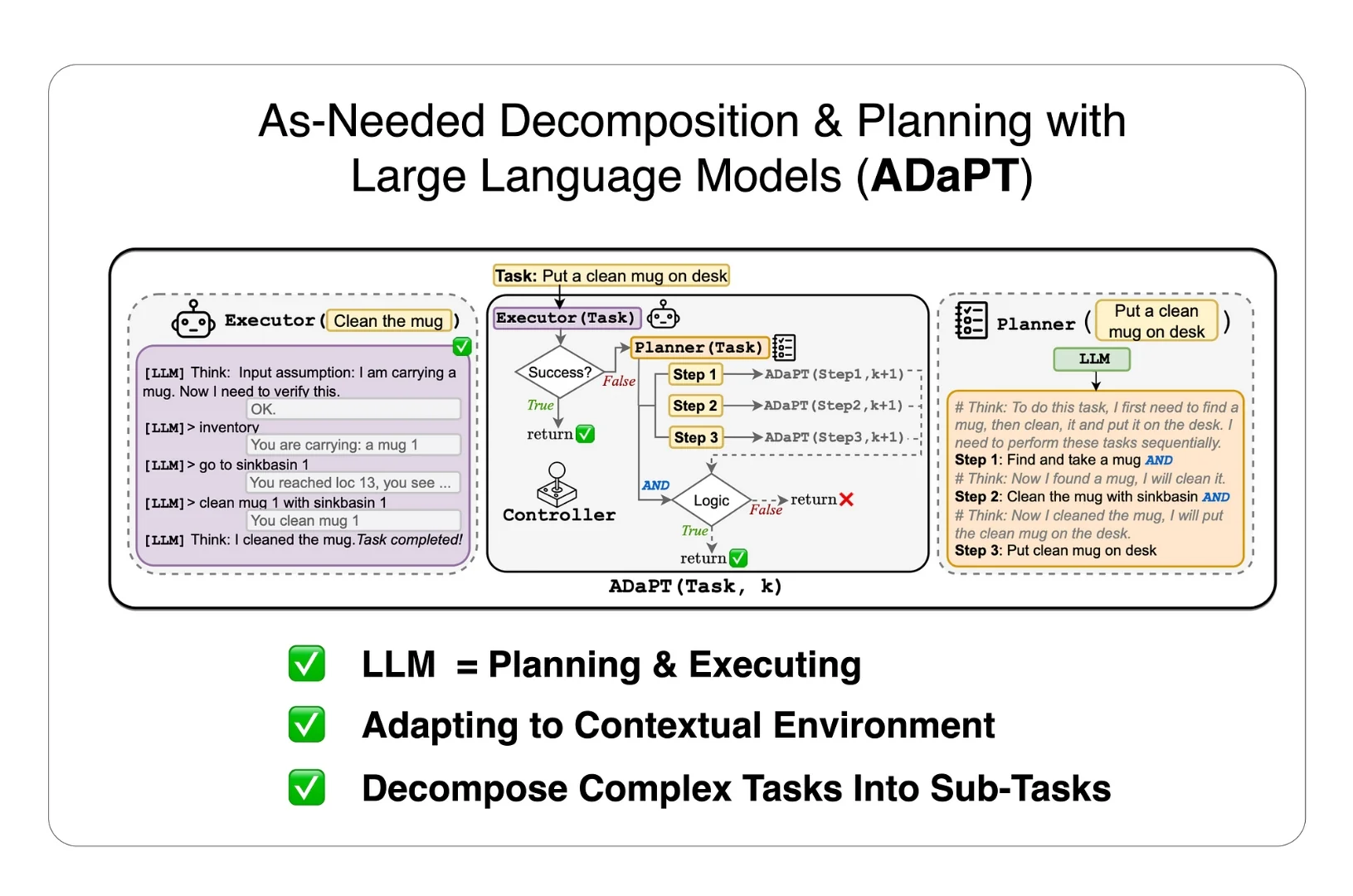
ADaPT overview: decomposition & planning flow

Decomposition & Sub-Tasks

ADaPT is an approach to explicitly plan and decompose complex sub-tasks as-needed, when the LLM is unable to execute the task.

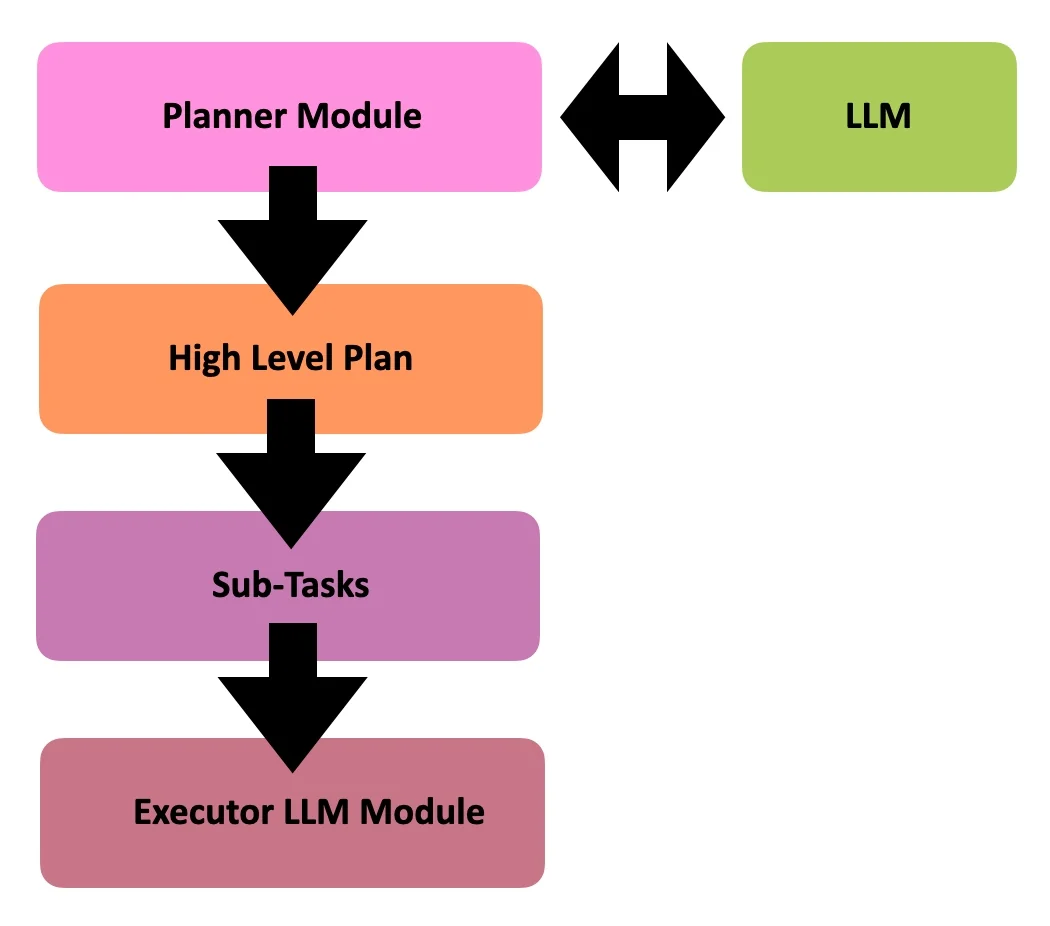
Hence ADaPT is an approach where a separate planner module is incorporated that leverages an LLM to create a high-level plan.

Considering the image below, a recognised approach is to use a separate planner module that leverages an LLM to create a high-level plan.

The planner in turn then delegates the simpler sub-tasks to an executor LLM module.

This reduces the compositional complexity and length of action trajectory of the query.

However, the ADaPT study considers this approach as non-adaptive and not resilient enough when faced with unachievable sub-tasks. The approach also cannot adapt to increased task complexity or manage execution failures. Failure in one sub-tasks will lead to overall task failure.
Planner-Module ↔ LLM: high-level plan to sub-tasks

More About ADaPT

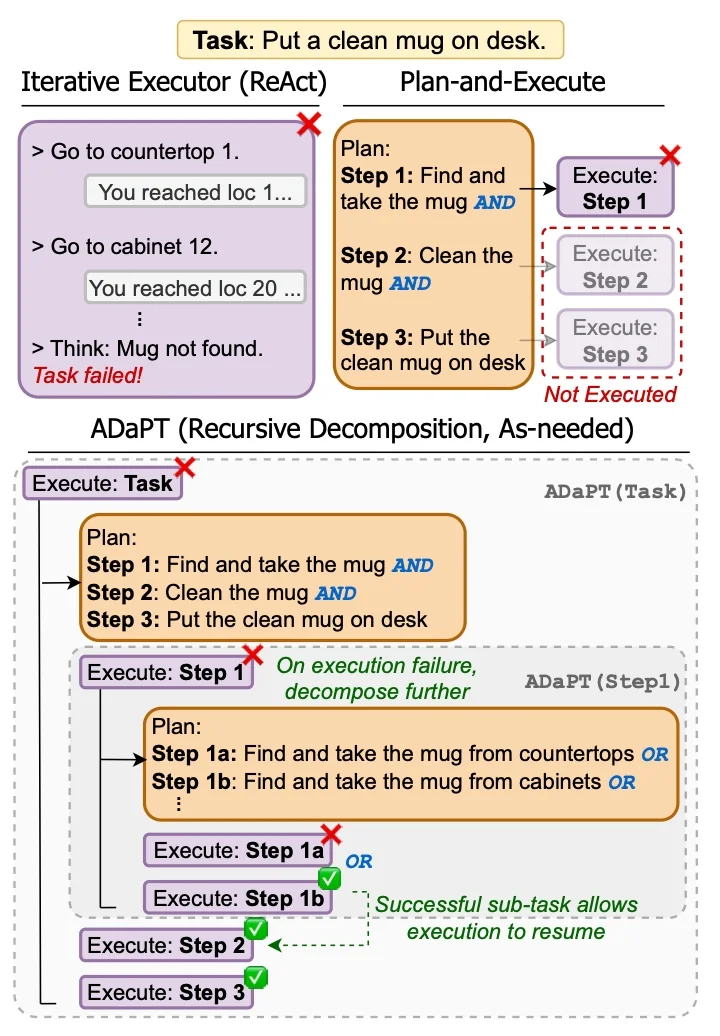
ADaPT is a recursive algorithm which decomposes a task into sub-tasks, but only when necessary. This adds a dynamic component when addressing task complexity.

Considering the image below, the ReAct approach is shown and also the Plan-And-Execute approach.

ADaPT with its recursive algorithm that dynamically decomposes complex sub-tasks on an as-needed basis and intervening only if the task is too complex for the executor.

It is evident that ADaPT is a more complex implementation and not merely a prompting strategy. ADaPT is really well suited for an LLM-based agent implementation.
Recursive decomposition example: mug-on-desk task

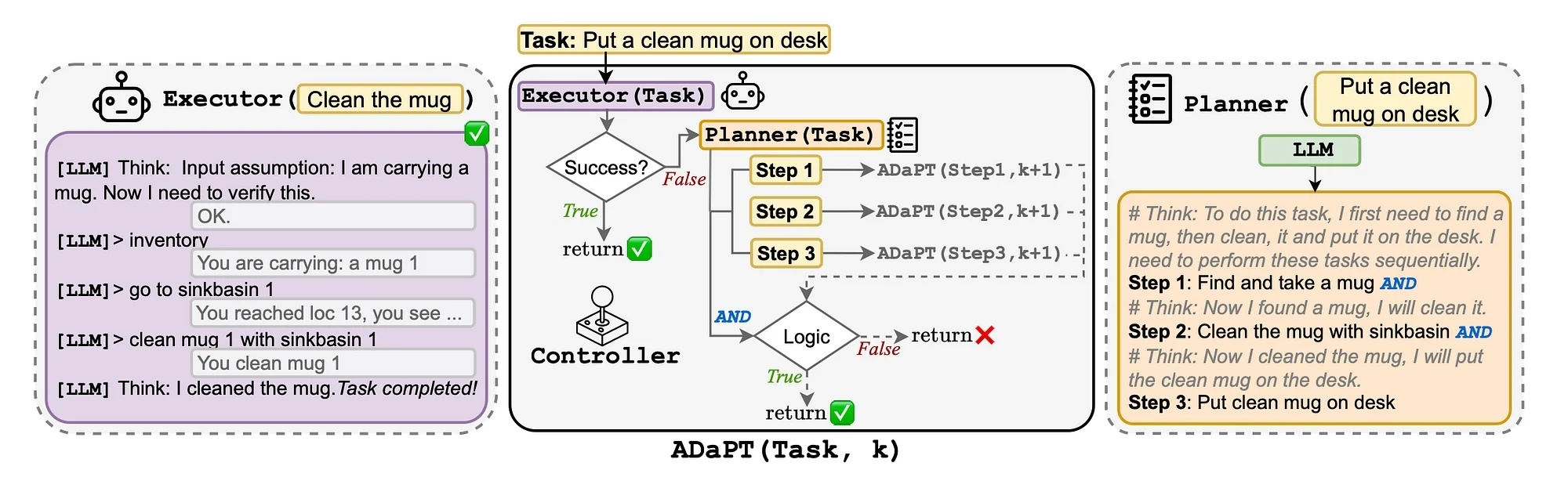
Considering the image below, the ADaPT pipeline is shown.

LLM Executor: the LLM is used for executing iterative interaction. An example execution trajectory is given.

Controller — LLM Program: This program, or module embeds the executor and planner.

LLM Planner: The LLM is used to generate sub-tasks.
LLM execution trace: finding and cleaning mug

Considerations

This approach adds resilience, exception handling and a high level of logic to LLM-based applications.

ADaPT cannot be described as prompting engineering technique, but rather as a LLM-based Agent implementation.

A large number of LLM-calls will be made; hence this approach demands a tool like LangSmith to implement inspectability and observability.

Cost is also a consideration with autonomous agents in terms of a large number of LLM calls. Prompt Chaining might serve as a good initial, more measured, hand-crafted approach.

Considering research, we have moved past the point of new Prompt Engineering techniques leveraging in-context learning (ICL), which was thought of previously as emergent abilities.

ADaPT moves into the realm of new agent types, by defining new algorithms.

ADAPT is also a good example of possible future multi-LLM orchestration; with using different LLMs in the capacity of LLM Executor, LLM Program (Controller) and LLM Planner.

Find the original study here. 

Request a demo
Share
Link copied
authors
Cobus Greyling
Cobus Greyling
Chief Evangelist
Forrester logo at display.
Kore.ai named a leader in the Forrester Wave™ Cognitive Search Platforms, Q4 2025
Access Report
Gartner logo in display.
Kore.ai named a leader in the Gartner® Magic Quadrant™ for Conversational AI Platforms, 2025
Access Report
Stay in touch with the pace of the AI industry with the latest resources from Kore.ai

Get updates when new insights, blogs, and other resources are published, directly in your inbox.

Subscribe
Thank you! Your submission has been received!
Oops! Something went wrong while submitting the form.

Recent Blogs

View all
AI agents in retail: 12 proven use cases & examples (2026)
March 5, 2026
AI agents in retail: 12 proven use cases & examples (2026)
The end of manual AP: Zero-Touch invoice processing with AI for Process
February 20, 2026
The end of manual AP: Zero-Touch invoice processing with AI for Process
AI Agent governance: A practical guide to risk, trust, and compliance
February 20, 2026
AI Agent governance: A practical guide to risk, trust, and compliance
Accelerate time-to-value from AI

Find out how Kore.ai can help

Talk to an expert
Start using an AI agent today

Browse and deploy our pre-built templates

Marketplace
Background Image 4
Background Image 9
You are now leaving Kore.ai’s website.

‍

Kore.ai does not endorse, has not verified, and is not responsible for, any content, views, products, services, or policies of any third-party websites, or for any verification or updates of such websites. Third-party websites may also include "forward-looking statements" which are inherently subject to risks and uncertainties, some of which cannot be predicted or quantified. Actual results could differ materially from those indicated in such forward-looking statements.


Click ‘Continue’ to acknowledge the above and leave Kore.ai’s website. If you don’t want to leave Kore.ai’s website, simply click ‘Back’.

CONTINUEGO BACK
Agentic AI applications for the enterprise
English
Spanish
Spanish
Spanish
Spanish
Pre-Built Applications
BankingHealthcareRetailRecruitingHRIT
Kore.ai agent platform
Platform OverviewMulti-Agent OrchestrationAI Engineering ToolsSearch and Data AIAI Security and GovernanceNo-Code and Pro-Code ToolsIntegrations
 
AI for WorkAI for ServiceAI for ProcessAgent Marketplace
company
About Kore.aiLeadershipCustomer StoriesPartnersAnalyst RecognitionNewsroom
resources
DocumentationBlogWhitepapersWebinarsAI Research ReportsAI GlossaryVideosGenerative AI 101Responsive AI frameworkCXO Toolkit
GET INVOLVED
EventsSupportAcademyCommunityCareers

Let’s work together

Get answers and a customized quote for your projects

Submit RFP
Follow us on
© 2026 Kore.ai Inc. All trademarks are property of their respective owners.
Privacy PolicyTerms of ServiceAcceptable Use PolicyCookie PolicyIntellectual Property Rights
|
×