Agentic AI Apps
AI Solutions
Pre-built Applications

Ready-to-deploy applications across industries and functions.

AI for Banking
AI for Healthcare
AI for Retail
AI for IT
AI for HR
AI for Recruiting
Application Accelerators

Leverage pre-built AI agents, templates, and integrations from the Kore.ai Marketplace.

Kore.ai Marketplace
Pre-built agents
Templates
Integrations
Tailored Applications

Design and build applications on our Agent Platform using our enteprise modules.

Platform
Agent Platform

Your strategic enabler for enterprise AI transformation.

Learn more
Enterprise Modules
AI for Work
AI for Service
AI for Process
Top Resources
Scaling AI: practical insights
from AI leaders
AI use cases: insights from AI's leading decision makers
Beyond AI islands: how to fully build an enterwise-wide AI workforce
QUICK LINKS
About Kore.aiCustomer StoriesPartnersResourcesBlogWhitepapersDocumentationAnalyst RecognitionGet supportCommunityAcademyCareersContact Us
Agent Platform
Agent Platform
Agent Platform

Your strategic enabler for enterprise AI transformation.

learn more
PLATFORM MODULES
Multi-Agent Orchestration
AI Engineering Tools
Search + Data AI
AI Security + Governance
No-Code + Pro-Code Tools
Observability
Integrations
Enterprise Modules
For Service
AI AgentsAgent AI AssistanceAgentic Contact CenterQuality AssuranceProactive Outreach
For Work
Modules
Enterprise SearchIntelligent OrchestratorPre-Built AI AgentsAdmin ControlsAI Agent Builder
Departments
SalesMarketingEngineeringLegalFinance
For Process
Process AutomationAI Analytics + MonitoringPre-built Process Templates
upcoming event

Join the first generation of leaders who are designing, governing, and leading the truly intelligent organization.

Orlando
12 May
register
Recent AI Insights
What's new in AI for Work: features that drive enterprise productivity
AI INSIGHT
20 Feb 2026
Parallel Agent Processing
AI INSIGHT
16 Jan 2026
The AI productivity paradox: why employees are moving faster than enterprises
AI INSIGHT
12 Jan 2026
Agent Marketplace
More
More
Resources
Resource Hub
Blog
Whitepapers
Webinars
AI Research Reports
AI Glossary
Videos
AI Pulse
Generative AI 101
Responsive AI Framework
CXO Toolkit
Private equity
support
Documentation
Get support
Submit RFP
Academy
Community
COMPANY
About us
Leadership
Customer Stories
Partners
Analyst Recognition
Newsroom
Events
Careers
Contact us
Agentic AI Guides
forrester cx wave 2024 Kore at top
Kore.ai named a leader in The Forrester Wave™: Conversational AI for Customer Service, Q2 2024
Generative AI 101
CXO AI toolkit for enterprise AI success
upcoming event

Join the first generation of leaders who are designing, governing, and leading the truly intelligent organization.

Orlando
12 May
register
Talk to an expert
Not sure which product is right for you or have questions? Schedule a call with our experts.
Request a Demo
Double click on what's possible with Kore.ai
Sign in
Get in touch
Background Image 1
Blog
Conversational AI
Active prompting with chain-of-thought for large language models

Active prompting with chain-of-thought for large language models

Published Date:
June 16, 2024
Last Updated ON:
February 18, 2026

By using AI accelerated human annotation this framework removes uncertainty and introduces reliability via a Chain-Of-Thought baseline.

Introduction

There are emergent abilities being discovered concerning Large Language Models (LLMs), these abilities are in essence different ways in-context learning (ICL) is leveraged within LLMs.

LLMs excel at ICL and it has been shown in the recent past that with effective task-specific prompt engineering LLMs can produce high-quality answers.

Question and answer tasks with example-based prompting and CoT reasoning is particularly effective.

The concern of a recent study is that these prompt examples might be too rigid and fixed for different tasks.

This approach follows a methodology which is gaining popularity in recent studies and developments. This procedure includes the following elements:

  1. Human annotated and vetted data.
  2. Leveraging one or more LLMs for intermediate tasks prior to the final inference.
  3. Adding flexibility to the prompt engineering process demand the introduction of complexity and some sort of framework which manages the process.

The four steps of active prompting

  1. Uncertainty Estimation
  2. Selection
  3. Annotation
  4. Final Inference

 Uncertainty estimation

The LLM is queried a predefined number of times, to generate possible answers for a set of training questions. These answer and question sets are generated in a decomposed fashion with intermediate steps.

An uncertainty calculator is used based on the answers via an uncertainty metric.

Selection

Ranked according to the uncertainty, the most uncertain questions are selected for human inspection and annotation.

Annotation

Human annotators are used to annotate the selected uncertain questions.

Final Inference

Final inference for each question is performed with the newly annotated exemplars.

Considerations

  1. There will be an increase in inference cost and token use when employing this approach; seeing a LLM is leveraged for the uncertainty calculation.
  2. This study again illustrates the importance of a data centric approach to applied AI with a RLHF approach, where training data is created via human supervised process which is AI accelerated.
  3. This is a good example where AI is used to accelerate the human annotation process by removing noise from the data and creating training data with a clear signal.
  4. This approach is moving us towards a data focussed way-of-work with data discovery, data design and data development.
  5. As this type of implementation scales, a data productivity studio or latent space will be required to streamline the data discovery, design and development process.

Contribution

The contribution of the study is three-fold:

  1. A very judicious process of identifying the most valuable and relevant information sets (question and answer) for annotation. Doing this while reducing the human data-related workload via a AI accelerated process.
  2. The establishment of an effective set of uncertainty metrics.
  3. The proposed method surpasses competitive baseline models by a large margin on multiple reasoning tasks.

Baselines

It is interesting to note that this approach has four methods serving as its main baselines:

  • Chain-of-thought (CoT) (Wei et al., 2022b): This method employs standard chain-of-thought prompting and offers four to eight human-written exemplars, comprising a sequence of intermediate reasoning steps.
  • Self-Consistency (SC) (Wang et al., 2022c): An enhanced version of CoT, SC diverges from greedy decoding. Instead, it samples a set of reasoning paths and selects the most prevalent answer.
  • Auto-CoT (Zhang et al., 2022b): This technique involves an automatic exemplar construction approach that clusters and generates rationales using zero-shot prompting (Kojima et al., 2022).
  • Random-CoT: Serving as a baseline for Active-Prompt, Random-CoT follows the same annotation process. The only distinction lies in its utilisation of a random sampling method for questions from the training data during annotation, rather than employing the proposed uncertainty metrics.

More on chain-of-x

A number of recent papers have shown that on user instruction to do so, Large Language Models (LLMs) are capable of decomposing complex problems into a series of intermediate steps.

This basic principle was introduced by the concept of Chain-Of-Thought(CoT) prompting for the first time in 2022.

The basic premise of CoT prompting is to mirror human problem-solving methods, where we as humans decompose larger problems into smaller steps.
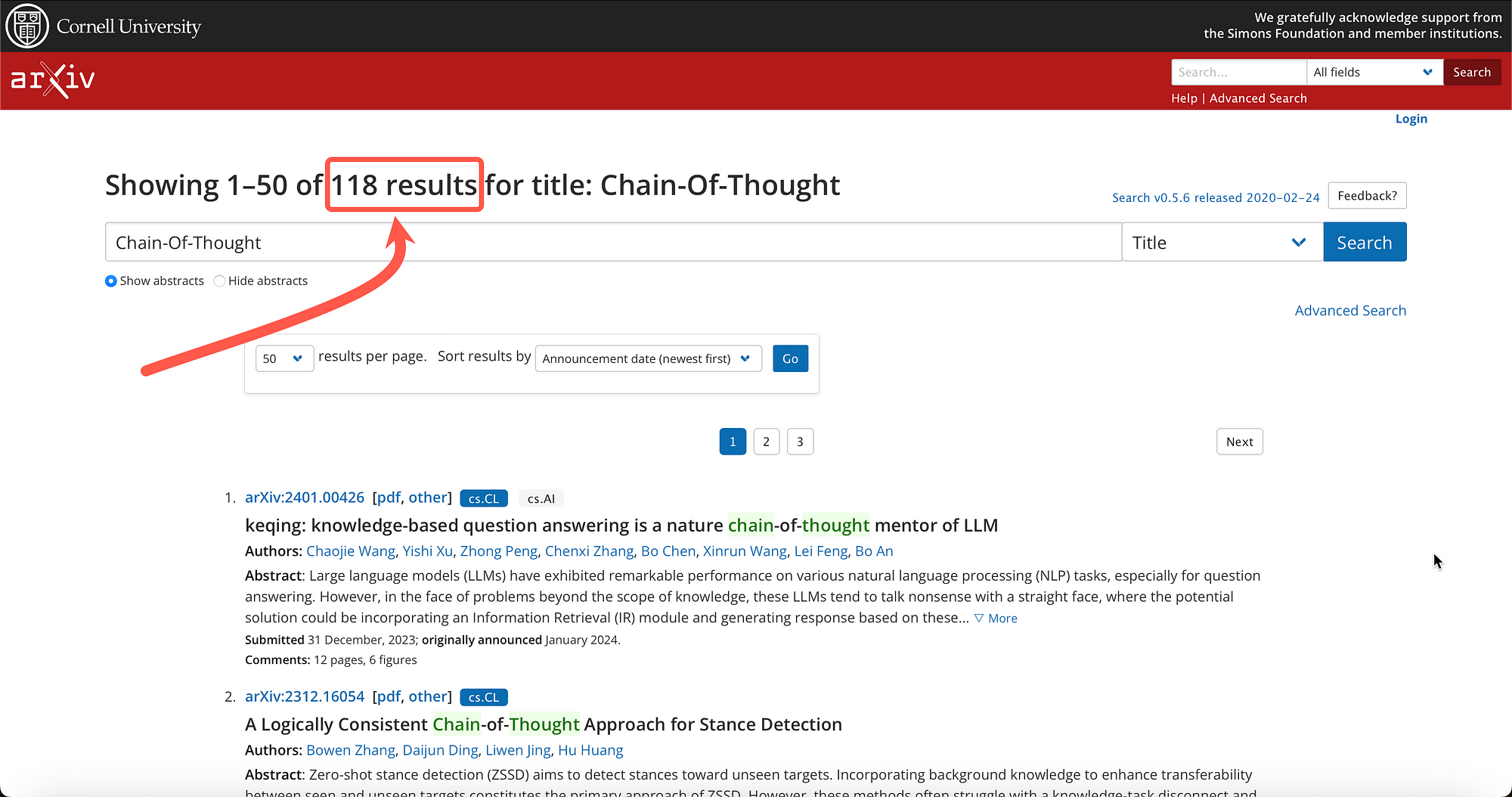
Source

The LLM then addresses each sub-problem with focussed attention hence reducing the likelihood of overlooking crucial details or making wrong assumptions.

A chain of thought is a series of intermediate natural language reasoning steps that lead to the final output, and we refer to this approach as chain-of-thought prompting. ~ Source

The breakdown of tasks makes the actions of the LLM less opaque with transparency being introduced.

Areas where Chain-Of-Thought-like methodology has been introduced are:

  • Chain-of-Thought Prompting
  • Multi-Modal CoT
  • Multi-Lingual CoT
  • Chain-of-Explanation
  • Chain-of-Knowledge
  • Chain-of- Verification
  • IR Chain-of-Thought
  • LLM Guided Tree Of Thought
  • Chain-Of-Note
  • Least-To-Most Prompting
  • Chain Of Empathy
  • Supervised Chain-Of-Thought Reasoning
  • Self-Consistency For Chain-Of-Thought Prompting
  • Knowledge Driven Chain-Of-Thought

And more…

Previously published on Medium.

Share
Link copied
authors
Cobus Greyling
Cobus Greyling
Chief Evangelist
Forrester logo at display.
Kore.ai named a leader in the Forrester Wave™ Cognitive Search Platforms, Q4 2025
Access Report
Gartner logo in display.
Kore.ai named a leader in the Gartner® Magic Quadrant™ for Conversational AI Platforms, 2025
Access Report
Stay in touch with the pace of the AI industry with the latest resources from Kore.ai

Get updates when new insights, blogs, and other resources are published, directly in your inbox.

Subscribe
Thank you! Your submission has been received!
Oops! Something went wrong while submitting the form.

Recent Blogs

View all
AI agents in retail: 12 proven use cases & examples (2026)
March 5, 2026
AI agents in retail: 12 proven use cases & examples (2026)
The end of manual AP: Zero-Touch invoice processing with AI for Process
February 20, 2026
The end of manual AP: Zero-Touch invoice processing with AI for Process
AI Agent governance: A practical guide to risk, trust, and compliance
February 20, 2026
AI Agent governance: A practical guide to risk, trust, and compliance
Accelerate time-to-value from AI

Find out how Kore.ai can help

Talk to an expert
Start using an AI agent today

Browse and deploy our pre-built templates

Marketplace
Background Image 4
Background Image 9
You are now leaving Kore.ai’s website.

‍

Kore.ai does not endorse, has not verified, and is not responsible for, any content, views, products, services, or policies of any third-party websites, or for any verification or updates of such websites. Third-party websites may also include "forward-looking statements" which are inherently subject to risks and uncertainties, some of which cannot be predicted or quantified. Actual results could differ materially from those indicated in such forward-looking statements.


Click ‘Continue’ to acknowledge the above and leave Kore.ai’s website. If you don’t want to leave Kore.ai’s website, simply click ‘Back’.

CONTINUEGO BACK
Agentic AI applications for the enterprise
English
Spanish
Spanish
Spanish
Spanish
Pre-Built Applications
BankingHealthcareRetailRecruitingHRIT
Kore.ai agent platform
Platform OverviewMulti-Agent OrchestrationAI Engineering ToolsSearch and Data AIAI Security and GovernanceNo-Code and Pro-Code ToolsIntegrations
 
AI for WorkAI for ServiceAI for ProcessAgent Marketplace
company
About Kore.aiLeadershipCustomer StoriesPartnersAnalyst RecognitionNewsroom
resources
DocumentationBlogWhitepapersWebinarsAI Research ReportsAI GlossaryVideosGenerative AI 101Responsive AI frameworkCXO Toolkit
GET INVOLVED
EventsSupportAcademyCommunityCareers

Let’s work together

Get answers and a customized quote for your projects

Submit RFP
Follow us on
© 2026 Kore.ai Inc. All trademarks are property of their respective owners.
Privacy PolicyTerms of ServiceAcceptable Use PolicyCookie PolicyIntellectual Property Rights
|
×