










.webp)
What are AI Hallucinations and why do they matter?
AI hallucinations occur when a model generates incorrect, fabricated, or unverifiable information while presenting it as accurate. Large language models produce outputs by predicting likely text patterns, not by validating facts. This can result in responses that are fluent but wrong.
AI models do not verify truth or access authoritative sources by default. They generate responses based on probability, not factual certainty. This creates a gap between plausible output and actual accuracy.
For enterprises, hallucinations are a reliability and governance issue. As AI systems move from content generation to decision-making and actions, the risk becomes operational rather than purely informational.
What are the key characteristics of AI hallucinations?
- Confident but incorrect outputs: Models present inaccurate information with the same confidence as correct responses, without signaling errors.
- Fluent but factually wrong: Outputs are structured and coherent, making errors harder to detect without verification.
- Error propagation in multi-step reasoning: Early mistakes can affect the entire response, especially in longer outputs.
- Higher risk in agentic systems: In systems that take actions, hallucinations can trigger incorrect workflows or decisions.
- Not fully eliminable: Hallucinations are inherent to current model design. They can be reduced but not removed entirely.
Why are AI hallucinations a critical concern for enterprises?
Earlier, hallucinations mainly affected content accuracy. Now, as AI is integrated into operations, the impact is broader.
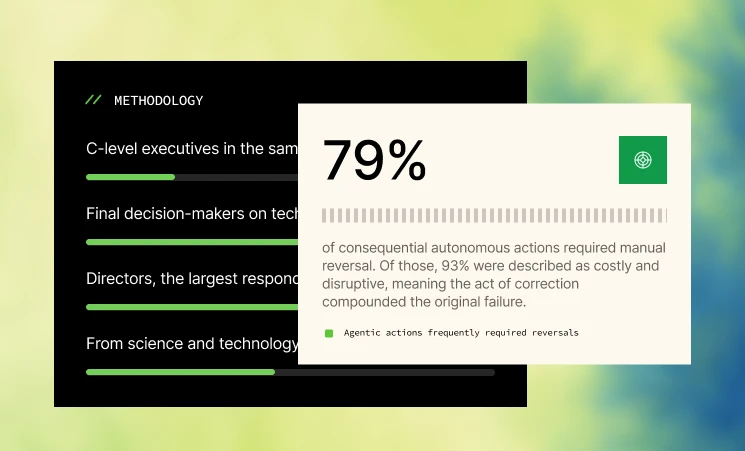
In agentic systems, hallucinations can lead to incorrect actions, workflow failures, or persistent errors. These issues are harder to detect and reverse.
Organizations should treat hallucination risk as a production reliability concern. Systems must be designed to detect, limit, and recover from such errors.