What are context graphs and how do they make AI agents smarter?
Last Updated
May 13, 2026

Juhi Tiwari
Read Time
Summary
Context graphs are an enterprise AI infrastructure layer that captures how organizations make decisions, including reasoning, exceptions, precedents, and decision lineage. This article explains how context graphs complement knowledge graphs and RAG by giving AI agents access to organizational judgment, not just documented information. It explores agentic AI, decision intelligence, contextual memory, AI agent observability, and autonomous decision-making, highlighting how Kore.ai uses context graphs within Artemis to improve agent accuracy, continuity, and enterprise-scale decision-making.
What’s on this page
Only one in five organizations report significant value from their generative AI investments. Not because the models are weak. Because the models do not know how the organization actually operates.
AI agents can follow rules. They cannot tell when a rule should bend. They can execute processes. They cannot apply the judgment that comes from knowing how similar situations have been handled before. Every exception ever approved, every precedent ever set, every edge case ever resolved: that reasoning lives in people and conversations, not in any system an AI can access.
Context graphs are the infrastructure layer that changes this. They capture organizational decision-making as structured, queryable data: who decided what, under which conditions, with which exceptions, referencing which prior decisions. Not just outcomes. The reasoning behind them.
Gartner and Forrester both identified context graphs as foundational infrastructure for agentic AI in early 2026. Gartner projects that by 2029, 80% of AI agent platforms will have context layers in place. Today, fewer than 10% do.
This blog explains what context graphs are, how they work, how they compare to knowledge graphs and RAG, what the analysts are saying, and what it takes to build one.
The invisible intelligence gap holding enterprise AI back
Enterprise AI has a structural blind spot, and it is not in the technology.
Every organization operates on two layers of intelligence. The first is documented: policies, playbooks, approval workflows, process guides. This layer lives in systems, it is searchable and transferable, and AI agents can access it today.
The second layer is invisible. It is the accumulated judgment of how things actually get done: which exceptions get approved and under what conditions, how edge cases get resolved when the rulebook runs out, which decisions set precedents that quietly govern everything that follows. This layer does not live in any system. It lives in people, in Slack threads, in escalation calls, in the institutional memory of whoever has been around long enough to absorb it. When those people leave, it leaves with them.
Your AI has full access to the first layer. It has no access to the second. And the second layer is precisely where the hard decisions happen.
Gartner identified this in its February 2026 research: the missing piece is the "why" and the "how," especially when decision elements happened outside of any formal system. The data tells agents what happened. Context tells them how and why. Without that second layer, even the most capable AI agents are operating with half the picture.
What is a context graph?
A context graph is a structured, continuously updated record of how your organization actually makes decisions, not how the documentation says it should.
Every time a decision gets made, a context graph records it: what the situation was, which policy applied, what exception was granted, who approved it, and why it was permitted. Not just the outcome. The reasoning behind it. Over time, these decision records connect into a queryable layer of organizational intelligence that AI agents can draw from at decision time.
The defining characteristic is decision lineage: the full record of how and why outcomes were permitted to happen the way they did, structured with time as a core dimension so agents can query not just what happened but what was true when it happened and what precedent should govern the situation in front of them right now.
Gartner describes context graphs as a structural source of truth: long-term memory that defines both the semantic entities and the operational governance of a specific domain. Unlike traditional retrieval methods that rely on probabilistic similarity, context graph layers ground model behavior in relational logic, transforming context from a passive reference into an active constraint that shapes how an agent decides.
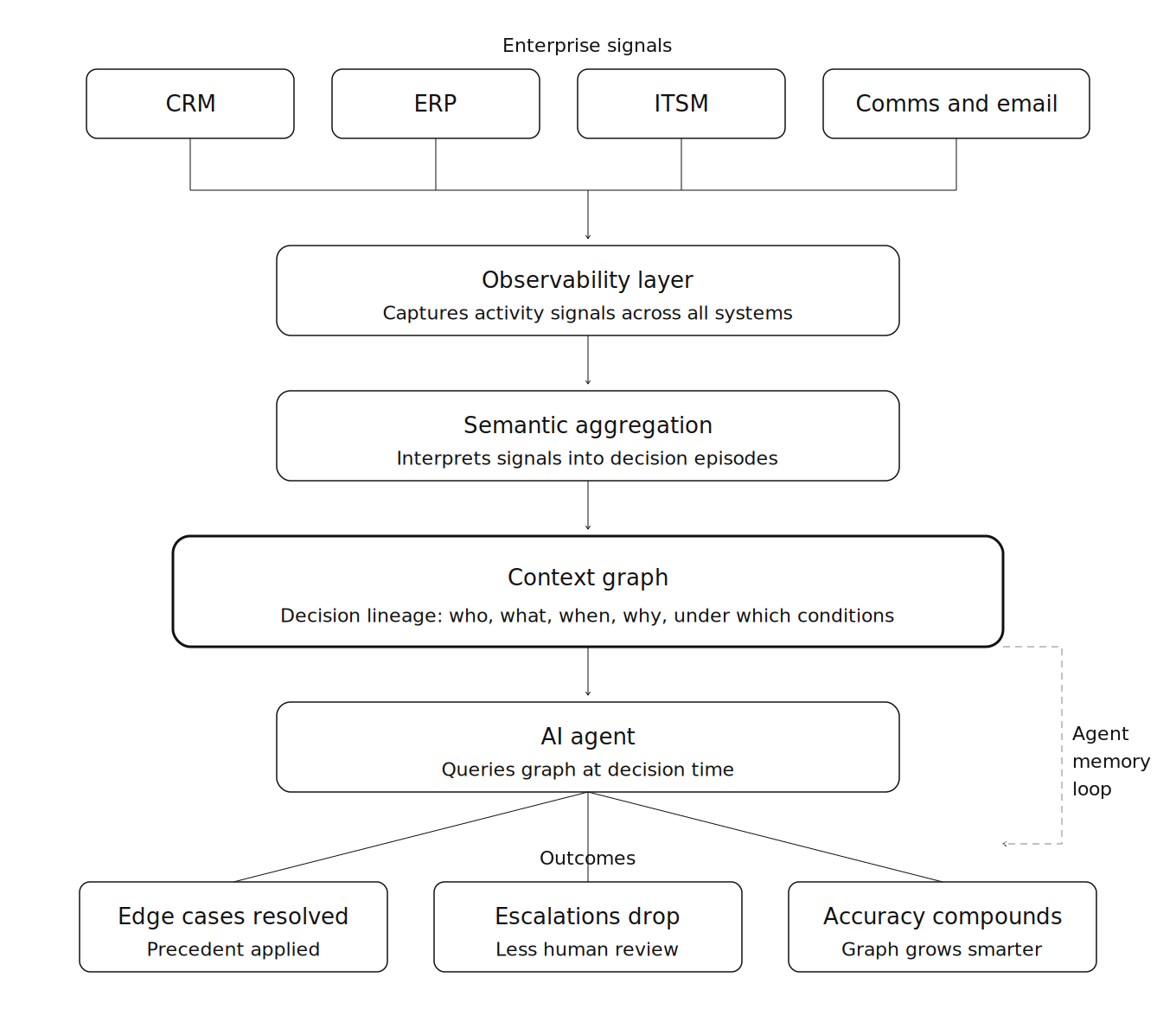
What a decision event looks like inside a context graph
To understand how a context graph works in practice, it helps to look at its core building block: the decision event.
A decision event is a structured record of a specific moment of organizational judgment. It captures the situation that triggered the decision, the entity involved, the conditions present, and the policy version in effect. It records what was decided, approved, escalated, or overridden. It notes whether the standard rule was followed or bent, under what conditions, and by whose authority. And it links to the prior decisions that informed it, creating a chain of reasoning that stretches back through time.
Over time, these events compound. A decision made this quarter references a precedent set two quarters earlier. A compliance exception approved under specific conditions becomes a retrievable pattern the next time a similar situation arises. A pricing call made in one context shapes how the next hundred like it get handled.
This is what separates a context graph from a log or a database. A log records that something happened. A database records the current state of something. A context graph records why a decision was permitted to happen, what it was based on, and what it means for every similar situation that follows. That chain of reasoning is what makes organizational judgment queryable, and it is what no other infrastructure layer in your AI stack currently captures.
Context graphs vs. knowledge graphs: what is the difference
Understanding the difference between context graphs and knowledge graphs is essential, because the two get conflated constantly, and confusing them leads to real gaps in AI strategy.
A knowledge graph maps what exists and how things relate: entities, relationships, ownership, structure. It answers the question of what is true right now. A context graph answers a fundamentally different question: how did we get here, and how have we handled situations like this before?
Gartner's February 2026 research draws the line precisely. Knowledge graphs are relatively static, updated periodically, with a query focus on "what" and "who." They capture data lineage and provide domain knowledge and reasoning support for AI agents. Context graphs are continuously evolving, updated in real time, with a query focus on "how" and "why." They capture decision lineage and provide process auditability, guardrailing, and continuous agentic learning through simulation.
Both are necessary, and they work together rather than in place of each other. Context graphs build on top of knowledge graph infrastructure. But they answer categorically different questions, and enterprises that have only one are leaving a significant gap in what their agents can access.
Context graphs vs. RAG: why you need both
The comparison with retrieval-augmented generation (RAG) reveals a similarly important distinction.
RAG surfaces relevant documents when an agent needs context. It is effective at answering: what does our documentation say about this? But documents capture what the rule is. They rarely capture the history of how the rule has been applied, bent, or overridden across hundreds of real decisions.
The difference is direct: RAG improves what a model knows. A context graph improves how an agent decides.
The two are complementary. RAG and context graphs work together in a complete agentic architecture: RAG provides the knowledge, context graphs provide the judgment. Enterprises need both.
What analysts say about context graphs in 2026
The analyst community's position on context graphs shifted significantly in early 2026, and the research is worth understanding directly.
Gartner's strategic planning assumption: by 2029, 80% of AI agent platforms using reasoning models will have aligned context layers in place, compared to less than 10% today. That is a near-complete market shift in three years, and it signals where enterprise AI infrastructure is heading.
The performance case is equally clear. Gartner's research shows context layers can improve reasoning accuracy by over 40% and reduce token consumption by approximately 70%, creating a compounding effect: higher-quality outputs at significantly lower computational cost. Separately, Gartner found that organizations implementing semantic modeling are more than twice as likely to achieve high effectiveness in AI data engineering practices, yet only 44% have done so.
Forrester reinforces the foundation argument in its February 2026 best practices report: a modern AI data fabric must embed knowledge graphs, semantic layers, and decision context to ensure data is not just accessible but understood and trusted. The data fabric delivers context. The context graph makes that context actionable at decision time.
Gartner also names the strategic implication directly: context graphs provide durable competitive moats through proprietary organizational knowledge accumulation, creating sustainable differentiation beyond commoditized model capabilities. That is not a performance claim. It is a strategic one, and it reframes the investment case for context graphs entirely.
Why agentic AI breaks without a context layer
When AI was assisting human decisions, missing context was a friction. A human reviewer caught the edge cases. The cost of a missed precedent was a correction, not a consequence.
Agentic AI raises the stakes entirely. When agents are routing approvals, making pricing calls, processing compliance reviews, and committing the organization to outcomes without a human in the loop, the quality of every decision depends directly on the institutional intelligence they can access. And two failure patterns show up consistently in enterprise deployments that lack a context layer.
The first is literal policy application: the agent follows the rules exactly and misses the organizational nuance that governs how those rules actually get applied. The output is technically correct and operationally wrong. The second is excessive escalation: the agent, having no access to precedent, routes everything to a human reviewer. The volume wipes out the efficiency case for automation entirely. Both failures look like AI underperformance. Both are actually context infrastructure failures, and neither gets fixed by a better model or a smarter prompt.
Context graphs solve both. With access to decision history, agents can recognize patterns, apply established precedents, and reserve escalation for situations that are genuinely novel. The result is autonomous operation that actually holds up under the conditions that matter most.
How context graphs make AI agents measurably better
The performance impact of context graphs shows up in three concrete and measurable ways.
- Agents stop over-escalating: With access to decision history, an agent recognizes that the situation in front of it matches a pattern the organization has resolved before, applies the established precedent, and moves forward. Escalation rates drop. Human review gets reserved for genuinely novel situations, which is where human judgment actually adds value.
- Edge cases get handled correctly: The hardest test for any autonomous system is the exception, not the routine case. Context graphs give agents access to how the organization has historically handled exceptions: under what conditions they were approved, by whom, and what the outcome was. The agent does not guess. It has a record.
- Accuracy compounds over time: Every decision agents make with the context graph in place extends the graph. Every new precedent captured deepens the intelligence layer. Gartner describes this as a learning loop: agents use decision traces to improve, run simulations, and optimize their decision flows continuously. Unlike most AI implementations that plateau once initial training data runs out, a context graph makes the system more accurate the more it is used.
How a context graph gets built:
Building genuine context graph capability requires four layers working together, each contributing something the others cannot replace.
- Execution-layer observability is the foundation: visibility into the raw activity signals produced as work moves through enterprise systems. Documents edited, fields updated, records changed in specific sequences, messages sent in coordination with state changes elsewhere. The breadth of this observability matters because behavioral patterns are only legible in full cross-system context.
- Semantic aggregation turns those raw signals into meaningful decision episodes. A series of document edits, communications, and record updates across several days might collectively represent a pricing exception process, even if no system ever labeled it that way. This layer infers the higher-level construct from atomic signals.
- Graph structure with temporal modeling organizes decision events into a queryable structure. Nodes are entities: accounts, policies, decisions, people, outcomes. Edges are relationships: who approved what, under which policy version, referencing which prior decision. Time is structural here, not decorative, so agents can query what was true at the moment a decision was made, not just what is true now.
- Agent memory from execution means every instrumented agent run extends the context graph. The graph grows more accurate and comprehensive with every deployment, creating the compounding advantage that makes the investment more valuable over time, not less.
Gartner is explicit: this is not an off-the-shelf product. It must be engineered by combining services, capabilities, and custom modeling to convert organizational tacit knowledge into machine-readable, explicit knowledge that agents can leverage.
Why building context graphs now is a strategic advantage
Foundation models are commoditizing faster than most forecasts anticipated. Within a few years, every serious enterprise will have access to capable AI reasoning on similar terms. The question will no longer be which model. It will be what that model knows about how your organization specifically works.
The decision history, exception patterns, and institutional precedents in your context graph cannot be licensed from a model provider. They cannot be purchased off the shelf. They can only be built by capturing the decisions your organization actually makes, over time, in the course of real operations. Gartner describes this compounding effect directly: every decision trace adds institutional memory that becomes increasingly valuable for agentic systems and ultimately hard to replace.
The organizations building context graph capability now will have two to three years of accumulated decision intelligence by the time others begin. That head start, in a world where context is the primary differentiator, does not close easily.
How Kore.ai builds context graph capability into Artemis
Artemis, Kore.ai's enterprise agent platform, is built around a contextual intelligence foundation that addresses the exact problem this blog describes: agents that can access not just what an enterprise contains, but how it operates and decides. This foundation combines a knowledge graph, agentic RAG, multi-vector search, agent memory, and context management into a unified layer that powers enterprise-scale agentic systems.
- A knowledge graph that unifies fragmented enterprise knowledge: Modern enterprise knowledge is distributed across CRM systems, business applications, content repositories, knowledge bases, documents, conversations, and operational systems. Artemis addresses this through a knowledge graph layer that works alongside agentic RAG and multi-vector search to help agents discover, retrieve, and use relevant enterprise knowledge more effectively. Agents do not work from raw, disconnected data. They work from a structured, unified map of what exists across the enterprise and how it relates. The result is improved retrieval quality, reduced information fragmentation, and more relevant context at the moment an agent needs to act.
- Context intelligence that maintains continuity across workflows: Knowing what exists is the first layer. Maintaining awareness of what is happening across conversations, workflows, tasks, and decisions as work progresses is the second. Artemis addresses this through a combination of long-term and short-term agent memory, durable session management, and structured context passing. The platform runtime manages conversation history, memory, and context across agent hierarchies, so agents retain continuity across interactions rather than starting fresh with every session.
- Structured context passing across multi-agent systems: In complex enterprise workflows, multiple agents collaborate, hand off tasks, and build on each other's outputs. Artemis enables structured context passing between agents: each agent in a workflow has access to the relevant history, decisions, and information produced by the agents before it. Organizational knowledge does not stay siloed inside individual agents. It moves with the workflow, ensuring consistency and continuity across even long-running, distributed processes.
- Adaptive memory that improves over time: Artemis includes teachability and adaptive memory capabilities that allow the platform to continuously incorporate new knowledge and improve retrieval relevance over time. Every interaction, every agent run, every decision made within the platform contributes to a richer organizational intelligence layer. The system does not plateau after initial deployment. It compounds, which is precisely the dynamic Gartner identifies as the source of durable competitive advantage in context graph infrastructure.
Together, these capabilities give Artemis agents something most enterprise AI systems lack: a contextual foundation that connects what the organization knows, remembers what it has done, and carries that intelligence forward across every workflow and every agent interaction. That is what context graph capability looks like in a production enterprise platform.
Conclusion
The enterprise AI conversation has spent years focused on models, data, and workflows. All of it necessary. All of it valuable. And all of it made meaningfully more reliable when the context layer is finally in place.
Context graphs are not a new category of software to evaluate. They are the infrastructure that closes the gap between what AI agents are capable of and what they are trusted to do autonomously in production. Without them, agents follow rules. With them, agents exercise judgment. That distinction is the difference between a pilot and a platform, between a productivity tool and a genuine transformation.
The organizations that understand this now, and start building the decision intelligence layer into their AI deployments today, will look back in three years at a compounding asset that no competitor can replicate without living through the same operational history. The ones that wait will spend those three years explaining why their AI still needs so much human oversight.
Context graphs are what make agentic AI trustworthy at scale. Building that foundation is the most consequential AI infrastructure decision an enterprise can make right now.
FAQ
Q1. What is a context graph?
A. A context graph is a structured, continuously updated data layer that captures how an organization makes decisions over time. It records the conditions, exceptions, approvals, precedents, and reasoning chains behind each decision, making that institutional intelligence available to AI agents at decision time. Unlike a database or a knowledge graph, a context graph is designed to capture organizational behavior and decision lineage, not just organizational state.
Q2. How is a context graph different from a knowledge graph?
A knowledge graph maps entities and their relationships: what exists and how things connect. A context graph captures decision events and behavioral patterns over time: how and why things happened, under what conditions exceptions were made, and what precedents govern future similar situations. Knowledge graphs answer structural questions. Context graphs answer reasoning questions. Both are necessary for agentic AI.
Q3. How is a context graph different from RAG?
RAG retrieves relevant documents to inform a model's response, improving what the model knows. A context graph captures the decision logic, exception patterns, and precedent chains that constitute organizational reasoning, improving how an agent decides. RAG tells the agent what the rule is. A context graph tells it how the rule gets applied in practice.
Q4. Why do AI agents need context graphs?
Without context graphs, AI agents apply rules too literally, escalate too frequently, and miss the organizational nuance that makes autonomous operation trustworthy. Context graphs give agents access to the decision history and exception patterns that experienced people carry naturally, enabling judgment rather than just rule-following.
Share
Tags