Voice AI agents in healthcare: Top use-cases
Last Updated
October 7, 2026

Juhi Tiwari
Read Time

Summary
Voice AI agents are helping healthcare organizations automate administrative interactions while keeping clinical decisions with healthcare professionals. This article explores healthcare voice AI use cases including appointment scheduling, insurance verification, prescription support, billing, referrals, post-discharge follow-ups, and multilingual patient service. It also highlights Kore.ai voice AI deployments and addresses PHI protection, compliance, auditability, testing, and secure integration with healthcare systems.
What’s on this page
Healthcare remains one of the few industries where patients still prefer a phone conversation over a digital interaction. When a matter feels urgent or unclear, a scheduling question, a billing concern, a health symptom, patients want to speak with someone and have the details confirmed directly. This preference is what makes healthcare a service-heavy industry, and it explains why voice has remained the primary channel here even as many other industries have shifted toward text and chat.
That preference is reflected in the numbers. Voice AI now handles roughly 19% of inbound contact-center volume across industries, up from just 6% two years ago, and healthcare has more reason than most to feel that shift: scheduling, refills, referrals, insurance questions, and follow-ups all still route through a phone line.
That is exactly the load voice AI agents are now taking on. Health systems and payers are running them in production today, handling scheduling, refills, and insurance checks at real volume, and every call one resolves is time handed back to staff who would rather focus on patient care than a routine reschedule. Here is where these agents are delivering the most value in healthcare today, what the data says about the risk and reward, and what separates a deployment patients trust from one that just adds a new robotic voice to the queue.
The state of voice AI in 2026
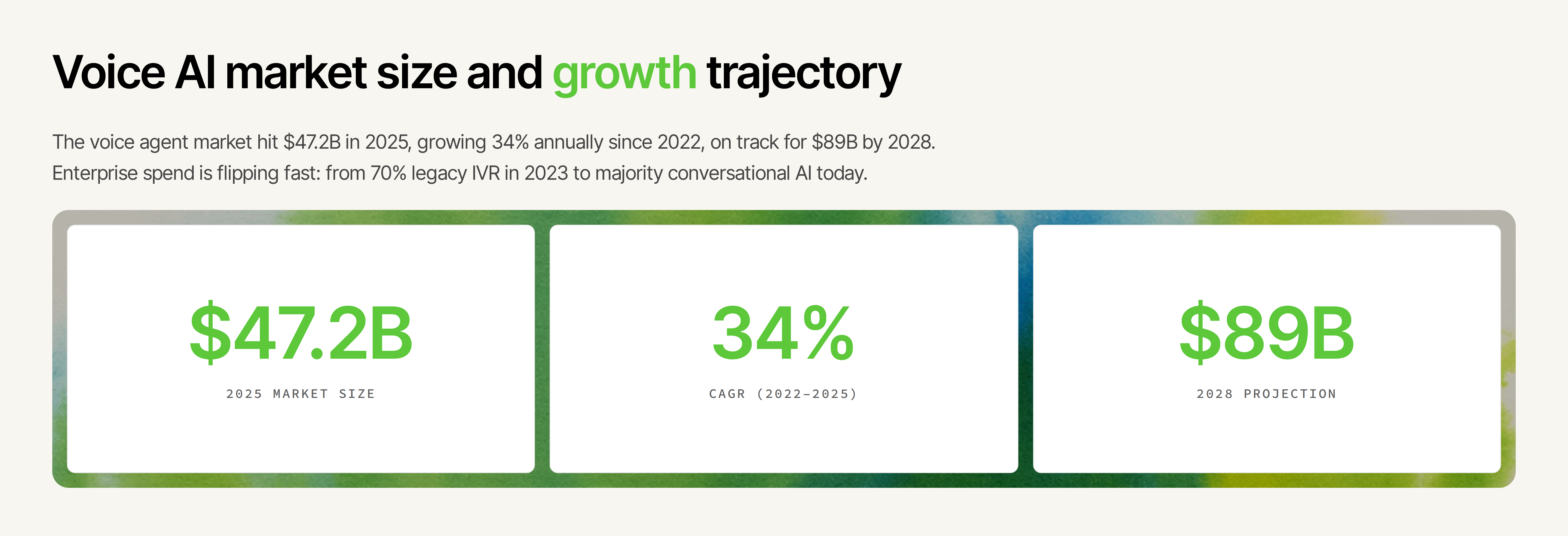
The state of voice AI in healthcare
Healthcare organizations are moving fast on this for five concrete reasons:
None of that means healthcare organizations are trying to automate away clinical judgment. It means the call types that are high in volume and administrative in nature are moving to AI first, while clinical conversations stay exactly where they belong: with licensed staff.
Proof it works: Two Kore.ai voice deployments
Industry-wide numbers are useful, but real deployments make the case better than any forecast. These are Kore.ai's own healthcare customers, built on a platform that's been named a Leader in Gartner's Magic Quadrant for Conversational AI Platforms in multiple consecutive years, alongside recognition from Forrester and Everest Group.
A California healthcare provider scales patient access
- Challenge: A mission-driven healthcare provider serving diverse communities across California was expanding rapidly, and its call center couldn't keep pace. Rising call volumes, multilingual support needs, and limited staffing flexibility made it increasingly difficult to deliver timely help, and care teams were spending time on administrative tasks instead of patient care.
- Solution: The provider deployed an AI agent built on Kore.ai's AI for Service platform, enabled by pre-built AI for Healthcare agents, directing complex or sensitive needs to the appropriate care team. The agent supports patients in multiple languages and beyond standard clinic hours.
- What the agent handles: Appointment scheduling and updates, notifications and reminders, lab result inquiries, pharmacy refill requests, and referral management.
- Impact: $3.2 million in revenue through automated appointment scheduling alone, a 468% ROI since inception, and a 24% containment rate, with continued growth expected as more workflows come online.
A major North American health insurer modernizes its member contact center
- Challenge: A large North American healthcare payer serving millions of members across diverse, multilingual communities was facing rising call volumes and a growing manual documentation burden, adding pressure to agents and creating inconsistent member experiences. The payer needed to move fast without compromising the accuracy and compliance a regulated health plan requires.
- Solution: Rather than a single rip-and-replace, the payer rolled out AI for Service in phases. Phase 1 introduced an AI-driven front-end experience across voice and digital, containing routine demand and routing members more efficiently. Phase 2 added AI-powered transcription and summarization, with Kore.ai's partnership with Deepgram providing the transcript accuracy needed across the payer's English and Spanish-speaking member base. Phase 3 layered in real-time agent assistance, giving member service representatives contextual suggestions and next-best actions during complex calls.
- What the agent handles: Routine member inquiries across voice and digital, call transcription and summarization, and real-time next-best-action support for service representatives.
- Impact: Higher containment of routine inquiries, a significant reduction in post-call documentation time, improved multilingual accuracy, and a trajectory toward up to 40% lower operational costs.
Neither of these is a novelty story. Both are about the same unglamorous thing: absorbing the administrative volume that's burning out staff and delaying patients, accurately enough that both groups actually get time back.
Top use cases for voice AI agents in healthcare
A quick map before the detail, what each use case covers and where the line to a human sits:
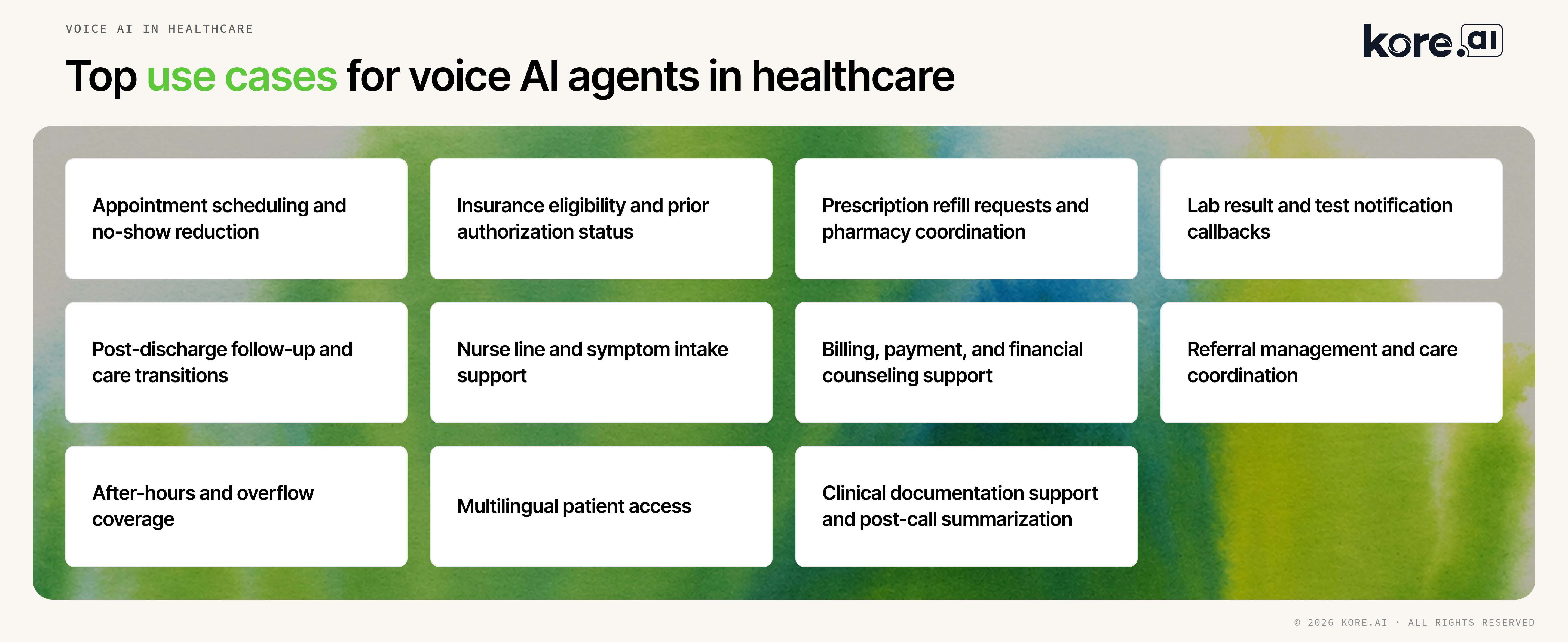
1. Appointment scheduling, rescheduling, and no-show reduction
The scenario: Appointment-related calls are among the highest-volume call types in any clinic or health system, and it's the workflow both Kore.ai deployments above led with.
What the agent handles:
- Books, reschedules, or cancels appointments against real-time provider availability
- Confirms insurance and visit type up front
- Reads back the date, time, and provider by name, not just a confirmation number, since patients frequently mishear or mistype details from a portal
- Offers same-day rescheduling the moment a patient says they can't make it, instead of just canceling and leaving a gap
- Flags high-value or hard-to-fill slots, a specialist visit, a pre-op consult, for a different reminder cadence than a routine follow-up
The stakes: No-show rates run 5-8% nationally and climb past 30% in some specialties, and 27% of practices name no-shows their top operational priority heading into 2026. A reminder call that's actually answered, understood, and acted on is one of the few interventions with a directly measurable return.
2. Insurance eligibility, benefits, and prior authorization status
The scenario: Prior authorization checks are dreaded on both ends of the phone, and physicians and their staff spend roughly 13 hours a week on the process.
What the agent handles:
- Verifies eligibility and benefits in real time against the payer's system
- Checks and reports the status of a submitted prior authorization request
- Collects and confirms documentation a submission is missing, so staff aren't chasing it down manually
The boundary: The agent can't make a clinical necessity determination. Anything requiring clinical judgment, a denial, an appeal, a peer-to-peer review, routes straight to the right person with full context attached. That doesn't shorten the underlying approval process, but it removes the hold-music tax both sides currently pay just to check where a request stands.
The payoff: 95% of physicians say prior authorization delays necessary care, and 79% report patients abandoning treatment because of it.
3. Prescription refill requests and pharmacy coordination
The scenario: A refill request is usually simple, but simple doesn't mean low-stakes.
What the agent handles:
- Verifies the patient and medication
- Checks whether a refill is authorized or needs prescriber approval
- Routes it to the pharmacy or the prescriber's queue accordingly
The boundary: The agent never advises on dosage, interactions, or whether a medication is still appropriate, that stays with a pharmacist or prescriber, full stop. Its job is logistics: confirming identity, confirming the medication on file, and checking refill eligibility. Anything ambiguous, an early refill request, a controlled substance, a mismatched pharmacy, hands off to a human rather than guessing.
4. Lab result and test notification callbacks
The scenario: Patients want to know their results are ready, and staff don't want to spend a shift playing phone tag to say so.
What the agent handles:
- Calls to confirm a result has been received
- Confirms it's available in the patient portal or through the provider
The boundary: The agent never reads out the clinical result itself over the phone. That's deliberate, not a limitation to work around: delivering an abnormal result requires clinical context, tone, and the ability to answer follow-up questions a script can't anticipate. Anything the patient asks that goes beyond "is it ready and how do I see it" gets an immediate, no-friction handoff to a clinical team member.
5. Post-discharge follow-up and care transitions
The scenario: The days right after a hospital discharge are when a lot of avoidable readmissions happen, often because nobody checked in before a small problem became a big one.
What the agent handles:
- Confirms the patient picked up their medications
- Confirms they understand their follow-up appointment
- Screens for the specific warning signs the care team flagged, using the same structured questions every time
The shift: Traditionally, discharge follow-up depends on staff finding time to call, screening relies on memory of a rushed script, concerning answers wait for the next callback, and there's no systematic record of who was reached. With a structured agent call, every discharged patient gets contacted on a consistent schedule, concerning answers trigger immediate escalation to a nurse, and every call and its outcome is logged automatically.
The boundary: The agent isn't making a clinical judgment about what a symptom means. It's asking the questions reliably and escalating immediately, with full context, the moment an answer falls outside the expected range.
6. Nurse line and symptom intake support
The scenario: This is the use case that needs the most careful design, and the most explicit boundary, of any on this list.
What the agent handles:
- Collects the patient's information and reason for the call
- Runs basic structured intake questions
- Routes the call to a nurse or triage line with that context already captured
The boundary: The agent never makes the triage decision itself, determining how urgent a symptom is, and what a patient should do about it, is clinical judgment. Any call touching a potential emergency, chest pain, difficulty breathing, thoughts of self-harm, or anything else on a defined red-flag list, routes immediately to a human or emergency services, with no attempt by the agent to assess or manage the situation.
The trust gap: Healthcare consumers report trusting their doctor roughly four times more than an AI chatbot for a medical decision, which is exactly why the agent's role here is intake speed, not a shortcut around the clinician.
7. Billing, payment, and financial counseling support
The scenario: "Why is this bill this amount" is a call center staple, and billing confusion is one of the most common reasons patients call in the first place.
What the agent handles:
- Pulls a patient's balance
- Explains what a specific charge was for in plain language
- Takes a payment or sets up a payment plan against pre-approved terms
The boundary: Anything that isn't a routine balance or payment, a disputed charge, a request for financial assistance, a question about whether a specific service was covered, gets gathered cleanly and routed to a billing specialist or financial counselor rather than an explanation the agent isn't positioned to get right.
8. Referral management and care coordination
The scenario: A referral that gets lost between a primary care office and a specialist is a common, quiet failure point in care delivery.
What the agent handles:
- Confirms a referral was received
- Helps schedule the resulting appointment
- Follows up if a patient hasn't booked within a set window, closing a loop that too often depends on someone remembering to check
9. After-hours and overflow coverage
The scenario: Not every question can wait for business hours, and not every clinic can staff a 24/7 line.
What the agent handles:
- Extends coverage for scheduling, refill requests, and basic billing questions outside normal hours
The boundary: Anything urgent routes to an answering service, on-call clinician, or emergency instructions, the way a well-run after-hours line already should.
10. Multilingual patient access
The scenario: Language access isn't a nice-to-have in healthcare, it's often the difference between a patient getting care and a patient giving up.
What the agent handles:
- Holds a natural conversation in multiple languages
- Switches mid-call if a family member joins to translate
- Extends the same scheduling accuracy and clarity to patients regardless of language
The scale: Roughly 68 million people in the US speak a language other than English at home, and about 29.6 million have limited English proficiency. It's the gap the California provider case study above addressed directly, and it's frequently the single biggest access lever available across healthcare broadly.
11. Clinical documentation support and post-call summarization
The scenario: This is a fast-growing category, and it's the contact-center side of documentation, transcribing and summarizing calls, not the clinical-encounter side handled by ambient scribing tools.
What the agent handles:
- Automatically transcribes patient and member calls
- Summarizes calls so staff aren't spending a large share of their day on post-call documentation instead of the next call
The boundary: This use case never touches clinical decision-making. It gives time back to staff without crossing into it.
What makes it work: Accuracy. Kore.ai's partnership with Deepgram is a concrete example, multilingual populations need transcription accuracy that holds up across languages, not just English, or the summaries and downstream records inherit the same errors.
How to make voice AI agents safe and secure
Look back at that list and a pattern shows up: almost every use case involves PHI, protected health information, the moment a patient's name is combined with an appointment time, a medication, or an insurance ID. That's why safety in healthcare voice AI isn't optional polish. It's the line between a compliant deployment and a HIPAA violation from the first call. Five things that actually requires:
1. Every vendor in the pipeline needs a signed BAA (Business Associate Agreement), not just the platform
Under HIPAA, any vendor that creates, receives, maintains, or transmits PHI on a covered entity's behalf is a business associate, and PHI can't legally flow to them without a signed Business Associate Agreement first.
- Not just the platform vendor: the speech-to-text provider, the LLM provider, the text-to-speech provider, and the telephony provider are all touching PHI in the pipeline
- Each one needs its own BAA, either directly or flowed down through the platform vendor's own agreements with its subcontractors
- Kore.ai's own compliance stack covers SOC 2 Type II, HIPAA with a signed BAA, GDPR, ISO 27001, HITRUST, PCI DSS, and FedRAMP, worth asking any vendor to match before a deployment touches a single patient record
2. Administrative and clinical work stay separate, enforced by the platform, not the script
Scheduling, eligibility checks, refill logistics, and billing are administrative. Diagnosing, triaging symptom severity, or advising on medication are clinical, and no voice AI agent should attempt them. The agent should never be the one deciding where that line falls in the moment.
- Any input touching a defined red-flag category, an emergency symptom, a mental health crisis, a request the agent isn't authorized to handle, triggers an immediate, unambiguous handoff to a human
- A rule written into a prompt is a suggestion the model can be talked around by an unusual phrasing; a rule enforced by the platform itself holds regardless of how the request is worded, and produces an audit trail a regulator can actually follow
3. Encryption is the floor, not the bar
HIPAA's Security Rule requires encryption in transit and at rest, but the minimum necessary standard goes further: the agent should only access and expose the PHI required for the specific task at hand, not a patient's full record for a simple appointment confirmation.
- Permission-aware retrieval grounds answers in only the records a given caller and use case are authorized to see, rather than the system's full knowledge base with access controls bolted on after the fact
- Real-time PII and PHI redaction in logs and transcripts
- Role-based access controls on who can review call recordings
4. Testing has to go beyond a script read in a quiet room
Voice fails in ways text doesn't: accents and dialects, speech patterns affected by a disability or a medical condition, background noise, a caller who interrupts mid-sentence or switches languages halfway through.
- Automated voice evals scored against real, messy scenarios
- Headless testing that catches regressions before a patient ever hears them
- Compile-time validation that catches configuration problems before a deployment goes live, rather than after the first patient call
- Specific tests for interruption handling, correction handling, and the red-flag escalation triggers above
5. The record has to outlast most people's instinct for how long to keep things
HIPAA-related audit trails are commonly expected to be retained six years or more, and breach notification requirements typically run on a 24-to-72-hour clock once a covered entity or business associate becomes aware of an issue.
- A compliant deployment logs every decision, tool call, and guardrail check end to end, encrypted per tenant
- A compliance review or an OCR audit means replaying the call and the reasoning behind it, not reconstructing it from memory
How Kore.ai's voice AI technology actually works
All eleven use cases above run on the same underlying architecture, so it's worth knowing what's actually happening on the call.
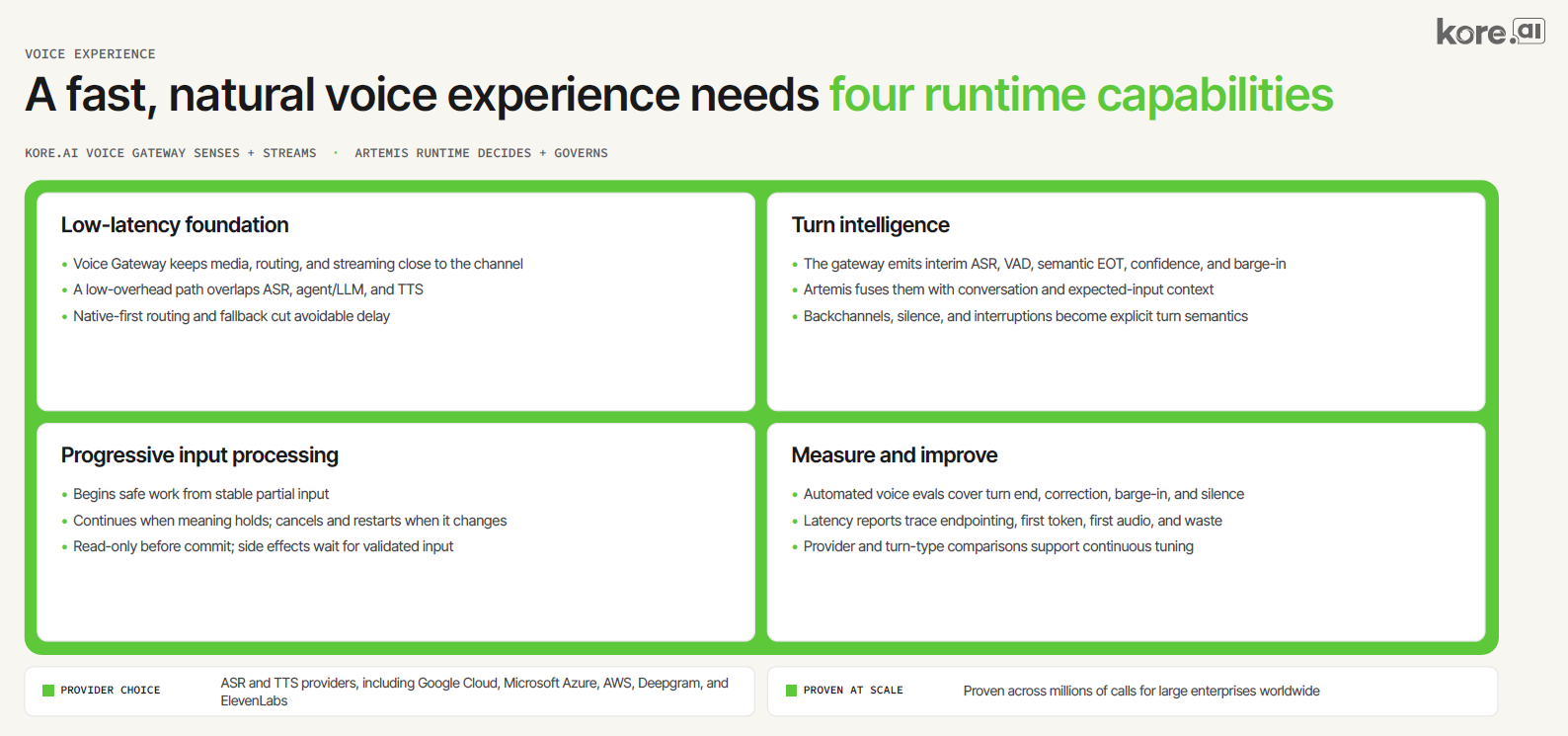
One session, not a relay race
Kore.ai's Voice Gateway handles the audio, routing, and telephony side of the call, streaming close to the channel itself. The Artemis runtime owns the decisions, fusing speech recognition, agent reasoning, and speech synthesis into one continuous session instead of bouncing the call across separate systems for every turn.
- First audio consistently under 1.5 seconds
- Turn-detection decisions land in roughly 230 milliseconds on the optimized path, fast enough that the agent knows the caller is done talking before an awkward pause sets in
- Replies stream back as they're generated rather than waiting for the full response, so the caller starts hearing an answer sooner
- Every phase of the turn is measured separately, so if a particular call runs slow, there's a specific, traceable answer for why
That single-session design is also what makes a caller changing their mind mid-call a non-event instead of a restart:
Example: a mid-call correction A patient calling to refill a prescription says, "It's for my mother, Jane Smith." Then she corrects herself: "Actually, wait, it's for me." The agent doesn't ask her to start over. It resumes the same field, replaces the value it was tracking, and keeps everything else, the identity verification already underway, intact. That's only possible because one session owns the entire turn from start to finish, rather than the call hopping across separate systems for recognition, reasoning, and speech output.
That same discipline governs what the agent is willing to act on:
- It starts working from a stable partial transcript before the caller has even finished the sentence, so it isn't sitting idle waiting for silence
- But it stays read-only until the input is confirmed: nothing gets booked, canceled, or charged until the meaning holds
- If what the caller says changes partway through, the agent cancels the in-flight work and restarts on the corrected version rather than acting on a guess
This architecture is already proven at scale, processing millions of calls for large enterprises worldwide.
It behaves like a person, not a phone tree
- Always listening, so there's no dead gap between the bot and the caller
- Can be interrupted mid-sentence and stops cleanly
- Recognizes backchannel cues like "uh-huh" or "okay" without treating them as the caller taking over the conversation
- Says so out loud when it needs a moment ("let me check your coverage now") instead of leaving dead air, while safety and compliance checks keep running in the background even as the response streams out
- Orchestrates multi-intent conversations: a patient who confirms a referral and then asks about a bill on the same call isn't routed as two separate transactions, the runtime resolves each task before the call ends, the way a capable human agent would handle a caller with more than one thing on their mind
Speech providers are a choice, not a lock-in
A health system or payer can bring its own ASR and TTS provider, or use Kore.ai's native integrations, all under one contract instead of managing a dozen separate vendor relationships.
- Roughly 35 speech providers and 150+ out-of-the-box integrations, plug-and-play rather than custom-built for each one
- Provider options include Google Cloud, Microsoft Azure, AWS, Deepgram, and ElevenLabs, switchable per use case
- Background noise reduction layered in where a busy nurse line needs it
- More than 100 languages overall, with up to five live on a single call and seamless switching between them mid-conversation, so adding a language is a configuration change, not a second build
That's what made the multilingual gains in both case studies above possible in the first place.
Recognition quality is measured, not assumed
The platform doesn't promise perfect transcription. It gives healthcare organizations the tools to keep raising the bar:
- Vocabulary boosting for clinical and pharmacy terms
- Language detection on the way in
- Turn-level confidence passed directly to the agent, so it can ask for clarification instead of guessing
- ASR analytics that surface quality and cascade problems by provider
- Recognition tuned per market rather than run as a single global model
- A disambiguating question instead of a guess whenever the system isn't confident in a name, place, or clinical term
That accuracy discipline is what the Deepgram partnership addressed for the payer case study's multilingual population.
A real example: In late 2025, GP surgeries across South Yorkshire began routing patient calls through an AI receptionist. A local health watchdog told the BBC that some patients could not get the system to understand their regional accents or speech impediments, and one patient said she could never get the system to understand her and ended up hanging up rather than continuing to try to book an appointment. The system's developer said it was designed to understand a range of accents and dialects, and hands off to reception staff whenever it can't follow a request.
An accent, a dialect, or a speech pattern the model wasn't trained on shouldn't be the reason someone gives up on getting care, exactly the failure mode measurement and handoff design are meant to catch before it reaches a patient.
Pre-built accelerators for a faster start
Kore.ai's AI for Healthcare pre-built agents are a starting point already configured for common healthcare workflows, appointment scheduling, eligibility checks, refill requests, referral management, with HIPAA-aware guardrails built in rather than bolted on. That's the same foundation both case studies above were built on.
The bottom line
Patients and members still reach for the phone when something about their care or coverage feels urgent or confusing, and that's not changing. The data now backs up what's already playing out at Kore.ai's own healthcare customers, from a California provider enabling $3.2 million in scheduling revenue to a major health insurer on a path toward 40% lower operational costs: voice AI agents can absorb enormous administrative call volume and improve access, but only when they're built with the HIPAA discipline, the clinical boundaries, and the auditability healthcare actually demands.
The economics scale with volume. Modeling that blends analyst benchmarks with Kore.ai customer data puts it in concrete terms: at 10 million calls a year, a scale several large health systems and payers operate at, moving from an all-human model to agentic-led voice can cut the cost of a resolved call by roughly half, an estimate, not a guarantee, but directionally the difference between staffing for volume and automating for it. Start with the calls that hurt staff and patients most today, prove the value with real numbers, and expand from there.
FAQ
Q1. Is voice AI HIPAA compliant?
It can be, but compliance isn't automatic just because a vendor says so. Every vendor touching PHI in the pipeline, the platform, the speech-to-text provider, the LLM, the telephony provider, needs a signed Business Associate Agreement, and the deployment needs encryption, audit trails, and a minimum necessary approach to data access. Ask any vendor directly for their BAA and their subcontractor list before assuming compliance.
Q2. Will voice AI agents replace nurses or clinicians?
No, and the staffing math argues against it happening. The US is already short more than 500,000 nurses, and demand for clinical judgment isn't going away. Voice AI agents are built to absorb the administrative call volume, scheduling, refills, eligibility checks, that currently competes with patient care for staff time, not to make clinical decisions. Every well-designed deployment routes anything requiring clinical judgment straight to a human.
Q3. Can voice AI actually help with prior authorization?
It can absorb the administrative parts, eligibility checks, status lookups, documentation collection, but it can't make the medical necessity determination itself, and it shouldn't try. The AMA's own data shows physicians and staff spend roughly 13 hours a week on prior authorization; a voice AI agent's realistic contribution is cutting the hold-music and status-checking portion of that time, not the underlying approval process.
Q4. What's the real difference between voice AI and a traditional phone tree?
A phone tree matches spoken input, or a keypad press, to a fixed menu; it can't understand context or handle a request phrased differently than expected. A voice AI agent understands natural language, follows the conversation even when a caller corrects themselves or switches languages mid-call, and can complete multi-step tasks like scheduling or eligibility verification instead of just routing calls to a queue.
Q5. Which use case should a healthcare organization start with?
Start with the highest-volume, lowest-clinical-risk call types, typically appointment scheduling, reminder calls, and basic eligibility checks. That's where both Kore.ai deployments above started, and they free up staff time fastest while carrying the least risk, building the trust needed to expand into more sensitive workflows like post-discharge follow-up or prior authorization support.
Share
Tags