Voice AI agents in banking: Top use-cases
Last Updated
October 7, 2026

Juhi Tiwari
Read Time

Summary
Voice AI agents are helping banks automate customer service while supporting secure, personalized interactions. This article explores banking voice AI use cases including transaction inquiries, card reporting, fraud alerts, payments, loan updates, collections, and multilingual service. It explains how Kore.ai integrates voice AI with banking systems while applying identity verification, security controls, policy enforcement, auditability, and human escalation for complex or sensitive requests.
What’s on this page
Banking remains one of the few industries where customers still prefer to resolve an urgent matter by phone. When something feels time-sensitive or uncertain, a lost card, a suspicious transaction, a payment that needs to move right now, customers want to speak with someone and hear the details confirmed directly. This preference is what makes banking a service-heavy industry, and it explains why voice has remained a primary channel here even as many other industries have shifted toward text and chat.
That preference is reflected in the numbers, and banking is leading the shift. Voice AI now handles roughly 19% of inbound contact-center volume across industries, up from just 6% two years ago, a jump spanning every sector from retail to telecom to healthcare. Banking is out ahead of that curve: among the 50 largest US banks, 78% now run a production voice AI agent for at least one customer-facing task, more than double the share that had one two years ago. Problems like password resets, balance checks, and card blocks map cleanly onto what a well-built voice agent can already do reliably, which gave banking the clearest path to real, high-stakes production use.
That is exactly the load voice AI agents are now taking on. Banks and financial institutions are running them in production today, handling balance checks, card blocks, and payment support at real volume, and every call one resolves is time handed back to staff who would rather focus on the conversations that need judgment than a routine balance inquiry. Here is where these agents are delivering the most value in banking today, what the data says about the risk and reward, and what separates a deployment customers trust from one that just adds a new robotic voice to the queue.
The state of voice AI in 2026
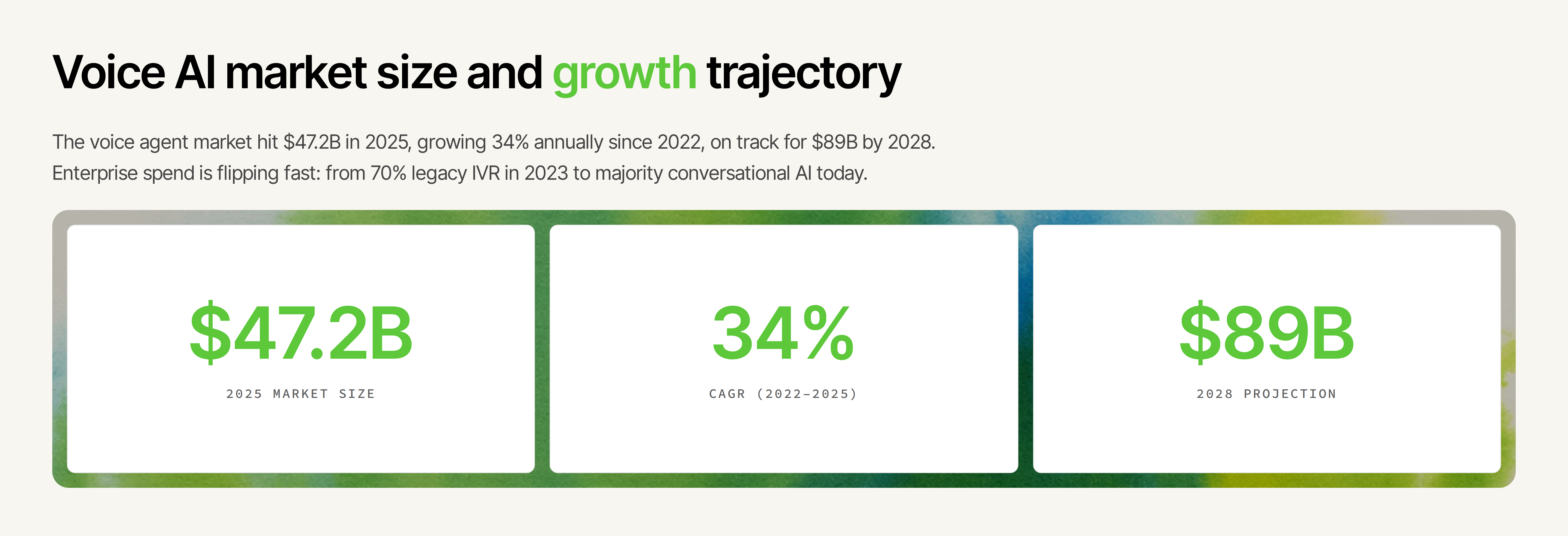
The state of voice AI in banking
None of that means banks are trying to remove humans from the phone entirely, and the staffing picture is a big reason why. Contact-center agent burnout is nearing a breaking point industry-wide, with roughly 74% of agents at elevated risk and average tenure down to just 14 months, a churn cycle that hits banks especially hard given how much training a compliant agent needs. Forrester has found that agentic AI deployments cut burnout by up to 25% by taking routine, cognitively draining work off agents' plates and giving them real-time support on what's left. And separately, 57% of service leaders expect total interaction volume to keep rising, meaning most banks aren't using AI to shrink their service teams, they're using it to absorb growth that hiring alone couldn't keep up with. It means the call types that are high in volume and low in ambiguity are moving to AI first, while harder conversations, and the humans who are best at them, stay in place.
Proof it works: Two Kore.ai voice deployments
Industry-wide numbers are useful, but real deployments make the case better than any forecast. These are Kore.ai's own deployments, built on a platform that's been named a Leader in Gartner's Magic Quadrant for Conversational AI Platforms in multiple consecutive years, alongside recognition from Forrester and Everest Group.
A U.S. regional bank retires its legacy IVR
- Challenge: A U.S.-based regional financial institution serving both retail and business customers was fielding more than one million customer calls a year through a legacy IVR that trapped callers in rigid, repetitive menu loops. Anyone who couldn't resolve their issue through self-service defaulted straight to a human agent, driving up handle times, telephony costs, and agent workload, with no context carried over when a call did escalate.
- Solution: The bank replaced that IVR with Kore.ai's AI for Banking, deploying voice and digital AI agents backed by real-time integrations into its core banking systems, online and mobile banking platforms, and CRM.
- What the agent handles: Balance inquiries, account updates, payments, card services, and transaction questions through natural conversation.
- Impact: Over 2.6 million customer sessions and more than 5 million minutes of automated voice interaction a year, all without expanding agent headcount. Containment, the share of interactions resolved without a human needing to step in, reached 85.7% on digital channels and 42.4% on voice.
A telecom leader shifts over half its call volume off legacy IVR
This one isn't a bank, but it's worth including because it's Kore.ai's strongest publicly documented proof point for voice specifically, and the underlying problem is one every bank call center will recognize.
- Challenge: One of the largest US broadband and cable operators was running more than 600,000 calls a day through an outdated IVR platform, with rigid logic that created friction for callers and constant pressure on support teams.
- Solution: The operator deployed Kore.ai voice AI agents across its highest-volume service needs, running in an enterprise-managed cloud environment built for the security and scale a nationwide carrier needs.
- What the agent handles: Billing, repair, activation, outages, payments, and account management.
- Impact: 53% of total IVR traffic shifted to Kore.ai's AI agents within the first year, voice automation performance improved by 20%, and the company is projecting $125 million in annual savings once the rollout reaches full scale, with more than 50 voice use cases now live or rolling out.
Together, these two deployments show the same pattern: the value isn't in novelty, it's in absorbing enormous, high-friction call volume accurately enough that legacy IVR stops being the bottleneck, freeing human agents for the conversations that actually need judgment.
Top use cases for voice AI agents in banking
A quick map before the detail, what each use case covers and where the line to a human sits:
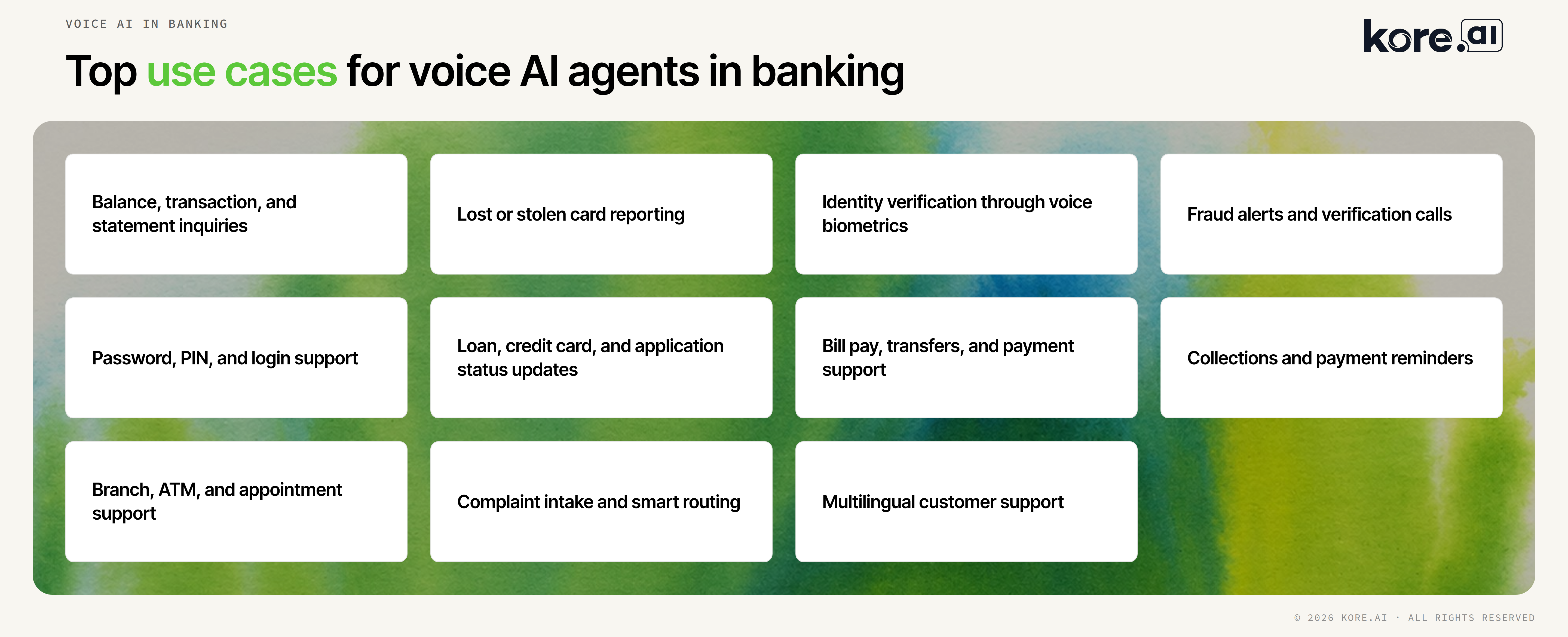
1. Balance, transaction, and statement inquiries
The scenario: This is the highest-volume call type at almost every bank, and it's the easiest to automate well, which is exactly why it's core to the regional bank deployment above.
What the agent handles:
- Verifies the caller, pulls the balance or recent transactions, and reads them back clearly
- Disambiguates accounts from context, "the account ending in 4821" versus "my savings", without a menu
- Reads back the specific transaction asked about, not the whole statement read out loud
- Offers to text or email a copy for the customer's own record
- Recognizes when "balance" is really the opening of a dispute ("that doesn't look right") and routes into that workflow instead of just repeating the number louder
The stakes: For a question that takes fifteen seconds to answer well, there's no reason a customer should sit on hold to get it.
2. Lost or stolen card reporting
The scenario: When a card is lost or stolen, speed matters more than almost anything else, and not just for peace of mind.
What the agent handles:
- Verifies identity and blocks the card immediately
- Confirms the last known legitimate transaction, to help establish where the fraud started
- Triggers an expedited replacement card
- Sets temporary controls, like blocking a specific merchant category, while the new card is in transit
The stakes: Under Regulation E, a customer's liability for unauthorized transactions is capped at $50 if they report within two business days, rises to $500 within 60 days, and becomes effectively unlimited after that. An agent that answers instantly at 2 a.m. and timestamps the report the moment the call starts is directly protecting the customer's liability tier, not just their convenience. Banks are also required to investigate these claims and typically issue provisional credit if the investigation runs past 10 business days, so a clean, time-stamped report gives the fraud and dispute teams a far stronger starting point than a rushed note taken by a human agent juggling three other calls.
3. Identity verification through voice biometrics
The scenario: This is one of the strongest proof points in banking for what voice AI can do for both convenience and security, analyzing voice patterns rather than just the words spoken.
What the agent handles:
- Verifies identity passively in the first few seconds of natural conversation, rather than as an awkward separate step
- Pairs the voiceprint with liveness detection and at least one additional signal before anything sensitive happens on the call
The proof: HSBC's Voice ID system is one of the most publicly documented examples: 100+ physical and behavioral voice characteristics analyzed, a 50% reduction in telephone banking fraud since introduction, £249 million in UK fraud blocked in a single year, 43,000+ fraudulent calls identified, and 2.8 million customers enrolled. The appeal is speed and resistance to the weakest link in most authentication schemes, shared secrets: a security question or a mother's maiden name is something a fraudster can look up, buy from a breached-data marketplace, or social-engineer out of a call center rep. A voiceprint verifies in seconds instead of the minute or more a security-question script usually takes.
The boundary: In the EU, voice data used to verify someone's identity counts as biometric data under GDPR, a specially protected category requiring a clear legal basis, typically explicit consent. The EU AI Act treats this kind of straightforward identity verification differently, and generally less strictly, than "biometric categorization" (inferring sensitive traits like ethnicity or beliefs from a voice), so the exact classification depends on how the system is actually built and used, worth confirming with compliance and legal counsel before launch rather than after.
4. Fraud alerts and verification calls
The scenario: Banks increasingly use voice AI on the outbound side too. When a transaction looks suspicious, an agent can call the customer, describe the flagged activity in plain language, and confirm whether it was them, closing the loop far faster than an email or app notification that might sit unread for hours.
What the agent handles:
- Identifies the bank clearly at the start of the call
- Describes the specific transaction, merchant, amount, location, rather than opening with "confirm your identity"
- Never asks for a full card number or online banking password
The boundary: The pattern this call follows is exactly what a scam caller impersonating the bank would try to copy, which is why the framing above isn't optional polish, it's the difference between a legitimate call and something indistinguishable from the fraud it's meant to prevent.
The stakes: One major voice security analysis found synthetic voice attacks targeting banks rose 149% in a single year, and contact centers overall now report a fraud attempt roughly every 46 seconds. Fast, proactive outbound verification, done with the right disclosure habits, is becoming a frontline defense against both the original fraud and the copy-cat scam calls that increasingly follow it.
5. Password, PIN, and login support
The scenario: "I'm locked out of my account" is one of the most common reasons people call a bank, and one of the most repetitive calls for a human agent to handle all day.
What the agent handles:
- Verifies identity through layered checks: account details, a one-time passcode sent to a registered device, and voice or knowledge-based verification
- Resets a PIN or password and confirms the change, without a person needing to be involved unless something looks off
The boundary: A mismatched device, an unusual location, or a caller who fails a verification step should trip the agent into a stricter path, additional verification or a direct handoff to a fraud specialist, rather than a more lenient one. Account recovery is one of the most common vectors for account takeover fraud, so the agent's job is to be at least as suspicious as a well-trained human agent would be, every time, without getting worn down by call volume the way people do late in a shift.
6. Loan, credit card, and application status updates
The scenario: Customers checking on a mortgage, personal loan, or credit card application usually just want to know one thing: where does it stand.
What the agent handles:
- Pulls the current status from the loan origination system and explains it in plain terms: current stage, what's outstanding, expected timeline
- Schedules a call with a human underwriter, or transfers with full history attached, when the next step needs one
The boundary: Under the Equal Credit Opportunity Act, a lender that takes adverse action on an application, denying it or approving it on materially different terms, has to give the applicant a notice with the specific principal reasons, and regulators have been explicit that using AI in the credit decision doesn't relax that requirement. The agent can freely say where an application stands and what's needed next, but any explanation of why a decision was made needs to come from the same compliant, auditable disclosure process a human loan officer would use, not an improvised summary.
7. Bill pay, transfers, and payment support
The scenario: Simple money movement, paying a bill, moving funds between accounts, is a natural fit for voice AI. But the stakes have quietly gone up as banks adopt real-time payment rails like Zelle, RTP, and FedNow, where money moves the instant a customer authorizes it, with little to no ability to reverse the transaction afterward.
What the agent handles:
- Reads back the recipient, the amount, and the payment rail out loud before committing anything
- Adds a deliberate pause or a plain-language warning ("this transfer can't be reversed once sent") for real-time transfers specifically, rather than rushing to close the call
The stakes: Zelle alone has been linked to roughly $1 billion in reported fraud losses since launch, much of it so-called authorized push payment fraud, where the customer is tricked into approving the transfer themselves, a scenario that sits outside what Regulation E's unauthorized-transaction protections were built to cover. On instant payment rails, that extra ten seconds of friction is often the only fraud control standing between a customer and an irreversible mistake.
8. Collections and payment reminders
The scenario: This is one of the most heavily regulated use cases in banking, and also one where voice AI is proving genuinely useful when it's built correctly. In the US, debt collection communications fall under three overlapping frameworks at once:
What the agent handles:
- Enforces every rule automatically, on every call, and logs exactly what was said and when
- Offers a payment plan, or routes a disputed debt straight to a specialist, the moment the customer raises one
The stakes: Human collectors, working long shifts across time zones, are the ones most likely to slip on these rules under pressure, and a single slip carries real liability: FDCPA violations can carry damages up to $1,000 per consumer plus attorney's fees, with no need to prove the bank meant any harm. Early data from voice AI vendors in this space suggests containment rates in the 45 to 50% range, without the compliance drift of asking tired humans to track seven overlapping rules at once.
9. Branch, ATM, and appointment support
The scenario: Not every banking need is digital. Customers still ask where the nearest branch is, whether it's open, whether it has a notary or safe deposit boxes, or how to book time with a financial advisor.
What the agent handles:
- Looks up locations against real-time branch and ATM data
- Checks live advisor availability
- Books, reschedules, or cancels appointments directly in the calendar system
The payoff: It's a low-drama use case, but a meaningful volume reducer. Getting it right on the first call, correct hours, correct services, correct advisor, avoids the second call that happens when a customer shows up to a closed branch or a fully booked slot.
10. Complaint intake and smart routing
The scenario: Complaints are sensitive, but the intake process doesn't have to eat up specialist time.
What the agent handles:
- Listens to the issue, captures the details accurately, and logs it correctly
- Routes it to the right team, disputes, fraud, or retention, with a clear summary already attached
The shift:
The payoff: The customer isn't waiting through five separate handoffs to get to the same outcome, and the specialist who eventually reviews the case, if one needs to, inherits a clean record instead of a rushed handwritten note.
11. Multilingual customer support
The scenario: Banks serving diverse communities often struggle to staff every language around the clock, and the population that needs this most is larger than most service leaders assume.
What the agent handles:
- Holds a natural conversation in multiple languages
- Switches mid-call if a customer code-switches or a family member joins to translate
- Extends the same accuracy and the same disclosures to every language, rather than a thinner, translated-on-the-fly version of the experience
The scale: Roughly 68 million people in the US speak a language other than English at home, and about 29.6 million are classified as having limited English proficiency, meaning real difficulty communicating in English about something as high-stakes as their own money. The CFPB has specifically encouraged financial institutions to expand language access, noting that gaps in interpretation and translated materials leave these customers underserved and more exposed to predatory alternatives.
How to make voice AI agents safe and secure
Look back at that list and a pattern shows up: almost every use case involves the agent doing something with real consequences, blocking a card, resetting a password, moving money, deciding whether a call escalates. That's exactly why safety can't be an afterthought bolted onto a working demo. It has to be designed in alongside the use case itself, from day one. Five things that actually requires:
1. Layer identity verification, never rely on one signal
A voiceprint is fast, but voice alone is no longer treated as sufficient on its own.
- The strongest deployments pair it with liveness detection and at least one additional factor, a one-time passcode, a device check, before anything sensitive happens on the call
- For the highest-risk actions, moving money, changing contact details, closing an account, the platform should also support a human-in-the-loop approval step before anything irreversible executes
- Kore.ai's own compliance stack covers SOC 2 Type II, PCI DSS, GDPR, ISO 27001, HITRUST, and FedRAMP, worth asking any vendor to match before a deployment touches a single account
2. Rules enforced by the platform, not the script
Banking regulation doesn't bend for a well-worded prompt.
- Disclosure requirements, the FDCPA mini-Miranda, Reg E timelines, ECOA adverse-action notices, run as deterministic steps, not improvised language
- Any input touching a defined high-risk category, a fraud claim, a dispute, a request the agent isn't authorized to handle, triggers an immediate, unambiguous handoff to a human
- A rule written into a prompt is a suggestion the model can be talked around by an unusual phrasing; a rule enforced by the platform itself holds regardless of how the request is worded, and produces an audit trail a regulator can actually follow
3. Minimum necessary access, not full-record access
Encryption in transit and at rest is the floor, not the bar. The agent should only access and expose the account data required for the specific task at hand.
- Permission-aware retrieval grounds answers in only the records a given caller and use case are authorized to see, rather than the system's full knowledge base with access controls bolted on after the fact
- Real-time PII redaction in logs and transcripts
- Role-based access controls on who can review call recordings
4. Test it like software before it ever reaches a customer
Voice fails in ways text doesn't: accents and dialects, speech patterns affected by a disability or a medical condition, background noise, a caller who interrupts mid-sentence or changes topic halfway through.
- Automated voice evals that score the agent against real, messy scenarios, not just the happy path
- Headless testing, calls placed with no phone and no human, to catch regressions before a customer ever hears them
- Compile-time validation that catches configuration problems before a deployment goes live, rather than after the first customer call
- Specific tests for interruption handling, correction handling ("wait, actually..."), and silence, since these are where rigid systems fail first
5. Build in escalation triggers, and make every call auditable after the fact
A safe agent knows exactly when to stop being autonomous, and everything it does needs to survive a regulatory exam.
- Defined in advance: repeated failure on the same request, rising frustration or distress, a high-risk intent like fraud or a dispute, or a direct request for a person, all force a handoff with the full conversation history, intent, and actions already taken attached, so the customer never repeats themselves to the human who picks up
- Every decision, disclosure, and tool call the agent makes is traceable end to end, encrypted per tenant, with sensitive data automatically redacted from logs and transcripts
- In banking, "the AI said something" isn't an acceptable answer during a regulatory exam; a full, timestamped trace of what it said and why is
How Kore.ai's voice AI technology actually works
All eleven use cases above run on the same underlying architecture, so it's worth knowing what's actually happening on the call.
Read more on Kore.ai voice AI agents.
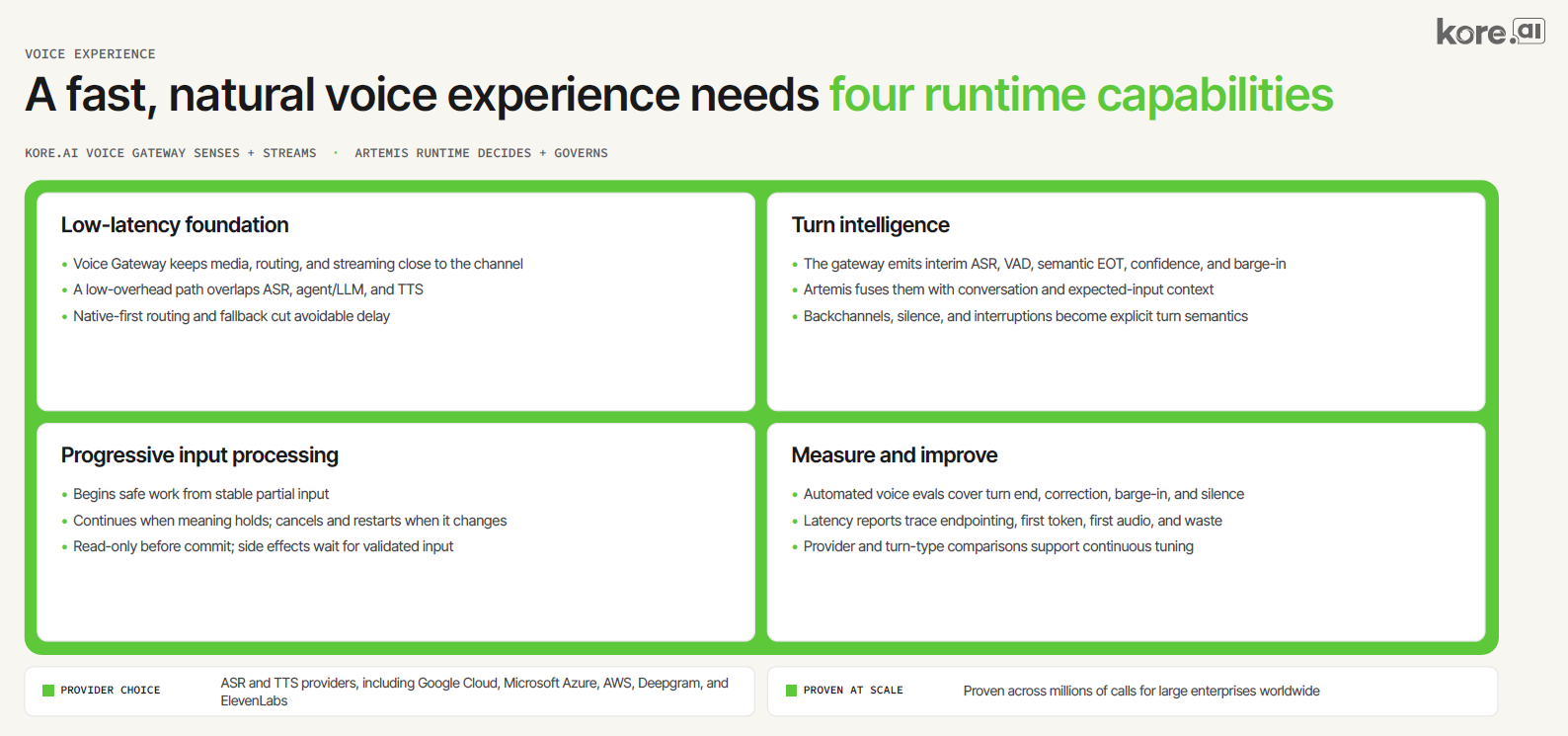
A. One session, not a relay race
Kore.ai's Voice Gateway handles the audio, routing, and telephony side of the call, streaming close to the channel itself. The Artemis runtime owns the decisions, fusing speech recognition, agent reasoning, and speech synthesis into one continuous session instead of bouncing the call across separate systems for every turn.
- First audio consistently under 1.5 seconds
- Turn-detection decisions land in roughly 230 milliseconds on the optimized path, fast enough that the agent knows the caller is done talking before an awkward pause sets in
- Replies stream back as they're generated rather than waiting for the full response, so the caller starts hearing an answer sooner
- Every phase of the turn is measured separately, so if a particular call runs slow, there's a specific, traceable answer for why
That continuity is what makes a caller changing their mind mid-call a non-event instead of a restart:
Example: a mid-call correction A customer says, "Block my card, last four 1234." Then corrects themselves: "Actually, wait, 5678." The agent doesn't ask them to repeat the request from scratch. It resumes the same field, replaces the value it was tracking, and keeps everything else, the rest of the conversation and any actions already taken, intact. That's only possible because one session owns the entire turn from start to finish, rather than the call hopping across separate systems for recognition, reasoning, and speech output.
That same discipline governs what the agent is willing to act on:
- It starts working from a stable partial transcript before the caller has even finished the sentence, so it isn't sitting idle waiting for silence
- But it stays read-only until the input is confirmed: nothing gets blocked, transferred, or changed until the meaning holds
- If what the caller says changes partway through, the agent cancels the in-flight work and restarts on the corrected version rather than acting on a guess
This architecture is already proven at scale, processing millions of calls for large enterprises worldwide.
B. It behaves like a person, not a phone tree
- Always listening, so there's no dead gap between the bot and the caller
- Can be interrupted mid-sentence and stops cleanly
- Recognizes backchannel cues like "uh-huh" or "okay" without treating them as the caller taking over the conversation
- Says so out loud when it needs a moment ("let me check that for you") instead of leaving dead air, while safety and compliance checks keep running in the background even as the response streams out
- Orchestrates multi-intent conversations: a customer who blocks a card and then asks about a recent charge on the same call isn't routed as two separate transactions, the runtime resolves each task before the call ends
C. Speech providers are a choice, not a lock-in
A bank can bring its own ASR and TTS provider, or use Kore.ai's native integrations, all under one contract instead of managing a dozen separate vendor relationships.
- Roughly 35 speech providers and 150-plus out-of-the-box integrations, plug-and-play rather than custom-built for each one
- Provider options include Google Cloud, Microsoft Azure, AWS, Deepgram, and ElevenLabs, switchable per use case, with voice biometrics or background noise reduction layered in where the call center actually needs it
- More than 100 languages overall, with up to five live on a single call and seamless switching between them mid-conversation, so adding a language is a configuration change, not a second build
D. Recognition and verification quality is measured, not assumed
The platform doesn't promise perfect transcription or perfect voice matching. It gives banks the tools to keep raising the bar:
- Vocabulary boosting and language detection on the way in
- Turn-level confidence passed directly to the agent, so it can ask for clarification instead of guessing
- ASR analytics that surface quality and cascade problems by provider
- Recognition tuned per market rather than run as a single global model
- Voice metrics tracking barge-in rate, latency, and containment, so a bank can see exactly where recognition is weakest and act on it, rather than assuming it's fine because nobody happened to complain
That discipline matters even more for voice biometrics specifically, where a false rejection isn't just an inconvenience, it can lock a legitimate customer out of their own account.
A real example: Several major banks have rolled out AI-driven voice-risk scoring that assigns a fraud risk level to each caller based on speech patterns. Reporting earlier this year found the systems sometimes misread an ordinary confirmation, a caller simply saying "yes" or "that's me", as a sign of spoofing, particularly when the call has background noise, comes through a speakerphone, or comes from an older phone that compresses audio differently. Older customers, who rely on phone banking more than any other age group and whose speech can shift with age, medication, or health conditions, were disproportionately affected, with some frozen out of their own accounts and referred to in-person verification instead of a phone call.
That's exactly why voice alone is never treated as sufficient, and why liveness detection, a second factor, and per-market recognition tuning aren't optional extras bolted onto a biometric system. They're what keeps a legitimate customer's ordinary "yes" from being read as an attack.
E. Pre-built accelerators for a faster start
Kore.ai's AI for Banking pre-built agents are a starting point already configured for common banking workflows, balance inquiries, card blocking, fraud verification, application status, with compliance-aware guardrails built in rather than bolted on. That's the same foundation the regional bank deployment above was built on.
The bottom line
Voice remains the channel customers reach for when money is involved and something feels urgent or uncertain. The data now backs up what's already playing out in Kore.ai's own voice deployments, from a U.S. regional bank retiring its legacy IVR to a telecom carrier shifting more than half its call volume off one: voice AI agents can absorb enormous call volume and improve satisfaction, but only when they're built with the verification, auditability, and regulatory discipline banking actually demands. Start with the calls that hurt the most today, prove the value with real numbers, and expand from there.
FAQ
Q1. Is voice AI safe to use for banking customer service?
Yes, when it's built with banking-grade guardrails. That means layered identity verification before any sensitive action, engine-enforced rules the AI can't talk its way around, and a full audit trail of every call. Regulators like the CFPB have made clear that existing consumer protection law applies fully to AI-driven customer service, so "safe" in banking means provably compliant, not just technically capable.
Q3. Will voice AI agents replace human bank agents?
Not entirely, and the data doesn't suggest that's the direction this is heading. In the regional bank deployment above, even strong voice containment (42.4%) still leaves the majority of voice calls reaching a human, deliberately, for the interactions that need judgment; the AI agent's job is to clear out the repetitive volume, not the relationship. Most service leaders, 57% in one industry survey, actually expect total interaction volume to keep growing, so the practical effect of voice AI is absorbing that growth rather than shrinking teams. It also addresses a retention problem banks already have: agent burnout is running high industry-wide, with average tenure down to around 14 months, and agentic AI support has been shown to cut that burnout by up to 25% by taking repetitive work off agents' plates.
Q4. What's the real difference between voice AI and a traditional IVR?
An IVR matches spoken input to a fixed menu; it can't understand context or handle a request phrased differently than expected. A voice AI agent understands natural language, follows the conversation even when the caller goes off script or corrects themselves mid-sentence, and can complete multi-step tasks instead of just routing calls.
Q5. Which use case should a bank start with?
Start with the highest-volume, lowest-ambiguity call types, typically balance inquiries, card blocking, and password or PIN resets. These free up the most agent capacity quickly and give customers an immediate, visible improvement in service, which builds the case for expanding into more complex, higher-risk use cases later.
Share
Tags