Kore.ai Named a Leader in Three Forrester Wave™ Reports: Employee Services, Customer Service, and Cognitive Search
Last Updated
August 18, 2026

Abhijit Mhetre
Read Time

Summary
As agentic AI becomes table stakes, enterprise buyers need to look beyond demos to what makes AI work reliably in production. Drawing on Kore.ai’s Leader placements across three Forrester Wave™ evaluations, this blog explores the capabilities that increasingly matter: context, governance, orchestration, enterprise integration, scalability, search and RAG, testing, and pricing flexibility, and what enterprises should scrutinize when evaluating AI platforms.
What’s on this page
How do you know if an AI platform is actually enterprise-grade, and not just a great demo?
That's the question every technology buyer is grappling with right now. Agentic AI, context layers, AI governance, new pricing models... everything is moving so fast that what looked modern and cutting-edge six months ago looks table stakes today. And honestly, in a market this noisy, buyers don’t want to risk their decision. So, they turn to independent evaluations like the Forrester Wave™ to figure out where vendor landscape truly stands. Analysts spend months on these evaluations with their rigorous evaluation process to pick the top platforms enterprise buyers can evaluate further for their specific situations. They dig into capabilities, they talk to real customers, they compare vendors side by side, they look at vision and future roadmap. There is no hiding.
So here is some news we are very, very proud of: Kore.ai has been named a Leader in three separate Forrester Wave™ evaluations, across three of the most significant enterprise AI use cases.
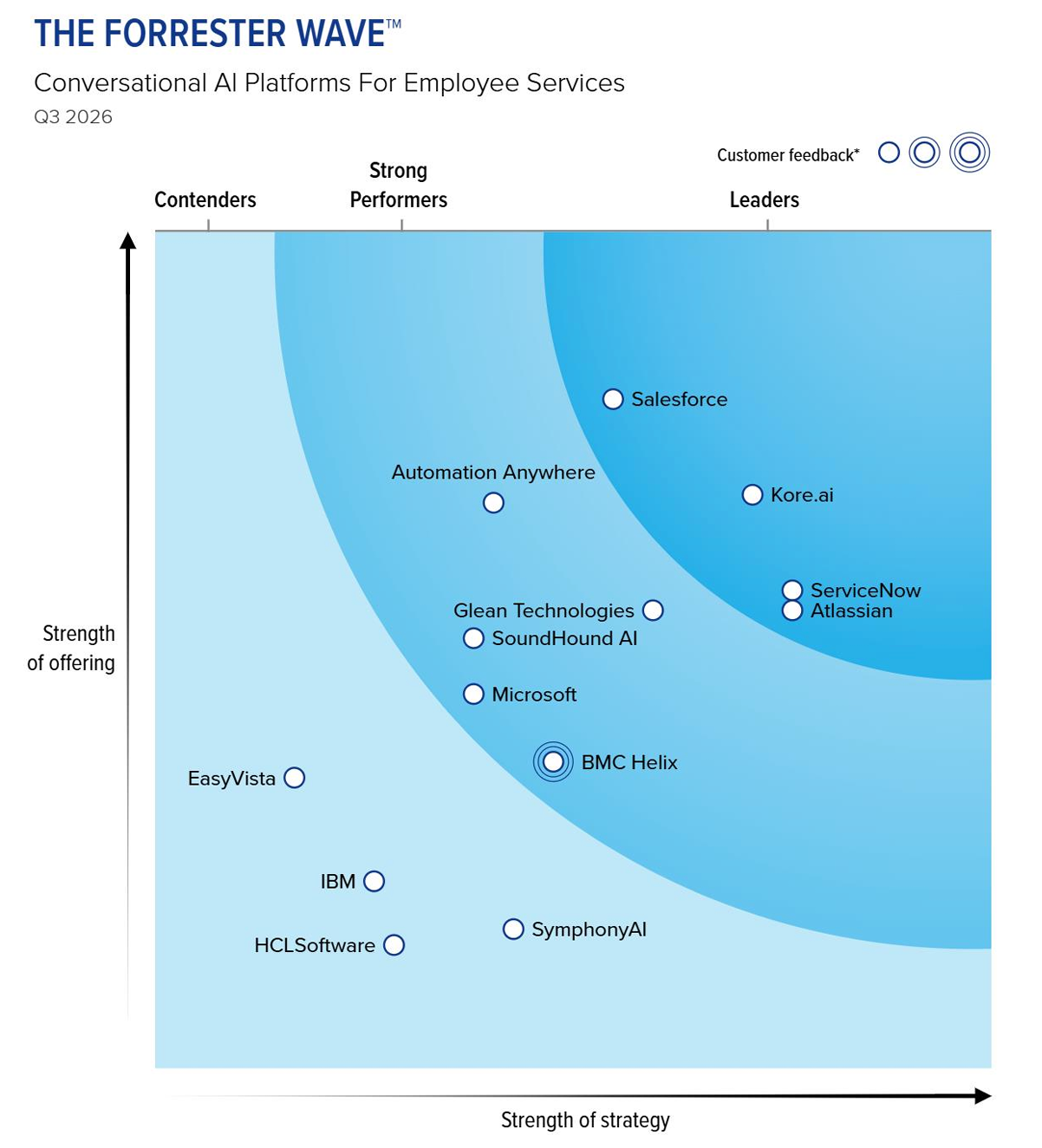
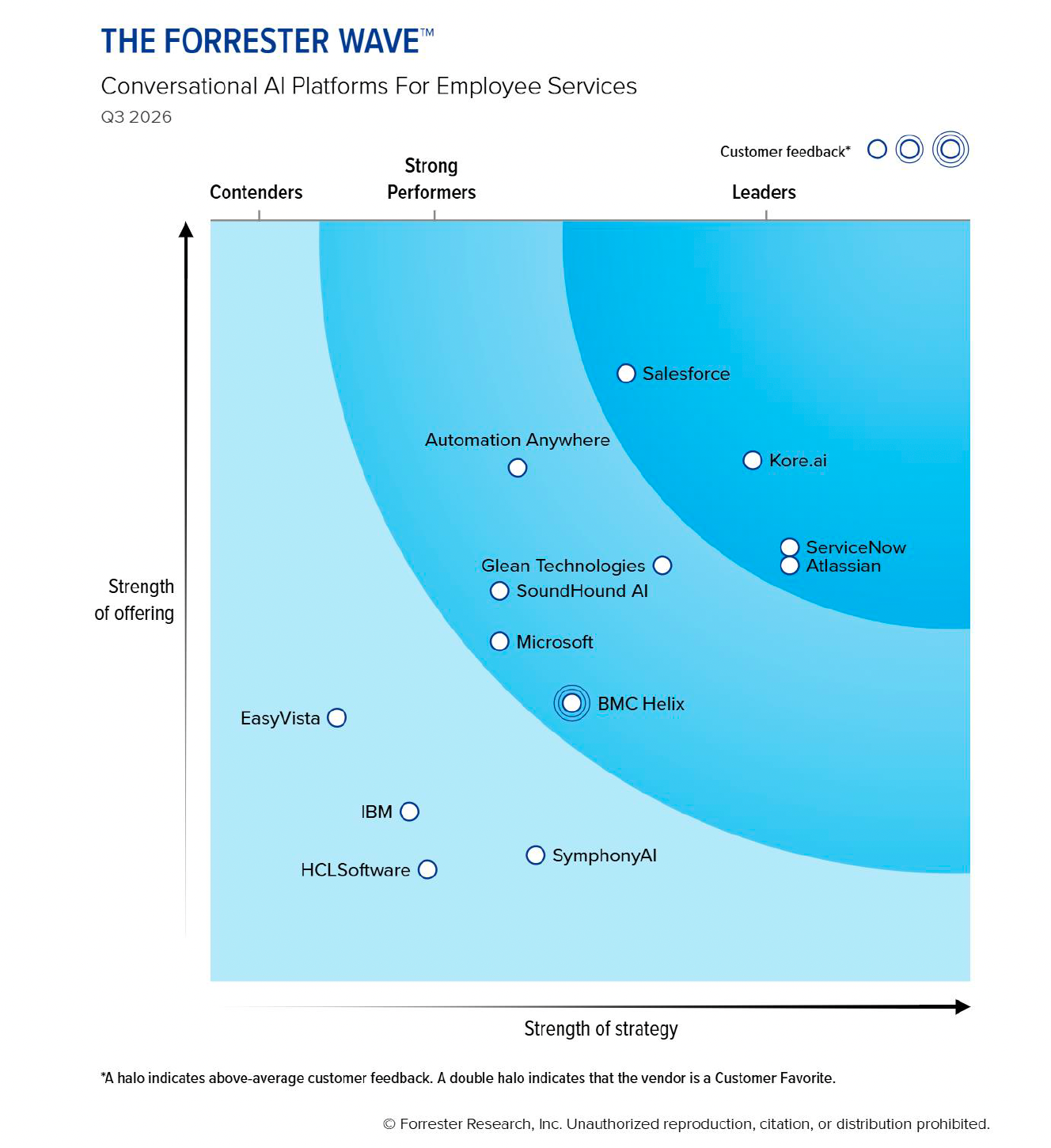
- Leader in The Forrester Wave™: Conversational AI Platforms For Employee Services, Q3 2026
- Leader in The Forrester Wave™: Conversational AI Platforms For Customer Service, Q2 2026
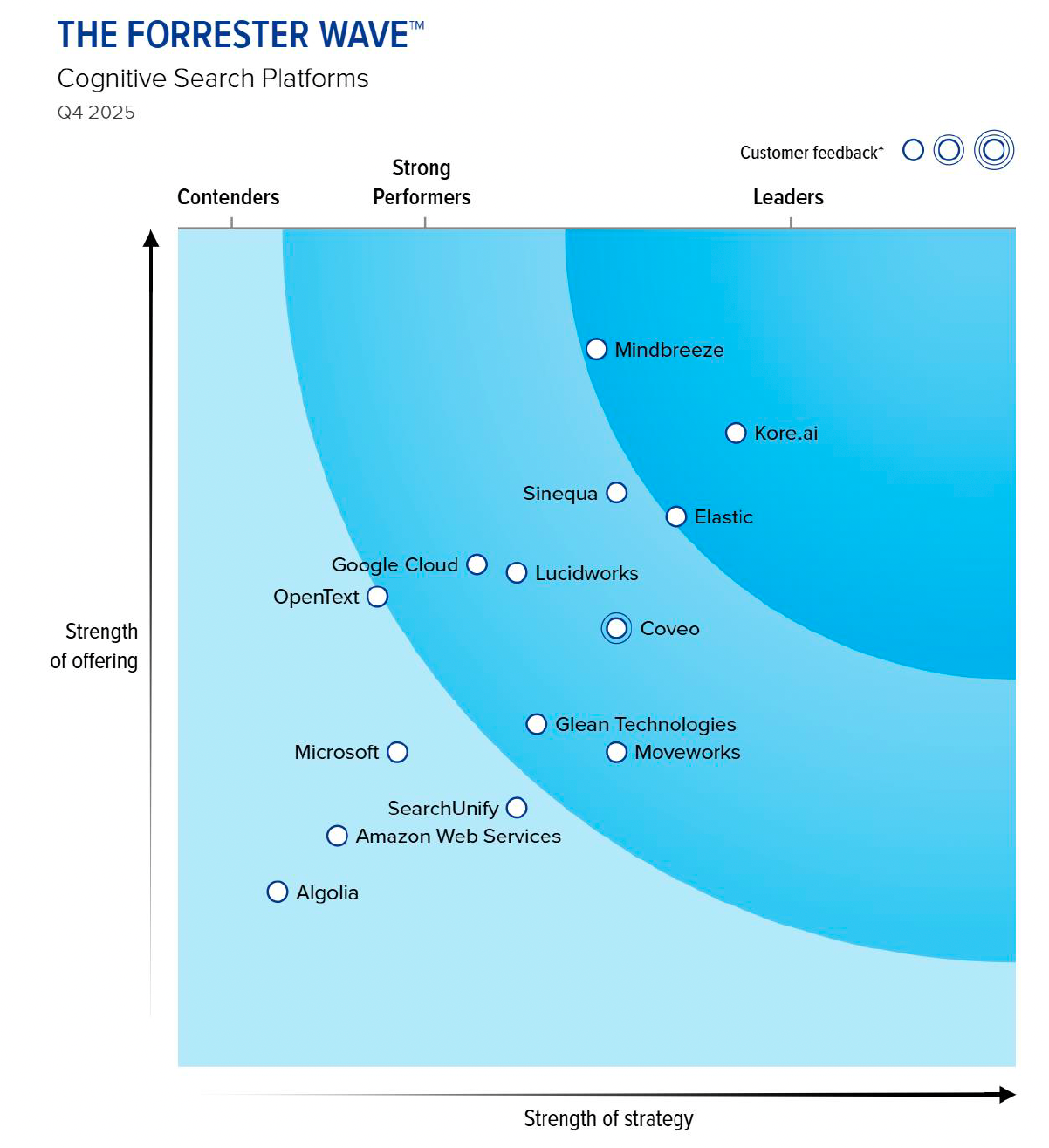
- Leader in The Forrester Wave™: Cognitive Search Platforms, Q4 2025
Think about it. Three different markets. Three different analyst teams. Three completely different sets of evaluation criteria. And one consistent name.
Why does that matter so much? Because each of these markets is in serious flux. Vendors are entering, exiting, getting acquired, repositioning.. at a pace I have rarely seen in my career. Through all that churn, our position has only strengthened. Let me walk you through each report, what the analysts are saying about the market, where we scored high ratings, and why I believe that matters if you are a large enterprise.
Quick note before we dive in: scores in Forrester Wave evaluations are on a scale of 1 (below par relative to others evaluated) to 5 (superior relative to others evaluated). So a 5 basically means top of the class.
The Forrester Wave™: Conversational AI Platforms For Employee Services, Q3 2026
First, what does Forrester say about this market?
This is the most recent of the three reports, published in July 2026, and its headline says it all: agentic AI is everywhere, so pick vendors who make it useful.
Forrester observes that pretty much every tool in this space has now completed the shift from the old NLU and intent-tree approach to agentic architectures. AI models can now reason and act on user goals. And the results are real.. the report cites 40% deflection of employee requests as a common outcome. But (and this is a big but) agentic task execution is inherently unpredictable, and most adopters are still on a learning curve.
The report tells buyers to scrutinize three things. One, vendor assistance and premade assets, because that's the key to time to value. Two, the breadth of the context layer, because that ultimately determines whether the agent is actually useful. Three, the honest reality that development interfaces and agentic controls across the industry are still rudimentary. Some platforms are missing basics like PII redaction and version control. Yes, in 2026!
Now, our result: from Strong Performer to Leader
For me personally, this recognition is the most meaningful of the three. Why? Kore.ai was positioned as a Strong Performer in the previous two editions of this evaluation. This year, we moved into the Leader category, in an evaluation of the 13 providers that matter most.
You see, moving up in a Wave is hard. The bar for "enterprise-ready" keeps getting higher every cycle. We didn't just keep pace with that bar, we cleared it.
In specific words from the report, “Kore.ai’s agent management system shines: It includes a context engine that supports multiple context graphs and behavioral enrichment as well as robust functionality for guardrails and enforcement. These deliver better answers and control over agent behaviors.“
Access the full report - Forrester Wave™ Cognitive Search Platforms, Q4 2025
Where we scored the top score of 5, and why it matters
In the current offering evaluation, Kore.ai received the top score of 5 in seven criteria: Personalization, memory, and context; Resource orchestration and application execution; Application/agent development tools; Prebuilt application components; Guardrails and customer data security; Scalability and reliability; and Analytics. On the strategy side, we received a 5 in Innovation and in Pricing flexibility and transparency.
Now here's the interesting part. Go back and read what Forrester said the market needs, and then look at this list again. You will notice the pattern.
Forrester says the context layer determines usefulness. We scored a 5 on personalization, memory, and context, backed by a context engine that supports multiple context graphs and behavioral enrichment. Forrester says builder tools across the industry are still rudimentary. We scored a 5 on agent development tools, and the report specifically called out our Agent Blueprint Language (ABL) as an innovation for improving agent predictability. Forrester says premade assets are key to time to value. We scored a 5 on prebuilt application components. Basically, the exact gaps Forrester flags in this market are the exact places we scored highest. That's not a coincidence; that's product strategy.
And notice one more thing. Guardrails and customer data security carry the single highest weighting in the entire current offering evaluation (9%), and Scalability and reliability come next (7%). We scored a 5 on both. If you have ever tried rolling out employee-facing AI agents to tens of thousands of employees across HR, IT, and finance, you know these two are exactly where deployments live or die. Governance is what gets legal, compliance, and security teams to say yes. Scalability is what turns a pilot in one department into an enterprise-wide capability. And the top score on Analytics? Forrester highlighted that our analytics stand out by translating agent impact into dollars saved. Dollars, not deflection percentages. That's the language your CFO actually speaks, right?
One more thing I have to mention. Pricing flexibility and transparency is weighted at a full 20% of strategy, and we scored a 5 there too. Forrester described our pricing as supremely flexible, supporting per-user and outcome-based models and even mixing them to fit client needs. In a market where several vendors got flagged for confusing or fluctuating pricing, this matters a lot when you are planning a multi-year AI investment.
Forrester's take? Kore.ai is ideal for enterprises that want a "highly configurable and governable agentic platform" with out-of-the-box resources across multiple domains to get them started.
The Forrester Wave™: Conversational AI Platforms For Customer Service, Q2 2026
What does Forrester say about this market?
Did you know more than 650 conversational AI vendors compete in this market? 650! All fighting for relevance in a space shaped by the needs of roughly 15 million contact center agents, many of whom still spend disproportionate time on routine, low-value tasks.
The report's central argument is one I keep repeating to anyone who will listen: success in this market depends on far more than impressive demos or novel AI techniques. Customer service leaders need platforms that integrate with entrenched, long-lived IT environments. They need highly tailored, brand-aligned applications. They need developers and business users building together. And enterprise-grade observability and enforceable guardrails are called out as prerequisites for earning the confidence of risk-averse legal and compliance teams.
Oh, and Forrester notes that agentic frameworks are now table stakes. Every single vendor in the evaluation has one. So the question is no longer "is your platform agentic?" The question is "is it enterprise-ready?"
Our result: a Leader again, with the highest Current Offering score
Among the 14 providers that matter most, Kore.ai was named a Leader, and received the highest Current Offering score of any vendor in the evaluation.
And this is not our first time here. Kore.ai was named a Leader in the 2024 edition of this Wave as well. Think about what happened between 2024 and 2026 in this market. The GenAI wave, the agentic shift, acquisitions everywhere. Being a Leader across both those eras, with completely different technology expectations? I believe that's the truest signal of durability.
From the report, “The company provides significant flexibility in management of AI models, agentic frameworks and resources, and tools for testing applications. The platform also includes sturdy guardrails to keep Kore’s bots out of trouble and security measures to keep customer data safe. Customers highlight additional strengths such as connectivity to multiple communications channels and the ability to integrate with back-end systems.”
Access the full report - Forrester Wave™: Conversational AI platforms for customer service, Q2 2026
Where we scored the top score of 5, and why it matters
Kore.ai received the top score of 5 in nine current offering criteria, more than any other vendor in this evaluation: AI model management; Agentic framework; Resource orchestration and application execution; Application testing tools; Guardrails and customer data security; Legacy system integration; Voice and telephony support; Scalability and reliability; and Knowledge management. On strategy, we scored a 5 in Roadmap.
Again, map these against what Forrester says actually matters. The report says platforms must fit safely into an IT environment, connecting to CCaaS platforms, legacy systems of record, external AI systems, all of it. We scored a 5 on legacy system integration, and customers in the report highlighted our connectivity across communication channels and back-end systems. Ask any bank running a 30-year-old core system, or any telecom sitting on layers of entrenched infrastructure. This is the difference between an AI project that ships and one that dies quietly in integration hell.
The report demands enforceable guardrails before legal and compliance will sign off. We scored a 5, and Forrester noted our sturdy guardrails that keep bots out of trouble and security measures that keep customer data safe. Agentic frameworks may be table stakes, but quality varies wildly, and we scored a 5 on both the agentic framework and on resource orchestration and application execution. That's what lets agentic AI perform complex, multistep operations reliably at contact center scale, not just in a demo.
Two more scores I want to call out for enterprise buyers. Voice and telephony support: 5. Voice is still the highest-volume, highest-stakes channel in customer service, and it's exactly where many digital-first platforms in this evaluation fall below par. And Scalability and reliability: 5. Here's my honest view: a customer service platform is judged on its worst day. The outage day. The product recall day. The holiday surge day. Not its best day. Forrester also recognized our above-par AI expertise, particularly in building our own LLMs and small language models, which gives enterprises model flexibility instead of lock-in.
Forrester's take is that Kore is a good fit for organizations that need "large, complex deployments" within complex customer service IT ecosystems. Which, if you look at the Fortune 2000 enterprises we work with every day, is exactly who we serve.
The Forrester Wave™: Cognitive Search Platforms, Q4 2025
What does Forrester say about this market?
Here's a line from this report that I think everyone building AI agents should sit with: cognitive search platforms will become the brains of accurate agentic AI.
Think about that for a second. Every AI agent you deploy, whether it serves a customer or an employee, is only as accurate as the knowledge it retrieves. The rising tide of AI has lifted this entire market, with buyers racing to leverage enterprise knowledge through LLMs and retrieval-augmented generation. But Forrester is candid that some vendors have risen to the occasion while others are struggling to keep pace.
The report tells buyers to look at three things: the breadth and depth of data connectors and how search integrates with enterprise data infrastructure, the ability to deploy at true enterprise scale with all the security and privileged-access complexity that comes with it, and, more crucially than ever, the vendor's roadmap for the onrushing agentic future.
Our result: a Leader, with the highest Strategy score
In this evaluation of the 14 providers that matter most, Kore.ai was named a Leader, with the highest Strategy score of any vendor evaluated.
Now, in a report whose central advice to buyers is literally "scrutinize vendor strategies and roadmaps," holding the top strategy position.. well, I will let you conclude.
The report highlights, “Kore.ai’s true multiturn conversational search experiences shine. It gives customers a deep and rich set of tools to understand a user’s intent and shape the experience accordingly, with strong capabilities to understand user behavior and fine-tune the retrieval and results for optimal relevancy. It has an excellent set of development and evaluation tools for traditional search and for developing RAG and hybrid search pipelines. The customers report that using Kore’s conversation-based search has increased the number of employee inquiries solved via self-service while improving satisfaction with the overall app experience.”
Access the full report - Forrester Wave™ Cognitive Search Platforms, Q4 2025
Where we scored the top score of 5, and why you should care
Kore.ai received the top score of 5 in eight current offering criteria: Data connectors; Data ingestion and preparation; Search methods; Intent; Relevancy; Applications and workflow; Search development, testing, and evaluation tools; and Hosting. On strategy, we scored a 5 in Innovation and in Partner ecosystem.
Once more, these line up directly with what Forrester says you should evaluate. The report's very first buyer consideration is integration of search with enterprise data infrastructure. We scored a 5 on both data connectors and data ingestion and preparation. And look, enterprise knowledge does not live in one tidy place. It's scattered across SharePoint, wikis, ticketing systems, chat platforms, decades of documents. A search platform is only as good as its ability to connect, ingest, and make sense of all of it.
The paired top scores on Intent and Relevancy go to the heart of what makes search useful instead of frustrating. Forrester highlighted our deep and rich set of tools to understand a user's intent and shape the experience accordingly, with strong capabilities to fine-tune retrieval and results for optimal relevancy. And customers in the report confirmed the business outcome: Kore's conversation-based search increased the share of employee inquiries resolved via self-service while improving satisfaction with the overall app experience. Self-service went up, satisfaction went up. That's the combination every CIO is chasing.
The 5 on search development, testing, and evaluation tools matters more than most people realize. Forrester called it an excellent set of tools for traditional search and for building RAG and hybrid search pipelines. And RAG quality, remember, is the foundation every AI agent's accuracy rests on. The brains, as Forrester puts it. The 5 on Hosting is the underrated one: regulated industries need deployment flexibility across clouds and environments, and this is where cloud-only players quietly fall short. Forrester also noted our huge R&D investment relative to our size and a superior roadmap, with a vision of being the agentic operating system at the core of enterprise knowledge work.
In Forrester's assessment, Kore.ai is a great fit for companies that want to build "conversation-first search experiences" grounded in a deep understanding of the user journey.
Okay, so what's the bigger story here?
Any single Leader placement is an achievement. Three Leader placements, across customer service, employee services, and enterprise search? That tells a different kind of story. Let me try to connect the dots.
These three markets are moving at very different speeds, in very different directions. Customer service is being reshaped by agentic self-service at massive scale. Employee services is grappling with fragmented knowledge, context layers, and governance. Cognitive search is being rebuilt as the retrieval and grounding foundation for agentic AI. Different problems, different buyers, different evaluation criteria. Forrester used a different lens for each.
And yet the same Kore.ai strengths earned top scores across all three. Go look at the three scorecards side by side. Guardrails and data security, scalability and reliability, resource orchestration, development and testing tools.. these earned the top score of 5 wherever they were evaluated. These are not use-case features. These are platform fundamentals. And they are precisely the fundamentals Forrester says separate production-grade platforms from impressive demos.
Here's my honest opinion, and I will commit to it: very few vendors can serve all three of these use cases at enterprise scale. Go check the reports yourself. Most platforms are strong in one domain and absent or below par in the others. Our presence as a Leader across all three reflects an architectural bet we made early. One model-agnostic, cloud-agnostic Agent Platform, with shared context, governance, analytics, and orchestration underneath every use case. Not three disconnected point products stitched together with marketing.
What does that mean for you as an enterprise? Simple. You can serve your customers, empower your employees, and unlock your knowledge on one governed platform, and expand from one use case to the next without starting over. Your compliance team approves the governance model once. Your IT team integrates once. Your teams learn one platform.
"Markets shift, categories get redefined, and vendor positions move dramatically year over year. What doesn't change is what enterprises actually need: a platform they can trust to deliver in production, across every use case that matters. We believe three Leader recognitions across three Forrester Wave evaluations validate exactly that." ~ Abhijit Mhetre, EVP and Head of Corporate Marketing.
If you are evaluating platforms right now, here's my advice
Drawing on the guidance across all three reports:
- Evaluate the context layer, not just the model. Forrester is clear that knowledge connectors and context layers ultimately determine agent effectiveness. Ask every vendor how they unify your fragmented enterprise knowledge. Push for specifics.
- Weight governance and scalability the way Forrester does. There's a reason guardrails and data security carried the heaviest weighting in the employee services evaluation. Favor enforceable, multilayered controls and proven scale over demo-day polish.
- Insist on proof of value in business terms. Dollars saved, not just deflection percentages. If a vendor can't show you the money, keep asking why.
- Scrutinize pricing flexibility. Pricing confusion was a recurring pain point across vendors in these reports. Look for transparent, mixable consumption models that fit a multi-year plan.
- Assess platform durability across use cases. If your customer service, employee services, and enterprise search strategies each need a different vendor, congratulations, you just signed up for three integration projects and three governance models. There's a better way.
Way forward
This market refuses to stand still, and neither will we. Three Leader recognitions in three Forrester Wave evaluations is a milestone we are celebrating, no doubt. But I see it as validation of a direction, not a destination. We will keep building an open, governed, enterprise-grade Agent Platform that helps the world's largest organizations move from AI experiments to enterprise-wide impact.
So, want to see what a triple Leader's platform can do for your customers, your employees, and your enterprise knowledge?
Read The Forrester Wave™: Conversational AI Platforms For Employee Services, Q3 2026
Read The Forrester Wave™: Conversational AI Platforms For Customer Service, Q2 2026
Read The Forrester Wave™: Cognitive Search Platforms, Q4 2025
The Forrester Wave™: Conversational AI Platforms For Employee Services, Q3 2026, Will McKeon-White with JT Thykattil, Madeleine Pralea, Kara Hartig, July 22, 2026. The Forrester Wave™: Conversational AI Platforms For Customer Service, Q2 2026, Max Ball with Fiona Swerdlow, Sarah Morana, April 16, 2026. The Forrester Wave™: Cognitive Search Platforms, Q4 2025, Rowan Curran with Sudha Maheshwari, Faith Born, Jen Barton, October 3, 2025.
Forrester does not endorse any company, product, brand, or service included in its research publications and does not advise any person to select the products or services of any company or brand based on the ratings included in such publications. Information is based on the best available resources. Opinions reflect judgment at the time and are subject to change. Forrester Wave™ is a trademark of Forrester Research, Inc.
Share