




.webp)
If you run customer operations for a global enterprise, voice is likely your largest service cost and your most visible customer moment: millions of calls a year, across regions, languages, and brands. The pressure to act is real. A 2026 Gartner survey found that 91% of customer service leaders report pressure from executive leadership to implement AI.
For voice, however, implementation is only the beginning. The harder question is whether a platform can perform reliably across millions of real customer conversations: at peak volume, on noisy phone lines, in every language your customers speak, and within every rule your business must follow. At that scale, small flaws become high costs.
This guide gives you the ten questions to ask before you choose, what good answers sound like, and the outcome each one protects. For the wider platform decision, start with our guide on how to choose the right conversational AI platform.
Quick answer
Before you choose a voice AI or CX automation platform, ask these 10 questions:
- Does one system control the entire voice interaction loop?
- What is the latency at peak production load?
- Can customers interrupt naturally?
- How well does it understand customers on real phone lines?
- Can customers switch languages and handle multiple requests in one conversation?
- How is personal and payment information protected?
- What happens when a dependency fails during a live call?
- Can customers reach a human without repeating themselves?
- How does the platform measure actual resolution rather than containment?
- What is the cost per resolved interaction, and how predictable is it?
The key is not to accept vendor claims at face value. Test these capabilities against your own calls, systems, traffic patterns, compliance requirements, and business outcomes.
Start with the outcomes you need to deliver
In most contact centers, voice is both the busiest and the most expensive channel to serve. According to ContactBabel's US contact center research, live-agent voice handles 62% of inbound interactions, and a call handled by a live agent costs about $7.16, against $0.58 for a call resolved through voice self-service. That cost gap is where the largest savings sit.
Agentic voice AI changes that math. Kore.ai analysis, based on ContactBabel (2025), McKinsey, BCG, and customer disclosures, shows the cost of a resolved call falling from $7.16 to $3.26 for an operation handling 10 million calls a year. That is about 55% lower, or $39M a year.
Set the outcomes this investment must deliver before you compare vendors:
The 10 questions: Before choosing the right voice AI platform
The call examples below are illustrative, based on common service calls.
1. Does one system own each voice turn, from start to finish?
Outcome at stake: satisfaction and abandonment.
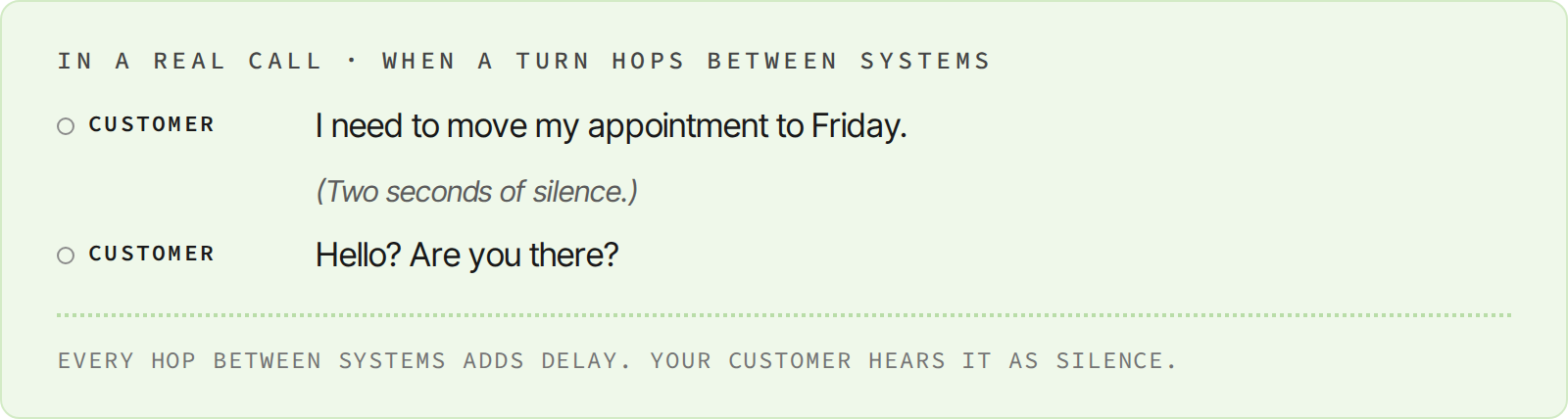
Every time your customer speaks, the platform must detect they have finished, transcribe, decide, reply, and speak. When those steps hop between separate systems, each hop adds delay and a new place to fail. Better platforms stream all five through one session and trace every phase, so you always have an answer to "why was that call slow?"
2. How fast will it respond to my customers when we are busiest?
Outcome at stake: abandonment and repeat calls at peak.
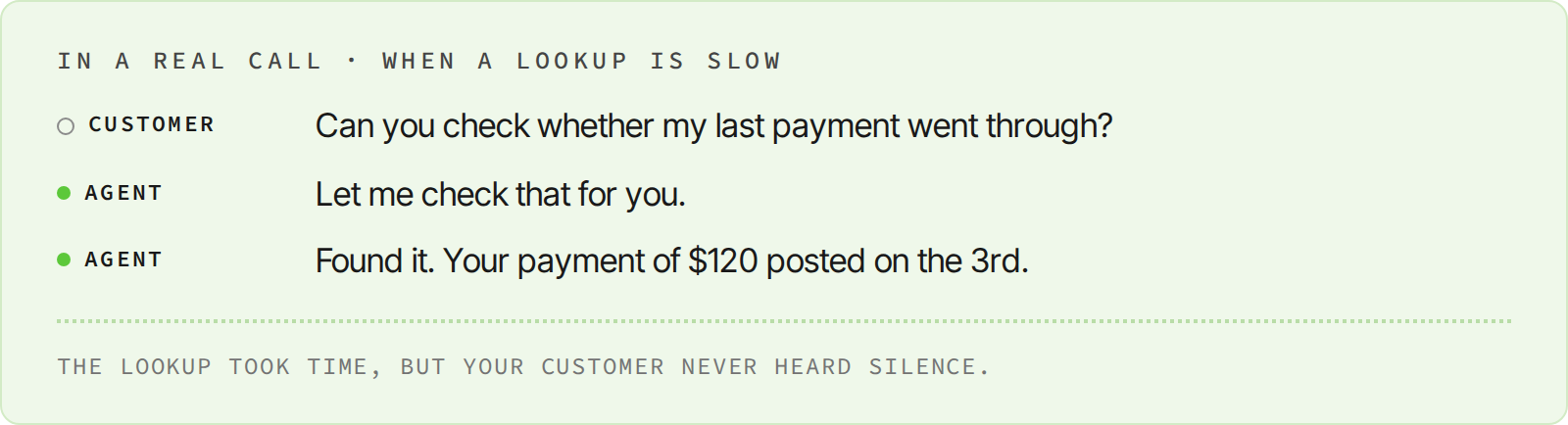
Speed is really three delays: deciding your customer has finished, producing the first words, and turning them into audio. The first is hardest. Decide too early and the agent talks over a customer who was only pausing. Better platforms use meaning as well as silence, and cover slow system lookups with natural spoken updates.
3. Will it let my customers interrupt, the way people naturally do?
Outcome at stake: satisfaction and handle time.
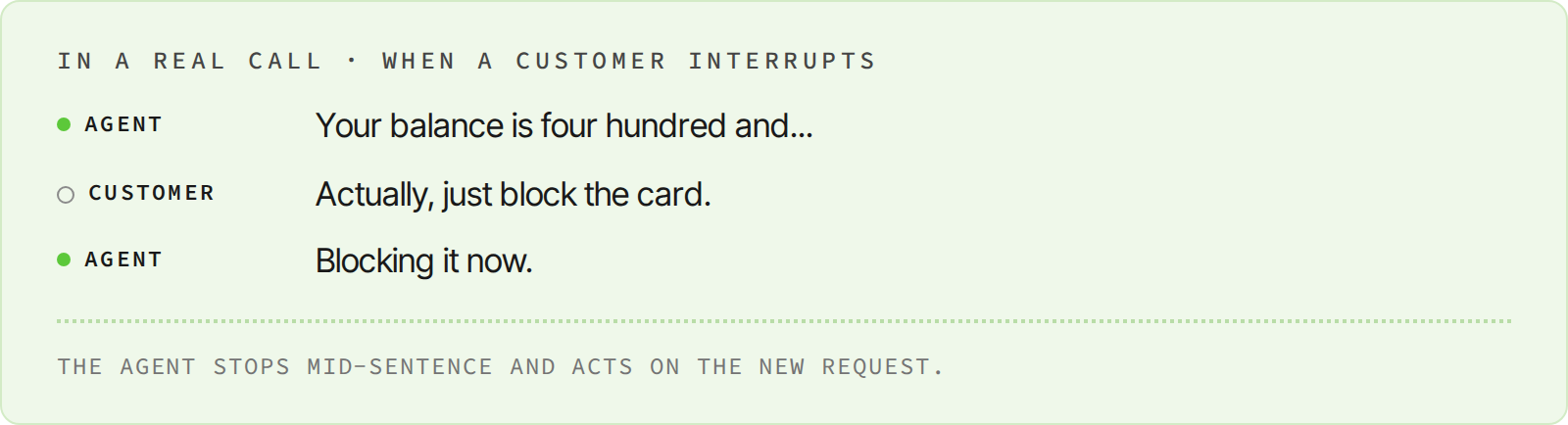
A natural conversation needs three skills. The agent keeps listening while it speaks, stops cleanly when interrupted, and also recognizes "uh-huh" as a backchannel, not an interruption or a new turn. It must also keep its records consistent, so no action fires on a detail your customer has just corrected.
4. Will it understand my customers, on real phone lines?
Outcome at stake: resolution rate and transfers.
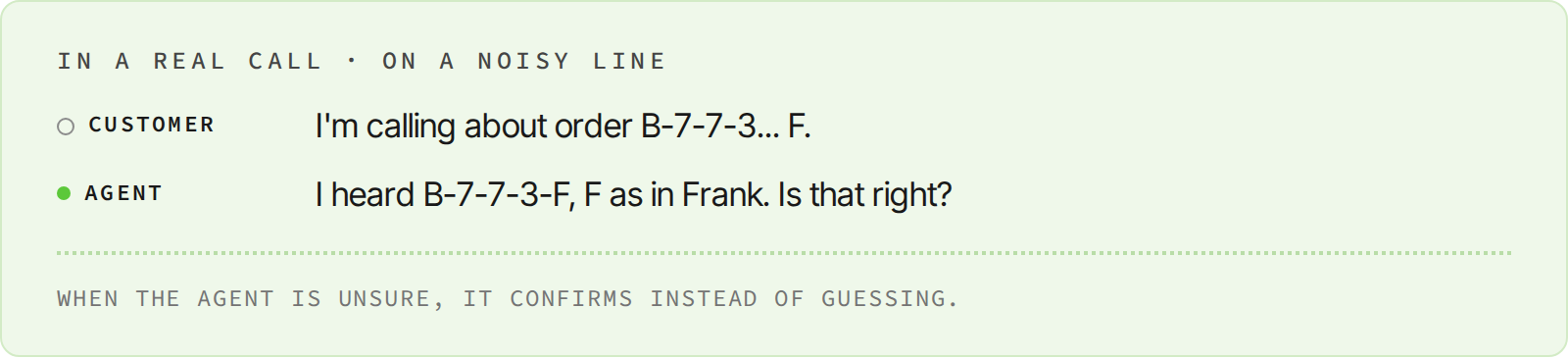
If the agent mishears an account number, even the best model gives the wrong answer. Phone audio is compressed and noisy, and no single speech engine is best in every market. That is why the freedom to choose engines per market matters. Correct pronunciation of your product and place names also builds trust quickly.
5. Can my customers speak naturally, in their language, about everything at once?
Outcome at stake: first-call resolution.
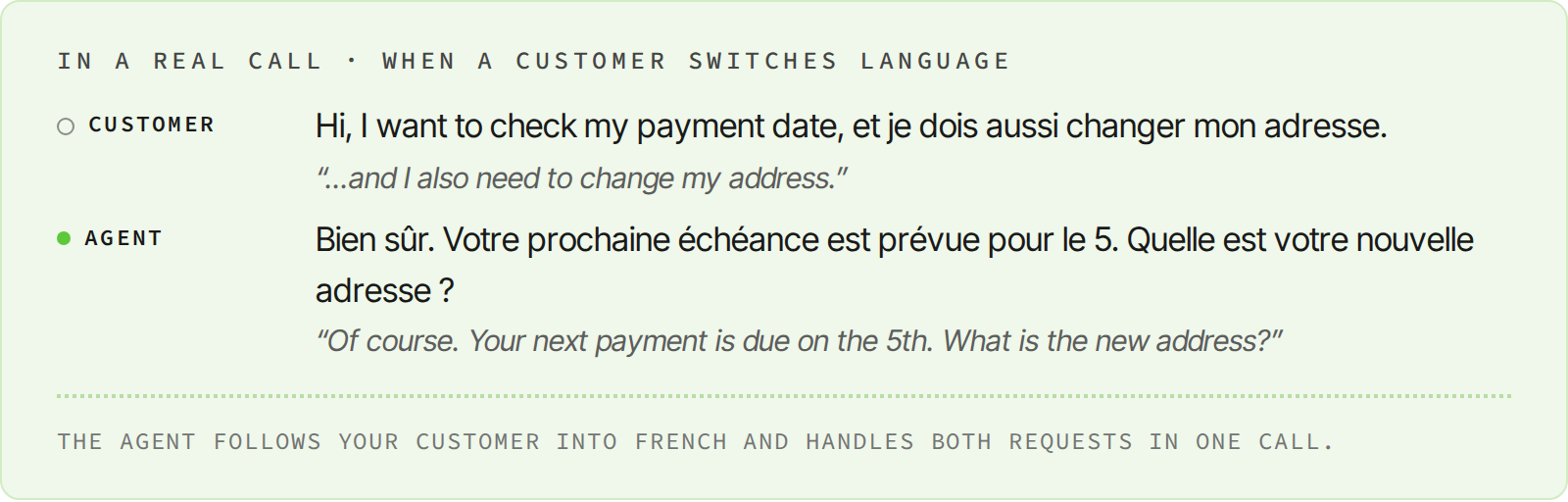
SQM Group research shows that every 1% gain in first-call resolution lifts satisfaction by about 1% and cuts operating cost by about 1%. Agents that handle one request per call quietly push that number down. Look for several requests handled in one call, and language followed sentence by sentence.
6. How will my customers' personal information be protected on the call?
Outcome at stake: zero compliance incidents and a clean audit.
Under PCI DSS, recordings must not store card data, yet many contact centers still rely on agents to pause recordings by hand. An AI agent can apply the rules on every call: redacting card numbers, accepting keypad entry, and reading required disclosures word for word as scripted steps. Outbound calls add telecom rules, such as TCPA in the US and TRAI's DND and calling-window limits in India.
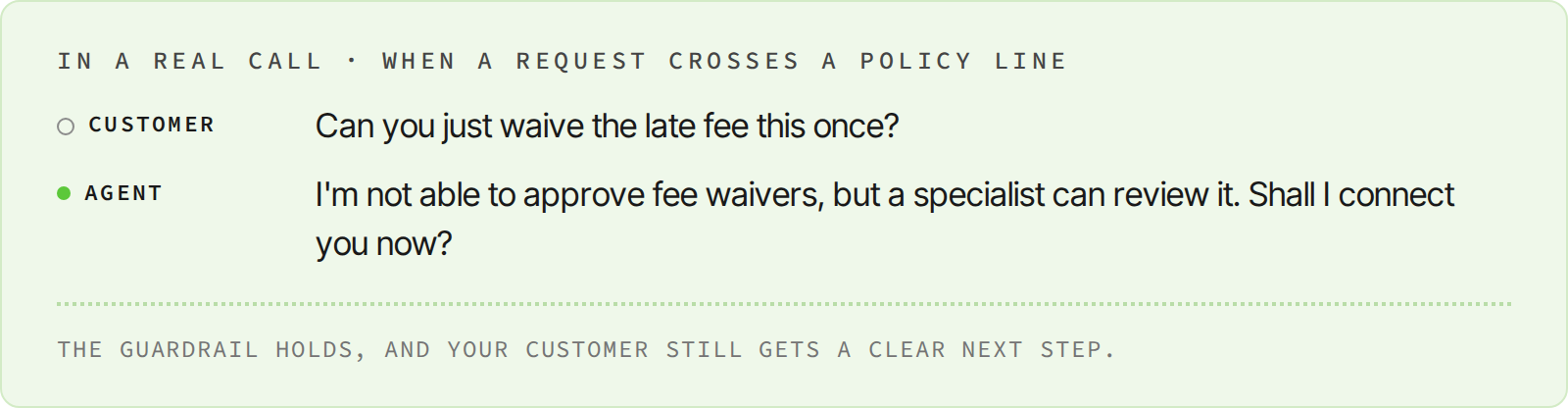
7. What will my customers experience if something fails mid-call?
Outcome at stake: service continuity.
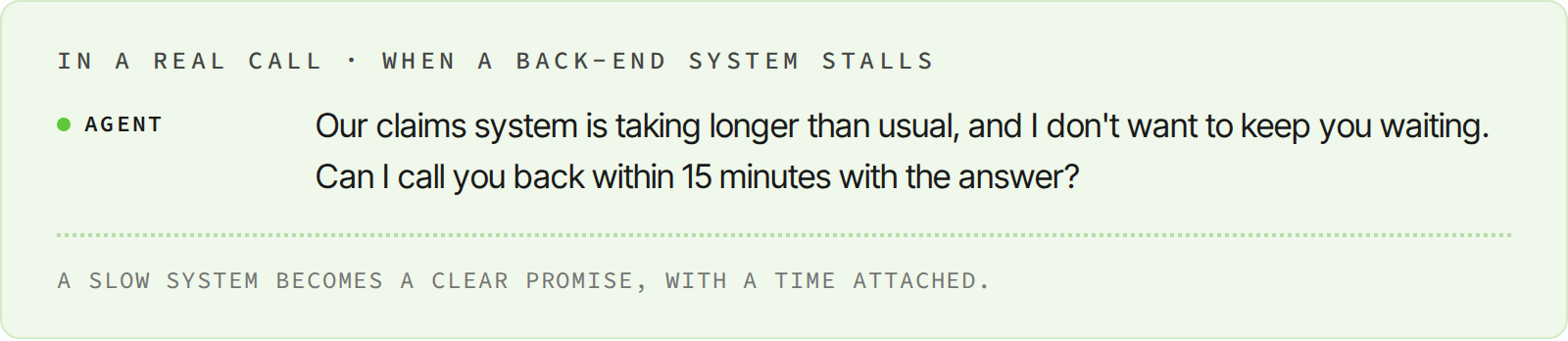
One call can depend on a carrier, several speech and model services, and your own systems. Any of them can slow down or fail. Plan for it: backup providers take over automatically, slow lookups get a spoken update, and long waits become a callback.
8. Will my customers reach a person smoothly when they need one?
Outcome at stake: handle time and satisfaction on escalated calls.
Around 74% of consumers are frustrated by repeating their story. A good agent answers only from your approved content, says when it cannot know something, and escalates on clear signals: repeated failure, rising frustration, high-risk requests, or a direct ask. You should control how much context passes on, from a summary to the full conversation.
.png)
9. Will I know if my customers' problems were actually solved?
Outcome at stake: a resolution rate that reflects real customer outcomes.
Containment measures whether a call avoided a human. Resolution measures whether the problem was solved. SQM finds the average contact center resolves about 70% of calls first time, and satisfaction drops about 16% with each extra call. Better platforms judge each call by comparing what your customer asked with what actually happened.
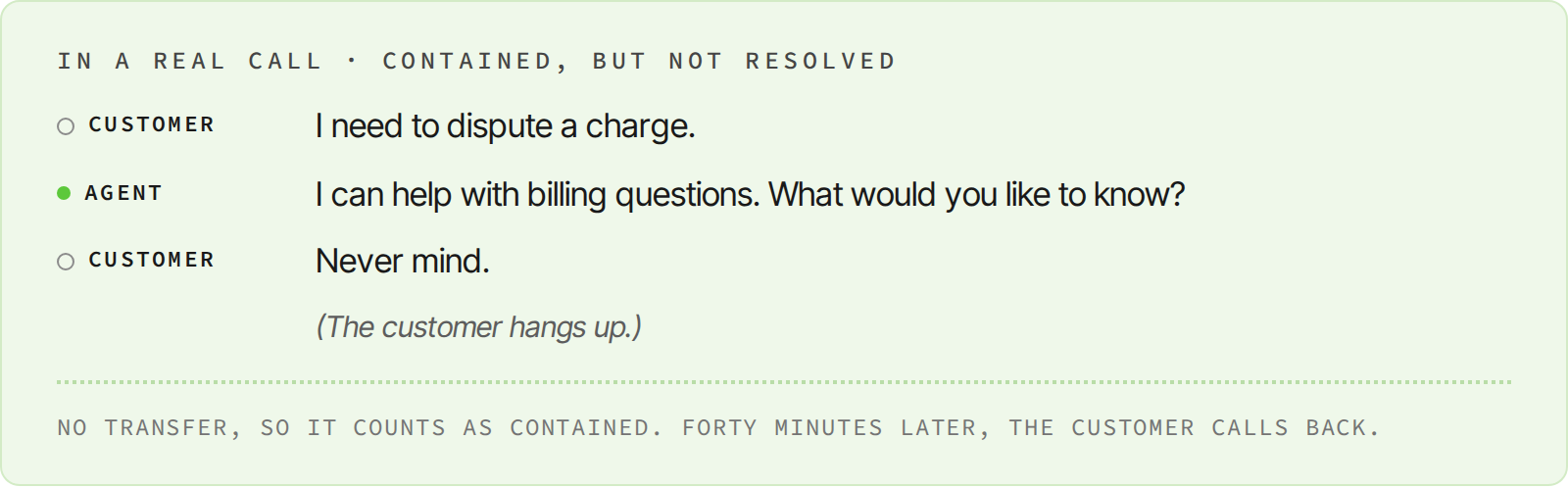
That call counts as "contained." Forty minutes later, the customer calls back.
10. What will this cost me, and can I predict it?
Outcome at stake: cost per resolved call.
A voice minute stacks telephony, speech recognition, the language model, and speech synthesis. The model is the most variable part: Gartner notes agentic AI can use 5 to 30 times more tokens per task than a chatbot. Two design choices keep cost in check. Simple turns go to smaller models, and routine turns run as scripted steps with no model at all.
.png)
Test it on your own calls
You should not have to take any vendor's word for these answers, including ours.
Your voice AI vendor scorecard
Score each vendor from 1 (weak) to 5 (strong), using your own calls as evidence.
Confirm the enterprise basics too: uptime SLA, environments and rollback, SSO and role-based access, data residency, deployment options, integrations with your contact center and CRM, portability of your data, and references live for at least a year.
Five answers worth a gentle follow-up
- "Our average latency is under 500 milliseconds." Ask what your slowest callers experience at peak.
- "We have the most human-sounding voice." Ask to see what sits behind it: "Transfer this call into my queue with full context. Now show me the audit trail."
- "Our agent builds itself in minutes." Ask: "What happens on turn 40, in Spanish, when my caller asks for a person?"
- "AI is already included in your contact center." Ask: "Which speech engines and models can I choose, and what leaves with me if I switch?"
- "Our containment rate is 80%." Ask how many of those customers called back within a week.
How Kore.ai helps you deliver these outcomes
Our voice AI agents run on Artemis, Kore.ai's agent platform, and are built around the outcomes above:
- Natural calls: barge-in at any time, backchannel awareness, and spoken fillers instead of silence.
- Fewer transfers: side questions and corrections handled, with answers from your verified content.
- Respectful handoffs: escalation on clear signals, and warm transfer into your existing contact center with configurable context.
- Controlled cost: model tiering, scripted routine turns, around 35 speech providers under one contract, and cost visible by session.
- Lower risk: platform-enforced guardrails, word-for-word disclosures, and a full trace of every call.
The better proof is in production results from our customers, measured in business outcomes:
- A large US telco: 370 million interactions a year, 50+ voice use cases, and $140M saved over three years.
- An international retail bank: 95% accuracy, 60% self-service containment, and $30M saved in two years.
- An EU health insurance payer: 42% of contacts handled by voice AI agents, and a 28% gain in member satisfaction.
- A US regional bank: its legacy IVR replaced, with more than 5 million voice minutes a year automated.
Decide on your own evidence
At enterprise scale, the right platform proves itself in your own data. Our team can run these ten questions against your call recordings, systems, and targets. Talk to a voice AI expert whenever you are ready.
FAQs
What is the difference between an IVR and a voice AI agent?
An IVR routes callers through fixed menus. A voice AI agent understands open speech, keeps context, handles interruptions, and completes tasks such as updating an account.
What should I look for in a CX automation platform for voice?
Natural conversation on real phone lines, grounded answers with smooth handoffs, platform-enforced compliance, and predictable cost per resolved call. Then confirm uptime, security, data residency, and integrations.
How long does a voice AI pilot take?
Most enterprises run one high-volume call type on live traffic for 60 to 90 days. That is long enough to measure resolution, handoff quality, and cost per call.
Will voice AI replace human agents?
In most deployments, voice AI handles routine, high-volume calls. Your people focus on complex, sensitive, or high-value conversations, supported by AI summaries.