Agentic AI for business automation: Scaling with autonomy
Last Updated
October 19, 2026

Juhi Tiwari
Read Time

Summary
Agentic AI for business automation enables AI agents to plan, reason, remember context, use tools, and autonomously execute complex enterprise workflows. This article explores AI-powered automation, multi-agent collaboration, memory, tool use, planning, observability, governance, and human oversight, alongside use cases in banking, customer service, procurement, insurance, lending, HR, and IT. It explains how enterprises can move from isolated AI pilots to scalable, governed autonomous operations.
What’s on this page
Agentic AI for business automation is redefining how enterprises scale operations. Unlike generative AI that creates content, Agentic AI enables autonomous systems that can plan, reason, and execute workflows across the enterprise. This blog explains what Agentic AI is, how it drives business automation, and the steps enterprises can take to scale it responsibly.
What is agentic AI: Are enterprises ready to scale it?
Agentic AI represents the next frontier of enterprise artificial intelligence, defined as systems that can operate with autonomy by combining advanced planning, contextual reasoning, memory, collaboration, and tool usage to achieve goals. Unlike Generative AI, which focuses on producing content, Agentic AI is designed to initiate actions, adapt to dynamic contexts, and deliver measurable business outcomes with minimal human intervention.
While enterprises are actively experimenting, the challenge lies in scaling these systems so they remain useful, safe, and trustworthy, while aligning with governance, compliance, and strategic objectives. The critical questions now are: What does enterprise readiness for Agentic AI look like, and how can organizations design it to deliver responsible and scalable value?
Read more - Agentic AI: What It Is, Use Cases & How It Works
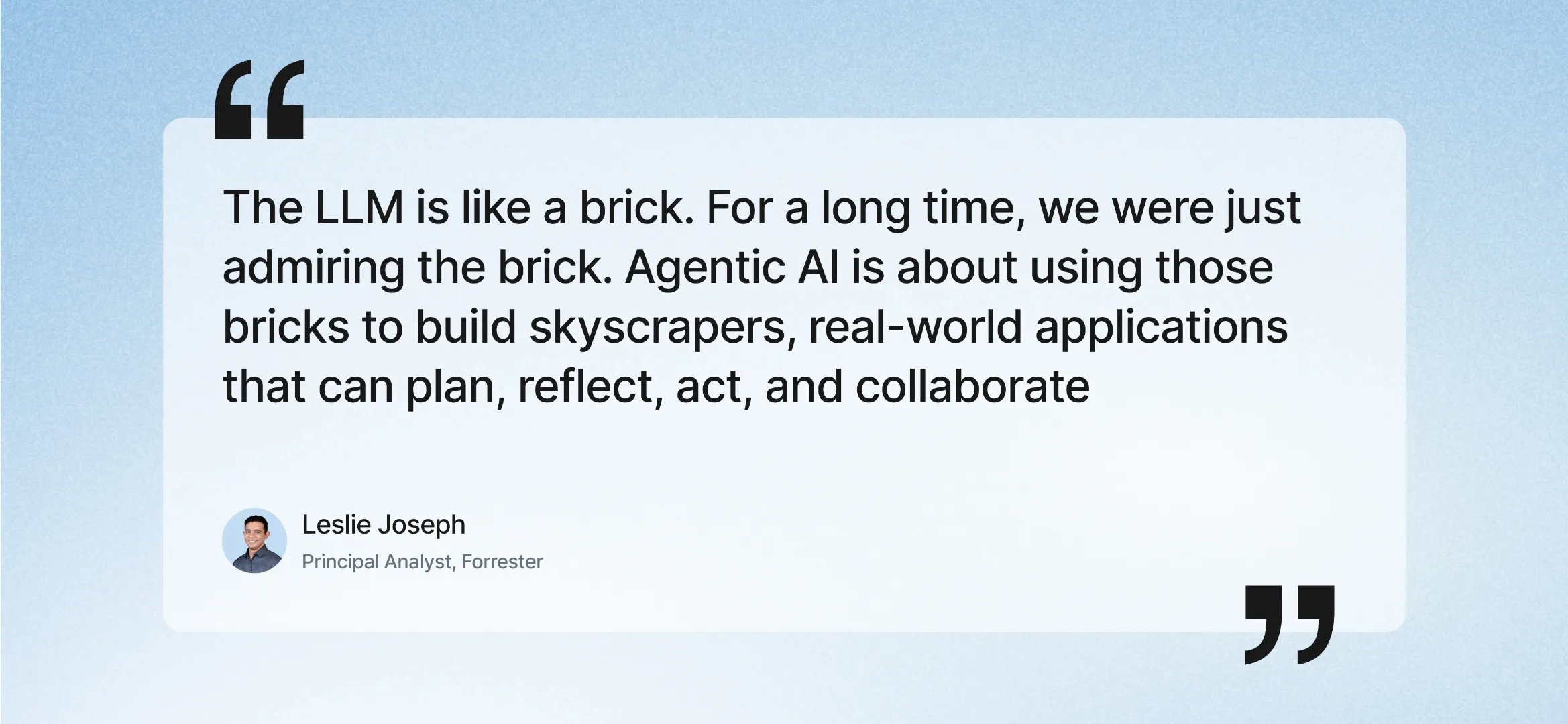
To explore this shift, Kore.ai invited a Forrester analyst to share views in a recent conversation. This blog is a summary of the most relevant takeaways and insights on Agentic AI that can help AI leaders move from early trials to real-world adoption with clarity.
On demand of the Webinar is here - Mind The Gap: Fulfilling The Promise Of Agentic AI
Agentic AI vs generative AI
At first glance, Agentic AI might look like just the next phase of Generative AI. In reality, it’s a different paradigm. Generative AI changed how we create and communicate, while Agentic AI is reshaping how work actually gets done.
The table below highlights the key differences that matter for enterprises.
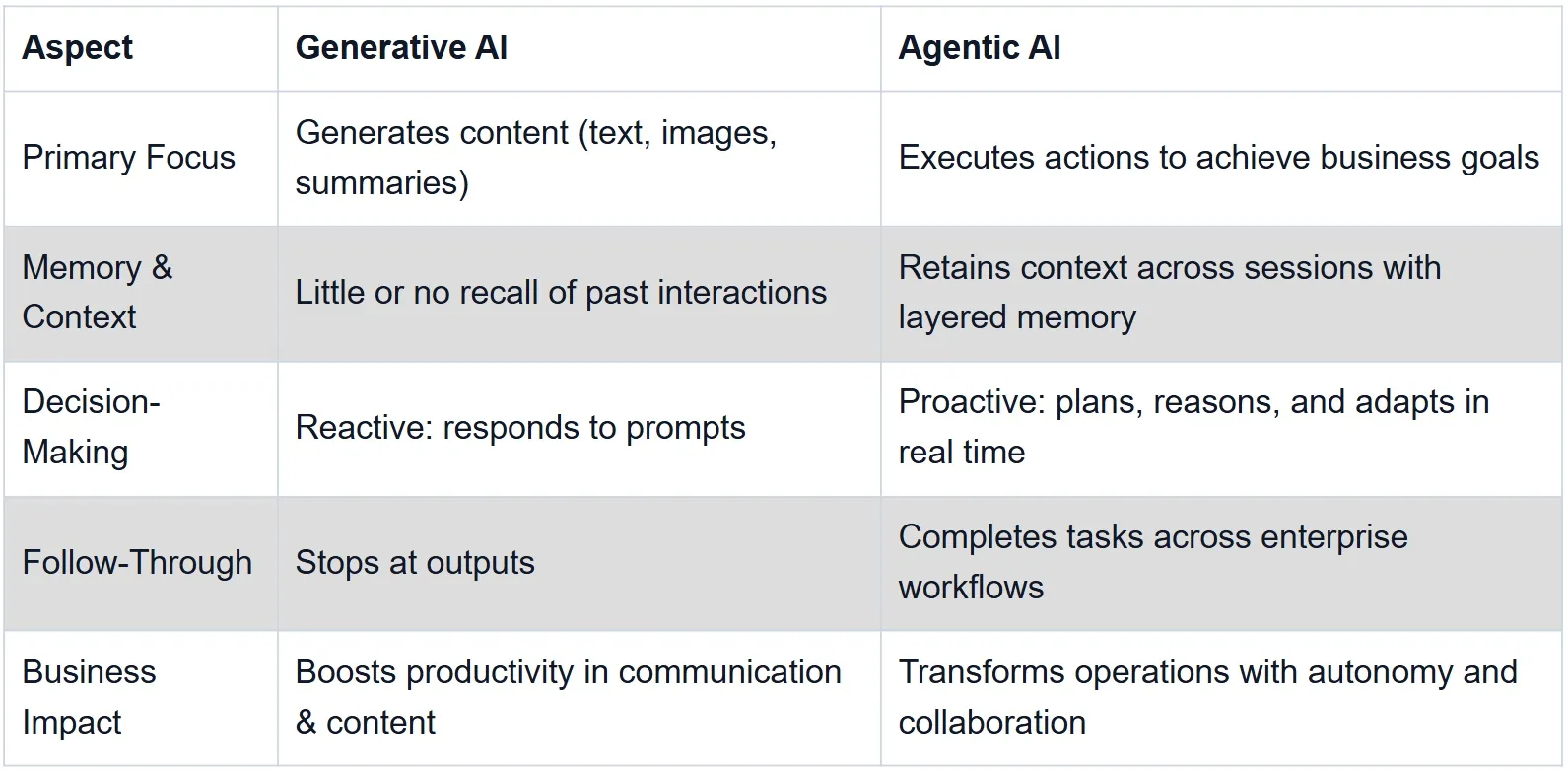
This shift redefines what AI is expected to do inside businesses. As rightly quoted by Leslie,
“The mission today isn’t just automation, it’s autonomy. You’re designing systems that can act with intent, recall, and decision-making power.”
Core capabilities of agentic AI:
Agentic AI isn’t just a smarter form of large language models (LLMs). It represents a new class of enterprise AI systems, ones that don’t just respond but think ahead, remember, take action, and collaborate across complex workflows. What makes an AI system truly “agentic” in the enterprise AI sense comes down to five core capabilities. These aren’t features of the LLM alone; they emerge when a model is integrated into a larger AI architecture built for real-world execution, automation, and decision-making at scale.
- Planning – Transforms high-level business goals into executable steps. Unlike static scripts, an agentic system updates plans in real time as data, context, and conditions change.
- Reflection – Continuously evaluates its own outputs, self-correcting and optimizing results. This reduces AI errors and improves reliability in mission-critical or high-risk enterprise tasks.
- Memory – Provides continuity through short-term, episodic, and long-term recall, enabling true context awareness, personalization, and adaptive learning across workflows.
- Tool Use – Seamlessly connects with APIs, enterprise applications, and data sources to retrieve information, update records, and execute real-world actions in business environments.
- Multi-Agent Collaboration – Coordinates with teams of AI agents or humans, sharing context and working together to complete complex, multi-step business processes.
Together, these capabilities form the core of enterprise-ready Agentic AI. They move systems beyond language understanding into something more powerful AI that can reason, act, and adapt inside real business workflows.
Explore more - Kore.ai Multi-agent orchestration
How agentic AI is transforming business operations:
Enterprise business operations have always struggled with friction. Manual handoffs, disconnected systems, and delayed decisions caused by missing context create inefficiencies that impact productivity and customer experience.
Agentic AI is transforming the way enterprises operate by introducing autonomy, intelligence, and speed into the core of workflows. It does not replace employees. Instead, it empowers them by managing complexity in the background and enabling people to focus on strategy, innovation, and higher-value work.
This transformation happens in stages, each advancing enterprises towards autonomous operations and intelligent automation:
- Augmentation: Agents serve as intelligent digital workers. They summarize documents, pull data from enterprise systems, guide employees through multi-step workflows, and automate repetitive tasks to improve productivity.
- Automation: Once workflows are stabilized, agents begin to own full tasks. They resolve customer service queries, process refunds, update records, and escalate issues with accuracy, speed, and consistency.
- Reinvention: Enterprises redesign business processes around Agentic AI capabilities rather than forcing them into legacy workflows. Agents collaborate across teams, integrate data across platforms, manage exceptions, and support real-time decision intelligence.
- Transformation: Agents evolve from helpers into operators. They monitor, reason, and act independently across enterprise applications. They understand intent, assess risk, validate inputs, and execute actions seamlessly, enabling end-to-end process automation.
By delivering clarity where there was once friction and momentum where there were bottlenecks, Agentic AI is no longer just an assistant. It is an active participant in enterprise operations, driving operational efficiency, scalability, business resilience, and digital transformation.
Real-world use-cases of agentic AI
Agentic AI is no longer theoretical. It is already being deployed across industries and critical enterprise workflows, where it brings structure, speed, intelligence, and autonomy to complex tasks. By combining planning, reasoning, memory, and tool integration, agentic systems help organizations reduce friction, improve decision-making, and accelerate business outcomes.
Below are some of the most impactful enterprise AI use cases today:
1. Banking and financial services
Instead of manually combing through compliance documents, Agentic AI agents continuously monitor transactions, identify anomalies in near real time, and flag potential fraud before losses occur. For wealth managers, agents prepare dynamic client briefings ahead of meetings, pulling in recent market activity, portfolio updates, regulatory alerts, and even news sentiment. This creates personalized, data-driven client engagement while ensuring regulatory compliance.
2. Customer experience and contact centers
In a contact center, Agentic AI doesn’t just summarize calls. It anticipates intent mid-conversation, surfaces relevant policy updates, and recommends the next-best action in real time. For example, if a customer calls about a delayed delivery, the AI agent can simultaneously check ERP shipment data, issue a refund, update the order, and generate a follow-up email. This shifts support from reactive to proactive, context-aware customer engagement.
3. Procurement and supply chain
In global supply chains, delays and missed approvals cost millions. With Agentic AI, procurement teams can deploy agents that extract and validate contract clauses, track supplier compliance across geographies, and orchestrate multi-system workflows across ERP, CRM, and vendor portals. If a shipment is delayed, the AI agent can automatically recalculate delivery timelines, renegotiate with suppliers using pre-approved clauses, and update both finance and logistics dashboards.
4. Insurance and lending
In insurance claims and loan processing, speed and accuracy are everything. Agentic AI agents can review structured and unstructured data (claims forms, photos, credit histories), assess eligibility against regulatory frameworks, and deliver explainable recommendations to underwriters. For example, when processing a loan, the AI agent can instantly validate applicant income, flag inconsistencies, assess repayment risk, and present a transparent decision rationale. This reduces cycle time from days to minutes while ensuring audit-ready compliance.
5. Workforce enablement
In HR onboarding, an agent can coordinate with Workday, payroll systems, and IT provisioning tools to set up a new hire’s access, schedule mandatory training, and create a tailored 30-60-90 day plan. In IT service management, instead of escalating every ticket, an agent can diagnose system logs, apply patches, and only escalate critical incidents with full context. This moves support from reactive firefighting to autonomous, predictive IT operations.
Where does agentic AI deliver the most value?
Across industries, the greatest impact of Agentic AI is seen in areas that require speed, accuracy, and compliance:
- High-volume, compliance-heavy processes where accuracy and speed are critical.
- Customer service automation that goes beyond response to proactive engagement.
- Cross-system workflow orchestration in procurement and supply chain.
- Decision-heavy, regulated industries like insurance and lending.
- Workforce enablement through smarter onboarding, IT automation, and predictive support.
How does agentic AI work?
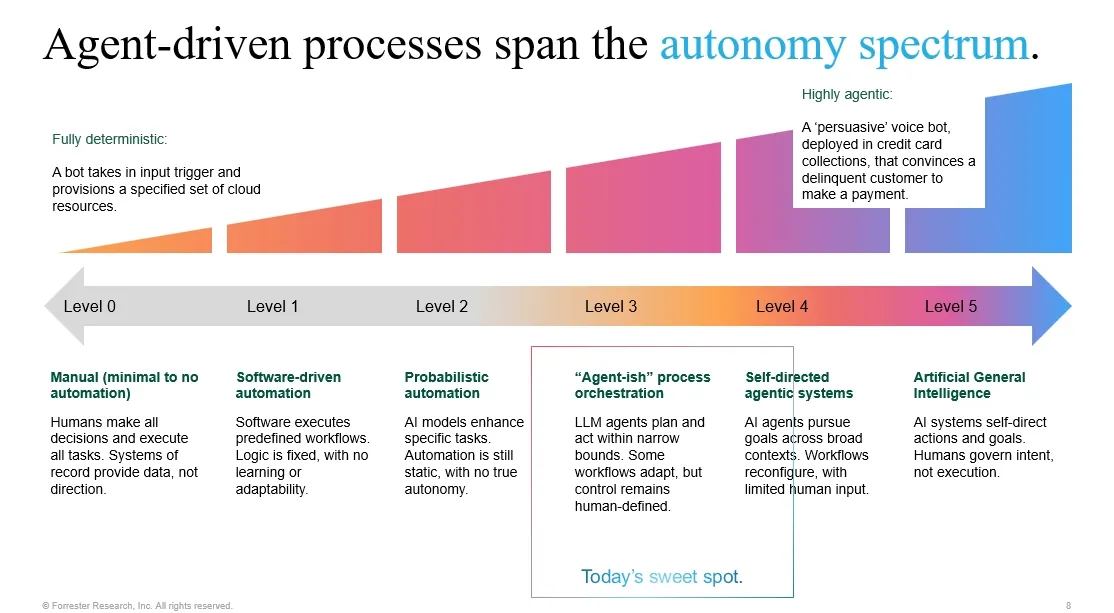
Agentic AI does not appear overnight. It evolves in stages, gradually moving from simple automation to intelligent decision-making and eventually toward full autonomy. AI autonomy is not binary; it is a maturity model that depends on how advanced your systems are, how much oversight your enterprise requires, and the kind of business outcomes you want to achieve.
Understanding these levels of AI autonomy is critical. It helps leaders assess where their organization stands today, identify gaps in AI adoption strategy, and build a roadmap for scaling responsibly.
Levels of agentic AI autonomy
- Level 0 – Manual work, no automation
Processes are handled entirely by humans, with little or no assistance from automation tools. This stage is still common in areas where legacy systems dominate or regulatory constraints prevent automation.
- Levels 1–2 – Rules-based automation and RPA
At this stage, enterprises use Robotic Process Automation (RPA) and scripted workflows. These are fast but brittle, limited in scope, and unable to adapt when business conditions change.
- Level 3 – Semi-agentic systems (today’s enterprise reality)
Most enterprises now operate here. Agents are given bounded autonomy but function under human oversight. They can plan and act within defined limits, guide employees through complex workflows, and deliver automation with control, intelligence with oversight. This balance makes Level 3 the sweet spot for scaling safely today.
- Level 4 – Fully agentic systems
At this stage, systems have the ability to plan, decide, and act independently across workflows. They use reasoning, memory, and multi-agent collaboration to deliver end-to-end process automation with minimal human intervention. While still emerging, this is the next frontier for enterprise AI adoption.
- Level 5 – General autonomy
Fully autonomous systems capable of self-directed decision-making across any domain. This remains aspirational and is not yet enterprise-ready, but it represents the long-term vision of general-purpose AI.
Today, most enterprises operate at 'Level 3 autonomy', and this is the right place to be. It strikes the ideal balance between automation and human control, combining efficiency with oversight. At this stage, organizations can scale Agentic AI in a responsible way, capturing the benefits of intelligence-driven automation while minimizing risk.
Understanding your current level of AI maturity allows you to align investments, strengthen governance, and refine risk management frameworks. It also provides a clear roadmap for advancing toward higher levels of autonomy with confidence and strategic clarity.
How should an ideal agentic AI system be?
An ideal Agentic AI system provides enterprises with the foundation to move beyond isolated pilots and scale into production-grade, enterprise-ready AI deployments. It must not only enable agents to reason, plan, act, and learn, but also ensure governance, flexibility, and visibility across every layer of the enterprise stack. The goal is to deliver autonomy while giving leaders full confidence in control, security, and cost efficiency.
Key capabilities of an ideal Agentic AI system include:
- Model Flexibility and Orchestration
Support both commercial LLMs (like GPT, Claude, Gemini) and open-source large language models, with the ability to seamlessly switch between them. This ensures enterprises can optimize for cost, performance, and compliance without vendor lock-in.
- Prompt Management at Scale
Treat prompts as governed, reusable enterprise assets. Implement versioning, approval workflows, A/B testing, and compliance checks so that every prompt is reliable, auditable, and aligned with enterprise standards.
- Advanced Memory Architecture
Integrate short-term, episodic, and semantic memory layers to maintain context across interactions. This enables personalization, continuity, and adaptive reasoning, critical for enterprise workflows that span multiple systems and timeframes.
- Multi-Agent Orchestration
Coordinate specialized agents through a central orchestrator that manages task allocation, context sharing, and workflow execution. This makes it possible to build modular, collaborative AI systems that mirror how teams operate inside enterprises.
- Evaluation and Feedback Frameworks
Deliver structured pre-deployment testing, continuous real-time monitoring, and audit-ready logging. These guardrails ensure that AI systems meet enterprise standards for accuracy, compliance, and responsible AI.
- Observability and Cost Monitoring
Provide token-level visibility into model usage, latency, throughput, and costs. Enterprises need transparency to optimize spend, manage performance, and ensure AI deployments remain scalable and financially sustainable.
An ideal Agentic AI platform combines technical sophistication with enterprise governance, giving organizations the tools to scale responsibly while unlocking the true business value of autonomy.
How can enterprises adopt agentic AI?
Adopting Agentic AI is not a single leap; it is a structured enterprise AI journey. Success requires starting small, proving value, and scaling responsibly with governance, compliance, and oversight built in at every stage. Enterprises that approach adoption methodically are better positioned to unlock real-world business value while maintaining trust and control.
Step 1: Start small
Begin with goal-oriented, mid-complexity processes that balance impact with manageable risk. Early wins in areas like customer service automation, compliance workflows, or IT support can build momentum and demonstrate tangible business outcomes.
Step 2: Prove value
Establish clear KPIs and ROI metrics from the start. Combine continuous evaluation frameworks with human-in-the-loop oversight to ensure accuracy, safety, and responsible scaling. Demonstrating measurable improvements in efficiency, customer experience, or compliance is key to building enterprise-wide confidence.
Step 3: Scale responsibly
When moving from pilots to enterprise-wide deployment, scaling should be guided by four critical principles:
- Data Governance: Use high-quality, compliant, and ethically sourced data to drive trust and reliability.
- Human Oversight: Keep people in the loop for high-stakes or regulated decisions, ensuring accountability and trust.
- Traceable Verification: Maintain audit-ready logs, explainable AI outputs, and transparent verification processes to satisfy both regulators and stakeholders.
- Intentional Architecture: Design systems to be modular, extensible, and future-ready, enabling integration with multiple models, tools, and enterprise systems.
By embedding these practices, enterprises can close the gap between experimentation and production-grade execution, moving confidently from AI pilots to scalable, explainable, and resilient Agentic AI systems.
Closing thoughts: Is your enterprise ready for agentic AI?
Agentic AI is not about replacing people. It is about building enterprise AI systems that operate with context, memory, autonomy, and governance. The difference between pilots that fizzle out and deployments that create lasting impact is execution.
Ask yourself:
- Are your current AI systems making decisions with true enterprise context and data-driven intelligence?
- Are your workflows rigid and manual, or adapting dynamically to real-time business changes?
- Are your AI initiatives driving measurable operational efficiency and customer experience improvements, or are they stuck in isolated silos?
Agentic AI is not a passing trend. It is becoming the future operating model for enterprise automation, workflow orchestration, and intelligent decision-making. Organizations that embed responsible AI governance, invest in explainable and audit-ready AI systems, and scale adoption with strategic clarity will not just keep pace with disruption. They will set the standard for how enterprises operate in the age of autonomy.
FAQs
Q1: What is agentic AI?
Agentic AI is an advanced form of artificial intelligence that autonomously understands goals, plans multi-step tasks, remembers context, and executes actions across enterprise workflows with minimal human input.
Q2: How does agentic AI differ from traditional AI?
Unlike traditional AI, which reacts to predefined commands or scripts, Agentic AI proactively makes decisions, adapts plans in real time, collaborates with multiple agents, and executes tasks autonomously to deliver measurable business outcomes.
Q3: What are the key building blocks of agentic AI?
The five core capabilities of Agentic AI are Planning, Reflection, Memory, Tool Use, and Multi-Agent Collaboration. Together, these enable reasoning, adaptability, and action inside complex enterprise workflows.
Q4: What are the practical use cases of agentic AI in enterprises?
Agentic AI is being applied in banking for compliance automation and fraud detection, in customer service for decision support and faster resolution, in procurement and supply chain for workflow orchestration, in HR for onboarding automation, and in insurance and lending for claims and risk assessment.
Q5: How can enterprises adopt agentic AI responsibly?
Successful adoption requires a phased approach: start small with mid-complexity processes, prove value through clear KPIs and human oversight, and scale responsibly with strong data governance, explainability, and intentional architecture.
Share
Tags