Introducing Dual-brain architecture: Reasoning and control, together
Last Updated
August 21, 2026

Juhi Tiwari
Read Time

Summary
Dual-Brain Architecture combines flexible AI reasoning with deterministic enterprise controls. Kore.ai Artemis uses an Agentic Brain to interpret requests, reason across context, and determine actions, while a Deterministic Brain enforces business rules, policies, permissions, and predictable workflows. A Shared Spine maintains context between both layers. This architecture enables enterprise AI agents to handle complex interactions while maintaining governance, control, and auditability.
What’s on this page
Every organization deploying AI agents has to make a difficult choice. Give an agent enough freedom to reason through complex customer needs, and its behavior becomes harder to predict and control. Restrict it enough to make every action predictable, and much of what makes the agent useful in the first place disappears.
Dual-Brain Architecture is how Kore.ai's Artemis platform removes that trade-off. Every Artemis agent runs two engines together: one that reasons through what the customer needs and how to respond, and another that makes sure the rules your business cannot compromise on are followed every time.
This piece explains what that means in practice: how the two engines divide the work, how they stay coordinated so neither acts without the context it needs, why we built the architecture this way, and what it looks like on an actual customer call.
In short: Dual-Brain Architecture is Kore.ai Artemis's approach to AI agent design, in which an Agentic Brain reasons through open-ended requests and a Deterministic Brain enforces policy, together, on every interaction, from a single agent definition.
The questions you have probably already asked yourself
If your team has spent any time evaluating AI agents for customer-facing work, some version of these questions has likely come up in the room:
- What happens when a customer asks something nobody scripted for?
- Can we prove to compliance that this agent will not cross a line, or are we just hoping it usually will not?
- If a conversation goes wrong, can we explain exactly why the agent did what it did?
- Do we really need two different platforms, one for the rule-bound work and one for the open-ended work?
- Are we paying full reasoning-model prices for tasks that are really just a lookup?
If any of these sound familiar, you have already found the gap Dual-Brain Architecture was built to close.
Consider a typical customer service interaction your organization handles today. Part of that exchange has exactly one correct answer: confirming who the customer is, verifying eligibility, checking whether the request falls within policy. This requires verification, not judgment. The remainder of the interaction requires genuine reasoning: understanding what the customer is concerned about, what they actually need, and the most effective way to help them. No script can fully anticipate this, because it depends on what the customer says next.
Most AI agent platforms assign both responsibilities to a single model. A reasoning model tasked with enforcing your policy tends to be unreliable at policy enforcement, precisely the function your compliance team scrutinizes most closely. A rules engine tasked with holding a conversation breaks down the moment a customer raises something it did not anticipate. Dual-Brain Architecture assigns each responsibility to the engine built for it, so your organization is not relying on a single system to function as both compliance officer and conversationalist.
Why we built dual-brain architecture
We reached this design after watching the same failure repeat across a decade of enterprise deployments, not after a single insight in a planning meeting.
Across banking, telecommunications, and healthcare, we saw the same pattern every time an organization tried to run an AI agent on a single engine, meaning one underlying system, typically a language model or a rules engine, asked to both reason through a request and enforce the rules governing it. A system tuned for reliability could not adapt to what a conversation actually needed. A system tuned for flexibility could not be governed with the confidence a regulated business requires. Neither extreme matched how work actually happens, because reasoning and enforcement are fundamentally different jobs, and one engine rarely does both well.
A single customer conversation frequently needs a deterministic step and a reasoning step, back to back, within the same exchange. Some workflows are cleanly deterministic or cleanly autonomous, but most are not, and no consistent line separates the two. Forcing every agent onto one side of that line meant enterprises were always compromising somewhere.
So we built Artemis around that reality directly. Every agent carries both engines from the start, rather than asking your organization to choose a single-engine platform first and accept its limitation second.
What dual-brain architecture means for your AI agents
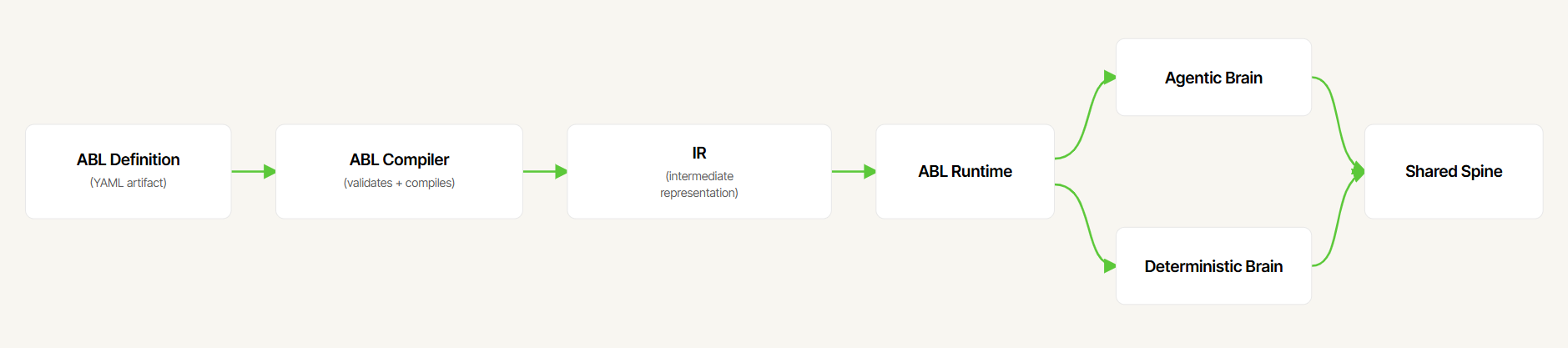
Every Artemis agent you build runs two engines in parallel, rather than relying on a single model to perform two fundamentally different jobs.
One engine, the Agentic Brain, reasons through your customer's open-ended requests. The other, the Deterministic Brain, governs the parts of an interaction that require exactly one correct answer, every time, for every customer. A shared memory layer ensures both engines operate from the same facts about your customer, so no part of the agent contradicts another.
The result is an agent that reasons with the judgment of your best-trained staff and enforces rules with the consistency of a machine, within the same conversation. It is also, structurally, what makes Artemis capable of building deterministic AI agents without giving up the flexibility reasoning provides.
How your agent understands what your customers actually need
This is the function of the Agentic Brain. On a single turn, it can:
- Interpret what your customer actually means, not just what they typed
- Break a request that is really three requests into its component parts
- Bring in a billing or compliance specialist when the situation calls for it
- Retrieve information from your CRM or knowledge base
- Hold the thread of the conversation across every turn, not just the current one
This is the component of the agent that recognizes a statement such as "I do not recognize this charge" for what it typically represents, a customer concerned about fraud rather than one confused about a bill, and responds accordingly rather than defaulting to a generic script.
How your agent enforces the rules you cannot afford to break
This is the function of the Deterministic Brain, and it is the component your compliance team will scrutinize most closely. It verifies who your customer is, what they are entitled to, and whether a request falls within policy, before any other action takes place.
Rules within this engine, often called AI agent guardrails, are not suggestions embedded in a prompt. They take three forms:
- Require: A condition must be satisfied before your agent can proceed at all.
- Limit: A value is capped, and escalation is triggered automatically the moment it is reached.
- Restrict: An action is prohibited outright, before any tool is ever allowed to run.
Your reasoning engine cannot argue its way past any of these, because it is never presented with the option. This is the distinction between "the agent should not do that" and "the agent cannot do that," and it is the distinction that earns approval from the people responsible for agentic AI governance at your organization.
This level of control does not come at the cost of speed. Artemis evaluates fast, deterministic pattern matches first, followed by a lightweight classifier, and reserves full model judgment for genuinely ambiguous cases. Most policy violations are identified before they incur any meaningful cost in latency or compute.
How the two brains stay in sync, so your customers get one coherent answer
Two engines are only effective if they operate from a consistent set of facts. If your reasoning engine considers a customer verified while your enforcement engine does not, the result is not a single agent but two systems in disagreement, visible to the customer you are trying to assist.
Artemis addresses this through a shared memory layer, the Shared Spine, from which both engines read and to which both engines write. Neither engine owns this layer, and neither can act without accessing it. It maintains:
- The customer's verified identity
- The conversation history to that point
- Which guardrails are currently active
Every read and write operation is logged as well, allowing you to reconstruct not only what the agent decided, but precisely what it knew at the moment the decision was made.
What this looks like on a real customer call
Consider a customer who calls regarding an unrecognized charge.
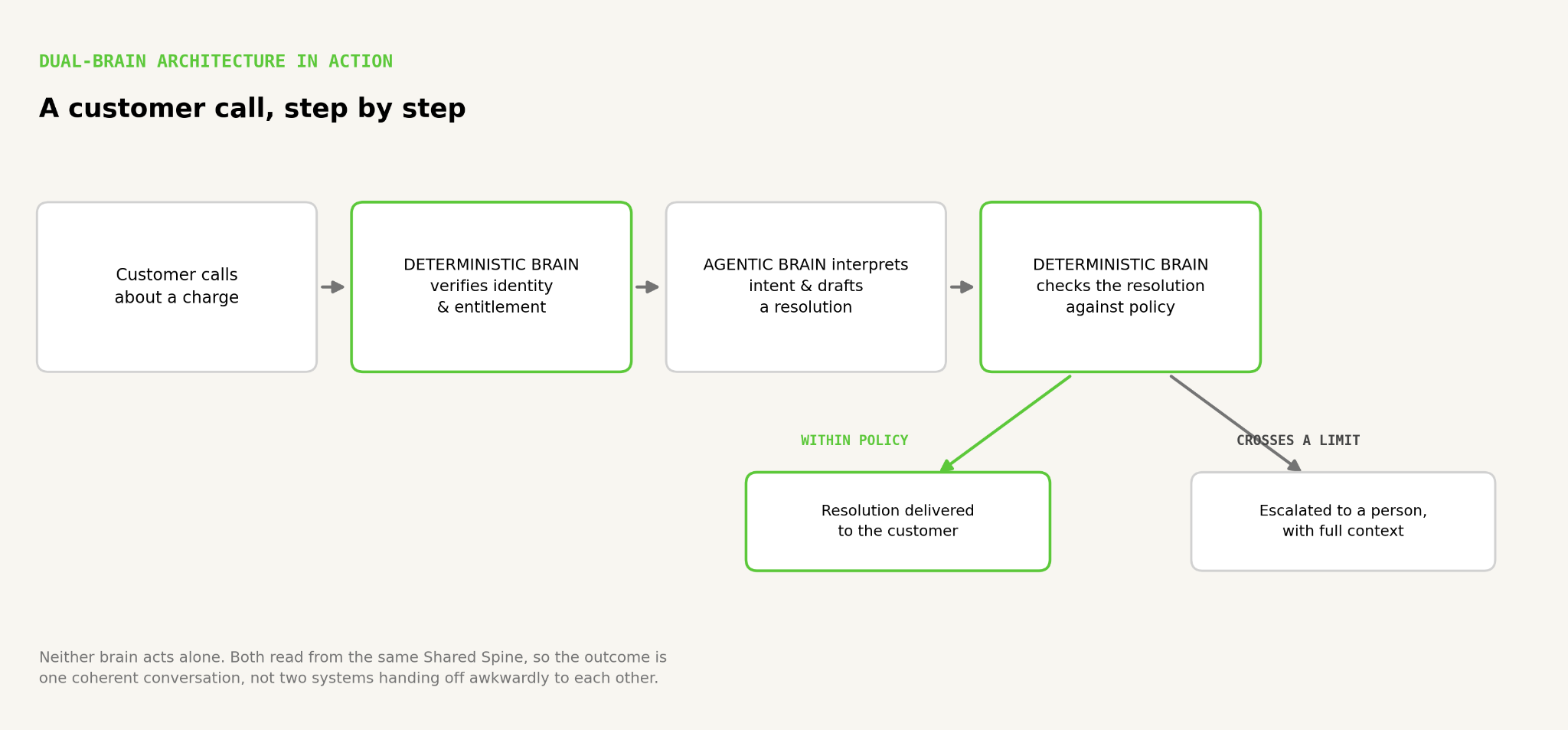
Before the agent says anything, the Deterministic Brain confirms who the customer is and what they are authorized to see, verification only, no reasoning involved at this stage.
Once identity is confirmed, control passes to the Agentic Brain. It interprets what the customer actually means, in this case likely concern about fraud rather than confusion over a bill, retrieves the relevant transaction history, and drafts a resolution.
That draft resolution does not go straight to the customer. It goes back through the Deterministic Brain, which checks it against policy: is this refund within the authorized limit, does this action fall inside what the agent is permitted to do. From there, the flow branches on that single check:
- Within policy. The resolution is delivered directly to the customer. This is the majority path, since most requests never approach a policy boundary.
- Crosses a limit. The Deterministic Brain halts the action before it executes and escalates to a person on your team, with the full conversation context already attached, so the person is not starting from a blank slate.
The important detail is where that check happens. The Agentic Brain never decides for itself whether a resolution is acceptable, it drafts, and the Deterministic Brain rules. That is what makes "the agent cannot do that" a structural fact rather than a hope based on how the model happened to interpret a prompt.
Your customer does not perceive two separate engines. They experience an agent that is efficient where efficiency matters, attentive where judgment matters, and firm precisely where your policies require it.
Why this changes what you can safely automate
The previous choice was reasoning without a guarantee, or a guarantee without reasoning. That trade-off is no longer necessary. Dual-Brain Architecture provides both, within the same agent, on every conversation, from a single agent definition rather than two systems your team must integrate and maintain separately.
This is what opens the door to workflows that were previously out of reach for enterprise AI agents, among them:
- Refund and credit decisions bound by policy limits, not by hope
- Identity-sensitive account changes that need both verification and judgment
- Multi-step disputes that shift between rule-bound checks and open-ended reasoning within a single conversation
None of these were safe to automate on a single-engine platform, because no such platform could guarantee both intelligence and control at the same time. Dual-Brain Architecture is what makes that guarantee possible.
FAQ
Q1. What is dual-brain architecture?
Dual-Brain Architecture is Kore.ai Artemis's approach to AI agent design, in which two engines, an Agentic Brain for reasoning and a Deterministic Brain for policy enforcement, run in parallel on every interaction from a single agent definition.
Q2. What is the difference between agentic AI and deterministic AI?
Agentic AI reasons toward a goal and can improvise when a situation was not fully anticipated, which makes it powerful but harder to fully predict. Deterministic AI follows fixed logic and produces the same output for the same input every time, which makes it predictable but unable to adapt to the unexpected. Dual-Brain Architecture runs both at once instead of forcing a choice between them, using agentic reasoning where judgment is genuinely needed and deterministic logic where policy cannot bend.
Q3. Can AI agents actually be trusted with real business decisions?
Only if the decision is enforced by something more reliable than a model's interpretation of a prompt. In Dual-Brain Architecture, the Agentic Brain can propose a resolution, but the Deterministic Brain checks it against policy before it ever takes effect, so trust does not depend on hoping the model behaves correctly.
Q4. Do AI agents need human oversight to meet compliance requirements?
Yes, for anything that approaches a policy boundary. Dual-Brain Architecture builds that human handoff into the agent itself: when a resolution would exceed a limit your business has set, the agent escalates automatically with full context attached, rather than requiring a person to review every interaction upfront.
Q5. Will checking every rule make an AI agent slower?
No. Deterministic checks run through fast pattern matching and lightweight classifiers before any full model call, so routine verification and policy checks add negligible latency compared to routing everything through a reasoning model.
Share